SECS/GEM Simulator Introduction and Features

[vc_row][vc_column width=”1/2″][vc_column_text css=””]In semiconductor manufacturing, reliable communication between equipment and host systems is essential for productivity, compliance, and automation. SECS/GEM (SEMI Equipment Communication Standard / Generic Equipment Model) provides the foundation for this communication. However, validating SECS/GEM implementation on new or legacy equipment can be time-consuming and complex.

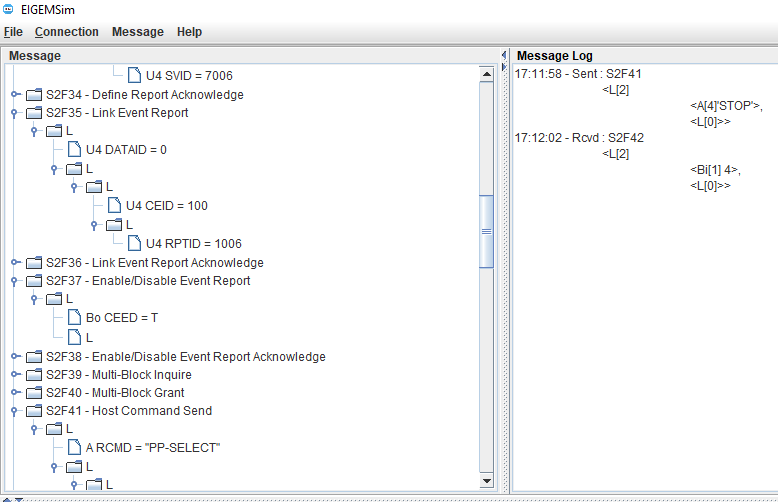
To address this, EINNOSYS has developed EIGEMSim, a powerful SECS/GEM simulator designed to help OEMs, fabs, and assembly/test facilities test and verify SEMI compliance. With EIGEMSim, engineers can simulate both equipment and factory host environments, making it an indispensable tool for development, integration, and testing.[/vc_column_text][/vc_column][vc_column width=”1/2″][vc_single_image image=”37139″ img_size=”full” alignment=”center” css=””][/vc_column][/vc_row][vc_row][vc_column][vc_column_text css=””]What is EIGEMSim?

EIGEMSim is a software application that allows seamless testing of SECS/GEM communication. Depending on the use case, it can be configured to act either as the equipment or as the factory host. This flexibility enables teams to validate their integration scenarios without requiring a physical host system or equipment during early development stages.

The simulator supports creation, configuration, transmission, and receipt of SECS messages. To simplify operations, EIGEMSim uses a Message Dictionary, which facilitates message transfers and ensures accuracy in communication testing.[/vc_column_text][vc_column_text css=””]Creating and Configuring SECS Messages

One of the strengths of EIGEMSim is its flexibility in creating and configuring messages. Engineers can:

Use a built-in wizard that guides them step-by-step in defining SECS messages.

Or, write messages in SML (SEMI Markup Language) format using any text editor and then import the SML file directly into EIGEMSim.

This dual approach caters to both beginners and advanced users, providing efficiency and control during development. All messages sent and received are automatically logged, giving developers a complete record for analysis and troubleshooting.[/vc_column_text][/vc_column][/vc_row][vc_row][vc_column][vc_column_text css=””]Key Features of EIGEMSim

EIGEMSim comes packed with features that simplify SECS/GEM compliance testing and integration:

✅ Cross-Platform Support – Runs seamlessly on both Windows and Linux environments.

✅ Pre-Configured Messages – Includes the most commonly used SECS messages, helping users start compliance testing quickly.

✅ User-Friendly Interface – Intuitive design for easy configuration and message transmission.

✅ Dual Configuration – Can be set up as equipment or factory host, depending on the testing scenario.

✅ Comprehensive Logging – Records all incoming and outgoing messages for review, debugging, and documentation.[/vc_column_text][/vc_column][/vc_row][vc_row][vc_column][vc_column_text css=””]Why Choose EIGEMSim?

For OEMs and fabs, validating SEMI compliance is critical before deploying equipment in production environments. Traditional testing methods can be slow and require multiple hardware components. EIGEMSim removes these bottlenecks by providing a software-only, configurable simulator that reduces both time-to-market and testing costs.

With its ability to simulate different roles (equipment or host) and its ready-to-use message library, EIGEMSim accelerates development while ensuring compliance with SEMI SECS/GEM standards.

SECS/GEM integration is at the heart of modern semiconductor factory automation, and reliable testing tools are key to ensuring success. EIGEMSim by EINNOSYS empowers equipment manufacturers, fabs, and assembly/test facilities to streamline compliance testing, reduce complexity, and achieve faster integration.

Whether you’re developing new semiconductor equipment, upgrading legacy systems, or validating host communication, EIGEMSim offers the flexibility and reliability you need.

👉 Learn more about EIGEMSim and other SECS/GEM solutions from EINNOSYS at einnosys.com[/vc_column_text][/vc_column][/vc_row]
Understanding SEMI, SECS, and GEM Standards in Semiconductor Manufacturing

In the world of semiconductor manufacturing, communication between equipment and factory systems is critical for efficiency, automation, and cost control. To make this communication seamless, the industry relies on well-defined standards known as SEMI, SECS, and GEM. Let’s take a closer look at what these terms mean and why they matter.

What Do SEMI, SECS, and GEM Stand For?

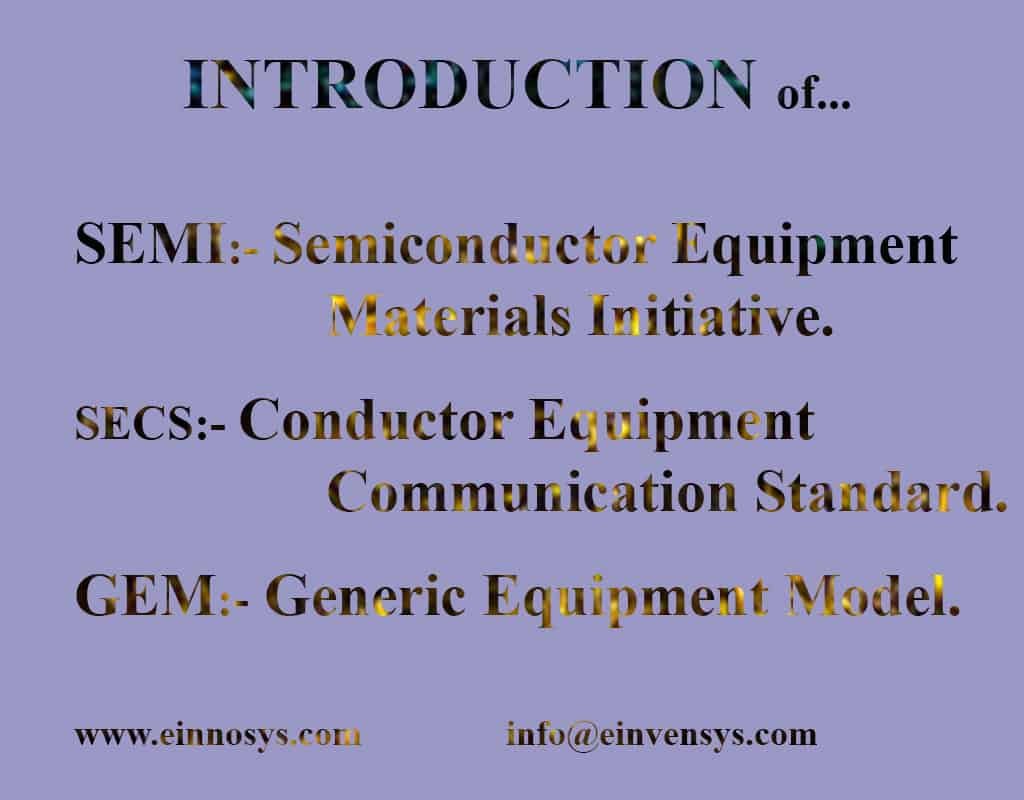
SEMI – Semiconductor Equipment and Materials International, an organization that develops global standards for semiconductor and electronics industries.

SECS – Semiconductor Equipment Communication Standard, which defines how semiconductor equipment communicates with host systems.

GEM – Generic Equipment Model, a set of guidelines for communications and control of manufacturing equipment.

Together, SECS/GEM standards ensure a common “language” for equipment-to-host communication in fabs and assembly facilities.[/vc_column_text][/vc_column][vc_column width=”1/2″][vc_column_text css=””]Why Were SECS/GEM Standards Introduced?

The semiconductor industry began adopting automation standards in the 1970s. At that time, communication between equipment and factory hosts was often proprietary, inconsistent, and expensive to implement.

Without a standard, every equipment manufacturer had to design unique communication protocols for each fab, leading to:

High development and integration costs

Performance issues

Longer equipment setup times

SEMI addressed this by introducing SECS/GEM standards—a unified way for equipment and hosts to exchange information. Much like how TCP/IP standardizes network communication or RS232 standardizes serial communication, SECS/GEM created a universal framework for semiconductor automation.

How Do SECS/GEM Standards Work?

The SECS/GEM standard must be implemented on both sides of the communication:

On the Equipment Side – The equipment’s computer runs SECS/GEM software that complies with SEMI standards such as E30, E4, E5, and E37. This software manages message formats, event reporting, and remote commands.

On the Host Side – The factory host software also implements the same SEMI standards. This ensures that the host can send commands, receive data, and control the equipment reliably.

By ensuring both sides “speak the same language,” fabs and equipment manufacturers achieve seamless interoperability.[/vc_column_text][/vc_column][/vc_row][vc_row][vc_column][vc_column_text css=””]Benefits of SECS/GEM Standards

Implementing SECS/GEM provides significant advantages to both fabs and OEMs:

Interoperability – Equipment from different vendors can easily integrate with fab automation systems.

Reduced Costs – No need for custom protocols or one-off integrations.

Faster Deployment – Standardized communication shortens installation and validation time.

Improved Efficiency – Consistent data collection, event reporting, and control functions enhance overall manufacturing productivity.

Scalability – As fabs adopt more automation, SECS/GEM ensures that new equipment fits into the existing ecosystem.[/vc_column_text][/vc_column][/vc_row][vc_row][vc_column][vc_column_text css=””]Why SECS/GEM Matters Today

Even decades after its introduction, SECS/GEM remains the foundation of smart manufacturing in semiconductors. Modern fabs are highly automated, with thousands of tools connected to centralized host systems. Without a standard protocol, this level of integration would be impossible.

As factories adopt AI, predictive maintenance, and advanced analytics, reliable and standardized data from equipment becomes even more important. SECS/GEM ensures that this data flows consistently, enabling fabs to optimize yield, reduce downtime, and stay competitive.

Conclusion

The SEMI SECS/GEM standards transformed semiconductor manufacturing by creating a universal framework for equipment and host communication. By eliminating proprietary protocols, these standards reduced costs, improved efficiency, and paved the way for today’s advanced automation.

For fabs and OEMs, adopting SECS/GEM isn’t just about compliance—it’s about ensuring smooth integration, scalability, and long-term success in a rapidly evolving industry.

To learn more about SECS/GEM integration solutions, explore Einnosys SECS/GEM products and services[/vc_column_text][/vc_column][/vc_row]