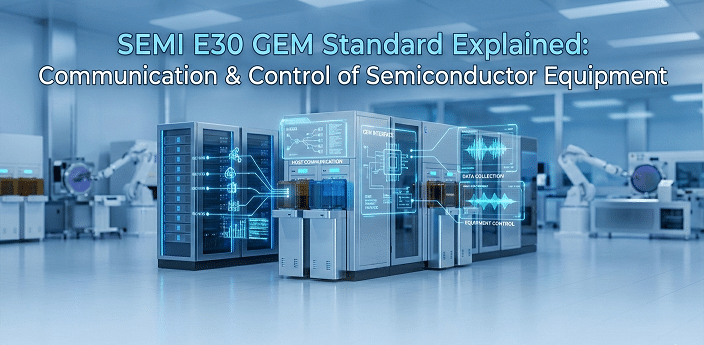
SEMI E30 GEM Standard Explained: Communication & Control of Semiconductor Equipment

Summary

  • The SEMI E30 GEM standard provides the foundational framework for communication between semiconductor manufacturing equipment and factory host systems.
  • It utilizes the SECS/GEM communication protocol to enable standardized data collection, alarm management, and remote command execution.
  • Implementing the GEM specification reduces integration costs for both OEMs and fabs by providing a universal “language” for equipment behavior.
  • Standardized state models ensure that tools from different vendors operate predictably within a highly automated environment.
  • Compliance is essential for modern fab operations, supporting high-volume production and the transition to Industry 4.0.

Introduction

According to reports from SEMI (2024), global semiconductor manufacturing equipment sales reached a record high of $106.3 billion recently. This massive investment highlights the critical need for precision and interoperability within the modern wafer fab. Central to this orchestrated dance of machinery is the SEMI E30 GEM standard, a protocol that ensures tools from different vendors can talk to a central factory system without a translator.

Without a unified framework, a semiconductor facility would resemble a chaotic bazaar where every merchant speaks a unique dialect. The SEMI E30 GEM standard prevents this linguistic breakdown by defining exactly how equipment should behave and communicate. By standardizing these interactions, facilities achieve higher yields and faster deployment times for new technology nodes.

Effective manufacturing equipment integration relies on these rules to manage everything from simple status updates to complex recipe management. While the technical documentation for the SEMI E30 GEM standard can feel as dense as a lead brick, its purpose remains simple: creating a predictable environment for high-stakes manufacturing. Why does a protocol established decades ago still dominate the most advanced factories on the planet? The answer lies in its elegant balance of flexibility and strict behavioral definitions.

Understanding the SEMI E30 GEM Standard

The SEMI E30 GEM standard, formally known as the Generic Model for Communications and Control of Manufacturing Equipment, serves as the primary bridge between the factory Manufacturing Execution System (MES) and the physical hardware on the floor. It defines which SECS-II messages are required, the context in which they are sent, and the resulting behavior expected from the tool.

The Philosophy of the GEM Specification

The GEM specification acts as a behavioral layer. It dictates how a machine responds when it receives a command. For instance, if the host sends a “Start” command, the standard ensures the tool transitions from an “Idle” state to a “Processing” state predictably. This consistency allows fab automation specialists to write software that controls hundreds of different tools using a single logic set.

It is a bit like a group chat where everyone actually agrees on the rules, a true miracle in the tech world. Without these rules, the MES might send a command that the tool isn’t ready to handle, leading to expensive downtime or, worse, damaged wafers.

Connectivity vs. Behavior

Distinguishing between connectivity and behavior is vital. While SECS-I or HSMS handles the “pipes” that carry data, GEM handles the “meaning” of that data. It moves beyond mere connectivity to define the soul of the machine’s operational logic. Every movement of a robotic arm or change in gas flow is governed by these definitions.

The Technical Foundation: SECS/GEM Communication Protocol

When engineers discuss the SECS/GEM communication protocol, they refer to a stack of standards working in unison. At the bottom sits the transport layer, typically SEMI E37 (HSMS), which uses TCP/IP for high-speed Ethernet communication. Above that resides SEMI E5 (SECS-II), which defines the structure of the messages.

Message Structure and Data Types

The SECS/GEM communication protocol uses a hierarchical tree structure for data. Messages are organized into “Streams” (categories) and “Functions” (specific actions). For example, Stream 1, Function 1 (S1F1) is a simple “Are you there?” request. This structured approach allows for extremely efficient parsing, which is essential when a tool generates thousands of data points every second.

The Significance of HSMS

Before Ethernet became the industry norm, tools relied on RS-232 serial connections. The transition to High-Speed SECS Message Services (HSMS) allowed the SEMI E30 GEM standard to handle the massive data volumes required by modern metrology and lithography tools. Today, the speed of light is essentially the only limit to how fast a fab can respond to tool deviations.

Core Capabilities of the GEM Specification

The GEM specification is categorized into fundamental requirements and additional capabilities. Every GEM-compliant tool must support the fundamental requirements, such as establishing a connection and handling basic state models. Beyond the basics, tools can implement advanced features like recipe management and sophisticated event reporting.

State Models and Control

One of the most powerful features of the SEMI E30 GEM standard is its use of state machines. These models track whether a tool is:

  • In “Local” or “Remote” control mode.
  • Currently processing a wafer or sitting idle.
  • Experiencing a fault or alarm condition.

By monitoring these states, the factory host knows exactly what a tool is doing at any given microsecond. If an operator tries to manually override a tool that the MES is currently controlling, the GEM state model prevents conflicting commands from causing a catastrophic wafer scrap event. It works like a very polite butler who won’t do anything unless you ask in the exact right way, but once he does, he gives you a 40-page report on how it went.

Data Collection and Event Reporting

Modern manufacturing thrives on data. The GEM specification allows the host to “subscribe” to specific events. Instead of the host constantly asking the tool for its temperature, the tool can be programmed to send an update every time the temperature changes by a specific increment. This “event-driven” architecture reduces network traffic and ensures that the most important information reaches the MES immediately.

Implementation for Manufacturing Equipment Integration

For Equipment OEMs, implementing the SEMI E30 GEM standard can be a daunting task. It requires a deep understanding of both the hardware’s physical capabilities and the software’s communication logic. However, the long-term benefits of compliance outweigh the initial development hurdles.

Benefits for Equipment Manufacturers (OEMs)

A tool that adheres to fab automation standards is much easier to sell. Fabs prefer “plug-and-play” equipment. If an OEM provides a robust GEM interface, the integration time for the customer drops from months to weeks. This speed-to-market is a significant competitive advantage in an industry where being late by a single quarter can cost millions in lost revenue.

Challenges in Integration

The primary challenge often involves mapping internal hardware variables to the standard GEM variables. A single etch chamber might have hundreds of sensors. Deciding which of these sensors should be exposed via the SECS/GEM communication protocol requires careful planning to avoid overwhelming the factory network with unnecessary noise.

Why Fab Automation Standards Matter

The move toward Industry 4.0 and “Lights Out” manufacturing makes semiconductor equipment control more critical than ever. According to Gartner (2023), automation in manufacturing environments can lead to a 15% increase in throughput when properly implemented.

Reducing Human Error

Human intervention remains one of the largest sources of contamination and error in a cleanroom. By utilizing the SEMI E30 GEM standard, the factory host can automate recipe downloads and substrate tracking. The tool knows exactly which process to run because the MES told it so, leaving no room for a technician to accidentally select the wrong settings on a touchscreen.

Future-Proofing the Fab

As technology progresses toward 2nm nodes and beyond, the complexity of the data will only increase. The SEMI E30 GEM standard provides a stable foundation that can evolve. While newer standards like SEMI EDA (Equipment Data Acquisition) provide even more data bandwidth, GEM remains the “control” backbone that keeps the factory running.

Advanced GEM Features: Alarms and Limits

Beyond simple status updates, the GEM specification provides robust mechanisms for error handling and process safety. This ensures that the equipment does not operate outside of its safe parameters, protecting both the hardware and the delicate silicon wafers inside.

Alarm Management

In the context of the SEMI E30 GEM standard, an alarm is more than just a flashing light. It is a structured message that tells the host exactly what went wrong and how severe the issue is. GEM requires tools to maintain a list of all possible alarms and their current states. This allows the factory host to disable certain routes or pause production lines automatically when a critical tool reports a fault.

Variable Limits and Monitoring

Modern tools use “Limits Monitoring” to track process variables. If a vacuum level or gas flow rate drifts outside of a pre-defined range, the SECS/GEM communication protocol triggers an event. This proactive approach allows maintenance teams to fix a tool before it produces a defective wafer, shifting the fab from reactive to predictive maintenance.

Conclusion

The SEMI E30 GEM standard continues to be the bedrock of semiconductor manufacturing, providing a reliable framework for semiconductor equipment control and manufacturing equipment integration. By adhering to these fab automation standards, manufacturers ensure that their tools remain productive, their data stays accurate, and their factories remain competitive in an increasingly automated world. Mastering the SEMI E30 GEM standard is the first step toward a truly intelligent fab.

Contact Us Today

Get Expert Guidance for GEM-Based Equipment Communication


Source From: SEMI

Taking the next leap forward in semiconductor yield improvement

Summary

Economic Context: With semiconductor revenue projected to hit $629.8 billion (Gartner, 2024), yield optimization remains the most significant driver of fab profitability.

Strategic Shift: Modern facilities are moving from reactive firefighting to proactive, data-driven yield improvement via real-time analytics.

Key Pillars: Successful yield enhancement relies on advanced metrology, machine learning for wafer map analysis, and rigorous process optimization in semiconductor manufacturing.

Future Readiness: Integrating AI and automated fab yield analytics allows engineers to identify root causes of defects before they compromise entire production lots.

Introduction

According to Gartner (2024), worldwide semiconductor revenue is projected to grow 18.8% to reach $629.8 billion. This massive expansion puts immense pressure on production facilities to minimize waste while accelerating output. Effective semiconductor yield improvement serves as the primary lever for maintaining profitability while meeting this skyrocketing demand.

As chips become more complex, the margin for error shrinks. A single airborne particle or a microscopic misalignment during lithography results in millions of dollars in lost revenue. Consequently, the industry is seeing a shift toward more sophisticated, automated solutions to manage these complexities.

Facilities that fail to adapt their yield management protocols face mounting losses. High-volume manufacturing requires a delicate balance of speed and precision that manual oversight can no longer provide. By embracing modern yield improvement strategies, fabs can secure their position in an increasingly competitive global market.

The Financial Reality of the Modern Fab

In the world of microchip fabrication, yield is the ultimate metric of health. It represents the percentage of functional devices produced compared to the maximum possible number on a wafer. When manufacturing costs for a single 300mm wafer can reach several thousand dollars, every percentage point of yield translates directly to the bottom line. According to SEMI (2024), global 300mm fab equipment spending is expected to reach $137 billion by 2027, highlighting the massive capital at stake.

Why 99% is the New Failure

In legacy nodes, a 90% yield might have been acceptable. However, for leading-edge nodes (5nm and below), the complexity of multi-patterning and 3D structures like Gate-All-Around (GAA) transistors makes achieving high yield significantly harder. A yield rate that lingers below targets for too long can bankrupt a product line before it even reaches the consumer market.

The Cost of Yield Excursions

A yield excursion, a sudden, unexpected drop in productivity, is the nightmare of every fab manager. These events often stem from equipment drift, contaminated chemicals, or software glitches in the automation layer. Rapid identification through fab yield analytics is essential to prevent these excursions from turning into month-long shutdowns.

Strategic Pillars for Semiconductor Yield Improvement

Improving output requires a multi-layered approach that addresses both the physical environment and the digital data stream. Engineers must look beyond the immediate defect and analyze the systemic issues within the production line.

Data-Driven Yield Improvement

Modern fabs are essentially giant data factories. Every tool on the floor generates a constant stream of telemetry. Data-driven yield improvement involves aggregating this information into a centralized “single source of truth.” By correlating sensor data with electrical test results, engineers find hidden patterns that human observation would miss.

Machine Learning and Wafer Map Analysis

Machine learning algorithms excel at recognizing defect patterns. If a specific cluster of “killer defects” appears in the same spot on every fifth wafer, the AI can trace this back to a specific robot arm or a cooling vent. This level of semiconductor manufacturing yield analysis moves the needle from “what happened” to “why did it happen.”

Yield Optimization in Fabs Through Metrology

Metrology, the science of measurement, is the backbone of quality control. Advanced optical and electron-beam inspection tools allow for real-time monitoring of wafer health. Implementing high-speed inspection at critical steps ensures that a flawed wafer is pulled from the line early, saving the costs of subsequent processing steps.

Process Optimization in Semiconductor Manufacturing

Refining the actual chemical and physical steps of production is where the hardest work occurs. This involves a constant feedback loop between the R&D team and the floor engineers.

Reducing Defect Density

Defect density is the number of defects per unit area. As die sizes grow for high-performance computing (HPC) chips, the probability of a defect landing on a functional area increases. Process optimization in semiconductor manufacturing focuses on “cleaning up” the process by stabilizing plasma etching, refining chemical mechanical polishing (CMP), and ensuring ultra-pure water systems remain pristine.

Advanced Process Control (APC)

APC systems automatically adjust tool parameters in real-time. If a sensor detects a slight rise in temperature during a deposition step, the APC system compensates by adjusting the gas flow or pressure. This prevents the process from drifting outside of the specified tolerances, maintaining a steady semiconductor manufacturing yield.

Overcoming Human and Environmental Factors

Engineers in bunny suits often resemble confused astronauts, yet their focus on particulates is deadly serious. Human error remains a significant contributor to yield loss, whether through improper tool handling or simple data entry mistakes.

The Role of Fab Automation

Automation reduces the number of human-wafer interactions. Automated Material Handling Systems (AMHS) transport wafers in sealed FOUPs (Front Opening Unified Pods), drastically lowering the risk of contamination. When the human element is minimized, the consistency of the process increases. Is it possible to reach “lights-out” manufacturing? While a fully autonomous fab is still a future goal, the industry is closer than ever.

Implementing Advanced Fab Yield Analytics

To take the next leap, fabs must transition from descriptive analytics (what happened) to prescriptive analytics (what should we do). This requires a robust software infrastructure capable of handling massive datasets without latency.

Identifying Spatial Signatures

Often, yield loss is not random. It follows a spatial signature like a ring around the edge of the wafer or a streak across the middle. Fab yield analytics tools can automatically classify these signatures. For instance, a “donut” pattern might indicate an issue with the gas distribution plate in a CVD (Chemical Vapor Deposition) chamber.

Shortening the Learning Cycle

The time it takes to find a problem, fix it, and verify the fix is known as the learning cycle. In a traditional setup, this might take weeks. With integrated yield improvement strategies, this cycle is compressed into days or even hours. This speed is vital when ramping up a new process node.

The Future of Yield Management

The next decade will see even tighter integration between design and manufacturing. Feedback loops will extend back to the chip designers, who will receive real-time data on which structures are failing most frequently. This “closed-loop” system will make semiconductor yield improvement a collaborative effort across the entire supply chain.

According to a McKinsey (2022) report, the semiconductor industry is on track to become a trillion-dollar industry by 2030. Reaching that milestone requires a relentless focus on efficiency. Facilities that prioritize data-driven yield improvement will be the ones that capture the lion’s share of that growth.

Do we really expect machines to manage themselves? In many ways, they already do. The shift toward “smart” factories means that the role of the yield engineer is changing from a data gatherer to a high-level strategist who oversees complex AI ecosystems.

Conclusion

Mastering semiconductor yield improvement is a journey of constant refinement rather than a final destination. By integrating advanced fab yield analytics and rigorous process optimization in semiconductor manufacturing, facilities can navigate the complexities of modern chip production. The combination of human expertise and machine intelligence ensures that every wafer produces the maximum number of functional dies, securing both profitability and technological progress.

Contact Us Today

Get Step-by-Step Help to Improve Semiconductor Yield


What is EiGEMSim, How to Use EiGEMSim, Features

[vc_row][vc_column][vc_column_text]Einnosys EiGEMSim implements GEM (SECS/GEM). EIGEMSim is a software that is used for testing SECS/GEM compliance of your equipment software. It simulates Factory Host with most SECS messages that are used for testing pre-bundled.

Why EIGEMSIM?

If you’re a factory you need the EIGEMSIM.
If you’re an Equipment Manufacturer you need the EIGEMSIM.
If you’re an Automation Developer you need the EIGEMSIM.
All industrial automation compatibility is capable with different in-built test scenarios![/vc_column_text][/vc_column][/vc_row][vc_row][vc_column width=”1/3″][vc_btn title=”Factories” color=”info” align=”center”][/vc_column][vc_column width=”1/3″][vc_btn title=”Equipment Makers” color=”info” align=”center”][/vc_column][vc_column width=”1/3″][vc_btn title=”Development Professionals” color=”info” align=”center”][/vc_column][/vc_row][vc_row][vc_column][vc_column_text]If you’re a factory

Machine and the Factory Systems will have to communicate for the purpose of automation! When a new machine comes into a factory suppose you have 1000 machines at a time in a factory!

and you, when you are developing an application you first time, and need something that you know, is already working! that you can use to test the communication with the machine!

Just to make sure that the communication with the machine is working! Proven Protocols

For that purpose after you verify the communication and the output to input accuracy, Now you develop your application and develop those commands. basically But before you actually do the whole development and deployment you need a SECS/GEM Tester & Simulator or a tool to test the communication!

and the protocols installed in the machine or factory MES! Here EIGEMSIM Comes in Advanced Requirements!
Protocol which is the communication language of machines and the factory systems can be a prototype and tested!
and for those purposes, you use a simulator or a testing tool! which is what EIGEM SIM is, Here you can use it both ways!

So if you have a machine and you want to use your factory system as a simulator then you configure the SIM in the factory host or the factory MES Simulator. and you connect it to the machine ant test all the protocols and responses.

For Equipment manufacturers!

Like wise if you’re a machine manufacturer!

And if you have already implemented the capability to communicate it with a factory host MES or other Machinery!

and you want to test communication and make sure that when the machine is installed in the factory the machine behaves in the Programmed Manner!

then you want to simulate a factory host also by having a complete SECS/GEM implementation solution.

and Hence EIGEM SIM can be used as your Simulated factory host to test the equipment’s in Production!

not only to check the Machine Environment but also to verify SECS/GEM Host Communications.

For Development Expert

If you’re a developer you will not always be going to the machine/Equipment for SECS/GEM Testing all the time to do testing so the simulator comes in role acting as a machine when you are doing the development for the designed equipment, and when the Prototype is ready you can go to the machine and do the final SECS Test.

Simulator or test tool EIGEMSIM! acts as a factory system and Machine in Every Factory will need this these variety of scenarios

EIGEM SIM at a Glance

What is EIGEM SIM!

EIGEMSIM is a software product developed by Einnosys Technologies USA

that can be used for testing SECS/GEM Reliability of your factory Systems/ MES / Equipment SECS/GEM simulation software it simulates and deploys developers environment for factory Host with most SECS message and protocols that are used for testing Pr-Verified

Benefits of Simulation in a factory or an Equipment Production Facility!

Eigem Sim is tested and causes no change in the functioning capability of the current asset/machinery due to simulation!

Eigem Sim Enables Better Prototyping and Pte-testing analysis

Eigem Sim has applied customization according to the Machine / Factory needs Configurable to simulate factory host or equipment accordingly!

[/vc_column_text][/vc_column][/vc_row]