8 Reasons to Use SECS GEM SDK in Your Automation Solutions

Quick Summary
  • The SECS GEM SDK significantly accelerates equipment integration, reducing development time by up to 70% (TechInsights, 2023).
  • It offers pre-built, production-ready modules that handle the complex HSMS SECS GEM communication stack.
  • An SDK ensures GEM300 Compliance, a critical requirement for modern factory automation software in the semiconductor industry.
  • By abstracting low-level message handling, developers can focus purely on the equipment’s unique control logic.
  • It drastically lowers the risk of communication errors and field issues through rigorous pre-validation.
  • The SDK provides essential SECS GEM developer tools for logging, testing, and debugging.
  • It supports various programming languages, offering flexibility for equipment integration SDK across different platforms.
  • Implementing a robust, off-the-shelf solution future-proofs the equipment for evolving smart factory solutions standards.

The relentless pursuit of efficiency in manufacturing, particularly in the semiconductor and electronics industries, has made seamless equipment communication non-negotiable. Connecting manufacturing equipment to the host system is a complex, time-consuming process that often requires specialized domain knowledge. But what if there was a way to bypass much of the heavy lifting?

According to TechInsights (2023), the global semiconductor equipment market size is projected to grow at a Compound Annual Growth Rate (CAGR) of 6.3% between 2023 and 2028. This rapid expansion demands faster, more reliable, and more standardized methods for bringing new manufacturing tools online. A key enabler for this acceleration is the SECS GEM protocol, the bedrock of equipment-to-host communication.

Adopting a robust SECS GEM SDK (Software Development Kit) is the answer for software managers and senior software engineers looking to shorten their development cycles and enhance reliability. An SDK provides the production-ready framework to implement this critical communication standard quickly and correctly, transforming a potential multi-month project into a matter of weeks.

The Business Case for a SECS GEM SDK

Why reinvent the wheel when a perfectly engineered one is available? Building a full SECS GEM implementation from scratch is an expensive, high-risk endeavor. It demands deep understanding of SEMI standards E5 (SECS-II), E30 (GEM), E37 (HSMS), and E39 (Object Services), among others. Most engineering teams have core competencies in equipment control, not esoteric communication protocols.

Cutting Development Time and Cost

The most immediate benefit is the massive reduction in the software development lifecycle. By using a pre-validated SECS GEM SDK, engineering teams avoid spending months writing, debugging, and testing the intricate communication layer. The SDK handles the heavy lifting of message parsing, session management, and error handling, allowing developers to focus on integrating the equipment’s unique process data and control logic.

Comparison: In-House Development vs Using SECS GEM SDK
Metric In-House Development (Estimate) Using SECS GEM SDK (Estimate)
Initial Setup Time 6–10 Weeks 1–3 Days
Full Implementation & Testing 4–6 Months 4–8 Weeks
Cost (Labor & Resources) High Medium (License + Integration)
Time to Market Slow Fast
Ensuring Out-of-the-Box Compliance

GEM300 Compliance is the gold standard for equipment used in automated wafer fabrication facilities (fabs). Fabs will simply reject any equipment that doesn’t meet these stringent standards. A high-quality SECS GEM Software SDK is pre-engineered to meet standards like E40 (Processing Management), E90 (Substrate Tracking), and E94 (Control Job Management) without requiring your team to become SEMI standard experts. This drastically reduces the risk of expensive compliance failures down the line.

8 Essential Reasons to Choose a SECS GEM SDK

8 Essential Reasons to Choose a SECS GEM SDK

For software engineering managers and directors of technology, the decision to use a SECS GEM SDK is a strategic one, offering a clear path to faster time-to-market, higher reliability, and lower long-term maintenance costs.

1. Accelerated Time-to-Market with Pre-built Modules

A full-featured SDK isn’t just a library; it’s a production-ready framework. It includes pre-built state machines for the GEM state model, handling all required primary and secondary message pairs (e.g., S1F1/S1F2 for establishing communication). This means engineers skip the tedious work of standard implementation and move straight to defining the equipment’s specific Variables (ECVs), Events (CEIDs), and Alarms (ALIDs). This is the core of equipment integration SDK efficiency.

2. Robust and Reliable HSMS Implementation

The high-speed communication backbone is the HSMS SECS GEM protocol (SEMI E37). Implementing a reliable, persistent HSMS layer that correctly handles connection, disconnection, and message interleaving is notoriously difficult. A professional SDK has this communication stack battle-tested and optimized for performance, virtually eliminating low-level communication errors before they even reach the application layer.

3. Focus on Core Competency, Not Protocol Plumbing

Your team’s expertise is in the specific physics and control systems of your equipment, whether it’s a PVD tool or a chemical vapor deposition system. Do you really want your senior software engineer spending weeks debugging S5F1 (Alarm Report Send) messages? By utilizing a pre-built SECS GEM SDK , your valuable engineering talent is freed to optimize the core process, adding business value instead of fixing protocol plumbing. It’s a fundamental question of resource allocation, isn’t it?

4. Built-in Tools for Debugging and Validation

One of the most valuable aspects of an SDK is the associated SECS GEM developer tools. These often include:

  • Log Viewers: Detailed logging of all SECS II Communication messages for easy tracing.
  • Message Simulators: Tools to simulate the host or the equipment, enabling isolated testing.
  • Compliance Testers: Utilities that automatically check if the equipment acts according to the GEM standard.

These tools are essential for SECS GEM Compliance Testing and dramatically shorten the debug cycle, especially when dealing with complex S9 (Exception) or S6 (Data Transfer) messages.

5. Simplified SECS GEM Message Handling

The SDK abstracts the complex S-F (Stream and Function) message structure into intuitive, developer-friendly methods. Instead of manually constructing a raw byte array for an S6F11 (Establish Communication Event), a developer can simply call a function like SendEquipmentEvent(eventID, data). This simplifies the SECS GEM Message Library interface, reducing the learning curve for new developers and lowering the chance of integration bugs. For more on cutting-edge integration solutions, check out the SECS GEM SDK available at Einnosys.

6. Platform and Language Flexibility

Good Equipment Controller Software development requires flexibility. A well-designed SDK supports multiple operating systems (Windows, Linux) and popular development languages (C#, Java, Python). This allows application engineering teams to integrate the protocol using their preferred environment, ensuring maximum compatibility and developer efficiency across the entire factory automation software landscape.

7. Future-Proofing for Smart Factory Solutions

The industry is rapidly moving towards Smart Factory Solutions and advanced analytics. Modern standards like E148 (Time Synchronization) and E164 (Specific Equipment Model) build upon a solid SECS GEM Protocol foundation. Implementing a commercial SDK means you are leveraging a product that is continually updated by domain experts to align with the latest SEMI standards, ensuring your equipment remains relevant and compliant for years to come. This provides a significant advantage in Semiconductor Equipment Communication.

8. Robust Error Handling and Session Management

A major headache in SECS GEM Host Communication is handling unexpected network drops, timeouts, and session management. The SDK’s built-in logic automatically manages these edge cases—reconnecting sessions, resuming data transfers, and notifying the host of communication errors according to the E30 standard. This level of autonomous reliability is nearly impossible to replicate perfectly in a DIY solution.

For software and technology leaders tasked with equipment integration, the choice is clear: attempting to build and maintain a proprietary SECS GEM implementation is a costly distraction. A professional SECS GEM SDK provides a vetted, reliable, and compliant framework, allowing your engineering team to focus their energy where it matters most—the unique value and functionality of your equipment. It accelerates development, ensures compliance, and offers the reliability necessary for the demanding world of automated manufacturing. Ready to fast-track your equipment integration?

To learn more about how a professional SECS GEM SDK can transform your automation software development process, contact our team for a demo today.

Frequently Asked Questions (FAQ)

  • 1. What is the primary difference between SECS I and HSMS?

    SECS I (SEMI E4) uses an older, slower communication method over an RS-232 serial interface. While still used in some legacy equipment, it has largely been replaced. HSMS SECS GEM (SEMI E37) stands for High-Speed SECS Message Services. It runs over a standard TCP/IP network, offering vastly higher speeds and more robust reliability, making it the required standard for modern factory automation.

  • 2. Does an SDK handle both the host and the equipment side of communication?

    Generally, a single SECS GEM Software SDK is designed to be used by either the equipment manufacturer (to make the equipment talk to the factory host) or by a host system developer (to create a host application that monitors and controls the equipment). However, most commercial SDKs offer separate components or libraries optimized for the specific requirements of the Equipment (GEM) side and the Host side.

  • 3. How does an SDK simplify regulatory compliance like GEM300?

    GEM300 Compliance isn’t a single switch; it’s a suite of standards (E40, E87, E90, E94, etc.). A good SECS GEM SDK will incorporate the state machines, message structures, and data handling requirements for these standards directly into its core design. It provides the boilerplate implementation for substrate handling, control job management, and process state tracking, ensuring that when the developer connects their specific equipment logic, the overall communication system is already compliant with the most complex regulatory requirements.

Semiconductors Bumping System Process Equipment SECS/GEM SDK

In the ever-evolving world of semiconductor manufacturing, Bumping System Process Equipment plays a crucial role in wafer-level packaging and advanced interconnect processes. As the industry continues to move toward automation, real-time monitoring, and precision control, equipment-to-host communication has become a core requirement for every fab.

That’s where the Bumping System Process Equipment SECS/GEM SDK from Einnosys makes a real difference.

The SECS/GEM (SEMI Equipment Communication Standard / Generic Equipment Model) protocol defines a unified framework that allows semiconductor equipment to communicate efficiently with factory host systems. By adopting this standard, fabs and OEMs can achieve consistent equipment integration, streamlined data collection, and improved process automation. Developing SECS/GEM functionality internally, however, can be highly complex — it demands deep understanding of SEMI standards, specialized engineering skills, and significant development time. That’s why using a proven SECS/GEM SDK is the smarter and faster approach to enable reliable equipment-to-host connectivity.

Einnosys bridges this gap with its Process Equipment SECS/GEM SDK — a ready-to-use, SEMI-compliant, and fully customizable software toolkit designed for equipment manufacturers (OEMs) and fabs that want to accelerate connectivity and improve automation efficiency.

Bumping System Process Equipment SECS GEM SDK

The Power of Einnosys SECS/GEM SDK

The Bumping System Process Equipment SECS GEM SDK from Einnosys provides a complete framework to integrate SECS-II, HSMS, and GEM functionalities directly into semiconductor tools. In bumping systems — where solder bumps or copper pillars are precisely formed on wafers — accuracy and stability are non-negotiable. The Einnosys SDK enables your equipment to exchange SECS-II messages seamlessly, manage alarms and events, and maintain GEM state models with minimal development effort.

A key advantage of using our Process Equipment SECS/GEM SDK is its GEM300 Compliance, which ensures your equipment remains compatible with automation environments in both 200 mm and 300 mm fabs. The SDK also includes advanced modules such as a SECS GEM Test Tool and a SECS GEM Message Library, allowing developers to validate communication scenarios quickly and efficiently. This helps shorten integration timelines and ensures your system is production-ready faster.

Purpose-Built for Semiconductor OEMs

For OEMs building or upgrading Bumping System Process Equipment, the SECS GEM SDK for Semiconductor Equipment offers exceptional flexibility. Through its HSMS SECS GEM SDK communication layer, equipment can connect over TCP/IP with high-speed and reliable message transfer — eliminating data delays and connection instability during intensive process cycles.

The SECS GEM SDK for Bumping Equipment is engineered to make communication simple, even for teams without deep SECS/GEM expertise. With an intuitive SECS GEM API, engineers can define variables, events, and reports through graphical interfaces — no need to manually code complex SECS-II message structures.

In addition, the SDK comes with an integrated Equipment Data Collection SDK module that empowers equipment to continuously track process parameters in real time, identify deviations, and communicate critical performance metrics to the fab’s MES or host system. It supports both automatic and host-initiated data collection, allowing fabs to implement advanced analytics, predictive maintenance, and yield optimization with ease. This capability forms the backbone of smart manufacturing and ensures complete visibility into every stage of the production process.

Reliable SECS/GEM Host Communication

At the heart of the Einnosys SDK lies its SECS GEM Host Communication module, which manages all interactions between the host and equipment controller. Whether it’s S1F1 (Are You There Request), S6F11 (Event Report), or S2F41 (Remote Command), the SDK ensures smooth, standards-compliant communication — a must-have for any fab moving toward Industry 4.0 automation.

The pre-built SECS GEM Message Library helps developers accelerate integration across multiple tool types by providing ready-to-use SECS-II message templates. Combined with the SECS GEM Test Tool, your team can simulate host-equipment communication, validate message flows, and ensure SEMI standard compliance before deployment.

Designed for Future Ready Fabs

Designed for Future-Ready Fabs

Einnosys understands the importance of GEM300 Compliance and consistent communication behavior across tools. Our Process Equipment SECS/GEM SDK ensures your bumping or process equipment integrates seamlessly into fully automated 200 mm and 300 mm fabs. With real-time diagnostics, advanced logging, and error handling tools, your engineering team can quickly identify communication issues and maintain uptime with confidence.

As a result, OEMs and fabs benefit from:

Faster integration cycles

Reduced development cost

Improved reliability and data traceability

Compliance with SEMI E5, E30, E37, and GEM300 standards

In the semiconductor industry, precision, speed, and automation define success. The Bumping System Process Equipment SECS/GEM SDK by Einnosys has become an essential enabler for manufacturers who aim to build smarter, more connected, and more reliable tools.

Whether you are developing new equipment or upgrading legacy systems, Einnosys provides a robust Process Equipment SECS/GEM SDK that includes everything you need — from SECS GEM Host Communication, HSMS SECS GEM SDK, and SECS GEM Message Library to SECS GEM Test Tools and GEM300 Compliance modules.

By leveraging Einnosys SECS GEM SDK for Bumping Equipment and Semiconductor Equipment SDK, fabs and OEMs can streamline integration, enhance traceability, and accelerate their journey toward smart manufacturing and predictive maintenance.

At Einnosys, we don’t just provide tools — we build the foundation for a connected, efficient, and future-ready semiconductor ecosystem.

Blog Post:
FAQs
  • What is the SECS/GEM SDK and why is it important for semiconductor equipment?

    The SECS/GEM SDK (Software Development Kit) is a ready-to-use framework that enables semiconductor equipment to communicate with factory host systems using the SEMI E5/E30 communication standards. It is essential for Bumping System Process Equipment because it ensures smooth data exchange, host control, and equipment monitoring — key elements for achieving full fab automation.

  • How does Einnosys SECS/GEM SDK benefit Bumping System Process Equipment?

    The Einnosys Bumping System Process Equipment SECS GEM SDK simplifies the integration of SECS-II, HSMS, and GEM protocols. It allows your equipment to exchange messages, manage alarms, monitor process data, and maintain GEM state models with minimal coding. This leads to faster deployment, better equipment reliability, and seamless GEM300 compliance for both 200 mm and 300 mm wafer fabs.

  • Does the Einnosys SECS/GEM SDK support GEM300 compliance?

    Yes, the Einnosys Process Equipment SECS/GEM SDK is fully compliant with GEM300 standards, ensuring compatibility with modern fabs and automation systems. This compliance guarantees consistent communication behavior across different tools and supports advanced manufacturing automation processes.

  • Can the SECS/GEM SDK be integrated into existing or legacy equipment?

    Absolutely. The Einnosys SECS/GEM SDK for Semiconductor Equipment can be retrofitted into older or legacy process equipment to make them SECS/GEM-ready. It provides all the necessary software modules — including SECS GEM Host Communication, HSMS SECS GEM SDK, and SECS GEM Message Library — without requiring any major hardware redesign.

  • What tools and features are included in the Einnosys SECS/GEM SDK?

    The SDK includes all the components required for full SEMI E5/E30 compliance:

    • SECS GEM Host Communication Module for message handling
    • SECS GEM API for easy customization
    • SECS GEM Test Tool for validation
    • SECS GEM Message Library with pre-built message templates
    • Equipment Data Collection SDK for real-time process monitoring and predictive maintenance
  • How does the Equipment Data Collection SDK enhance fab efficiency?

    The built-in Equipment Data Collection SDK enables real-time monitoring of process variables such as temperature, pressure, or vacuum level. It supports both automatic and host-triggered data collection, allowing fabs to perform predictive maintenance, detect anomalies, and optimize yield — a critical component of smart manufacturing.

How to Get Started with SECS/GEM SDK: Step-by-Step Instructions

In the semiconductor industry, automation is essential to improve efficiency, quality, and throughput. To achieve complete automation, communication between manufacturing equipment and the factory host system must follow standard protocols. One of the most widely adopted communication standards is SECS/GEM — defined by the SEMI (Semiconductor Equipment and Materials International) organization.

If you’re developing equipment software or integrating legacy tools into a modern fab automation environment, using a SECS/GEM SDK (Software Development Kit) is the best way to accelerate implementation. In this guide, we’ll explore what SECS/GEM SDKs are, why they’re crucial, and how to get started step—by—step—based on insights from Einnosys’ SECS/GEM solutions such as EIGEMBox and EIGEMEquipment.

What Is SECS/GEM and Why It Matters

SECS/GEM (SEMI Equipment Communication Standard / Generic Equipment Model) defines how semiconductor manufacturing equipment communicates with factory host systems.

It ensures interoperability, real-time data exchange, event handling, and command control.

Key Benefits:

  • Enables factory automation and real-time monitoring
  • Standardizes communication between diverse tools
  • Supports data collection, alarms, and recipe management
  • Essential for Industry 4.0 and smart manufacturing initiatives

However, implementing SECS/GEM from scratch can be complex and time-consuming. This is where a SECS/GEM SDK simplifies the process.

What Is a SECS/GEM SDK?

A SECS/GEM SDK is a prebuilt software toolkit that helps equipment developers quickly add SECS/GEM communication capabilities to their systems.

It typically includes:

  • SECS/GEM libraries (DLLs / APIs)
  • Configuration tools for message definitions and event handling
  • Testing utilities (like host simulators and message monitors)
  • Documentation and sample code

Using an SDK drastically reduces development effort, testing time, and integration risks — allowing teams to focus on equipment logic instead of communication layer implementation.

Why Choose Einnosys SECS/GEM SDKs

Einnosys provides multiple SECS/GEM integration tools designed to meet the diverse needs of equipment and fab automation at various stages.

EIGEMEquipment

EIGEMEquipment is an SDK toolkit that enables equipment manufacturers to quickly make their tools SECS/GEM-compliant.

It supports both SEMI E30 (GEM) and E37 (HSMS) standards, enabling seamless communication with factory hosts.

Key Capabilities:

  • Predefined SECS/GEM message templates
  • Configurable event reports and data collection
  • Supports GEM control states, equipment status variables, and alarms
  • Easy integration with tool controller software
  • Works on Windows and Linux platforms
  • Minimal coding required

Yield Improvement - einnosys

EIGEMBox

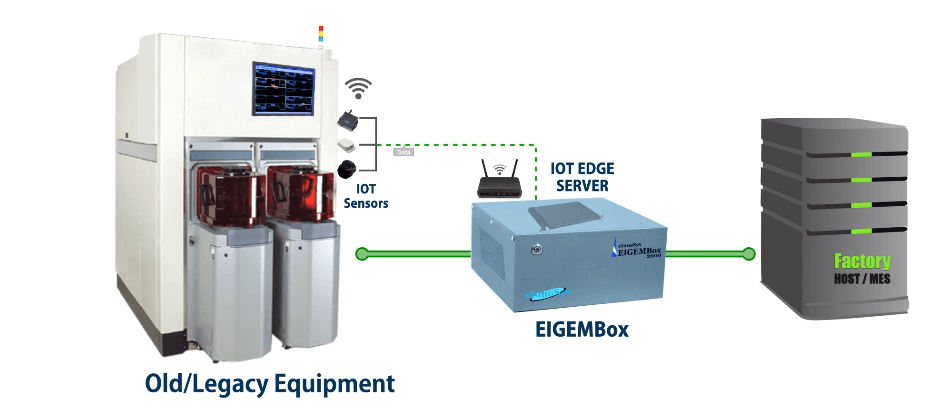
EIGEMBox is a turnkey SECS/GEM interface solution for legacy or non-GEM equipment.

It allows older 150mm/200mm tools to connect to modern factory automation systems without modifying the existing controller software.

Key Features:

  • External hardware/software gateway for SECS/GEM conversion
  • Plug-and-play communication between legacy tools and fab host
  • Supports recipe upload/download, trace data, and alarms
  • Ideal for equipment without native SECS/GEM support
  • Fast deployment and easy configuration
Step-by-Step Guide to Getting Started with a SECS/GEM SDK

Let’s look at how you can set up and start using a SECS/GEM SDK like EIGEMEquipment for your equipment development.

Step-by-Step Guide to Getting Started with a SECS_GEM SDK

Step 1: Understand the Communication Standards

Before coding, familiarize yourself with:

  • SEMI E5 (SECS-II) – Message structure and data format
  • SEMI E30 (GEM) – Equipment communication model
  • SEMI E37 (HSMS) – TCP/IP-based message transport protocol

Understanding these standards ensures correct configuration of messages, variables, and event reports.

Step 2: Install the SECS/GEM SDK

Once you obtain the SDK (e.g., EIGEMEquipment SDK):

  1. Install it on your development machine (Windows/Linux).
  2. Set up the runtime environment and dependencies.
  3. Review the SDK documentation for supported APIs and configuration files.

Einnosys SDKs come with example applications that help you test GEM scenarios right out of the box.

Step 3: Define Equipment Variables and Events

In your tool’s control software:

  • Identify status variables (SVs) (e.g., temperature, pressure, motor state).
  • Define collection events (CEs) (e.g., wafer load, process complete).
  • Configure alarms for fault conditions.

Using the SDK’s configuration editor, you can map each variable/event to the appropriate SECS message format.

Step 4: Implement Communication Logic

Use the SDK’s APIs to:

  • Establish a connection with the Host (via HSMS/TCP).
  • Send and receive SECS messages (SxFy format).
  • Handle host commands and responses.
  • Update status data and report events as they occur.

The EIGEMEquipment SDK simplifies this process with ready-to-use C++/C# interfaces.

Step 5: Test Using a SECS/GEM Simulator

Before deploying to production, test communication using a SECS/GEM simulator like EIGEMSim.

This tool simulates the host system and lets you:

  • Verify SECS messages
  • Test event reporting, variable updates, and recipe transfers
  • Validate your equipment’s GEM compliance

Testing early ensures your equipment passes factory acceptance faster.

Step 6: Integrate and Deploy

Once testing is complete:

  • Deploy your SECS/GEM-enabled software to the equipment controller.
  • Connect to the factory host for real-time validation.
  • Monitor communication logs to ensure reliability and performance.

With Einnosys SDKs, you can scale the integration easily for multiple tools or newer equipment models.

Common Challenges (and How to Avoid Them)
Challenge Solution
Misconfigured SECS message IDs Use the SDK’s message templates for consistency
Data mismatches between host and tool Use real-time logging and event validation tools
Long development cycles Start with prebuilt SDK components and sample code
Legacy tool integration Use EIGEMBox for non-GEM equipment
Benefits of Using a SECS/GEM SDK
  • Faster time to market for new tools
  • Reduced coding and debugging effort
  • Guaranteed SEMI compliance
  • Scalable and maintainable communication layer
  • Simplified testing with host simulation tools
  • Proven reliability (used by global OEMs and fabs)

Getting started with SECS/GEM doesn’t have to be complicated.

With a robust SDK like Einnosys’ EIGEMEquipment and supporting tools such as EIGEMBox and EIGEMSim, equipment developers can easily achieve full SECS/GEM compliance, connect with fab hosts, and accelerate their automation roadmap.

Whether you’re upgrading legacy equipment or developing next-generation 300mm tools, Einnosys provides the complete suite of solutions — SDKs, simulators, and integration expertise — to help you build smart, connected, and factory-ready equipment.

FAQs
  • What programming languages are supported by EIGEMEquipment SDK?

    EIGEMEquipment supports C++, C#, and .NET-based environments on both Windows and Linux platforms.

  • Can I integrate EIGEMBox with third-party equipment?

    EIGEMBox can be connected to any 150mm or 200mm tool lacking SECS/GEM support, providing a plug-and-play communication gateway to the factory host.

  • How long does it take to integrate SECS/GEM using the SDK?

    Most equipment teams can achieve full SECS/GEM integration in 2–4 weeks, compared to several months of manual development.

Alignment Film Coating Equipment SECS/GEM SDK Software Solutions

[vc_row][vc_column][vc_column_text css=””]

In the fast-evolving semiconductor and flat panel display (FPD) industries, precision, automation, and connectivity are the cornerstones of efficient manufacturing. One critical process that demands these qualities is alignment film coating, where even a minor deviation can impact yield and product quality. To ensure smooth communication and compliance with industry standards, equipment manufacturers need robust SECS/GEM SDK software solutions — and that’s where eInnoSys stands out.

[/vc_column_text][/vc_column][/vc_row][vc_row][vc_column width=”1/2″][vc_column_text css=””]Why Software Solutions Matter for Alignment Film Coating Equipment

In today’s smart factories, software is the bridge that connects complex equipment to the host systems, enabling full factory automation and real-time process control. For Alignment Film Coating Equipment, the right software ensures seamless communication, data collection, monitoring, and traceability.

Here’s why software solutions are essential for equipment OEMs and FPD manufacturers:

Factory Integration: Seamlessly connect equipment to factory host systems through SECS/GEM communication standards.

Process Visibility: Monitor and control every step of the film coating process in real-time for enhanced yield and consistency.

Data-Driven Insights: Collect, store, and analyze equipment data to predict maintenance needs and improve uptime.

Faster Time-to-Market: Reduce development time and integration challenges with ready-to-use SDKs that comply with SEMI standards.[/vc_column_text][/vc_column][vc_column width=”1/2″][vc_single_image image=”37850″ img_size=”full” alignment=”center” css=””][/vc_column][/vc_row][vc_row][vc_column width=”1/2″][vc_column_text css=””]Comprehensive Equipment Software Solutions by eInnoSys

eInnoSys offers a full suite of equipment software solutions designed specifically for semiconductor, FPD, and related high-tech manufacturing industries. Our solutions are built to help OEMs easily enable SECS/GEM, GEM300, and EDA (Interface A) communication on their equipment — without spending years on custom software development.

Our SECS/GEM SDK Highlights:

  • Plug-and-Play Integration: Rapidly implement SEMI-compliant host communication.
  • Customizable Framework: Tailor the SDK for the unique process needs of alignment film coating tools.
  • Cross-Platform Support: Compatible with Windows and Linux-based equipment controllers.
  • Comprehensive Documentation: Easy-to-follow integration guides, APIs, and example codes.
  • Global Support: Backed by experienced SECS/GEM engineers who assist in deployment, testing, and certification.

[/vc_column_text][/vc_column][vc_column width=”1/2″][vc_column_text css=””]Why Choose eInnoSys for Alignment Film Coating Equipment SDK Solutions?

When it comes to enabling SECS/GEM connectivity for alignment film coating equipment, choosing the right technology partner makes all the difference. Here’s what sets eInnoSys apart:

✅ Proven Industry Expertise: Decades of experience in semiconductor and FPD automation software development.

✅ End-to-End Solutions: From SECS/GEM SDKs to full equipment control software, eInnoSys covers the complete software stack.

✅ SEMI Standards Compliance: Our SDKs are fully compliant with SEMI E5, E30, E37, E39, and related standards.

✅ Faster Certification: Reduce time and cost of SECS/GEM compliance testing with pre-validated modules.

✅ Scalable Architecture: Our SDKs support future expansion, including EDA, IoT, and AI-driven analytics.[/vc_column_text][/vc_column][/vc_row][vc_row][vc_column width=”1/2″][vc_column_text css=””]With our SDK suite, OEMs and FPD manufacturers can:

  • Easily enable SECS/GEM communication on new or legacy equipment.
  • Improve production efficiency with real-time data exchange.
  • Reduce downtime with predictive maintenance integrations.
  • Shorten development cycles with pre-tested software components.
  • Stay ahead of Industry 4.0 trends with scalable digital solutions.

[/vc_column_text][/vc_column][vc_column width=”1/2″][vc_single_image image=”37849″ img_size=”full” alignment=”center” css=””][/vc_column][/vc_row][vc_row][vc_column][vc_column_text css=””]

As the semiconductor and FPD industries continue to advance, automation and data integration are key to achieving precision, efficiency, and scalability. With eInnoSys SECS/GEM SDK software solutions, Alignment Film Coating Equipment manufacturers can streamline factory connectivity, ensure SEMI compliance, and accelerate innovation.

Whether you’re developing new equipment or upgrading existing systems, eInnoSys provides the reliable, scalable, and smart software foundation you need to succeed in the era of intelligent manufacturing.

[/vc_column_text][/vc_column][/vc_row][vc_row][vc_column][vc_column_text css=””]

Expanded Frequently Asked Questions (FAQs)

[/vc_column_text][vc_toggle title=”What is SECS/GEM and why is it important for alignment film coating equipment?” css=””]SECS/GEM is a set of SEMI standards that define communication between manufacturing equipment and host systems. For film coating tools, it ensures standardized data exchange, process control, and automation.[/vc_toggle][vc_toggle title=”Can eInnoSys SDK integrate with my existing equipment controller?” css=””]Yes, our SECS/GEM SDK supports most industrial controllers, including those running on Windows or Linux platforms.[/vc_toggle][vc_toggle title=”Does eInnoSys provide customization for film coating process control?” css=””]Absolutely. We can tailor our SDK and software modules to support specific alignment and coating process parameters.[/vc_toggle][vc_toggle title=”Is your SDK compatible with Industry 4.0 or smart factory initiatives?” css=””]Yes, our SDKs are Industry 4.0-ready, supporting data analytics, IoT connectivity, and AI/ML integration.[/vc_toggle][vc_toggle title=”What is SECS/GEM and why is it important for alignment film coating equipment?” css=””]SECS/GEM is a SEMI communication standard that enables manufacturing equipment to communicate with factory host systems. For alignment film coating equipment, it ensures smooth automation, consistent data collection, and real-time process control across the production line.[/vc_toggle][vc_toggle title=”Can eInnoSys SDK integrate with my existing equipment controller?” css=””]Yes. eInnoSys SECS/GEM SDK supports major industrial platforms such as Windows, Linux, and embedded controllers, allowing seamless integration with both new and legacy alignment film coating equipment.[/vc_toggle][vc_toggle title=”How long does SECS/GEM integration take using your SDK?” css=””]Most customers achieve complete SECS/GEM integration within a few weeks, thanks to our ready-to-deploy SDK modules, detailed documentation, and expert support.[/vc_toggle][vc_toggle title=”Does eInnoSys provide customization for film coating process control?” css=””]Absolutely. Our SDK and software solutions can be customized to match the specific alignment, film coating, and curing process parameters required by OEMs or manufacturers.[/vc_toggle][vc_toggle title=”Is your SDK compatible with Industry 4.0 or smart factory initiatives?” css=””]Yes. eInnoSys SDKs are Industry 4.0-ready, supporting IoT data integration, AI/ML analytics, and predictive maintenance applications for advanced smart manufacturing.[/vc_toggle][vc_toggle title=”What SEMI standards does the eInnoSys SECS/GEM SDK comply with?” css=””]Our SDK is fully compliant with key SEMI standards including E5 (SECS-II), E30 (GEM), E37 (HSMS), E39 (Object Services), and GEM300 for 300mm equipment support.[/vc_toggle][vc_toggle title=”Does eInnoSys offer support after SDK implementation?” css=””]Yes, we provide comprehensive post-integration support, including troubleshooting, factory acceptance testing, remote assistance, and software updates to ensure long-term reliability.[/vc_toggle][vc_toggle title=”Can I upgrade older alignment film coating tools to be SECS/GEM compliant using your SDK?” css=””]Definitely. Our SDK allows retrofit upgrades for older or legacy equipment, enabling them to meet current SEMI communication and automation standards without full hardware redesign.[/vc_toggle][vc_toggle title=”Is training provided for my engineering or software team?” css=””]Yes. eInnoSys offers hands-on training programs covering SECS/GEM fundamentals, SDK integration, testing procedures, and best practices for film coating equipment developers.[/vc_toggle][vc_toggle title=”How does eInnoSys ensure data security and system reliability?” css=””]Our SDK uses secure communication protocols (HSMS/TCP) and is rigorously tested for fault tolerance, data integrity, and uptime reliability, ensuring consistent factory communication under demanding production environments.[/vc_toggle][/vc_column][/vc_row][vc_row][vc_column][/vc_column][/vc_row]