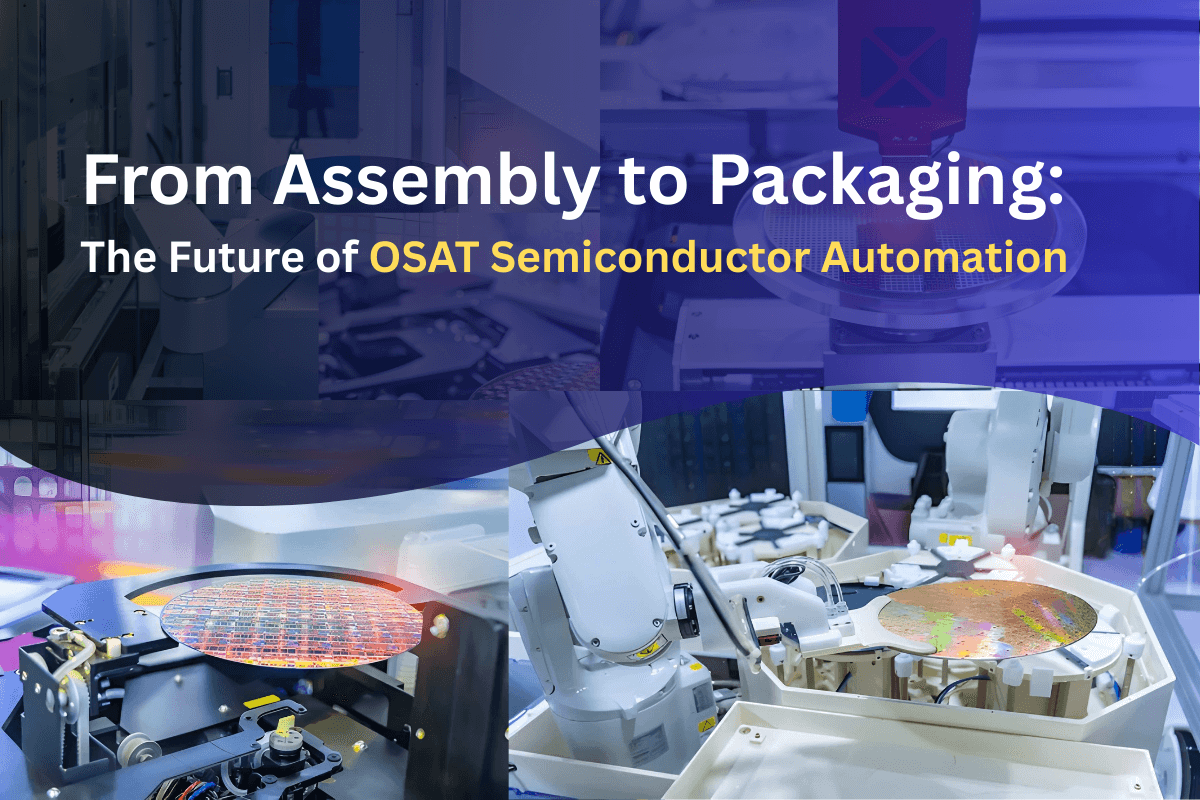
From Assembly to Packaging: The Future of OSAT Semiconductor Automation

Introduction

The semiconductor industry continues to evolve rapidly, driven by increasing demand for advanced chips used in artificial intelligence, automotive electronics, consumer devices, and high-performance computing. While much attention is often focused on wafer fabrication, the assembly and packaging stage plays an equally critical role in semiconductor manufacturing. This is where OSAT Semiconductor Automation becomes essential.

Outsourced Semiconductor Assembly and Test (OSAT) companies are responsible for assembling, packaging, and testing semiconductor devices before they reach end customers. As chip complexity increases and production volumes grow, traditional manual processes are no longer sufficient. The industry is now shifting toward OSAT Factory Automation to improve efficiency, ensure product quality, and reduce operational costs.

Modern semiconductor back-end facilities are implementing Semiconductor OSAT Automation solutions that connect equipment, factory systems, and data platforms. Through advanced OSAT Manufacturing Automation, manufacturers can streamline production processes, minimize human error, and enable real-time decision-making. The future of semiconductor packaging will depend heavily on Semiconductor Assembly and Packaging Automation, supported by intelligent factory systems and connected equipment.

The Evolution of OSAT Manufacturing

Historically, semiconductor assembly and packaging operations relied on highly manual workflows. Operators manually moved materials between tools, monitored equipment performance, and handled production scheduling. However, as semiconductor devices became more complex, this approach became inefficient and error-prone.

Today, OSAT Equipment Automation is transforming how back-end semiconductor manufacturing operates. Automation technologies allow equipment to communicate with factory systems, enabling seamless coordination across production lines. This connectivity forms the foundation of Semiconductor Factory Automation, where machines, systems, and operators work together through digital platforms.

With advanced OSAT Manufacturing Automation, factories can automate key tasks such as material handling, inspection, and process monitoring. Automation also enables faster response to equipment alarms and process variations, helping manufacturers maintain high production yield.

A major driver of this transformation is the integration of OSAT Manufacturing Software and factory automation platforms. These systems support OSAT Equipment Integration, allowing different tools to share operational data and coordinate production activities.

Through improved Semiconductor Assembly Automation and Semiconductor Packaging Automation, OSAT companies can achieve higher throughput while maintaining strict quality standards required for modern semiconductor devices.


Enabling Smart Semiconductor Manufacturing

The future of semiconductor assembly and packaging lies in intelligent automation and connected factory systems. By implementing OSAT Smart Manufacturing strategies, manufacturers can create data-driven environments that optimize production performance.

In a modern Smart OSAT Factory, equipment is connected through digital communication networks that enable real-time monitoring and control. These systems support automated production scheduling, equipment health monitoring, and predictive maintenance.

Advanced OSAT Production Automation also improves operational visibility across the entire factory. Managers can monitor equipment utilization, production efficiency, and product quality in real time, enabling faster decision-making.

Automation also plays a critical role in supporting emerging Semiconductor Packaging Technology. Advanced packaging methods such as 2.5D and 3D integration require precise process control and highly coordinated equipment operations. These requirements can only be achieved through robust Semiconductor Packaging Process Automation.

Through improved Semiconductor Back-End Manufacturing Automation, OSAT facilities can maintain tight control over complex packaging processes while reducing variability and improving yield.

Digital Transformation in OSAT Manufacturing

Digital transformation is becoming a major strategic priority for OSAT companies worldwide. By adopting OSAT Digital Transformation initiatives, manufacturers can leverage advanced technologies such as artificial intelligence, big data analytics, and industrial IoT to enhance factory performance.

A key component of digital transformation is the implementation of connected automation systems. Semiconductor OSAT Automation platforms allow equipment to share production data with factory software, enabling advanced analytics and process optimization.

Modern OSAT Factory Automation systems collect vast amounts of operational data from production tools. This information can be used to identify process trends, detect anomalies, and improve equipment reliability.

The adoption of OSAT Industry 4.0 technologies further enhances automation capabilities. Industry 4.0 frameworks integrate intelligent sensors, machine learning algorithms, and cloud-based analytics to create highly adaptive manufacturing environments.

Through these innovations, OSAT Semiconductor Automation enables manufacturers to improve productivity while maintaining high product quality. Automation also supports flexible manufacturing, allowing OSAT companies to quickly adapt to changing market demands.

Contact Us Today

Get Step-by-Step Help for Canada PR Application

Improving Efficiency and Quality Through Automation

One of the biggest advantages of OSAT Manufacturing Automation is the ability to improve both efficiency and quality across semiconductor packaging operations. Automated production systems reduce human intervention, which minimizes the risk of errors and process inconsistencies.

With advanced OSAT Equipment Automation, machines can automatically report operational status, performance metrics, and alarms. This allows factory systems to monitor equipment health and detect potential issues before they impact production.

Automation also enhances Semiconductor Assembly and Packaging Automation by enabling precise process control. For example, automated inspection systems can detect defects at early stages of the packaging process, preventing defective devices from moving further down the production line.

Integrated OSAT Equipment Integration frameworks ensure that different tools within the factory can communicate and coordinate their operations. This level of connectivity is essential for enabling full Semiconductor Factory Automation.

By combining automation with advanced analytics, OSAT manufacturers can create intelligent production environments that continuously optimize performance.

The Road Ahead for OSAT Automation

The future of the semiconductor back-end manufacturing industry will depend heavily on continued innovation in automation technologies. As devices become smaller and more complex, the demands placed on packaging and assembly operations will continue to grow.

Through advanced OSAT Smart Manufacturing strategies, manufacturers can create flexible and scalable production environments capable of supporting next-generation semiconductor packaging technologies.

The continued adoption of OSAT Production Automation will allow factories to increase throughput while maintaining strict quality standards. Automation will also play a key role in enabling fully connected Smart OSAT Factory environments where equipment, data, and analytics work together to optimize manufacturing performance.

As part of this transformation, Semiconductor Packaging Automation and Semiconductor Assembly Automation will continue to evolve alongside emerging packaging technologies.

Ultimately, the integration of intelligent automation platforms, connected equipment, and advanced analytics will define the next generation of Semiconductor Back-End Manufacturing Automation.

Conclusion

The semiconductor assembly and packaging sector is undergoing a major transformation as automation technologies reshape traditional manufacturing processes. The rise of OSAT Semiconductor Automation is enabling factories to achieve higher efficiency, improved product quality, and greater operational flexibility.

By implementing robust OSAT Factory Automation systems and investing in OSAT Manufacturing Automation, OSAT companies can build highly connected manufacturing environments capable of supporting modern semiconductor production requirements.

Advanced Semiconductor OSAT Automation solutions enable seamless OSAT Equipment Integration, allowing tools and factory systems to communicate effectively. This connectivity is essential for supporting next-generation Semiconductor Assembly and Packaging Automation.

As the industry continues to move toward OSAT Industry 4.0 and OSAT Digital Transformation, automation will become even more important. The development of intelligent OSAT Production Automation systems will drive the creation of fully connected Smart OSAT Factory environments.

In the coming years, manufacturers that invest in advanced automation and embrace the principles of OSAT Smart Manufacturing will be best positioned to succeed in the rapidly evolving semiconductor industry.

How SECS GEM SDK Can Transform Your Production Line

In today’s highly competitive semiconductor landscape, production efficiency, equipment connectivity, and real-time data visibility are no longer optional—they are essential. As fabs and OEMs move toward smarter and more connected environments, SECS/GEM for Semiconductor Manufacturing has become the backbone of reliable communication between equipment and host systems. At the center of this transformation lies the SECS/GEM SDK, a powerful toolkit that enables seamless equipment connectivity, automation, and compliance.

Whether you are modernizing legacy tools or deploying new manufacturing lines, investing in SECS GEM SDK Development can dramatically improve operational efficiency. From enabling structured Equipment to Host Communication to supporting full-scale Semiconductor Factory Automation, the right SDK simplifies SECS/GEM Integration, ensures protocol compliance, and accelerates time-to-market.

This blog explores how implementing a robust SECS/GEM Communication Software solution can transform your production line and future-proof your manufacturing strategy.

Understanding the Role of SECS/GEM in Modern Production

The SECS/GEM SDK is built on the globally recognized SEMI SECS/GEM Standard, which defines communication between semiconductor manufacturing equipment and host systems such as MES. It provides a structured framework for SECS GEM Protocol Implementation, enabling standardized data exchange and remote equipment control.

At its core, SECS/GEM Software Development enables manufacturers to implement consistent messaging using the SECS II and HSMS Protocol, ensuring reliable and secure communication. This structured communication enables real-time monitoring, recipe management, alarm reporting, and equipment state tracking.

By adopting SECS/GEM for Semiconductor Manufacturing, companies eliminate manual interventions and enable automated workflows. This strengthens Semiconductor Equipment Connectivity, reduces errors, and enhances productivity across the production floor.

Enhancing Equipment-to-Host Communication

One of the biggest advantages of deploying a SECS/GEM SDK is its ability to streamline Equipment to Host Communication. In traditional manufacturing setups, disparate systems often operate in silos. With proper SECS GEM Equipment Integration, production tools can communicate directly with MES, EAP, and other factory systems.

Through structured SECS/GEM Host Integration, fabs can:

  • Collect real-time production data
  • Automate recipe downloads and uploads
  • Monitor alarms and equipment states
  • Improve traceability and reporting

By leveraging advanced SECS GEM Automation Software, manufacturers can create a synchronized production environment where data flows seamlessly between tools and control systems. This strengthens Factory Automation Software strategies and drives measurable gains in OEE and yield.

Accelerating Semiconductor Equipment Integration

As fabs expand or upgrade production lines, integrating new equipment quickly becomes critical. SECS GEM SDK Development simplifies Semiconductor Equipment Integration by offering reusable libraries and prebuilt protocol stacks.

Instead of building communication layers from scratch, engineers can use a validated SECS/GEM Communication Software framework to accelerate deployment. This approach ensures compliance with the SEMI SECS/GEM Standard while reducing development time and risk.

For manufacturers dealing with older tools, a Legacy Equipment SECS/GEM Upgrade becomes essential. Modern SDK solutions allow legacy systems to be retrofitted with standardized communication capabilities, bringing them into modern Semiconductor Factory Automation environments without replacing expensive hardware.

This capability not only reduces capital expenditure but also ensures long-term scalability through structured SECS GEM Protocol Implementation.

Driving MES Integration and Smart Manufacturing

A production line truly transforms when equipment communication integrates seamlessly with Manufacturing Execution Systems. Through MES Integration with SECS/GEM, manufacturers gain centralized control over scheduling, tracking, and quality management.

The SECS/GEM SDK plays a pivotal role in enabling smooth SECS/GEM Integration between tools and MES platforms. It ensures consistent data exchange, supports event reporting, and facilitates recipe verification.

With strong SECS/GEM Host Integration, manufacturers can:

  • Enable automated lot start and stop
  • Implement advanced traceability
  • Reduce cycle time
  • Improve compliance reporting

Modern SECS GEM Automation Software also supports predictive analytics by feeding structured equipment data into AI and monitoring systems. This integration strengthens Semiconductor Equipment Connectivity while supporting Industry 4.0 initiatives.

Ensuring Compliance and Standardization

Compliance with industry standards is critical for global semiconductor operations. A professionally designed SECS/GEM Software Development solution ensures alignment with GEM Compliance Software requirements and global SEMI specifications.

Using a reliable SECS GEM SDK Development approach helps manufacturers:

  • Maintain consistent message structures
  • Validate equipment behavior
  • Ensure standardized alarm handling
  • Achieve smooth customer acceptance testing

With proper SECS GEM Equipment Integration, equipment suppliers can confidently deliver tools that meet customer expectations across international markets.

Standardized SECS GEM Protocol Implementation also simplifies audits and accelerates deployment in multi-fab environments, reducing operational complexity.

Enabling Scalable Factory Automation

As semiconductor manufacturing becomes more advanced, scalability is essential. A flexible SECS/GEM SDK provides the foundation for building robust Factory Automation Software ecosystems.

Through seamless SECS/GEM Integration, manufacturers can integrate:

The use of modern SECS/GEM Communication Software ensures consistent performance across different equipment vendors. This strengthens overall Semiconductor Factory Automation architecture and enables centralized monitoring and control.

Additionally, strong SECS/GEM Host Integration allows production lines to scale without major reconfiguration. Whether expanding a single tool cluster or deploying a new fabrication line, the SDK ensures standardized connectivity.

Improving Operational Efficiency and ROI

Implementing SECS/GEM for Semiconductor Manufacturing directly impacts operational performance. By enabling structured Semiconductor Equipment Connectivity, fabs gain real-time visibility into tool performance and production metrics.

With comprehensive SECS GEM Automation Software, manufacturers can:

  • Reduce downtime through proactive alerts
  • Improve yield through automated recipe validation
  • Minimize human error
  • Enhance data-driven decision-making

Furthermore, investing in SECS GEM SDK Development significantly reduces custom coding requirements. Pre-tested libraries streamline SECS GEM Protocol Implementation, lowering engineering costs and speeding up deployment.

By modernizing infrastructure through Legacy Equipment SECS/GEM Upgrade, manufacturers extend equipment lifespan while aligning with modern automation strategies.

Future-Proofing Your Production Line

The semiconductor industry continues to evolve rapidly, with increasing demand for high-mix, low-volume production and advanced nodes. A scalable SECS/GEM SDK ensures your production line remains adaptable to changing requirements.

Through robust SECS/GEM Software Development, manufacturers can integrate new tools, expand MES capabilities, and implement AI-driven monitoring systems without disrupting existing operations.

With standardized SECS GEM Equipment Integration, global fabs can maintain consistency across multiple sites. Combined with strong SECS/GEM Communication Software, this ensures seamless interoperability and reduced integration risk.

Ultimately, embracing SECS/GEM Integration is not just about connectivity—it’s about building a resilient, data-driven production ecosystem powered by reliable SECS GEM Automation Software.

Conclusion

Transforming a semiconductor production line requires more than upgrading equipment—it demands a strategic approach to connectivity, compliance, and automation. Implementing a powerful SECS/GEM SDK provides the technological foundation needed for scalable growth and operational excellence.

Through structured SECS GEM SDK Development, reliable SECS GEM Protocol Implementation, and seamless SECS/GEM Host Integration, manufacturers can achieve true Semiconductor Factory Automation. From enabling advanced MES Integration with SECS/GEM to modernizing systems through Legacy Equipment SECS/GEM Upgrade, the benefits are measurable and long-lasting.

By investing in robust SECS/GEM Software Development and advanced SECS GEM Automation Software, your production line becomes smarter, more efficient, and fully aligned with global SEMI SECS/GEM Standard requirements.

In a world where precision, speed, and data visibility define success, the right SECS/GEM SDK doesn’t just support your production line—it transforms it.