Cutting-Edge Software Solutions for Semiconductor Equipment Manufacturers

Summary

  • Growth Drivers: The semiconductor market is projected to reach $1 trillion by 2030, necessitating high-precision software to manage equipment complexity.
  • Core Connectivity: SECS/GEM and GEM300 standards remain the backbone of communication between equipment and factory host systems.
  • Operational Efficiency: Advanced equipment automation solutions reduce human error, increase throughput, and ensure 24/7 uptime in cleanroom environments.
  • Future-Proofing: Integrating AI-driven predictive maintenance and cloud-based analytics allows manufacturers to stay ahead of Moore’s Law.
  • Strategic Integration: Seamlessly connecting fab automation systems with existing MES/ERP frameworks is vital for digital transformation.

Introduction

According to the SEMI Year-End Total Semiconductor Equipment Forecast (2024), global sales of semiconductor manufacturing equipment reached $100 billion, marking a significant rebound as the industry prepares for the next wave of AI-driven demand. This massive investment highlights a shift toward smarter, more autonomous hardware. To keep these multi-million dollar machines running at peak performance, developers are increasingly focused on specialized software solutions for semiconductor equipment manufacturers.

Building a chip is a bit like trying to build a skyscraper out of Lego bricks while riding a unicycle during an earthquake. The precision required is staggering. If the software controlling the lithography or etching equipment lags by even a fraction of a second, an entire wafer of high-value chips becomes a very expensive coaster. This reality makes the underlying software layer as critical as the hardware itself.

Modern semiconductor manufacturing software must handle massive data streams while maintaining nanosecond-level control. Manufacturers are moving away from monolithic, legacy architectures toward modular, interoperable systems. This evolution allows for faster updates and better integration with the broader factory ecosystem.

Essential Software Solutions for Semiconductor Equipment Manufacturers

The complexity of modern chipmaking requires a multi-layered software approach. It starts with the basic machine control and extends to how that machine talks to the rest of the factory. Without a cohesive strategy, equipment remains an “island of automation,” unable to share vital data or receive remote instructions.

Mastering Connectivity with SECS/GEM

Standardization is the secret sauce of the semiconductor world. The SEMI Equipment Communications Standard/Generic Equipment Model (SECS/GEM) is the primary protocol used for communication between the equipment and the factory’s Manufacturing Execution System (MES). These software solutions for semiconductor equipment manufacturers enable the host to start or stop processing, select recipes, and collect data for quality analysis.

The Leap to GEM300 Standards

As wafers grew to 300mm, the industry introduced the GEM300 standards. These protocols manage complex tasks like carrier handoffs and automated material handling. Implementing semiconductor OEM software that fully supports E39 (Object Services), E40 (Process Management), and E94 (Control Job Management) is mandatory for any equipment intended for a modern 300mm fab.

Driving Efficiency Through Equipment Automation Solutions

Automation is no longer a luxury; it is a survival mechanism. Human intervention in a cleanroom is a primary source of contamination. Consequently, OEMs are prioritizing equipment automation solutions that minimize manual touchpoints. This includes everything from robotic arm calibration to automated recipe management.

Real-Time Monitoring and Data Visualization

You cannot fix what you cannot see. High-fidelity dashboards provide engineers with real-time insights into machine health. Modern industrial software for semiconductors uses edge computing to process sensor data locally, providing immediate feedback loops that can adjust process parameters on the fly.

AI-Driven Predictive Maintenance

Is the vacuum pump about to fail? Or is that vibration just a ghost in the machine? Predictive maintenance software uses machine learning models to analyze historical data and identify patterns that precede a failure. By addressing issues before they cause a shutdown, manufacturers avoid the “emergency scramble” that ruins production schedules.

Benefits of Modern Semiconductor OEM Software

Investing in high-quality software yields dividends across the entire product lifecycle. For the OEM, it means faster deployment and fewer support headaches. For the fab operator, it means higher yield and lower total cost of ownership.

  • Faster Time-to-Market: Pre-built software modules for common tasks like wafer mapping or alarm handling allow engineers to focus on their unique hardware IP.
  • Global Compliance: Modern software ensures that equipment meets international standards for safety and communication right out of the box.
  • Scalability: Modular fab automation systems can be updated with new features without requiring a complete hardware overhaul.

Implementing Fab Automation Systems Successfully

Integration is where the rubber meets the road. Even the best machine is useless if it refuses to play nice with the factory host. This requires a deep understanding of both the hardware capabilities and the IT requirements of the end-user.

Overcoming Legacy System Hurdles

Many fabs still run on older software stacks. Bridging the gap between a brand-new etching tool and a 15-year-old MES requires flexible software solutions for semiconductor equipment manufacturers. Middleware and protocol converters often act as the “universal translator” in these scenarios.

Ensuring Cybersecurity in the Fab

As equipment becomes more connected, it also becomes a target. Intellectual property is the lifeblood of the semiconductor industry. Modern industrial software for semiconductors must include robust encryption, secure boot processes, and role-based access control to prevent unauthorized data exfiltration or tampering.

User Interface (UI) and Experience (UX)

A cluttered interface leads to mistakes. Modern software design focuses on intuitive touchscreens and clear visual cues. If an operator needs a PhD to find the “Emergency Stop” or the recipe upload button, the software has failed. Simple, clean, and responsive designs are the new standard for semiconductor manufacturing software.

The Human Element in a Silicon World

Despite the “lights-out” factory goals, humans still design, build, and maintain these machines. Why is it that we can order a pizza with one click, but sometimes updating a recipe on a wafer-bonder feels like writing a letter in Cuneiform? Software should empower the people on the floor, making their jobs easier, not more frustrating.

When we talk about software solutions for semiconductor equipment manufacturers, we are really talking about trust. The OEM trusts the software to represent their hardware accurately. The fab operator trusts the software to handle billions of dollars in inventory. It is a heavy responsibility, but when done right, it makes the impossible task of chipmaking look like a walk in the park.

Conclusion

The path to the next generation of electronics is paved with code. As chips get smaller and demands get higher, the reliance on sophisticated software solutions for semiconductor equipment manufacturers will only intensify. By prioritizing connectivity, automation, and user-centric design, OEMs can deliver machines that aren’t powerful; they are smart.

Whether you are looking to upgrade legacy systems or build a new platform from scratch, the right software partner makes all the difference. Are you ready to optimize your equipment for the future of the fab?

Contact Us Today

Get Custom Software Built for Semiconductor Manufacturing Needs
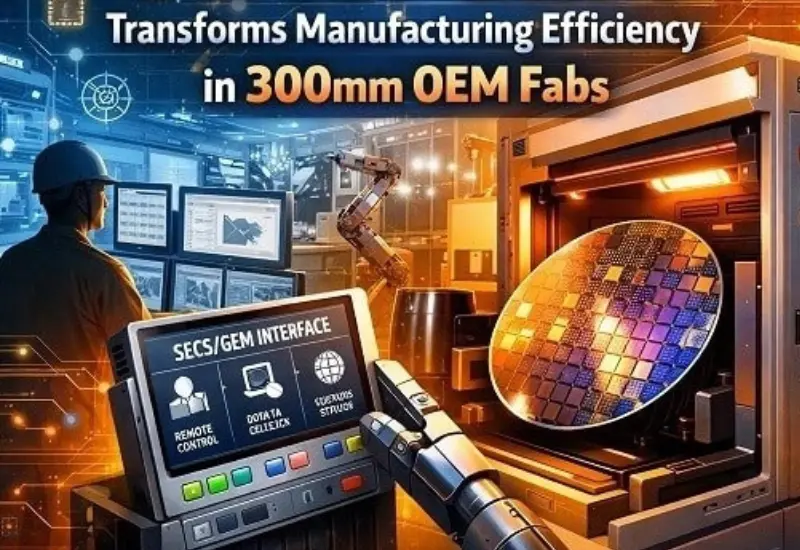
 

How SECS/GEM Transforms Manufacturing Efficiency in 300mm OEM Fabs

Summary

  • Drastic Downtime Reduction: Implementing predictive maintenance can decrease unplanned machine failures by up to 70% (Deloitte, 2022).
  • Financial Optimization: Manufacturers see an average ROI of 10x through reduced repair costs and better spare parts management.
  • Asset Longevity: Real-time monitoring extends the useful life of heavy machinery by preventing “run-to-failure” cycles.
  • Safety & Compliance: Automated alerts prevent catastrophic failures, ensuring a safer work environment and easier regulatory adherence.
  • Operational Excellence: Data-driven insights streamline labor allocation, allowing technicians to focus on high-value tasks rather than routine checks.

Introduction

According to SEMI (2024), global 300mm fab equipment spending is projected to reach a record $137 billion by 2027 as the industry expands to meet AI and automotive chip demand. This massive investment highlights a significant transition where manual handling disappears in favor of total automation. Within this landscape, the implementation of SECS/GEM for 300mm OEM fabs serves as the backbone for all data exchange.

For any OEM entering this space, compliance with specific communication protocols is an entry ticket. High-volume manufacturing facilities require tools that “speak” the same language as the factory’s Manufacturing Execution System (MES). Without this synchronization, the multi-billion-dollar facility grinds to a halt.

Modern OEM wafer equipment must handle complex tasks like automated carrier delivery and substrate tracking without human error. These machines operate within a digital ecosystem where every movement is logged, analyzed, and optimized in real-time.

Understanding SECS/GEM Communication Standards

The SEMI Equipment Communications Standard (SECS) and Generic Model for Communications and Control of Manufacturing Equipment (GEM) define how equipment and host systems interact. While SECS-I and SECS-II provide the syntax and message structure, GEM adds the semantic layer. This ensures that a tool from one vendor behaves predictably when connected to a host from another.

The Evolution from 200mm to 300mm Requirements

In older 200mm facilities, automation was often optional or semi-automated. However, 300mm wafers are heavier and more fragile, making robotic handling a necessity. This shift introduced the “GEM300” suite of standards, which expands upon basic GEM to handle the specific needs of larger substrate processing.

Key Protocols in the GEM300 Suite

To achieve full host equipment integration, OEMs must implement several specific SEMI standards:

  • E30 (GEM): The foundation for status collection and remote control.
  • E40 (Process Management): Manages the execution of recipes and process jobs.
  • E87 (Carrier Management): Oversees the movement and placement of FOUPs (Front Opening Unified Pods).
  • E90 (Substrate Tracking): Monitors the location of every individual wafer inside the tool.
  • E94 (Control Job Management): Coordinates the sequencing of multiple process jobs.

Boosting Semiconductor Manufacturing Efficiency via Automation

Why does standardized communication matter so much for the bottom line? Efficiency in a fab is measured by throughput, yield, and tool uptime. When SECS GEM communication is optimized, the host system can make split-second decisions based on live tool data.

Consider the impact of alarm management. A tool that fails to report the specific cause of a stoppage forces a technician to spend an hour diagnosing the issue. A GEM-compliant tool sends a specific alarm code immediately, allowing the MES to trigger a repair ticket or reroute material to another machine.

Data-Driven Process Optimization

Modern fabs function as giant data engines. Every sensor reading, from gas flow rates to chamber pressure, can be collected via the High-Speed Message Services (HSMS/E37) protocol. This granular intelligence allows engineers to perform predictive maintenance, fixing a component before it breaks and ruins a batch of expensive silicon.

Reducing Human Error through Remote Control

Human presence in a cleanroom is a primary source of contamination. In fact, even a tiny skin cell can ruin a 2nm circuit. By utilizing fab automation software, OEMs allow operators to control tools from a remote command center. This “lights-out” manufacturing approach is the gold standard for 300mm facilities.

Challenges in Host Equipment Integration for OEMs

Building a world-class etching or lithography tool is difficult enough. Adding a complex software layer that complies with dozens of SEMI standards adds another level of frustration. Many OEMs struggle with the nuance of state machines and message timing.

How many times has a tool shipment been delayed because the software failed a “Host Acceptance Test”? These tests are rigorous. The factory host expects the tool to respond to specific commands within milliseconds. If the software architecture is clunky, the tool becomes a bottleneck rather than an asset.

The Complexity of Multi-Vendor Environments

A typical 300mm fab contains equipment from dozens of different suppliers. SECS/GEM for 300mm OEM fabs ensures that the “Tower of Babel” problem is avoided. Without these standards, the factory integration team would need to write custom code for every single machine, a task that would be both expensive and impossible to maintain.

Overcoming Legacy Code Hurdles

Some OEMs attempt to patch old 200mm software to work in 300mm environments. This rarely ends well. The 300mm standards require a more robust handling of “Object Services” (E39), which older systems lack. Starting with a purpose-built automation framework is usually the faster route to compliance.

Choosing the Right Fab Automation Software

For an OEM, the decision to “build vs. buy” its SECS/GEM interface is pivotal. Building a compliant stack from scratch can take years of development and testing. Conversely, utilizing a proven fab automation software solution allows the engineering team to focus on their core competency: the wafer processing technology itself.

Scalability and Future-Proofing

The semiconductor industry moves fast. Today it is 300mm; tomorrow, we might see more 450mm research or even more complex chiplet integration. A flexible software interface can adapt to new SEMI standards without requiring a total rewrite of the tool’s control logic.

Streamlining the Integration Process

A high-quality GEM driver offers a graphical interface for defining the tool’s variables, events, and alarms. This simplifies the task for the software engineer, who can map these internal data points to the SECS/GEM messages required by the fab host.

The Role of HSMS in High-Speed Data Exchange

While the original SECS-I protocol relied on serial communication (RS-232), modern 300mm fabs use HSMS over Ethernet. This allows for massive bandwidth. According to a Gartner report (2023), the volume of data generated by a single fab is expected to grow by 500% over the next five years. HSMS is the pipe that makes this possible.

Is your OEM wafer equipment prepared for this data deluge? High-speed communication is no longer a luxury. It is a fundamental requirement for Advanced Process Control (APC), where the host adjusts tool parameters during a process step to maintain yield.

Conclusion

The transition to high-volume 300mm production requires a radical commitment to connectivity. By prioritizing SECS/GEM for 300mm OEM fabs, equipment manufacturers ensure their tools remain competitive in a landscape that demands perfection. Standardized SECS GEM communication reduces the friction of deployment and maximizes the long-term value of the equipment. As fabs become smarter and more autonomous, the ability to provide seamless host equipment integration will remain the defining factor for success.

Contact Us Today

Get Expert Support to Boost Efficiency with SECS/GEM Automation


Revolutionizing Semiconductor Manufacturing with Automation Technologies

Summary

  • Efficiency Gains: Automation increases fab throughput by removing human error and optimizing material transport.
  • Yield Improvements: Advanced sensors and AI-driven analytics detect defects earlier than manual inspections.
  • Market Growth: The push toward 2nm and 3nm nodes makes semiconductor manufacturing automation a necessity rather than a luxury.
  • Data Integration: Modern fab automation solutions rely on SECS/GEM protocols for seamless equipment-to-host communication.
  • Future Readiness: Transitioning to “lights-out” manufacturing reduces contamination risks and operational overhead.

Introduction

According to a report by McKinsey & Company (2022), the global semiconductor industry is on track to become a $1 trillion sector by 2030. This massive expansion places unprecedented pressure on fabrication plants to increase output while maintaining microscopic precision. To meet these demands, semiconductor manufacturing automation has shifted from a peripheral upgrade to the central nervous system of the modern fab.

The complexity of contemporary chip design means a single mistake during the photolithography or etching stage can lead to millions of dollars in scrapped material. Automation acts as a safeguard, ensuring that every movement within the cleanroom is executed with robotic consistency. Beyond simple robotics, the integration of smart software allows for real-time adjustments that humans simply cannot perform at scale.

Facilities that embrace industrial automation in semiconductor environments see a drastic reduction in cycle times. By removing the variability of manual handling, these plants achieve higher reliability and a more predictable supply chain. As the industry moves toward increasingly smaller nodes, the margin for error disappears, making automated systems the primary driver of competitive advantage.

The Evolution of Semiconductor Process Optimization

The journey from manual wafer handling to fully autonomous environments marks a significant era in electronics history. In the early days, technicians moved wafers by hand, a process that invited contamination and physical damage. Today, the focus has shifted toward semiconductor process optimization through sophisticated material handling and data-driven decision-making.

Moving Beyond Manual Handling

Modern fabs utilize Automated Material Handling Systems (AMHS) to transport wafers between process steps. These systems, often involving Overhead Hoist Transport (OHT) or Automated Guided Vehicles (AGVs), minimize the vibration and particles that human operators inevitably introduce. Because a single speck of dust can ruin a 300mm wafer, keeping humans away from the product is a primary goal.

The Impact of 300mm and 450mm Wafers

As wafer sizes increased, their weight and fragility made manual transport nearly impossible. Automation became the solution for handling these heavy loads without sacrificing speed. This transition required a complete redesign of fab layouts to accommodate tracks, elevators, and robotic arms that operate in tight spaces.

Key Technologies in Fab Automation Solutions

Implementing effective fab automation solutions involves a mix of hardware and software working in tandem. It starts with the equipment on the floor and extends to the cloud-based analytics that predict when a machine might fail.

Equipment Communication and SECS/GEM Protocols

For a tool to be “automated,” it must communicate with the Manufacturing Execution System (MES). This is achieved through SECS/GEM (Semiconductor Equipment Communication Standard/Generic Equipment Model). These protocols allow the factory host to start or stop processing, track wafer locations, and collect data for quality control.

The Role of E58 and E142 Standards

Beyond basic communication, standards like SEMI E58 (Object Management) and E142 (Substrate Mapping) provide deeper insights. They help engineers track the “genealogy” of a chip. If a defect appears in the final testing phase, automation software can trace it back to the exact chamber and time of the incident.

AI and Machine Learning in Defect Detection

Visual inspection used to be a bottleneck. Today, high-speed cameras paired with machine learning algorithms scan wafers for imperfections at speeds no human could match. These systems learn from every scan, becoming more accurate over time and reducing “false catches” that slow down production.

Strategic Benefits of Industrial Automation in Semiconductor Fabs

Why do stakeholders invest billions in these systems? The ROI comes from three main areas: yield, throughput, and safety. A silicon wafer is essentially a very expensive piece of glass that refuses to cooperate if the environment is slightly off. Automation ensures that the environment remains perfect.

  • Yield Enhancement: Automated metrology identifies process drifts before they result in scrapped wafers.
  • Reduced Contamination: Fewer humans in the cleanroom means fewer skin cells and fibers entering the airflow.
  • Lower Operational Costs: While initial CAPEX is high, the long-term cost per wafer drops as throughput increases.
  • Safety Improvements: Robotic systems handle hazardous chemicals and heavy machinery, protecting the workforce from workplace accidents.

Overcoming Challenges in Semiconductor Manufacturing Automation

Despite the benefits, the road to a fully automated fab is paved with technical hurdles. Legacy equipment remains one of the largest obstacles for established companies. Older machines frequently lack the native digital interfaces required for modern manufacturing technology in semiconductors.

Integrating Legacy Tools

Many fabs operate with “vintage” tools that are still mechanically sound but digitally silent. Engineers often use “retrofitting” to add sensors and communication bridges to these machines. This allows a 20-year-old etcher to participate in a modern data ecosystem without requiring a multi-million-dollar replacement.

Data Silos and Interoperability

Even with new equipment, data often gets trapped in proprietary formats. True semiconductor manufacturing automation requires a horizontal data flow where the lithography tool “talks” to the development track. Breaking these silos is a major focus for MES engineers who want a holistic view of the factory floor.

The Future of Lights-Out Manufacturing

The “lights-out” factory is the ultimate goal for many high-volume manufacturers. In this scenario, the fab operates with zero human intervention on the production floor. This setup relies on advanced AI to manage scheduling and maintenance autonomously.

Digital Twins and Predictive Maintenance

Digital twins are virtual replicas of the physical fab. By running simulations on a digital twin, engineers can predict how a change in the production schedule will affect throughput. This prevents “bottlenecking” before it occurs in the real world. Predictive maintenance takes this further by analyzing vibration and heat data to schedule repairs before a tool breaks down.

Workforce Shift: From Operators to Orchestrators

Automation fails to eliminate jobs; instead, it changes their nature. The role of a fab worker is evolving from manual labor to system orchestration. Engineers now focus on optimizing algorithms and managing robotic fleets rather than moving boxes. Is your team ready to trade their wrenches for code? This shift requires significant upskilling and a new approach to technical training.

Implementing Manufacturing Technology in Semiconductors

Selecting the right partner for automation is a critical decision. It involves evaluating the scalability of software and the durability of hardware. A successful implementation usually follows a phased approach to avoid disrupting current production.

  1. Assessment: Identify the biggest bottlenecks in the current workflow.
  2. Pilot Programs: Automate a single line or process step to prove ROI.
  3. Data Harmonization: Ensure all tools speak a common language (SECS/GEM).
  4. Full Integration: Connect the floor tools to the MES and ERP systems.
  5. Continuous Optimization: Use AI to refine processes based on real-time data.

Conclusion

The transition toward semiconductor manufacturing automation is no longer a choice for those who wish to remain relevant. With global demand for chips skyrocketing and transistor sizes shrinking to the atomic level, the precision of robotics and the speed of AI are the new industry standards. By investing in fab automation solutions, manufacturers can ensure higher yields, lower costs, and a safer environment for their workforce.

Contact Us Today

Get Expert Help to Implement Advanced Fab Automation Technologies


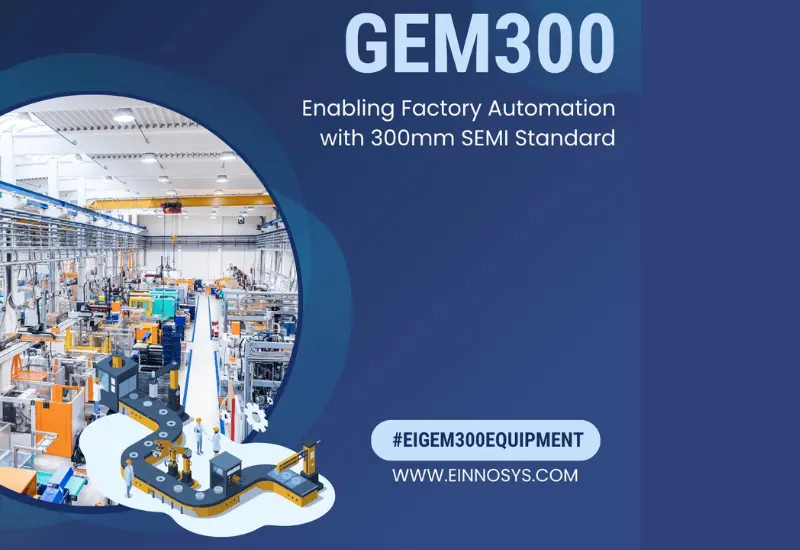
How GEM300 Enables 300mm Semiconductor Factory Automation

Summary

  • The 300mm Paradigm: Examining how the transition from 200mm to 300mm wafers necessitated the shift toward fully automated software control.
  • Core SEMI Standards: A technical breakdown of E87 (Carrier Management), E40 (Process Jobs), E94 (Control Jobs), and E90 (Substrate Tracking).
  • Performance Metrics: How compliance directly improves Overall Equipment Effectiveness (OEE) and reduces scrapped material.
  • OEM Strategy: Guidelines for equipment manufacturers to achieve seamless integration with factory host systems.
  • Future Resilience: The role of automation in supporting “lights-out” manufacturing and AI-driven process control.

Introduction

According to Statista (2024), 65% of global semiconductor manufacturing capacity expansion is now focused exclusively on 300mm facilities, with total monthly capacity expected to hit 9.6 million wafers by 2026. This massive investment underscores a critical reality in modern electronics: the era of manual intervention is over. To manage these gargantuan volumes with the precision of a master watchmaker, the industry relies on a sophisticated framework known as GEM300 factory automation.

When the industry moved from 200mm to 300mm wafers, the changes were far more than just physical. A fully loaded 300mm Front Opening Unified Pod (FOUP) weighs roughly 9 kilograms and carries silicon worth as much as a luxury sports car. Expecting a human technician to carry these across a cleanroom floor is a recipe for both ergonomic disasters and financial heartbreak. Silicon is quite the diva; it demands a vibration-free, perfectly clean, and highly predictable environment to yield results.

To solve this, the industry standardized the communication between the factory host and the equipment. This standardization ensures that every tool in a 300mm semiconductor fab speaks the same digital dialect. Without these rules, a factory would be a chaotic Babel of proprietary software, where the robots and the process tools could never agree on when to start or stop. GEM300 factory automation provides the script that keeps the entire facility in sync.

The Physical Necessity of 300mm Semiconductor Fab Automation

In older 200mm fabs, automation was often a luxury or a secondary thought. Operators could manually move “open cassettes” and use basic barcode scanners to tell the host which lot was being processed. In a 300mm environment, however, the wafers are housed in sealed FOUPs to maintain a pristine micro-environment. This makes manual identification and handling virtually impossible at scale.

The sheer size of these wafers also means that the cost of a single error is magnified. If a batch of wafers is processed with the wrong recipe, the financial loss is roughly 2.25 times higher than it was in the 200mm era. Automation isn’t about saving on labor costs; it’s about eliminating the variance that humans inherently introduce into a system.

The Evolution from SECS/GEM to GEM300

While the original SECS/GEM (E30) standards provided a way for tools to report their status, they were designed for simpler times. Basic GEM can tell a host that a tool is “Running” or “Idle,” but it lacks the nuance required to handle automated overhead transport systems or complex job queuing. GEM300 factory automation was developed to fill these gaps, providing a comprehensive management layer for material, recipes, and substrate locations.

Deciphering the Core SEMI GEM 300 Standards

The term SEMI GEM 300 refers to a suite of standards that work together to create a “hands-off” manufacturing environment. Each standard addresses a specific logistical challenge.

E87 – Carrier Management System (CMS)

E87 is perhaps the most visible part of the automation suite. It manages the interaction between the equipment and the material carriers (FOUPs).

  • Load Port Control: It manages the state of the load ports, signaling to the Overhead Hoist Transport (OHT) when a port is ready for a new pod.
  • Carrier ID Verification: It ensures that the ID of the FOUP matches the ID expected by the factory host.
  • Content Map: E87 checks that the number of wafers reported by the pod’s sensor matches the factory records.

E40 – Process Job Management

A Process Job is the digital instruction that tells a tool what to do with a specific set of wafers. It specifies the recipe to be used and the specific wafers within the FOUP that should be processed. E40 allows the factory host to download these instructions in advance, ensuring the tool is ready to start the moment the FOUP is clamped and unsealed.

E94 – Control Job Management

If the Process Job is the “what,” the Control Job is the “how and when.” E94 organizes multiple process jobs into a logical sequence. It manages the flow of material through the tool, coordinating how different carriers are handled if a tool has multiple load ports. This allows for continuous processing, where the tool is already preparing for the next batch while the current one is still in the process chamber.

E90 – Substrate Tracking

In high-end chipmaking, knowing where a wafer is isn’t enough; you need to know exactly which slot it occupies at every microsecond. E90 provides real-time tracking of every individual wafer (substrate) as it moves from the FOUP to the robot arm, into the load lock, and through the process modules. This is essential for modern “wafer-level traceability.”

Operational Gains through GEM300 Factory Automation

Why do companies spend millions on GEM300 compliance? The answer lies in the data. According to a McKinsey (2023) report on semiconductor manufacturing, fabs that implement high-level automation see an average increase of 15% in Overall Equipment Effectiveness (OEE).

Eliminating the “Fat Finger” Error

Manual data entry is the enemy of yield. When an operator has to type in a recipe name like “ETCH_GATE_POLY_V2,” there is a constant risk of a typo. Semiconductor equipment automation removes this risk. The host system sends the recipe name directly to the tool via the E40 standard. The tool then verifies that it actually possesses that recipe before it even begins to move a wafer.

Reducing Cycle Times

In a manual fab, a tool might sit idle for twenty minutes while an operator realizes a process is finished and comes to move the material. In a 300mm semiconductor fab using GEM300, the tool alerts the AMHS (Automated Material Handling System) minutes before the process ends. The robot is often waiting at the load port the moment the FOUP is ready to be moved, shaving hours off the total cycle time for a single lot.

The Roadmap to GEM300 Compliance for OEMs

For Equipment Original Equipment Manufacturers (OEMs), building a tool for the 300mm market is a daunting task. You could have the most advanced etch chemistry on the planet, but if your tool cannot pass a GEM300 compliance test, no tier-one fab will buy it.

Mapping the State Machines

The biggest challenge in compliance is mapping the tool’s internal hardware states to the SEMI-defined state models. SEMI standards require the tool to report its status in a very specific way. If the tool is in a “Maintenance” state, it must report that via the software interface so the host doesn’t try to send it new work.

Handling Exception Scenarios

True automation is easy when everything goes right. It becomes difficult when things go wrong. What happens if the power blips? What if a wafer breaks inside a chamber? A SEMI GEM 300-compliant tool must be able to report these errors clearly to the host, allowing for “graceful” recovery rather than a total system crash that requires a manual reboot.

Utilizing Middleware for Faster Integration

Many OEMs choose to use specialized middleware to handle the communication layer. This allows their internal software teams to focus on the tool’s core process (like lithography or deposition) while the middleware handles the complex handshake protocols required by the smart factory SEMI standards.

The Data Layer of the Smart Factory

Modern fabs are essentially giant data centers that happen to produce silicon. GEM300 factory automation provides the primary pipeline for this data. Every event—every wafer move, every temperature change, every vacuum pressure reading—is reported through the GEM interface.

Advanced Process Control (APC)

With the rich data provided by GEM300, fabs can implement Advanced Process Control. If a metrology tool detects that a layer is slightly too thick, it can send a signal through the host to the next process tool to adjust its etch time accordingly. This “closed-loop” manufacturing is only possible because of the standardized communication provided by the GEM300 suite.

Predictive Maintenance and SVIDs

Through the use of Status Variable IDs (SVIDs), a tool can report its internal health metrics. Is the pump drawing more current than usual? Is the robot arm moving slightly slower? By analyzing this data over time, fab engineers can predict when a part is failing and schedule maintenance before the tool breaks down. This shift from “fix it when it’s broken” to “fix it before it breaks” is a massive driver of profitability.

Overcoming Challenges in Automation Implementation

Is the road to a fully automated fab paved with silicon? Yes, but it also has its share of potholes. Even with standards in place, integration can be tricky.

Variation in Fab Interpretations

While SEMI provides the “alphabet,” each fab operator often has their own “dialect.” One company might require specific custom reports that another does not. This means MES integration engineers must often customize the communication layer for every specific factory site, even if the tool is theoretically “compliant.”

Data Overload

A single tool can generate thousands of events per second. In a fab with hundreds of tools, the sheer volume of data can overwhelm older host systems. Modern smart factory SEMI standards are increasingly looking at ways to filter this data at the “edge,” ensuring that only the most critical information is sent to the central host, while the rest is stored locally for deep-dive analysis.

Conclusion

The success of modern semiconductor manufacturing depends on the seamless execution of GEM300 factory automation. By bridging the gap between physical material handling and digital process control, these standards have allowed the industry to scale to the massive volumes required by the global AI and mobile economies. As we look toward the future of 450mm wafers or even more complex 3-D chip architectures, the lessons learned from the SEMI GEM 300 transition will remain the blueprint for industrial excellence.

Contact Us Today

Get Expert Guidance to Achieve Full GEM300 Factory Automation

Revolutionize Semiconductor Equipment with SECS/GEM SDK

Summary

  • Modern fabs require standardized communication to maintain high yields and operational efficiency.
  • Implementing a SECS/GEM SDK allows OEMs to bypass complex protocol development and focus on core hardware features.
  • Standards like SEMI E5 and E30 provide the framework for status data, alarm management, and remote control.
  • Choosing pre-built SDK solutions reduces time-to-market while ensuring compatibility with diverse Host/MES environments.
  • Reliable integration is the cornerstone of Industry 4.0 within the semiconductor manufacturing technology sector.

Introduction

According to Statista (2024), the global semiconductor manufacturing equipment market size is projected to reach approximately $135 billion by 2027. This massive expansion places immense pressure on tool manufacturers to deliver machines that can “talk” to factory systems without a hitch. Utilizing a SECS/GEM SDK has become the standard method for bridging the gap between sophisticated hardware and the factory’s central nervous system.

When a tool enters a high-volume manufacturing environment, it cannot behave like a lone wolf. It must report every movement, alarm, and wafer transition to the Host system. If your equipment speaks a different dialect than the factory’s Manufacturing Execution System (MES), the result is a costly silence that halts production.

Standardizing these conversations ensures that a wafer scanner from one vendor and an etch tool from another can coexist under the same software umbrella. This uniformity is precisely what makes modern semiconductor equipment communication possible across thousands of diverse tools globally.

The Standard Language of the Silicon Frontier

Semiconductor manufacturing depends on a hierarchy of protocols established by SEMI (Semiconductor Equipment and Materials International). These standards ensure that every piece of equipment, regardless of its specific function, follows the same rules for data exchange. At the heart of this ecosystem lies the Generic Model for Communications and Control of Manufacturing Equipment, or GEM.

Without these rules, a fab would be a chaotic mess of proprietary cables and custom code. Instead, the industry uses SECS/GEM to provide a predictable interface. It specifies how to format messages, how to handle errors, and how the host should take control of the machine during automated sequences.

Decoding E5, E30, and the SECS/GEM Hierarchy

The architecture of SECS/GEM integration is built on several layers. The SECS-II (SEMI E5) standard defines the structure of the messages being sent. You can think of it as the grammar and vocabulary of the fab. It dictates exactly how data items like integers, strings, and lists are packed into a message.

Above that sits the GEM (SEMI E30) standard. This layer defines the behavior of the equipment. It specifies which SECS-II messages must be used in specific situations, such as when an operator presses a “Start” button or when a sensor detects a vacuum leak. If SECS-II is the vocabulary, GEM is the etiquette manual that tells the tool how to behave in polite fab society.

Transitioning to High-Speed Messaging (HSMS)

As data volumes grew, the old serial connections (SECS-I) became a bottleneck. The industry moved toward SEMI E37, known as High-Speed SECS Message Services (HSMS). This protocol allows SECS-II messages to travel over TCP/IP networks. Modern fab automation software relies almost exclusively on HSMS because it provides the bandwidth required for real-time monitoring of hundreds of variables per second.

Why OEMs Prefer a Ready-Made SECS/GEM SDK

Building a communication stack from scratch is a bit like forging your own bolts before building a car. It is possible, but it is a poor use of engineering resources. A dedicated SECS/GEM SDK provides a library of pre-tested functions that handle the heavy lifting of protocol compliance.

Software teams often find that the nuances of SEMI standards are surprisingly deep. Handling “State Models” or “Spooling” manually can lead to months of debugging. By adopting an SDK, developers can focus on the unique logic of their equipment while the toolkit manages the handshake with the MES.

Shortening the Development Lifecycle

Time is the most expensive resource in the chip world. Using a toolkit can shave months off the development cycle. Instead of writing thousands of lines of code to handle message parsing and timeout logic, engineers call a few functions to expose variables or trigger events. This efficiency is a core component of successful semiconductor manufacturing technology deployment.

Ensuring Compliance and Interoperability

Every fab has its own specific “flavor” of host software. Some might be more strict about certain message sequences than others. A professional SDK has usually been tested against a wide variety of Host simulators and real-world MES environments. This battle-tested nature means the tool will likely work the first time it is plugged into a customer’s network, avoiding embarrassing failures during factory acceptance tests.

Technical Pillars of SECS/GEM Integration

To truly appreciate the value of an SDK, one must look at the specific features it manages. It handles more than simple data transfers. It manages the very identity of the machine within the factory.

  • Variable Management: Tracking hundreds of Data Values (DVs), Status Variables (SVs), and Equipment Constants (ECs).
  • Alarm Management: Ensuring the Host knows the difference between a minor warning and a catastrophic failure.
  • Remote Control: Allowing the factory to start, stop, or pause the tool without a human operator touching the screen.
  • Event Reporting: Sending a message every time a wafer moves from a load port to a process chamber.

Did you know that some advanced tools track over 5,000 unique parameters? Trying to manage that many data points without a structured framework is like trying to organize a library by throwing books through a window.

Managing Data Streams with Logic

A robust SECS/GEM SDK organizes these parameters into a searchable, manageable database. When the Host asks for a specific set of reports, the SDK automatically compiles the data and formats it into the correct SECS-II structure. This automation prevents the tool’s main control software from becoming bogged down by communication overhead.

Improving Fab Automation Software Efficiency

Efficiency in a fab is measured in “wafer starts per month” and “uptime.” If a tool’s communication interface crashes, the tool is effectively dead, even if the hardware is fine. High-quality fab automation software must be resilient.

When an SDK is implemented correctly, it operates in its own thread or process. This isolation ensures that if the network fluctuates or the Host sends a malformed message, the tool’s primary safety and process logic remain unaffected.

The Vital Link to the MES

The Manufacturing Execution System (MES) is the brain of the factory. It decides which recipes to run and which lots have priority. The SECS/GEM link is the “nerves” that carry those instructions. A reliable SECS/GEM SDK ensures these nerves are healthy. It provides the Host with the visibility needed to optimize the entire factory floor, reducing idle time and maximizing throughput.

Common Challenges in Semiconductor Manufacturing Technology

One might assume that since the standards are decades old, everything would be simple. However, new challenges appear as the industry moves toward 300mm and 450mm wafers. The complexity of the data increases, and the tolerance for communication errors drops to zero.

Legacy equipment also presents a hurdle. Many older machines lack the processing power to handle modern HSMS traffic. In these cases, developers use the SDK to build “proxy” applications that sit between the old hardware and the new factory network, effectively giving a vintage machine a modern voice.

Handling High-Density Data

With the rise of “Advanced Process Control” (APC), factories now demand more data than ever. They want to see sensor readings at 100Hz or higher to predict failures before they happen. An optimized SECS/GEM SDK can handle these high-frequency updates without causing latency issues on the tool’s user interface.

Cybersecurity in the Fab

While SECS/GEM itself lacks built-in encryption, modern SDKs often provide hooks to implement secure wrappers. Protecting intellectual property and preventing unauthorized remote commands is becoming a top priority for IT teams. A modern software approach allows for the integration of these security layers without rewriting the entire protocol stack.

Conclusion

Revolutionizing the way tools interact with the factory floor is no longer a luxury it is a requirement for survival in the chip industry. By adopting an SECS/GEM SDK, OEMs and engineers can ensure their equipment meets the rigorous demands of modern fab environments. This approach minimizes development risks, guarantees compliance with SEMI standards, and allows teams to focus on what they do best: building the hardware that powers the world. Reliable SECS/GEM SDK solutions are the silent heroes behind the scenes, ensuring that the complex dance of semiconductor manufacturing continues without a missed step.

Contact Us Today

Get Step-by-Step Help for Canada PR Application


Why Predictive Maintenance Matters for Industrial Vacuum Pumps

Summary

  • Predictive maintenance for vacuum pumps utilizes IIoT sensors and data analytics to detect equipment failures before they occur.
  • Market data shows significant growth in industrial predictive maintenance, driven by the need to reduce unplanned downtime and maintenance costs.
  • Key monitoring parameters include vibration, temperature, and motor current, which provide early warning signs of mechanical wear.
  • Implementing these solutions leads to improved equipment reliability and extended asset lifespans.
  • Transitioning from reactive to condition-based maintenance offers a measurable ROI through energy savings and optimized spare parts inventory.

Introduction

According to Statista (2024), the global market for predictive maintenance is expected to reach approximately $15.9 billion by 2026 as industries seek to eliminate operational inefficiencies. Within high-precision manufacturing and process industries, the health of vacuum systems determines the quality of the final product. Implementing predictive maintenance for vacuum pumps provides a technological shield against the sudden mechanical failures that often lead to cascading production delays.

The shift toward industrial predictive maintenance reflects a broader move away from the “run until failure” mindset. Historically, facilities relied on rigid schedules or reactive repairs, both of which incur unnecessary costs. By integrating smart sensors, plant managers gain a real-time window into the internal health of their machinery.

A vacuum pump that stops working is essentially a silent protest in the middle of a production line, halting everything from semiconductor fabrication to food packaging. Rather than waiting for the protest to begin, modern reliability teams use data to address grievances before the machine decides to go on strike. This proactive approach ensures that equipment reliability remains a constant rather than a variable.

The Financial Impact of Vacuum Pump Failure

When a vacuum pump fails unexpectedly, the cost extends far beyond the price of a replacement unit. McKinsey (2023) reports that digitizing maintenance processes can reduce total maintenance costs by 10% to 40% while decreasing downtime by up to 50%. For a facility relying on continuous vacuum pressure, even an hour of lost suction can result in thousands of dollars in scrapped material.

Hidden Costs of Reactive Maintenance

Reactive maintenance often forces teams to pay premium rates for emergency shipping and overtime labor. These surprise expenses frequently balloon the total cost of ownership for vacuum systems. Furthermore, sudden failures can damage upstream or downstream equipment, creating a ripple effect of mechanical issues across the floor.

Efficiency Losses and Energy Waste

A pump nearing failure usually operates with diminished efficiency. It may draw more power to maintain the same vacuum level, leading to spiked utility bills. Vacuum pump monitoring identifies these efficiency drops early, allowing for minor adjustments that keep energy consumption within optimal ranges.

Mechanics of Predictive Maintenance for Vacuum Pumps

The core of predictive maintenance for vacuum pumps lies in the ability to capture and interpret subtle physical signals. Most mechanical failures leave “fingerprints” in the form of heat, noise, or movement changes long before the hardware actually seizes.

Vibration Analysis as a Diagnostic Tool

Vibration is the most common indicator of bearing wear or rotor imbalance. Specialized transducers attached to the pump housing measure frequency shifts. According to research from the Society for Maintenance & Reliability Professionals (SMRP) (2022), vibration monitoring can detect over 80% of rotating equipment issues before they become critical.

Thermal Monitoring and Lubrication Health

Excessive heat often points to friction caused by lubricant degradation or cooling system clogs. By tracking temperature trends, condition-based maintenance protocols can trigger an oil change exactly when needed. This prevents the “over-maintenance” trap where perfectly good oil is discarded simply because a calendar date was reached.

Motor Current and Pressure Analytics

Monitoring the electrical draw of the pump motor reveals if the system is working harder than intended. If pressure sensors indicate a slow climb in the time required to reach a specific vacuum level, it might suggest a leak or a failing seal. Combining these data points creates a holistic view of the system.

Scaling Reliability with IIoT Maintenance Solutions

The integration of the Industrial Internet of Things (IIoT) has changed how data moves from the machine to the decision-maker. IIoT maintenance solutions act as a central nervous system for the factory, connecting disparate pumps into a single, manageable interface.
Can a machine actually tell you it is tired before it collapses? Through machine learning algorithms, the answer is a resounding yes. These systems compare current performance against historical baselines, identifying anomalies that a human inspector would likely miss during a standard walk-through.

Breaking Down Data Silos

One major hurdle in traditional plants is that maintenance data lives in a paper log while production data lives in a digital PLC. Industrial predictive maintenance bridges this gap. When the maintenance team sees what the production team sees, they can coordinate repairs during scheduled gaps in the manufacturing cycle.

Remote Monitoring and Accessibility

With cloud-based platforms, a reliability engineer can check pump health from a tablet at home or a workstation across the country. This accessibility ensures that critical alerts reach the right people instantly, regardless of their physical location on the plant floor.

Steps to Implementing Condition-Based Maintenance

Transitioning to a predictive model requires more than merely buying a few sensors. It involves a shift in culture and a clear strategy for data management.

  • Criticality Assessment: Identify which vacuum pumps are essential to production and which have redundancies.
  • Sensor Selection: Choose hardware capable of surviving the specific environment, such as high heat or chemical exposure.
  • Baseline Establishment: Run the pumps under normal conditions to define what “healthy” looks like for that specific unit.
  • Alert Logic Configuration: Set thresholds for vibration, temperature, and pressure that trigger maintenance actions.
  • Continuous Improvement: Use failure data to refine the algorithms and improve the accuracy of future predictions.

Overcoming Common Implementation Challenges

Implementing IIoT maintenance solutions is not without its speed bumps. Maintenance managers often treat pumps like that one cousin who solely calls when they need money; you ignore the signs until a full-blown crisis occurs. Breaking this habit requires addressing technical and organizational hurdles.

Managing “Data Drowning”

A common mistake is collecting too much data without a plan to analyze it. Without proper filtering, the sheer volume of sensor readings can overwhelm a team. Effective systems use AI to surface the relevant “exceptions,” allowing engineers to focus on the pumps that actually require attention.

Integration with Legacy Equipment

Not every vacuum pump in a facility is a brand-new, “smart” model. Fortunately, many vacuum pump monitoring sensors can be retrofitted onto older machinery. This allows plants to modernize their reliability programs without a massive capital expenditure on new pumps.

The Future of Vacuum Pump Reliability

As sensor technology becomes more affordable, the barrier to entry for predictive maintenance for vacuum pumps continues to drop. We are moving toward a future where “autonomous maintenance” is the norm. In this scenario, the pump not only reports a fault but also triggers a work order and confirms that the necessary spare parts are in stock.

According to a report by Deloitte (2022), companies that adopt these advanced maintenance strategies see a 10% to 20% increase in equipment uptime. This improvement directly correlates to higher throughput and better profit margins.

Conclusion

Adopting predictive maintenance for vacuum pumps is no longer a luxury for high-tech facilities. It is a necessity for any operation prioritizing equipment reliability. By moving away from reactive “firefighting” and embracing condition-based maintenance, plants can protect their bottom line and ensure consistent production quality.

Contact Us Today

Get a Customized Plan to Monitor Your Industrial Vacuum Pumps

Semiconductor Factory Automation: Shaping the Future of Manufacturing Production

Summary

  • Market Growth: Semiconductor equipment spending is projected to hit $124 billion by 2025, driven by a surge in automation.
  • Key Technologies: Modern fabs rely on semiconductor MES, automated production lines, and AI-driven smart manufacturing to maintain precision.
  • Operational Benefits: Automation reduces human error, boosts wafer yield, and optimizes material handling through OHT and AMR systems.
  • Future Outlook: The shift toward “lights-out” manufacturing and digital twins defines the next era of Industry 4.0 semiconductor development.

Introduction

According to SEMI (2024), global front-end equipment spending will reach a record $124 billion by 2025 as the industry expands to meet AI and automotive demands. This massive investment highlights a critical reality: manual labor can no longer keep up with the microscopic tolerances required for modern nodes. Semiconductor factory automation has evolved from a luxury for top-tier fabs into a survival requirement for any facility aiming to remain competitive.

Precision is the law of the land in silicon fabrication. A single speck of dust or a vibration during the lithography stage can ruin a batch of wafers worth hundreds of thousands of dollars. By removing human variability from the cleanroom, manufacturers ensure that every movement is tracked, measured, and optimized for maximum output.

Integrating these systems involves more than buying new robots. It requires a cohesive ecosystem where software and hardware communicate in real-time. From the robotic arms that transport wafers to the sophisticated algorithms managing the workflow, every component plays a role in creating a seamless, high-yield environment.

The Evolution Toward Smart Manufacturing

The transition to smart manufacturing represents a fundamental shift in how silicon is born. Traditional fabs often functioned as a series of disconnected islands, where data lived in silos and manual intervention was frequent. Modern facilities have shed this fragmented approach in favor of a unified architecture.

Industry 4.0 Semiconductor Integration

The rise of Industry 4.0 semiconductor standards has forced a rethink of equipment connectivity. Historically, tools used proprietary protocols that made communication difficult. Today, the adoption of SECS/GEM standards allows different machines to “speak” the same language. This connectivity enables a fab to function as a single, living organism rather than a collection of independent tools.

According to a report by McKinsey & Company (2023), AI-integrated manufacturing can reduce quality-related costs by up to 20% while increasing production capacity by 15%. These gains are realized when data flows freely between the tool level and the executive level. When a sensor detects a slight deviation in plasma density, the system can automatically adjust parameters before the wafer is compromised.

The Role of Digital Twins

Digital twins act as a virtual mirror of the physical fab. Engineers use these simulations to test new floor layouts or process changes without risking actual hardware. If you ever wondered how a facility manages to double its throughput without expanding its footprint, the answer usually lies in a digital twin that found a way to shave three seconds off a robotic transit path.

Key Components of Fab Automation Systems

Building a truly automated facility requires a multi-layered approach. It begins with the software that governs logic and moves down to the mechanical hardware that handles physical materials.

The Brain: Semiconductor MES

A semiconductor MES (Manufacturing Execution System) serves as the central nervous system of the plant. It tracks every wafer’s journey from “start” to “finish,” ensuring that each piece of silicon follows its specific recipe. Without a robust MES, a fab would quickly descend into chaos, with wafers ending up in the wrong furnace or skipping critical cleaning steps.

Modern MES solutions go beyond simple tracking. They incorporate advanced scheduling modules that predict bottlenecks before they happen. If a specific lithography tool is scheduled for maintenance, the MES reroutes incoming lots to ensure the automated production lines remain saturated.

Moving Parts: Automated Production Lines

Material handling is perhaps the most visible aspect of semiconductor factory automation. In a modern 300mm fab, humans rarely touch the product. Instead, a complex network of overhead systems and ground robots handles the heavy lifting.

  • Overhead Hoist Transport (OHT): These vehicles move along a ceiling track, lowering Front Opening Unified Pods (FOUPs) onto tool load ports.
  • Automated Material Handling Systems (AMHS): This refers to the entire network of conveyors and storage stockers that keep wafers moving through the facility.
  • Autonomous Mobile Robots (AMRs): Unlike older AGVs that follow fixed paths, AMRs use LIDAR and cameras to move freely through the fab, avoiding obstacles and humans alike.

Economic and Technical Benefits

The financial case for automation is often built on yield. In semiconductor physics, the relationship between defects and yield is frequently modeled using formulas such as Seed’s model:

Y=Y0​⋅e−AD

Where:

  • YYY = Yield
  • Y0Y_0Y0​ = Theoretical maximum yield
  • AAA = Chip area
  • DDD = Defect density

By utilizing fab automation systems, manufacturers can significantly reduce DDD by minimizing human-generated particulates and handling errors, leading to higher overall yield and more consistent production quality.

Reduced Labor Costs and Enhanced Safety

While the initial capital expenditure is high, the long-term reduction in operational costs is significant. Automation allows a fab to operate 24/7 without the fluctuations in performance that come with shift changes. Furthermore, it keeps workers away from hazardous chemicals and high-voltage equipment, reducing workplace incidents and insurance premiums.

Consistency Across Global Sites

For major OEMs, maintaining consistency across multiple locations is a major challenge. If a fab in Taiwan produces chips with slightly different characteristics than a fab in Arizona, it creates supply chain headaches. Automation ensures that “Recipe A” is executed identically, regardless of where the factory is located. This “Copy Exactly” philosophy is the bedrock of global semiconductor scaling.

Navigating Implementation Challenges

If automation were easy, every fab would already be “lights-out.” However, several hurdles prevent a simple plug-and-play experience.

Legacy Tool Integration

Many operational fabs still use “vintage” equipment that was never designed for internet connectivity. Retrofitting these tools with sensors and communication gateways is a tedious process. It is a bit like trying to teach a 1990s graphing calculator how to browse the web; it is possible, but it requires a lot of patience and custom hardware.

The Data Deluge

An automated fab generates terabytes of data every single day. The challenge is no longer gathering data, but rather making sense of it. Many facilities struggle with “data paralysis,” where they have plenty of charts but very few actionable insights. Implementing edge computing—where data is processed locally on the tool—helps filter the noise before it hits the central servers.

The Talent Gap

The irony of automation is that it requires highly skilled humans to manage it. There is a global shortage of engineers who understand both semiconductor physics and software engineering. Fabs must invest heavily in training or partner with specialized automation OEMs to bridge this gap.

The Future of Semiconductor Factory Automation

Looking ahead, we are moving toward the “Self-Healing Fab.” In this scenario, the semiconductor factory automation system doesn’t just report a failure; it fixes it.

AI and Machine Learning

Future automated production lines will use machine learning to predict tool failures weeks in advance. By analyzing subtle patterns in vibration or power consumption, the system can order spare parts and schedule a technician before the machine actually breaks down. This shift from reactive to proactive maintenance is the holy grail of fab management.

Sustainability and Energy Efficiency

Automation also plays a vital role in green manufacturing. Smart systems can power down non-essential tools during low-demand periods or optimize HVAC settings based on real-time cleanroom occupancy. According to the World Bank (2023), industrial energy efficiency is a primary driver for meeting global climate goals, and the semiconductor sector is under increasing pressure to lead the way.

Can we reach a point where a fab operates for a month without a single human stepping onto the floor? We are already remarkably close. With the convergence of 5G, AI, and advanced robotics, the factory of the future will be a quiet, dark, and incredibly efficient environment.

Conclusion

The evolution of semiconductor factory automation is no longer a trend; it is the blueprint for the next generation of global technology. By integrating smart manufacturing principles and advanced semiconductor MES software, fabs can achieve yields and efficiencies that were once considered impossible. As we push toward even smaller nodes and more complex architectures, the reliance on automated production lines will only grow. For manufacturing directors and digital transformation leaders, the path forward is clear: automate or risk being left behind in the digital dust.

Contact Us Today

Get Step-by-Step Help to Implement Semiconductor Factory Automation


eInnosys Announces Partnership with QES Vision Solutions Sdn Bhd as Sales & Support Representative for Southeast Asia

[vc_row][vc_column][vc_column_text]Fremont, CA, 21-Feb-2023 – eInnosys, a leading provider of technology solutions, announced today that it has partnered with QES Vision Solutions Sdn Bhd (“QES”), a subsidiary of QES Group Berhad, as its official Sales & Support Representative for the Southeast Asia region, covering Malaysia, Philippines, Singapore, Thailand, and Vietnam.

QES Group Berhad is a reputable provider of quality products and services in the technology industry, with a proven track record of delivering value and exceptional customer service. This partnership will enable eInnosys to expand its reach and strengthen its presence in the Southeast Asia market.[/vc_column_text][/vc_column][/vc_row][vc_row][vc_column width=”1/2″][vc_column_text]We are excited to partner with QES, a company that shares our values and commitment to delivering high-quality products and services to our customers,” said Nirav Thakkar, CEO of eInnosys. “This partnership will allow us to better serve our customers in the region and offer them access to our latest technology solutions.

As eInnosys’ official Sales & Support Representative for Southeast Asia, QES will provide customers with a dedicated team to assist with product inquiries, technical support, and after-sales services. With this partnership, customers can expect to receive prompt and reliable support, ensuring smooth implementation and seamless integration of eInnosys’ technology solutions.

We are pleased to be partnering with eInnosys, a company that is well-known for its innovative technology solutions,” said Chew Ne Weng, Managing Director of QES Group Berhad. “This partnership is a strategic move for QES Group Berhad to further expand our offerings to our customers in Southeast Asia.[/vc_column_text][/vc_column][vc_column width=”1/2″][vc_single_image image=”30876″ img_size=”400×400″ alignment=”center” style=”vc_box_shadow”][/vc_column][/vc_row][vc_row][vc_column][vc_column_text]For more information about eInnosys and its partnership with QES Group Berhad, please visit einnosys.com[/vc_column_text][vc_column_text]About eInnosys

eInnosys is a leading provider of automation and software solutions for the manufacturing industry. With a focus on Factory & Assembly Automation, Equipment Software, Industry 4.0, AI/ML, and predictive maintenance, the company has developed innovative and patented products in these areas. As a leader in the field of smart manufacturing and industrial automation, eInnosys specializes in upgrading legacy equipment and implementing predictive maintenance solutions to drive efficiency and productivity. The company’s expertise in AI/ML enables them to analyze data and provide predictive insights, helping their clients to stay ahead of the competition.

About QES Group Berhad

QES Group Berhad is listed on the Main Market of Bursa Malaysia Securities Berhad. QES was founded in October 1991 and through its subsidiaries, it is principally involved in the manufacturing, distribution and provision of engineering services for inspection, test, measuring, analytical and automated handling equipment. The Group serves customers from a broad range of industries including the semiconductor, electrical & electronics, automotive and metal, higher education institutions, petrochemical, pharmaceutical, environment and renewable energy industry.[/vc_column_text][/vc_column][/vc_row]

Exciting Announcement – eInnoSys Partners with JPKummer as European Sales & Support Representative

Fremont, CA, 06-June-2023 – eInnoSys, a leading provider of innovative technology solutions, today announced a strategic partnership with JPKummer as its official Sales & Support Representative for Europe.

This partnership will further enhance eInnoSys’ presence in the European market and provide customers with a dedicated sales and support team. JPKummer has a strong reputation for delivering exceptional customer service and technical support, making them the perfect partner for eInnoSys in Europe.

We are thrilled to partner with JPKummer, who shares our commitment to delivering the highest quality products and services to our customers,” said Nirav Thakkar, CEO, of eInnoSys. “This partnership will allow us to better serve our European customers and support their growth and success”.

JPKummer has extensive experience in the technology industry and a proven track record of success in providing sales and support services to a wide range of customers. The partnership with eInnoSys will allow JPKummer to expand its offerings and provide its customers with access to the latest technology solutions.

We are honored to partner with eInnoSys, a company that is at the forefront of innovation in the technology industry,” said Nicolas Schwarz, MD, of JPKummer. “Together, we will provide European customers with the support they need to stay ahead in an increasingly competitive market.

For more information about eInnoSys and its partnership with JPKummer, please visit https://newsite.einnosys.com/contact-us/.

About eInnoSys

eInnoSys is a pure play automation company for semiconductors and other related industries such as PV (solar), MEMS, Flat Panel Display (FPD), LED, and other such electronics industries. We serve Equipment Manufacturers (OEMs) and factories – Fabs, ATMs (Assembly Test Manufacturing). eInnoSys is a customer-centric and solution-oriented company, offering automation products as well as custom automation solutions for OEMs and factories.

About JPKummer

We attach great importance to trade with reliable products. We verify the quality of the manufacture of the products sold by us regularly. Our employees are trained in continuous intervals of our suppliers and maintain them with an intensive exchange of information.

In the autumn of 2008, John P. Kummer Ltd took over the responsibility as a distributor for EPO-TEK® adhesives to serve the markets in the UK and Ireland. A custom-designed packaging facility and QA laboratory were established for the supply of premixed frozen syringes of the highest quality. This facility is now supplying customers across Europe in high volume. In May 2012, John P. Kummer Ltd has awarded the certification ISO 9001:2008 from the notified body BSI.

Early in 2011, John P. Kummer GmbH took over the responsibility as a distributor for EPO-TEK® adhesives to provide excellent local distribution services and technical applications support for specialty adhesives from Epoxy Technology Inc. in Germany, Austria, and Eastern Europe.

Since August 2013, John P. Kummer AG has been the official EPO-TEK® distributor for Switzerland, Liechtenstein, Russia, Belarus, and Ukraine.

In February 2014 Epoxy Technology Europe Ltd. was founded. This company is a joint venture between Epoxy Technology, Inc and the John P. Kummer Group. Production facilities, management, and employees as well as all QS and production processes from John P. Kummer Ltd were integrated into the new company which is also located in Marlborough (UK). The existing ISO 9001:2008 certification has been reissued under the new company name.

In total, the KUMMER GROUP is able to provide its customers with its combined expertise when applied to various specialized applications in the field of semiconductors, hybrid microelectronics, circuit/electronic assembly, medical devices, and optical materials.

Contact:

eInnoSys
Website: newsite.einnosys.com/
Tel: +1.805.334.0710
Email: sales@eInnoSys.com
Skype: eInnoSys

Benefits of Predictive Maintenance for Rotary Devices, Pumps, and Heating Elements

Summary

  • Cost Reduction: Modern maintenance strategies reduce maintenance costs by up to 30% and eliminate 75% of equipment breakdowns.
  • Asset Longevity: Real-time monitoring extends the life of rotating equipment maintenance cycles and heating components.
  • Operational Efficiency: Industrial IoT maintenance allows for planned repairs, preventing the “firefighting” culture in plants.
  • Specific Utility: Tailored approaches for pump predictive maintenance and heating element monitoring ensure specific failure modes like cavitation or burnout are caught early.
  • Data-Driven ROI: Transitioning to condition-based maintenance yields measurable gains in asset reliability and safety.

Introduction

According to a report by Deloitte (2023), poorly maintained industrial assets cost global manufacturers an estimated $50 billion annually. This staggering figure highlights a fundamental shift in how plant engineers view their machinery. Instead of waiting for a bearing to seize or a coil to pop, teams are turning to data to tell them when a failure is imminent.

Integrating predictive maintenance benefits into a facility does more than save a few dollars on spare parts. It fundamentally changes the relationship between the operator and the machine. By using sensors and software, facilities move from a “guess and check” schedule to a precise, data-backed strategy.

This approach is particularly vital for the three workhorses of the industrial world: rotary devices, pumps, and heating elements. These components are the literal heart and lungs of manufacturing. When they stop, everything stops.

The Financial and Operational Impact of Predictive Maintenance Benefits

The primary reason leadership teams greenlight technology investments is the financial return. According to a McKinsey (2022) study, AI-enhanced maintenance can boost production capacity by 20% while cutting inspection costs by 25%. These predictive maintenance benefits aren’t theoretical; they are the result of eliminating “unplanned” from the vocabulary of the plant floor.

Reducing Unplanned Downtime

Unplanned downtime is a silent profit killer. When a critical pump fails, it’s never during a scheduled break. It’s usually at 3:00 AM on a Tuesday during a peak production run. Transitioning to condition-based maintenance allows the team to see that failure coming weeks in advance. This foresight means parts are ordered and labor is scheduled during natural gaps in production.

Optimizing Spare Parts Inventory

Why keep $500,000 in spare motors sitting in a dusty warehouse? With asset reliability data, you know exactly which components are at risk. This allows for a “just-in-time” approach to inventory. You save on capital expenditure and reduce the footprint of your storage facilities.

Mastering Rotating Equipment Maintenance

Rotating equipment, such as motors, gearboxes, and fans, is the most common candidate for monitoring. These devices often signal their distress through vibration and heat long before they actually fail. Effective rotating equipment maintenance relies on catching these subtle hints.

Vibration Analysis: The Heartbeat of Rotary Devices

Every rotating machine has a unique vibration signature. When a bearing begins to pit or a shaft loses alignment, that signature shifts. Using industrial IoT maintenance tools, sensors detect these micro-changes in velocity and acceleration.

  • Early Detection: Catching misalignment before it ruins the bearing housing.
  • Precision Balancing: Identifying when a fan blade is slightly off-weight.
  • Lubrication Management: Knowing when grease is degraded, rather than greasing on a fixed (and often incorrect) calendar.

Case Study: The Paper Mill Motor

A large paper mill recently implemented vibration sensors on its main drive motors. Within three months, the system flagged a high-frequency peak on a specific bearing. Without this data, the motor would have likely seized within 48 hours. Instead, the team swapped the bearing during a shift change, saving an estimated $120,000 in lost production time.

Elevating Pump Predictive Maintenance

Pumps are notoriously difficult to manage because they deal with moving fluids, which introduces variables like pressure, viscosity, and chemistry. However, pump predictive maintenance has evolved to handle these complexities.

Monitoring for Cavitation and Flow Issues

Cavitation is the “pump killer.” It happens when vapor bubbles form and collapse, essentially sandblasting the internal components. By monitoring suction and discharge pressure alongside motor current, systems can alert operators to cavitation before the impeller is destroyed.

Seal Integrity and Leak Prevention

A leaking seal is a safety hazard and an environmental nightmare. Condition-based maintenance systems use ultrasonic sensors to “hear” the high-frequency hiss of a failing seal. This is far more effective than manual inspections, which might miss a small leak until it becomes a visible puddle.

  • Pressure Transducers: Monitoring for drops that indicate internal wear.
  • Current Signature Analysis: Detecting if the motor is working harder than usual to move the same volume of fluid.
  • Temperature Probes: Checking for overheating in the pump housing or motor casing.

Have you ever wondered why the most expensive pump in the building is always the one tucked in the darkest, hardest-to-reach corner? It’s an unwritten law of engineering, which makes remote monitoring even more essential.

Precision in Heating Element Monitoring

Heating elements are often ignored until they burn out. Because they have no moving parts, people assume they don’t need “maintenance.” This is a mistake. In industries like semiconductor manufacturing or food processing, precise temperature control is everything. Heating element monitoring ensures consistency and safety.

Resistance and Current Trends

As a heating element ages, its electrical resistance changes. By tracking the relationship between voltage and current, you can predict the remaining useful life of the coil. If the resistance spikes, a “hot spot” is likely forming, which could lead to a catastrophic burnout or a fire.

Thermal Imaging and IR Sensors

Fixed infrared (IR) sensors provide a 24/7 view of the heat distribution. In a large oven or a multi-zone heater, a single failing element can create “cold zones.” This ruins product quality long before the whole system shuts down. Industrial IoT maintenance platforms can trigger an alert the moment a zone deviates from its setpoint by even a fraction of a percent.

  • Preventing Thermal Runaway: Shutting down power before a fault causes a fire.
  • Energy Efficiency: Identifying elements that are drawing excess power due to scaling or degradation.
  • Quality Assurance: Ensuring every batch is treated with the exact thermal profile required.

The Role of Industrial IoT Maintenance and Data Analytics

The hardware (the sensors) is only half the battle. The real magic of predictive maintenance benefits happens in the software. Modern platforms take raw data—vibration, temperature, pressure—and turn it into actionable insights.

Asset Reliability Through Machine Learning

Machine learning algorithms are exceptionally good at finding patterns. They don’t just look at one sensor; they look at all of them simultaneously. If a pump’s temperature is rising and its vibration is increasing, the system knows that’s a much higher risk than a temperature spike alone. This holistic view is the definition of asset reliability.

Integrating with CMMS

When the IoT system detects a problem, it shouldn’t just send a text to a technician. It should automatically generate a work order in the Computerized Maintenance Management System (CMMS). This creates a seamless loop from “detection” to “fix.”

Overcoming the Challenges of Implementation

While the predictive maintenance benefits are clear, the path to implementation has a few speed bumps. Most of these aren’t technical; they are cultural.

  • Data Overload: Collecting too much data without a plan to analyze it.
  • Legacy Equipment: Retrofitting older machines with modern sensors (this is easier than it sounds with wireless IoT).
  • Skill Gaps: Training the team to trust the data over their “gut feeling.”

Is it better to spend a weekend fixing a machine that might break, or a weekend fixing a machine that is broken? Most engineers would choose the former, but it requires a shift in mindset from the front office to the shop floor.

Future Trends in Asset Reliability

Looking ahead, the integration of “Digital Twins” will further enhance predictive maintenance benefits. A Digital Twin is a virtual replica of your physical pump or motor. By running simulations on the twin, engineers can predict how the machine will react to different loads or environmental conditions without risking the actual equipment.

Furthermore, edge computing is making these systems faster. Instead of sending data to the cloud for analysis, the sensor itself (the “edge”) can make a split-second decision to shut down a machine if it detects a dangerous fault.

Conclusion

Embracing predictive maintenance benefits is no longer a luxury reserved for Fortune 500 companies. As sensor costs drop and AI becomes more accessible, even small-to-mid-sized plants can achieve world-class asset reliability. Whether you are managing complex rotating equipment maintenance, critical pump predictive maintenance, or sensitive heating element monitoring, the data is there for the taking. Moving to a condition-based maintenance model is the single most effective way to protect your equipment, your budget, and your peace of mind.

Contact Us Today

Get Expert Guidance to Prevent Failures in Pumps, Motors & Heating Systems