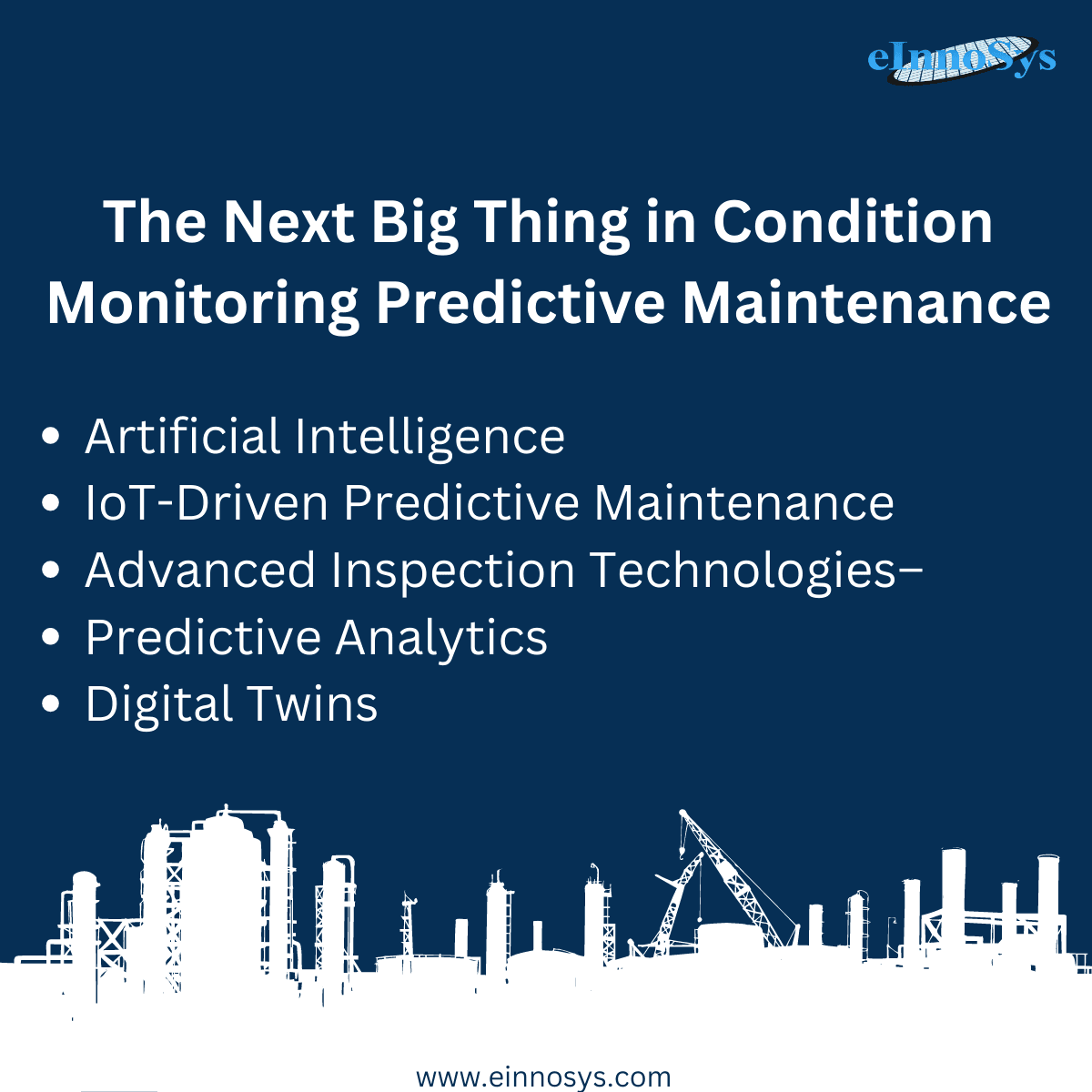
The Next Big Thing in Condition Monitoring Predictive Maintenance

Running a manufacturing unit is challenging due to various external and internal factors. While companies invest in the efficiency of their staff through corporate training, they also need to enhance the efficiency of machines. Therefore, production becomes static at a certain saturation point. Nevertheless, production needs to be improved due to the wear and tear of the machines.

The introduction of predictive maintenance and condition monitoring has changed the scenario drastically, as manufacturing units can now predict the maintenance and repair required for a production unit. According to the reports, the global predictive maintenance market size was 7.3 billion USD in 2022. But, the market size will be around 64.3 billion USD by 2030. So, the huge growth in market size suggests that IoT predictive maintenance and condition monitoring is the next big thing.

Businesses should partner with professional and reliable companies to integrate predictive maintenance and condition monitoring solutions. The experts suggest that predictive maintenance will undergo various changes due to emerging technologies. In the following section, you can find a guide on the upcoming trends in predictive maintenance.

1. Artificial Intelligence

PDM maintenance has started evolving with artificial intelligence. Artificial intelligence (AI), machine learning, and deep learning technologies aim to run specific industrial tasks without human intervention. The AI applications will collect data from different sources and run data analysis simultaneously. As a result, the machine will become self-sufficient to predict its maintenance and repair.

AI-driven predictive maintenance and condition monitoring will be more cost-effective for businesses. Since no humans are involved in data collection and analysis, the process will be cheaper. On the other hand, predictions for maintenance and repair will be more accurate due to machine intelligence.

2. IoT-Driven Predictive Maintenance

One can use IoT predictive maintenance in different ways to establish more efficient predictive maintenance. For example, many businesses have multiple assets, and monitoring the predictive maintenance of those assets is challenging. The job will be much easier when you have a central platform to track and watch the predictive maintenance of all machines.

The Internet of Things (IoT) collects data from different sources and interprets data to create structured analytics. For example, smart sensors collect information such as supply voltage, operating temperature, vibration, etc. IoT-driven applications collect such data and create analytics and insights. Both human operators and machine intelligence can interpret data and make maintenance decisions accordingly.

3. Advanced Inspection Technologies

Condition monitoring maintenance is an integral part of predictive maintenance. Condition monitoring tries to keep machines from breaking down so that a factory can make things without stopping. Introducing advanced inspection technologies can improve the accuracy of preventing machine failure.

Nowadays, predictive maintenance integrates robotic inspection to improve condition monitoring efficiency. Instead of humans, robots inspect and assess the machine’s condition. On the other hand, ultrasonic analysis has also become an advanced inspection technology. The ultrasonic analysis helps identify problems with a machine’s internal parts. The technology can check the condition of even the most fragile parts and give accurate data.

4. Predictive Analytics

The production units are moving from preventative maintenance to predictive maintenance. However, separating preventive maintenance and predictive maintenance often requires more work. Preventative maintenance often becomes a part of predictive maintenance, though preventative maintenance leads to a higher expense for businesses.

PDM solutions are the next big thing in predictive maintenance, as these analytics-driven solutions analyze unstructured data and convert it into structured data. Robust data analytics makes predictive maintenance systems more cost-effective by eliminating preventative maintenance. Therefore, a production unit will only invest in maintenance where it is required. Preventative maintenance proves unnecessary in various scenarios.

5. Digital Twins

The digital twin is one of the trending predictive maintenance technologies. The way we track the changes in industrial equipment could be better with the technology we have now. The digital twin can help businesses overcome such challenges by creating a virtual replica of the physical equipment. As a result, the operators can manage the machines from the virtual platforms. Monitoring the machines from the virtual platforms and scheduling maintenance will save time and hassles.

So, these are the next big things you can expect to see in the predictive maintenance industry 4.0 in the future. Overall, the next-level technologies will be more data-driven to establish automation to eliminate human intervention.
SEMICON CHINA 2023 (June 29-July 1, 2023) – SEMI

SEMICON China connects you to the world’s fastest-growing and most dynamic microelectronics market and gives you the platform to showcase your products, technologies, and brand in front of the most qualified audience of industry professionals in China.

Dates: June 29 – July 1, 2023 (Thursday – Saturday)
Venue: Shanghai New International Expo Centre (SNIEC)
Organizer: SEMI and CECC

SEMI is a global industry association serving companies that provide equipment materials and services used to manufacture semiconductors, displays, nano-scaled structures, micro-electromechanical systems (MEMS), photovoltaic and related technologies. SEMI maintains offices and hosts programs and activities in every major microelectronics and display manufacturing regions around the world.

SEMI exists to advance the growth and prosperity of its members and the industries it serves. SEMI does this by creating and delivering access to markets, customers, investors, suppliers, governments, market information, and the global industry community. Through its programs and activities, SEMI promotes the development of the microelectronics and display industries, advances the mutual business interests of its members, and encourages fair competition and open markets. For more information, please visit www.semi.org.cn

Become an Exhibitor

Dear Exhibitor,

Thank you for your attention and support SEMICON China.

Current booth for SEMICON 2023 were booked. Please email us your requirements of booth size, company info & contact, we will contact you once we have an alternative exhibition space. (semichina@semi.org)

More participate opportunities please visit SEMICON / FPD 2022 MPO plan at http://www.semiconchina.org/en/274

Or New Technology Release Conference http://www.semiconchina.org/en/1264

Advertising and Sponsorship

SEMICON China trade events are unique sales environments that attract the most influential and important buyers in China semiconductor industry. Having a thorough marketing campaign can reinforce your sales message in a dynamic setting where exhibitors compete for attention.

The key to a successful trade show experience is leveraging available tools and techniques to maximize your sales opportunities. Experienced exhibitors take advantage of the many promotional opportunities in event directories, on-site signage, advertising, etc. to set their company apart from the rest.

Latest Marketing opportunities

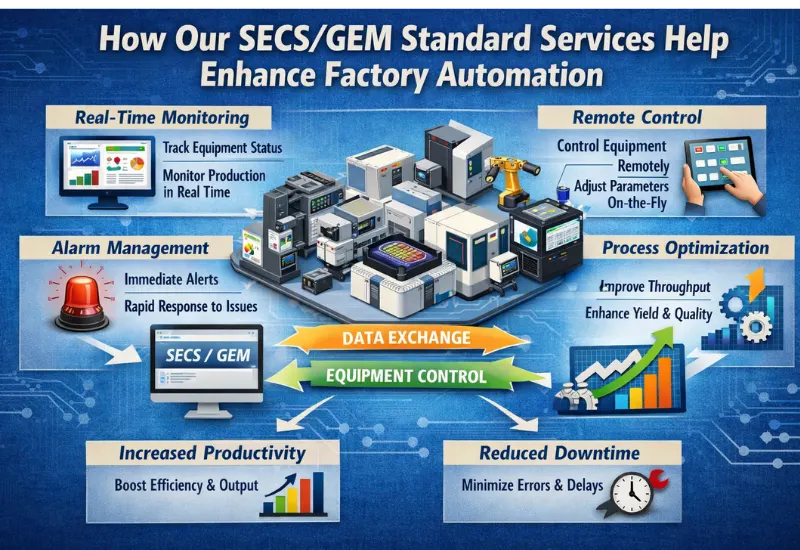
วิธีที่บริการมาตรฐาน SECS/GEM ของเราช่วยยกระดับระบบอัตโนมัติในโรงงาน

[vc_row][vc_column][vc_column_text css=””]

สรุป

Standardization: การนำบริการมาตรฐาน SECS/GEM ไปใช้มอบภาษาสากลสำหรับอุปกรณ์และซอฟต์แวร์โฮสต์
Efficiency: การสื่อสารระหว่างอุปกรณ์กับโฮสต์แบบอัตโนมัติช่วยลดข้อผิดพลาดจากมนุษย์และเพิ่มปริมาณการผลิตเวเฟอร์
Compliance: การรับรองการปฏิบัติตามมาตรฐาน GEM ช่วยให้ OEMs สามารถตอบสนองข้อกำหนดการผลิตระดับโลกและขยายกำลังการผลิตได้รวดเร็วยิ่งขึ้น
Integration: การบูรณาการอุปกรณ์เซมิคอนดักเตอร์อย่างราบรื่นช่วยลดเวลาหยุดทำงานระหว่างการติดตั้งเครื่องมือใหม่
Data-Driven: การสื่อสาร SECS/GEM ที่ได้รับการปรับปรุงช่วยให้สามารถตรวจสอบแบบเรียลไทม์และบำรุงรักษาเชิงคาดการณ์ได้[/vc_column_text][vc_column_text css=””]

บทนำ

ตามข้อมูลของ Statista (2024) ตลาดการผลิตเซมิคอนดักเตอร์ทั่วโลกคาดว่าจะมีมูลค่าประมาณ 912 พันล้านดอลลาร์ภายในปี 2030 การเติบโตมหาศาลนี้สร้างแรงกดดันอย่างมากต่อโรงงานในการเพิ่มประสิทธิภาพทุกวินาทีของเวลาการผลิต เพื่อรักษาความสามารถในการแข่งขัน โรงงานสมัยใหม่พึ่งพาบริการมาตรฐาน SECS/GEM เพื่อเชื่อมช่องว่างระหว่างฮาร์ดแวร์ที่ซับซ้อนกับระบบควบคุมระดับสูง
ระบบอัตโนมัติที่มีประสิทธิภาพเริ่มต้นจากการเชื่อมต่อที่เชื่อถือได้ระหว่างเครื่องมือในสายการผลิตกับระบบ Manufacturing Execution System (MES) หากไม่มีกรอบมาตรฐาน วิศวกรจะติดอยู่ในวงจรของการเขียนโค้ดแบบกำหนดเองสำหรับเครื่องจักรใหม่ทุกเครื่อง การทำให้การเชื่อมต่อเหล่านี้เป็นมาตรฐานช่วยให้ข้อมูลไหลเวียนได้อย่างไร้แรงเสียดทาน เปลี่ยนฮาร์ดแวร์ดิบให้กลายเป็นทรัพย์สินอัจฉริยะที่ตอบสนองได้
การสร้างโรงงานที่เชื่อมต่อถึงกันต้องการมากกว่าฮาร์ดแวร์ แต่ต้องการระบบประสาทดิจิทัลที่แข็งแกร่ง ด้วยการให้ความสำคัญกับความสามารถในการทำงานร่วมกัน ผู้ผลิตสามารถลดงานที่ใช้แรงงานมากซึ่งเกี่ยวข้องกับการรวบรวมข้อมูลด้วยตนเอง การเปลี่ยนผ่านนี้ย้ายจุดสนใจจาก “การแก้ไขการเชื่อมต่อ” ไปสู่ “การเพิ่มประสิทธิภาพกระบวนการ” ซึ่งเป็นจุดที่กำไรที่แท้จริงซ่อนอยู่[/vc_column_text][/vc_column][/vc_row][vc_row][vc_column][vc_column_text css=””]โครงสร้างพื้นฐานที่เงียบงัน: ทำความเข้าใจบริการมาตรฐาน SECS/GEM

อุตสาหกรรมเซมิคอนดักเตอร์เคลื่อนไหวด้วยความเร็วที่ทำให้ทีมพิทสต็อปของ Formula 1 ดูเหมือนกำลังงีบหลับ หัวใจสำคัญของความเร็วนี้คือชุดมาตรฐานของ SEMI (Semiconductor Equipment and Materials International) โปรโตคอลเหล่านี้รับรองว่าเครื่องมือจากผู้ขายรายหนึ่งสามารถสื่อสารกับ MES จากอีกรายหนึ่งได้โดยไม่ต้องใช้ตัวแปลเฉพาะทาง[/vc_column_text][/vc_column][/vc_row][vc_row][vc_column][vc_column_text css=””]

การถอดรหัสโปรโตคอล SECS

โปรโตคอล SECS (Semi Equipment Communication Standard) กำหนดวิธีที่ข้อมูลเคลื่อนที่ผ่านสายสื่อสาร ลองนึกภาพว่ามันคือไวยากรณ์และโครงสร้างประโยคของภาษา มันจัดการโครงสร้างข้อความ เพื่อให้แน่ใจว่าเมื่อโฮสต์ร้องขอการอัปเดตสถานะ อุปกรณ์จะรู้แน่ชัดว่าต้องจัดแพ็กเกจข้อมูลนั้นอย่างไร

เลเยอร์ GEM และการปฏิบัติตามมาตรฐาน

หาก SECS คือไวยากรณ์ Generic Equipment Model (GEM) ก็คือคำศัพท์เฉพาะที่ใช้สำหรับการดำเนินงานในโรงงาน การบรรลุการปฏิบัติตามมาตรฐาน GEM หมายความว่าอุปกรณ์ปฏิบัติตามชุดพฤติกรรมที่คาดการณ์ได้ เช่น การรายงานสัญญาณเตือนหรือการเริ่มทำงานจากระยะไกล หากไม่มีสิ่งนี้ เครื่องมือแต่ละตัวจะทำงานเหมือนวัยรุ่นอารมณ์แปรปรวน อาจทำตามที่คุณขอ แต่ก็อาจทำในแบบของตัวเองและไม่บอกคุณเมื่อมันทำเสร็จ

การแก้ไขวิกฤตการเชื่อมต่อด้วยการสื่อสารระหว่างอุปกรณ์กับโฮสต์

ในยุคแรกของการผลิต ข้อมูลมักถูกจดลงบนคลิปบอร์ด หากวิศวกรต้องการทราบว่าเหตุใดเครื่องมือจึงหยุดทำงาน พวกเขาต้องเดินข้ามคลีนรูมที่มีขนาดใกล้เคียงกับพื้นที่รหัสไปรษณีย์ขนาดเล็ก ระบบการสื่อสารระหว่างอุปกรณ์กับโฮสต์สมัยใหม่ช่วยขจัดอุปสรรคทางกายภาพนี้
ระบบโฮสต์ทำหน้าที่เป็นสมอง ส่งคำสั่งและรวบรวมข้อมูลจากเครื่องมือหลายสิบเครื่องพร้อมกัน การไหลของข้อมูลแบบสองทิศทางนี้ช่วยให้โรงงานสามารถตอบสนองต่อการเปลี่ยนแปลงแบบเรียลไทม์ หากเซ็นเซอร์บ่งชี้ว่าอุณหภูมิสูงผิดปกติ โฮสต์สามารถหยุดแบตช์โดยอัตโนมัติก่อนที่ซิลิคอนมูลค่าหลายพันดอลลาร์จะกลายเป็นที่รองแก้วราคาแพงมาก

การปรับปรุงการบูรณาการอุปกรณ์เซมิคอนดักเตอร์ให้มีประสิทธิภาพ

การรวมเครื่องมือใหม่ เช่น เครื่องลิโทกราฟีหรือเครื่องกัด (etching) เข้าสู่สายการผลิต เคยใช้เวลาหลายสัปดาห์ในการกำหนดค่าที่ปรับแต่งเฉพาะ ปัจจุบัน การใช้ซอฟต์แวร์ระบบอัตโนมัติในโรงงานที่มีไดรเวอร์มาตรฐานติดตั้งล่วงหน้าช่วยลดเวลานั้นลงอย่างมาก เมื่อทั้งโฮสต์และอุปกรณ์ปฏิบัติตามกฎเดียวกัน ความฝันแบบ “plug and play” ก็กลายเป็นความจริง
เหตุใดต้องใช้เวลาหลายเดือนในการดีบักไดรเวอร์ที่พัฒนาขึ้นเอง ในเมื่อมีมาตรฐานที่พร้อมใช้อยู่แล้ว ประสิทธิภาพนี้ช่วยให้ OEMs สามารถส่งมอบเครื่องมือที่ “พร้อมสำหรับแฟบ” ตั้งแต่มาถึง สร้างความได้เปรียบอย่างมหาศาลในตลาดที่มีการแข่งขันสูง[/vc_column_text][/vc_column][/vc_row][vc_row][vc_column][vc_column_text css=””]

ประโยชน์ที่จับต้องได้ของการสื่อสาร SECS/GEM ความเที่ยงตรงสูง

การสื่อสาร SECS/GEM ที่เชื่อถือได้ให้มากกว่าเพียงคำสั่ง “เริ่ม” และ “หยุด” แบบง่าย ๆ แต่ยังเปิดหน้าต่างสู่สุขภาพของเครื่องจักร ด้วยการเก็บข้อมูลความถี่สูง โรงงานสามารถนำการควบคุมกระบวนการขั้นสูง (APC) และการบำรุงรักษาเชิงคาดการณ์มาใช้ได้

  • Reduced MTTR (Mean Time to Repair): มีการรายงานสัญญาณเตือนทันทีพร้อมรหัสข้อผิดพลาดเฉพาะ
  • Improved OEE (Overall Equipment Effectiveness): การติดตามแบบอัตโนมัติช่วยระบุการหยุดชะงักเล็กน้อยที่ผู้ปฏิบัติงานอาจมองข้าม
  • Data Integrity: บันทึกอิเล็กทรอนิกส์ช่วยขจัดปัจจัย “ลืมจดบันทึก” ของการบันทึกด้วยตนเอง

บทบาทของซอฟต์แวร์ระบบอัตโนมัติในโรงงาน

เลเยอร์ซอฟต์แวร์อยู่ระหว่างฮาร์ดแวร์กับโครงสร้างพื้นฐาน IT ของโรงงาน มันแปลบิตข้อมูลดิบของโปรโตคอล SECS ให้เป็นข้อมูลเชิงลึกที่นำไปใช้ได้จริงสำหรับวิศวกร MES การเลือกผู้ให้บริการที่เชี่ยวชาญในบริการเหล่านี้ช่วยให้มั่นใจได้ว่าซอฟต์แวร์สามารถรองรับปริมาณข้อมูลจำนวนมากที่พบได้ทั่วไปในแฟบเวเฟอร์ขนาด 300 มม. สมัยใหม่

การเอาชนะอุปสรรคในการดำเนินการ

การเปลี่ยนผ่านสู่สภาพแวดล้อมอัตโนมัติเต็มรูปแบบเป็นเรื่องง่ายหรือไม่ คำตอบคือแทบจะไม่เลย อุปกรณ์รุ่นเก่ามักขาดฮาร์ดแวร์ที่จำเป็นเพื่อรองรับมาตรฐานสมัยใหม่ การอัปเกรดระบบเหล่านี้ต้องอาศัยความละเอียดอ่อนและความเข้าใจอย่างลึกซึ้งในตรรกะดั้งเดิม

หลายโรงงานประสบปัญหา “โค้ดมนต์ดำ”—สคริปต์ที่เขียนขึ้นโดยวิศวกรที่เกษียณไปในปี 1998 และไม่ทิ้งเอกสารใดไว้ การแทนที่คอขวดเหล่านี้ด้วยบริการมาตรฐาน SECS/GEM ที่เป็นมาตรฐานคือหนทางเดียวที่จะรับประกันเสถียรภาพระยะยาว มันเปลี่ยนการตั้งค่าที่เปราะบางและปรับแต่งเฉพาะให้กลายเป็นสถาปัตยกรรมที่ขยายขนาดได้และได้รับการสนับสนุน

การรักษาความปลอดภัยในแฟบที่เชื่อมต่อถึงกัน

เมื่อเครื่องมือเชื่อมต่อกันมากขึ้น พื้นที่เสี่ยงต่อการโจมตีก็เพิ่มขึ้น ซอฟต์แวร์ระบบอัตโนมัติที่แข็งแกร่งต้องมีคุณสมบัติด้านความปลอดภัยที่ป้องกันการเข้าถึงช่องทางการสื่อสารโฮสต์ของอุปกรณ์โดยไม่ได้รับอนุญาต ในยุคที่ทรัพย์สินทางปัญญาเป็นสกุลเงินที่มีค่าที่สุด การปกป้องไฟล์สูตรการผลิตบนเครื่องมือของคุณจึงมีความสำคัญอย่างยิ่ง

การเตรียมความพร้อมสำหรับอนาคตในยุค Industry 4.0

การก้าวสู่การผลิตแบบ “Lights Out” ขึ้นอยู่กับความพร้อมของสแตกระบบอัตโนมัติในโรงงานทั้งหมด เมื่อเราเข้าใกล้แฟบอัตโนมัติเต็มรูปแบบมากขึ้น ความสำคัญของการปฏิบัติตามมาตรฐาน GEM จะเพิ่มขึ้น ตัวจัดตารางการผลิตที่ขับเคลื่อนด้วย AI ไม่สามารถตัดสินใจได้หากขาดข้อมูลที่เชื่อถือได้จากพื้นที่การผลิต

ตามรายงานของ McKinsey (2023) การเพิ่มประสิทธิภาพการผลิตที่ขับเคลื่อนด้วย AI สามารถเพิ่มผลผลิตได้ถึง 30% สำหรับบริษัทเซมิคอนดักเตอร์ อย่างไรก็ตาม AI นั้นจะมีประสิทธิภาพเท่ากับคุณภาพของข้อมูลที่มันใช้ การสื่อสาร SECS/GEM คุณภาพสูงทำหน้าที่เป็นเชื้อเพลิงสำหรับอัลกอริทึมขั้นสูงเหล่านี้

บทสรุป

ความซับซ้อนของการผลิตชิปสมัยใหม่ไม่เปิดโอกาสให้มีการสื่อสารที่ไม่มีประสิทธิภาพ ด้วยการนำบริการมาตรฐาน SECS/GEM มาใช้ ผู้ผลิตสามารถเปลี่ยนการดำเนินงานจากการเป็นกลุ่มเครื่องจักรที่แยกจากกัน ให้กลายเป็นระบบนิเวศที่ชาญฉลาดและทำงานร่วมกันอย่างสอดประสาน การเปลี่ยนแปลงนี้ช่วยเพิ่มปริมาณการผลิตและสร้างรากฐานข้อมูลที่จำเป็นสำหรับนวัตกรรมเซมิคอนดักเตอร์ยุคถัดไป การลงทุนในบริการมาตรฐาน SECS/GEM ที่เป็นมาตรฐานคือวิธีที่มีประสิทธิภาพที่สุดในการรับรองว่าโรงงานของคุณยังคงทำกำไรได้ในโลกที่มีระบบอัตโนมัติเพิ่มขึ้นอย่างต่อเนื่อง[/vc_column_text][/vc_column][/vc_row]

Contact Us Today

รับคำแนะนำแบบทีละขั้นตอนเพื่อใช้งาน SECS/GEM ในโรงงานของคุณ

SECS/GEM Standaarddiensten voor Efficiënte Fabrieksautomatisering

Summary

Standardization benefits: Het implementeren van SECS/GEM verkort de integratietijd van apparatuur met wel 40% en waarborgt tegelijkertijd leveranciersneutrale communicatie.

Data Accuracy: Real-time dataverzameling elimineert fouten door handmatige logging en biedt één “single source of truth” voor MES- en ERP-systemen.

Compliance: Het bereiken van volledige GEM-compliance is verplicht voor moderne semiconductor-OEM’s om concurrerend te blijven op wereldwijde markten.

Efficiency Gains: Geautomatiseerd receptbeheer en mogelijkheden voor afstandsbediening verhogen de Overall Equipment Effectiveness (OEE) aanzienlijk.

Scalability: Deskundige integratiediensten stellen fabs in staat om hun activiteiten op te schalen zonder maatwerkcode voor elk nieuw hulpmiddel dat aan de productievloer wordt toegevoegd.

Introduction

Volgens Statista (2024) zal de wereldwijde markt voor semiconductorproductieapparatuur dit jaar naar verwachting een duizelingwekkende $122,8 miljard bereiken. Naarmate fabs uitbreiden om te voldoen aan de honger naar AI-chips en autosensoren, is de druk om maximale uptime te handhaven onverbiddelijk. Deze groei vereist naadloze communicatie tussen complexe machines en de hostsystemen die ze beheren. SECS/GEM-standaarddiensten bieden het essentiële raamwerk dat dit hightech gesprek zonder haperingen mogelijk maakt.

Handmatige gegevensinvoer en gefragmenteerde communicatieprotocollen zijn de vijanden van een moderne fab. Wanneer tools verschillende talen spreken, wordt de productievloer een chaotische toren van Babel. Door gestandaardiseerde protocollen te adopteren, kunnen fabrikanten de kloof tussen hardware en software overbruggen. Deze diensten zorgen ervoor dat elk stuk apparatuur, ongeacht de fabrikant, zich houdt aan één uniforme communicatielogica.

Efficiëntie in een semiconductoromgeving is afhankelijk van snelheid en precisie. Elke seconde stilstand vertaalt zich in duizenden dollars aan verloren inkomsten. Einnosys biedt gespecialiseerde SECS/GEM-standaarddiensten om apparatuurproducenten en fabs te helpen hun datapijplijnen te stroomlijnen en hun meest kritieke workflows te automatiseren.

The Foundation of Modern Factory Automation Services

De SEMI Equipment Communications Standard/Generic Equipment Model (SECS/GEM) vormt de ruggengraat van slimme productie. Het definieert hoe apparatuur communiceert met het Manufacturing Execution System (MES). Zonder deze standaarden blijft een fabriek een verzameling geïsoleerde machines in plaats van een samenhangend, intelligent organisme.

Why Standardization Trumps Custom Scripts

In de beginjaren van automatisering schreven ingenieurs vaak maatwerkdrivers voor elk nieuw hulpmiddel. Deze aanpak is fragiel en kostbaar om te onderhouden. Gestandaardiseerde communicatie zorgt ervoor dat, zodra een hostsysteem is geconfigureerd, het kan communiceren met elk GEM-compatibel hulpmiddel. Deze plug-and-play-mogelijkheid maakt moderne fabrieksautomatiseringsdiensten zo effectief.

The Role of SEMI Standards (E5, E30, E37)

Om de efficiëntiewinsten te begrijpen, moet men kijken naar de specifieke betrokken standaarden.

  • SEMI E5 (SECS-II): Definieert de berichtstructuur en -inhoud.
  • SEMI E30 (GEM): Definieert welke SECS-II-berichten in specifieke situaties moeten worden gebruikt.
  • SEMI E37 (HSMS): Biedt het hogesnelheidstransportprotocol over Ethernet.

Enhancing OEE Through SECS GEM Integration Services

Overall Equipment Effectiveness (OEE) is de gouden standaard voor het meten van fabproductiviteit. Een hoge OEE vereist hoge beschikbaarheid, prestaties en kwaliteit. Onze SECS GEM-integratiediensten hebben rechtstreeks invloed op deze metrics door dataverzameling en toolbesturing te automatiseren.

Wanneer een operator handmatig een receptnaam moet invoeren, is het risico op een typefout groot. Eén verkeerd teken kan leiden tot een afgekeurde batch wafers ter waarde van een klein fortuin. Geautomatiseerd receptbeheer via GEM-protocollen zorgt ervoor dat het MES de juiste parameters rechtstreeks naar de tool stuurt.

Real-Time Monitoring and Error Detection

Wachten tot een technicus opmerkt dat een tool is gestopt, is een luxe die geen enkele fab zich kan veroorloven. SECS/GEM maakt onmiddellijke alarmering mogelijk. Op het moment dat een sensor een afwijking detecteert, ontvangt het MES een melding. Deze directe feedbacklus maakt “lights-out”-productie mogelijk, waarbij het systeem sneller op problemen reageert dan een mens ooit zou kunnen.

Data Collection for Predictive Maintenance

Geavanceerde semiconductorsoftwarediensten gebruiken de datastromen die door GEM worden geleverd om te voorspellen wanneer een onderdeel mogelijk zal falen. Door variabelen zoals vacuümdruk of motortemperatuur in de tijd te volgen, kunnen fabs onderhoud plannen voordat een storing optreedt. Deze verschuiving van reactief naar proactief onderhoud bespaart miljoenen aan ongeplande stilstand.

Navigating the Path to GEM Compliance

Voor Original Equipment Manufacturers (OEM’s) is het leveren van een tool zonder GEM-compliance een breekpunt. De meeste Tier-1-fabs weigeren zelfs apparatuur te bekijken die niet kan integreren met hun bestaande automatiseringshost. Het vanaf nul opbouwen van deze mogelijkheden is echter een ontmoedigende taak voor een hardwaregerichte organisatie.

Simplifying the OEM Journey

Wil uw engineeringteam echt zes maanden besteden aan het lezen van SEMI-handleidingen, of richten ze zich liever op het perfectioneren van het fysieke proces van de tool? De meesten kiezen voor het laatste. Onze diensten bieden een “black box”-oplossing waarbij we uw bestaande hardware en software omhullen met een GEM-compatibele laag. Hierdoor kan uw tool met minimale wijzigingen aan uw kernlogica deelnemen aan het fabnetwerk.

Testing and Validation

Compliance is meer dan een vinkje; het vereist rigoureus testen. Wij gebruiken geavanceerde simulatietools om te garanderen dat uw apparatuur correct reageert op hostcommando’s. Dit verificatieproces voorkomt gênante en kostbare integratieproblemen tijdens de eerste installatie van de tool bij een klant.

The Impact of Equipment Communication Services on Labor Costs

Arbeid blijft een van de hoogste kostenposten in chipproductie. Automatisering helpt het aantal medewerkers dat nodig is om apparatuur te monitoren te verminderen, maar alleen als die apparatuur eenvoudig te beheren is. Uitgebreide apparatuurcommunicatiediensten maken monitoring op afstand mogelijk, waardoor één engineer tientallen tools vanuit een centrale controlekamer kan overzien.

Reducing Human Intervention

Elke keer dat een mens een cleanroom betreedt, brengt hij deeltjes met zich mee. Het verminderen van de noodzaak voor fysieke interactie met de tool verbetert de yield. GEM-ondersteunde afstandsbediening maakt het starten, stoppen en pauzeren van batches mogelijk via de MES-interface. Dit houdt de cleanroom schoner en het personeel veiliger.

Streamlined Training and Onboarding

Wanneer communicatie gestandaardiseerd is, wordt de interface voor verschillende tools consistenter. Operators en softwareteams besteden minder tijd aan het leren van de eigenaardigheden van propriëtaire software van een specifieke leverancier. Deze consistentie versnelt de “time-to-productivity” voor nieuw fabpersoneel.

Future-Proofing with Advanced Semiconductor Software Services

De industrie beweegt momenteel richting GEM300-standaarden, die nog robuuster zijn. Deze standaarden, zoals E40 (Process Management) en E94 (Control Job Management), bieden nog fijnmazigere controle over het productieproces.

Is Your Fab Ready for Industry 4.0?

De overgang naar “Smart Manufacturing” of Industry 4.0 is onmogelijk zonder een solide datafundament. SECS/GEM biedt dat fundament. Als uw data vastzit in een propriëtaire silo, kunt u geen AI of machine learning gebruiken om uw yields te optimaliseren.

Scalability and Flexibility

Een belangrijk voordeel van onze SECS/GEM-standaarddiensten is de mogelijkheid om op te schalen. Of u nu een klein R&D-lab runt of een enorme 300 mm-volume fab, het protocol blijft hetzelfde. U kunt nieuwe apparatuurtypen toevoegen of uw MES upgraden zonder u zorgen te maken dat de onderliggende communicatielaag faalt.

Conclusion

Efficiëntie in de moderne fab is geen luxe; het is een vereiste om te overleven. Naarmate de industrie richting de biljoen-dollargrens groeit, zullen de bedrijven die floreren degenen zijn die standaardisatie omarmen. Door SECS/GEM-standaarddiensten te gebruiken, zorgt u ervoor dat uw fabriek wendbaar blijft, uw data nauwkeurig blijft en uw apparatuur op topprestaties blijft draaien.
Met jarenlange ervaring in de semiconductorloopgraven weet Einnosys dat “goed genoeg” niet overleeft in high-pressure fabs. Waarom worstelen we met protocol-time-outs wanneer onze specialisten alles afhandelen, van initiële consultancy tot site acceptance testing? Wij zorgen ervoor dat uw apparatuur slim en communicatief is en vereenvoudigen zo het pad door de toenemende complexiteit van de industrie. Door robuuste SECS/GEM-standaarddiensten te leveren, helpen wij u technische hoofdpijn te omzeilen en uw productievloer om te vormen tot een echt efficiënte, datagedreven krachtpatser.

Contact Us Today

Krijg stapsgewijze hulp bij het implementeren van SECS/GEM-standaarden in uw fabriek

5 Core Benefits of Predictive Maintenance for Smart Manufacturing

Summary

  • Drastic Downtime Reduction: Implementing predictive maintenance can decrease unplanned machine failures by up to 70% (Deloitte, 2022).
  • Financial Optimization: Manufacturers see an average ROI of 10x through reduced repair costs and better spare parts management.
  • Asset Longevity: Real-time monitoring extends the useful life of heavy machinery by preventing “run-to-failure” cycles.
  • Safety & Compliance: Automated alerts prevent catastrophic failures, ensuring a safer work environment and easier regulatory adherence.
  • Operational Excellence: Data-driven insights streamline labor allocation, allowing technicians to focus on high-value tasks rather than routine checks.

Introduction

According to a study by Deloitte (2022), predictive maintenance can reduce maintenance costs by 25%, reduce breakdowns by 70%, and lower equipment downtime by 50%. These figures represent a massive shift in how factory floors function. For decades, maintenance crews operated on a “fix it when it breaks” or a “fix it every six months regardless of health” schedule, neither of which suits the demands of a high-speed production line.

Modern manufacturing thrives on precision. A single bearing failure in a conveyor system can halt an entire facility, leading to thousands of dollars in lost revenue every minute. By using manufacturing predictive maintenance, leaders move away from guesswork. This approach uses sensors and data analytics to determine exactly when a machine requires attention before a problem actually occurs.

The transition toward smart maintenance systems is no longer a luxury for the few. As global competition intensifies, the ability to maintain continuous uptime becomes a primary differentiator. This article explores the specific ways that a data-centric industrial maintenance strategy reshapes the bottom line and improves factory culture.

The Financial Impact of Predictive Maintenance Benefits

The most immediate reason organizations adopt a new industrial maintenance strategy is the impact on the profit and loss statement. Traditional methods often waste money on parts that still have life or, conversely, lose money when an unexpected crash occurs.

Reducing Unplanned Downtime Costs

Unplanned downtime is the “silent killer” of manufacturing profitability. When a machine stops without warning, the costs ripple through the organization: idle labor, missed delivery deadlines, and rush shipping fees for replacement parts. According to Forbes (2022), industrial manufacturers lose an estimated $50 billion annually to downtime. Predictive maintenance mitigates this by providing an early warning system.

Optimizing Spare Parts Inventory

Many facilities keep a “just in case” warehouse full of expensive components. This ties up capital that could be used elsewhere. By understanding the health of assets through condition-based maintenance, managers order parts exactly when needed. This shift toward a “just-in-time” parts model reduces warehouse overhead and minimizes the risk of components becoming obsolete while sitting on a shelf.

Labor Efficiency and Allocation

Instead of sending a technician to check 50 machines that are running perfectly, sensors identify the three that actually require a look. This ensures that the maintenance team is always working on the most critical tasks. It also reduces the need for overtime pay during emergency “all hands on deck” repair scenarios.

Extending Asset Life with Condition-Based Maintenance

Machines are expensive. Whether it is a CNC mill or a robotic arm, these assets represent a significant capital investment. Treating them well is common sense, yet the “run-to-failure” mentality persists in many legacy shops.

Preventing Secondary Damage

When one small component fails, it often triggers a chain reaction. A worn belt might cause a motor to overheat, which then fries the control board. By using predictive maintenance benefits to catch the belt wear early, you save the motor and the electronics. This proactive approach ensures that the “health” of the machine remains high throughout its lifecycle.

Consistent Performance and Quality

Degrading machines rarely produce high-quality parts. A lathe with a slightly vibrating spindle will produce components with poor surface finishes or out-of-spec dimensions. Monitoring the condition of the tool ensures that every piece coming off the line meets quality standards. This reduces the “scrap rate,” which is another hidden cost of poor maintenance.

Enhancing Workplace Safety and Compliance

Safety is paramount in any industrial setting. A sudden mechanical failure is not a mere inconvenience; it is a hazard. According to the Bureau of Labor Statistics (2023), mechanical failures are a contributing factor in thousands of industrial accidents annually.

Mitigating Catastrophic Failures

High-speed rotating equipment or pressurized systems can be dangerous if they fail suddenly. Smart maintenance systems monitor for the precursors of these events, such as abnormal heat or excessive vibration. By shutting down or repairing a machine before a catastrophic failure, companies protect their most valuable asset: their people.

Simplified Regulatory Audits

In regulated industries like aerospace or pharmaceuticals, documentation is everything. Having a digital log of all maintenance activities and sensor data makes compliance audits a breeze. Instead of digging through greasy paper logs, managers present a clean, data-backed report showing that every machine was maintained according to safety standards.

Boosting Total Throughput and Productivity

A factory that never stops is a factory that makes money. The primary goal of an industrial maintenance strategy is to keep the “green lights” on across the floor.

Eliminating the “Maintenance Window” Bottleneck

Traditional preventive maintenance often requires scheduled shutdowns. While these are better than unplanned crashes, they still stop production. Predictive models allow for “opportunistic maintenance.” If a line is down for a product changeover, the system can signal that now is the perfect time to fix a nearing-end-of-life component on a nearby machine.

Energy Efficiency Gains

Worn-out machinery is notoriously inefficient. A motor with bad bearings or a compressor with a small leak consumes significantly more power to do the same amount of work. According to a report by the U.S. Department of Energy (2022), well-maintained industrial equipment can be 15% to 20% more energy-efficient. Lower energy bills are a direct, albeit sometimes overlooked, benefit of staying on top of machine health.

Building a Data-Driven Culture in the Factory

The shift to manufacturing predictive maintenance changes the mindset of the entire organization. It moves the culture from “reactive and stressed” to “proactive and informed.”

Improved Inter-Departmental Communication

When maintenance has data, they can speak the language of the finance and operations departments. Instead of saying, “I think we need to fix this,” they can say, “The data shows an 85% chance of failure within the next 48 hours.” This clarity helps leadership make better decisions regarding production schedules and budget allocations.

Upskilling the Workforce

Adopting smart maintenance systems provides an opportunity for technicians to learn new skills. Moving from turning wrenches to analyzing data dashboards makes the workforce more versatile and valuable. This upskilling is a core component of the Industry 4.0 movement and helps with employee retention in a competitive labor market.

How to Begin Your Predictive Maintenance Journey

Many managers feel overwhelmed by the idea of “going digital.” However, you do not have to automate every single bolt in the building on day one.

  • Step 1: Identify Critical Assets. Start with the “bottleneck” machines—the ones that would cause the most pain if they stopped.
  • Step 2: Choose the Right Sensors. Vibration, temperature, and acoustic sensors are the most common starting points.
  • Step 3: Pilot a Smart Maintenance System. Use a small-scale implementation to prove the ROI before scaling across the entire plant.
  • Step 4: Integrate with Existing Systems. Ensure your maintenance data flows into your ERP or CMMS for a unified view of the facility.

Is it possible to skip these steps? Of course, but doing so is a bit like trying to bake a cake without a recipe. You might end up with something edible, but the kitchen will probably be a mess.

Conclusion

The move toward predictive maintenance represents the natural evolution of the modern factory. By focusing on data rather than dates, manufacturers can protect their equipment, their budgets, and their employees. While the initial setup requires an investment in technology and training, the long-term gains in uptime and efficiency are undeniable. Transitioning to a smarter industrial maintenance strategy is the most effective way to ensure your facility remains competitive in an increasingly automated world.

Contact Us Today

Get Expert Guidance to Reduce Downtime with Smart Maintenance Solutions

한국 최고의 공장 자동화용 SECS/GEM 소프트웨어

SECS/GEM 공장 자동화 소프트웨어

eInnoSys는 장비-호스트 데이터 통신을 위한 반도체 공장 자동화 시스템을 전문으로 하는 독일 최고의 SECS/GEM 회사입니다.

SECS/GEM이란 무엇입니까?

SECS(SEMI 장비 통신 표준)/GEM(일반 장비 모델)은 반도체 장치와 팹 호스트 간의 통신을 위한 통신 인터페이스 프로토콜입니다. Fab-Host는 SECS/GEM 프로토콜을 사용하여 장치 처리를 제어하고 모니터링하는 소프트웨어 응용 프로그램입니다. SECS/GEM 호환 장치는 TCP/IP(SEMI 표준 E37 및 E37.1 – HSMS 사용) 또는 RS-232(SEMI 표준 E4 – SECS-I 사용)를 통해 팹 호스트와 통신할 수 있습니다.

SECS/GEM 표준 인터페이스는 장치 처리를 시작 및 중지하고, 측정 데이터를 수집하고, 제품에 대한 레시피를 선택하고, 변수를 변경하는 데 사용됩니다. SECS/GEM을 사용하면 이 모든 것을 즉시 수행할 수 있습니다. SECS/GEM 프로토콜은 비영리 협회 SEMI(반도체 장비 및 재료 국제)에서 표준화했습니다. SEMI 표준 및 SECS/GEM 프로토콜에 대해 자세히 알아보려면 www.SEMI.org를 방문하십시오.

SECS/GEM은 어떻게 작동합니까?

SECS GEM 프로토콜은 장치 처리 시작/중지, 측정 데이터 수집, 변수 변경 및 제품 레시피 선택과 같은 원격 명령을 보내는 데 사용됩니다.

SECS/GEM 인터페이스는 반도체 제조(프론트 엔드 및 백엔드), 표면 실장 기술(SMT), 전자 조립, 태양광, 평면 패널 디스플레이(FPD) 및 기타 관련 산업의 전 세계 대부분의 장치에 사용됩니다. 이를 통해 효과적인 모니터링 및 제어를 위해 공장 호스트 소프트웨어와 장비 간의 통신이 가능합니다.

eInnoSys SECS/GEM을 선택하는 이유는 무엇입니까?

eInnoSys는 반도체 및 PV(Solar), MEMS, FPD(Flat Panel Display), LED 및 기타 전자 산업과 같은 기타 관련 산업의 순수 자동화 회사입니다. 우리는 장비 제조업체(OEM) 및 공장 – 공장, ATM(조립 테스트 제조)을 공급합니다. eInnoSys는 자동화 제품과 OEM 및 공장을 위한 맞춤형 자동화 솔루션을 제공하는 고객 중심의 솔루션 지향 기업입니다.

60년 이상의 팀 경험을 통해 우리는 전 세계 공장 또는 ATM에서 연중무휴 안정적으로 실행되는 수백 가지 자동화 애플리케이션을 개발했습니다. 우리가 성공적으로 구현한 대부분의 자동화 프로젝트는 혁신적이고 틀에 얽매이지 않는 사고와 수십 년의 경험의 결과입니다. 우리 팀원들은 전문 저널에 여러 기사를 게재했으며 혁신적인 자동화에 관한 컨퍼런스에서 발표했습니다.

우리는 우리 자신을 고객 요구 사항에 따라 시스템을 구축하는 소프트웨어 또는 자동화 솔루션 공급자가 아니라 고객을 위한 기술 파트너로 봅니다. 우수한 자동화 소프트웨어 외에도 다년간의 경험을 바탕으로 고객에게 귀중한 통찰력을 제공하고 서비스를 통해 최고의 고객 가치를 창출할 수 있도록 합니다.

포함된 서비스

  • 무료 제품 조언
  • 이메일 및 전화 지원
  • 설치 및 문제 해결
  • 엔드 투 엔드 프로젝트 제공
SECS/GEM 제품 찾아보기

EIGEMBox

EIGEMBox는 하드웨어나 소프트웨어 설치 없이 기존 장비에 SECS/GEM 기능을 추가하는 고유한 제품입니다!

EIGEMHost

EIGEMHost는 호스트에서 자동화 기능을 활성화하기 위해 FAB 또는 ATM(조립, 테스트 또는 패키징 제조 시설)의 모든 호스트 애플리케이션에 통합될 수 있는 SEMI 표준 호환 플러그 앤 플레이 SECS/GEM 소프트웨어입니다.

EIGEMSim

EIGEMSim은 장치 소프트웨어의 SECS/GEM 준수를 테스트하는 데 사용되는 SECS/GEM 시뮬레이터 소프트웨어입니다. 테스트에 사용되는 대부분의 SECS 메시지가 사전 번들로 제공되는 팩토리 호스트를 시뮬레이션합니다.

EIGEMEquipment

EIGEMEquipment는 플러그 앤 플레이 SEMI 표준 호환 SECS/GEM 소프트웨어로 웨이퍼 처리, 계측, 조립, 패키징 및 테스트 장비와 같은 반도체 장비에 신속하게 통합할 수 있어 소프트웨어 개발 및 비용을 수개월 절약할 수 있습니다.

EIGEM300Equipment

EIGEM300Equipment는 플러그 앤 플레이 SEMI 표준 호환 SECS/GEM 소프트웨어로 웨이퍼 처리, 계측, 조립, 패키징 및 테스트 장비와 같은 반도체 장비에 신속하게 통합할 수 있어 소프트웨어 개발 및 비용을 수개월 절약할 수 있습니다.

Contact Us Today

최고의 SECS/GEM 소프트웨어 선택을 위한 단계별 지원 받기

SECS/GEM Communication Protocol Study Notes

Summary

  • SECS/GEM is the common language that lets fab equipment and the MES actually understand each other, built on well-defined SEMI standards.
  • It handles the essentials: remote control, alarms, recipes, and clean data exchange so operators don’t have to guess what a machine is doing.
  • HSMS brings fast, modern TCP/IP communication, while SECS-I still supports older tools that refuse to retire.
  • GEM’s state models and event-driven logic keep equipment behavior predictable and automation stable.
  • All that data feeds Industry 4.0 analytics, but real value comes only when integration is done right.

Introduction

According to Gartner (2023), the implementation of advanced factory automation communication protocols can reduce operational costs by up to 15% in high-volume manufacturing environments. That saving doesn’t happen by magic. It comes from a shared language that lets very different machines talk to a single brain. The SECS/GEM communication protocol is the language that shapes almost every action on the fab floor.

Without a robust standard, equipment integration quickly becomes a tower of Babel. Engineers would end up writing custom drivers for every new tool. Months wasted. Competitors move faster. By adopting the SEMI standards, fabs make sure a wafer sorter from one vendor can coexist with a metrology tool from another. Seamlessly.

The following study notes dig into the layers, behaviors, and benefits of this critical technology. Whether you’re a seasoned automation engineer or a developer building a first MES interface, these concepts are must-know. Master them, and you’re set up for success in modern semiconductor manufacturing.

The Building Blocks of SECS/GEM Basics

To get SECS/GEM basics, start with the acronyms. SECS stands for Semiconductor Equipment Communication Standard, and GEM is the Generic Equipment Model. Together, they define both equipment behavior and the data format used when information is exchanged.

The SEMI (Semiconductor Equipment and Materials International) organization maintains these standards to guarantee global interoperability. Before these rules existed, factory IT teams battled proprietary interfaces that made data collection a nightmare. Today, the protocol is the backbone of “Lights Out” manufacturing, human intervention minimized, operations humming.

The Hierarchy of Standards

The protocol suite is not a single document. It’s a stack of specialized standards, each handling different layers from the physical wiring up to the machine’s logical state.

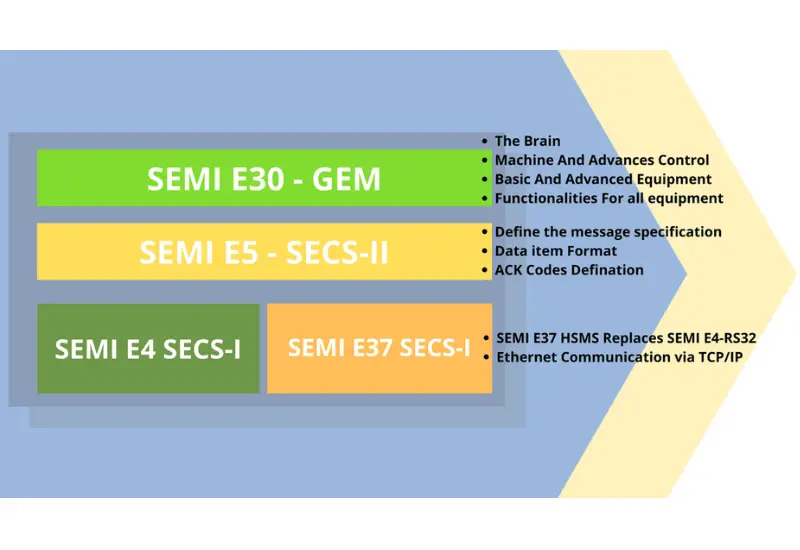
  • SEMI E4 (SECS-I): The veteran of the group, defining serial communication (RS-232). While less common in new facilities, it still haunts legacy tools in older fabs.
  • SEMI E37 (HSMS): The modern successor to SECS-I. High-Speed SECS Message Services (HSMS) uses TCP/IP, allowing machines to connect via standard Ethernet cables at lightning speeds.
  • SEMI E5 (SECS-II): This defines the actual content of the messages. It explains how to wrap data into “streams” and “functions,” so both sides understand if they are discussing a temperature reading or a hardware failure.
  • SEMI E30 (GEM): The “behavior” layer. It dictates how a machine should respond to certain commands and how it should report its status to the host.

Why GEM is the Gold Standard

If SECS-II gives you the vocabulary, GEM gives you the grammar and etiquette. A machine may be able to send messages (SECS-II), but without GEM, the host won’t know when to expect them. GEM defines specific “state machines” that govern equipment behavior, for example, whether a tool is in “Local” or “Remote” mode. It’s the social contract between host and tool. Simple. Powerful.

Deep Dive into the Architecture of the SECS/GEM Communication Protocol

The SECS/GEM communication protocol runs on a host-equipment relationship, master-slave in traditional terms. Usually, the factory MES plays the host, and the production tool plays the equipment. They trade requests and acknowledgments in a continuous dialogue.

Does a machine truly exist if the MES can’t see its status? In automated fabs, the answer is no. Visibility is the currency of efficiency. The architecture of this protocol is built to maximize that visibility through structured messaging.

The Role of HSMS (SEMI E37)

In modern facilities, HSMS is the preferred transport layer. It replaces the clunky serial cables of the 1980s with high-speed network infrastructure. HSMS handles connection state so that if a network glitch happens, the equipment and host can re-establish their “handshake” without losing critical data. Resilient. Fast.

Understanding SECS-II Streams and Functions

SECS-II messages are organized into Streams (S) and Functions (F). Think of a Stream as a category of conversation and a Function as a specific sentence within that category.

  • Stream 1 (Equipment Status): Used to ask if the machine is alive and what it is doing.
  • Stream 2 (Equipment Control): Used by the host to tell the machine to start, stop, or change a setting.
  • Stream 6 (Data Collection): This is where the heavy lifting happens, as the machine sends chunks of production data back to the host.
  • Stream 10 (Terminal Messages): Simple text messages that can appear on the operator’s screen.

Formatting Data Items

Inside these messages, data is packed into precise formats — integers, ASCII strings, lists. That strict formatting ensures a “300” sent by a furnace is read as a numerical temperature, while a “300” sent by a wafer handler is read as a diameter in millimeters. Context matters. Always.

Critical Behaviors Defined by the GEM Standard

The real beauty of the semiconductor communication protocol is predictability. GEM forces every piece of equipment, regardless of function, to follow mandatory behaviors. That consistency lets developers write one set of code to manage hundreds of different machines.

Trying to run a modern fab without a standard protocol is like conducting a symphony where half the musicians play jazz and the other half tune banjos. GEM brings everyone into the same key and tempo.

State Models and Control

A key part of GEM is the Control State Model. It decides who has the authority to move a robot arm or start a process.

Offline: The equipment is disconnected from the host.
Online/Local: An operator at the tool can make changes, but the host can solely watch.
Online/Remote: The host has full control. This is the goal for true factory automation communication.

Collection Events and Variables

Rather than the host constantly polling the machine with “Are you done yet?”, the machine uses Collection Events (CEIDs). When a specific action occurs, say a door closes or a process completes, the machine “publishes” an event. The host subscribes to events it cares about. Result: massive bandwidth savings and cleaner systems.

Enhancing Efficiency through SECS/GEM Tutorial Concepts

If you follow a basic SECS/GEM tutorial, the first lesson is usually Alarms and Limits. In a high-stakes environment where a single ruined wafer costs thousands, knowing the instant a tool deviates is crucial.

Alarm Management

GEM requires equipment to report alarms in a prescribed way. The host must be notified when an alarm is set (triggered) and when it is cleared. That enables real-time dashboards showing which machines are down and why, and it reduces Mean Time to Repair (MTTR). Quick triage. Faster fixes.

Recipe Management

A “recipe” is the set of instructions that tells the tool how to process material. SECS/GEM lets the host upload new recipes or select existing ones. That removes the risk of an operator picking the wrong program and melting a batch of expensive silicon. Big money saved. Small mistakes avoided.

Data Logging for Machine Learning

As Industry 4.0 advances, SECS/GEM-collected data becomes raw material for AI. By analyzing thousands of hours of sensor data sent via Stream 6, engineers can predict when a motor will fail — before it actually does. Predictive. Proactive.

Challenges in Implementation and Integration

Despite well-defined standards, integration rarely goes perfectly. Vendors might implement “optional” GEM features in different ways, causing friction during commissioning. Expect surprises. Plan for them.

Compliance Testing

Before a new tool hits the fab floor, it usually faces rigorous compliance testing. Tools must prove they can handle hundreds of messages per second without crashing. Companies use specialized software simulators to mimic a host and stress-test the equipment’s SECS/GEM interface.

Bridging Legacy and Modern Systems

Many fabs run a mix of HSMS-capable tools and ancient serial-based machines. Integration engineers often use “SECS Gateways” or an “EAP (Equipment Automation Program)” layer to translate these dialects into a single data stream for the MES.

According to a report by McKinsey (2024), “Digital leaders in manufacturing are those who successfully integrate legacy data silos into a unified communication framework.” That line underscores the point: the real value is in the data, and SECS/GEM is the pipe that delivers it.

Conclusion

SECS/GEM isn’t a collection of dusty manuals. It’s the living infrastructure that makes modern electronics manufacturing possible. By standardizing how equipment shares data and accepts commands, it lets factories scale, adapt, and innovate at speeds that once seemed impossible.

The standards will keep evolving as the industry gets smarter. Still, the core principles — structured messaging and predictable behavior — will remain the foundation of any successful factory automation strategy. Want your production line optimized or your new equipment “fab-ready”? A solid GEM implementation is the most effective first step.

Contact Us Today

Get Step-by-Step Help to Master SECS/GEM Communication Protocols

台灣最佳 secs/gem 軟件解決方案

[vc_row][vc_column][vc_column_text]SECS(SEMI 设备通信标准)/GEM(通用设备模型)是用于半导体设备和晶圆厂主机之间通信的通信接口协议。

SECS(SEMI 设备通信标准)/GEM(通用设备模型)是用于半导体设备和晶圆厂主机之间通信的通信接口协议。 Fab 主机是一个使用 SECS/GEM 协议控制和监控设备处理的软件应用程序。符合 SECS/GEM 的设备可以使用 TCP/IP(使用 SEMI 标准 E37 和 E37.1 – HSMS)或 RS-232(使用 SEMI 标准 E4 – SECS-I)与晶圆厂主机通信。[/vc_column_text][/vc_column][/vc_row][vc_row][vc_column width=”1/2″][vc_single_image image=”28577″ img_size=”large”][/vc_column][vc_column width=”1/2″][vc_column_text]SECS/GEM 标准接口用于启动和停止设备处理、收集测量数据、选择产品配方和更改变量。使用 SECS/GEM,所有这些都可以以标准方式执行。 SECS/GEM 协议已由非营利协会 SEMI(国际半导体设备和材料)标准化。查看 www.SEMI.org 了解更多关于 SEMI 标准和 SECS/GEM 协议的信息。[/vc_column_text][/vc_column][/vc_row][vc_row][vc_column width=”1/2″][vc_column_text]简而言之,SECS/GEM 标准定义了消息、状态机和场景,以使工厂主机应用程序能够控制和监控制造设备。 GEM 标准正式指定为 SEMI 标准 E30,但通常称为 GEM 或 SECS/GEM 标准。 GEM 对设备制造商和设备供应商都有好处,因为它定义了一组通用的设备行为和通信能力,以提供功能以及支持制造的灵活性。由于 GEM 标准只有少数半导体特有的特性,它也被其他制造业采用,例如光伏。[/vc_column_text][/vc_column][vc_column width=”1/2″][vc_single_image image=”28579″ img_size=”large”][/vc_column][/vc_row][vc_row][vc_column][vc_column_text]

半標準:

[/vc_column_text][vc_row_inner][vc_column_inner width=”1/4″][vc_column_text]

E30 : 製造設備 GEM 通信和控制通用模型規範

[/vc_column_text][/vc_column_inner][vc_column_inner width=”1/4″][vc_column_text]

E5 : SEMI 設備通信標準 2 消息內容規範 (SECS-II)

[/vc_column_text][/vc_column_inner][vc_column_inner width=”1/4″][vc_column_text]

E37: 高速 SECS 消息服務 (HSMS) 通用服務規範

[/vc_column_text][/vc_column_inner][vc_column_inner width=”1/4″][vc_column_text]

E37: 高速 SECS 消息服務 (HSMS) 通用服務規範

[/vc_column_text][/vc_column_inner][/vc_row_inner][vc_text_separator title=”SECS/GEM 標準提供的功能包括”][vc_column_text]

  • 晶圓廠主機開始和停止處理
  • 供晶圓廠主機從/到設備選擇、下載和上傳配方
  • 供晶圓廠主機查詢設備的各種工藝參數值和設備配置
  • 為晶圓廠主機設置設備配置參數值
  • 用於設備向晶圓廠主機發送警報
  • 晶圓廠主機定義各種變量的報告並將它們與諸如批量開始或晶圓完成等事件相關聯
  • 用於設備向晶圓廠主機發送各種事件和相關報告

由於 SECS/GEM 是一種通信協議,它獨立於平台和技術以及編程語言。 連接的主機端在工廠提供的計算機系統上執行,連接的設備端在設備製造商提供的控制器計算機上運行。 這為工廠和設備製造商提供了互操作性、靈活性和平台獨立性。 晶圓廠和 OEM 都可以開發他們的軟件應用程序,而不必擔心通信兼容性,只要他們都遵守 SECS/GEM 標準。[/vc_column_text][vc_text_separator title=”SECS/GEM 軟件解決方案的最佳報價”][vc_row_inner][vc_column_inner width=”1/5″][vc_btn title=”eigemequipment” color=”sky” align=”center” link=”url:https%3A%2F%2Feinnosys.com%2Feigem-equipment%2F|target:_blank”][/vc_column_inner][vc_column_inner width=”1/5″][vc_btn title=”eigembox” color=”sky” align=”center” link=”url:https%3A%2F%2Feinnosys.com%2Feigembox%2F|target:_blank”][/vc_column_inner][vc_column_inner width=”1/5″][vc_btn title=”eigem300equipment” color=”sky” align=”center” link=”url:https%3A%2F%2Feinnosys.com%2Feigem-300-equipment%2F|target:_blank”][/vc_column_inner][vc_column_inner width=”1/5″][vc_btn title=”eigem host” color=”sky” align=”center” link=”url:https%3A%2F%2Feinnosys.com%2Feigem-host%2F|target:_blank”][/vc_column_inner][vc_column_inner width=”1/5″][vc_btn title=”eigemsim” color=”sky” align=”center” link=”url:https%3A%2F%2Feinnosys.com%2Feigem-sim%2F|target:_blank”][/vc_column_inner][/vc_row_inner][vc_column_text]eInnoSys 為設備製造商 (OEM) 和工廠(FAB 或 ATM)提供 SECS/GEM 軟件解決方案。 通過將 eInnoSys 的 EIGEMEquipment 即插即用軟件與設備的設備控制器軟件集成,OEM 可以顯著降低使其設備具備 SECS/GEM 能力所需的成本和時間。 同樣,EIGEMHost 是一個 SECS/GEM 軟件,用於 FAB 和 ATM(裝配和測試製造)與工廠中的各種設備進行通信。 EIGEMSim 是一款用於 SECS/GEM 測試的模擬器軟件。 它是可以配置為主機或設備來測試對方的SECS/GEM通信的軟件。

SECS 描述了主機和設備之間使用單一連接的通信。 在最初的概念中,甚至在今天最常見的場景中,設備都提供了一個 SECS 接口,供單個主機獨享。 SECS 定義的消息類型是部分不對稱的——一些消息類型僅定義為主機使用,其他消息類型僅定義為設備,但也有許多定義為任何一方的相同用途。

但是,SECS 標準中有一條規定是通過在每個消息中指定設備標識值來共享連接。 不建議將連接共享的做法用於新部署。 通常的做法是長時間保持連接,並且只有在設備或主機重新啟動時才會中斷。 SECS 連接是輕量級的,不會使用太多的網絡帶寬。 可以在典型的台式計算機上運行多個 SECS 連接。[/vc_column_text][/vc_column][/vc_row][vc_row][vc_column][vc_text_separator title=”定价和信息”][gem_button position=”center” size=”medium” corner=”3″ icon_pack=”elegant” text=”联系我们” link=”url:https%3A%2F%2Feinnosys.com%2Fcontact-us%2F” text_color=”#81d742″ background_color=”#081072″][/vc_column][/vc_row]

한국 SECS/GEM SDK: 장비 통합 가속화

요약

과제: 반도체 제조업체들은 점점 더 복잡해지는 장비를 자동화된 스마트 팹 환경에 통합해야 하며, 동시에 엄격한 SEMI 표준을 충족해야 하는 압박을 받고 있습니다.

해결책: 전문 SECS/GEM 소프트웨어 SDK를 활용하면, OEM은 수개월에 달하는 수작업 코딩을 피하고 사전 검증된 통신 계층을 바로 사용할 수 있습니다.

핵심 이점: 신뢰성 향상, 장비 출시 시간 단축, 글로벌 제조 실행 시스템(MES)과의 네이티브 호환성 확보.

산업적 영향: 한국이 ‘메가 클러스터’를 확장함에 따라, 고성능 로컬 SDK는 글로벌 반도체 공급망의 핵심 인프라로 자리 잡고 있습니다.

소개

SEMI(2024)에 따르면, 글로벌 반도체 장비 시장은 2025년까지 1,240억 달러에 이를 것으로 전망됩니다. 이는 동아시아 지역의 첨단 로직 및 메모리 팹 확장에 크게 기인합니다. 이러한 환경에서 장비와 호스트 시스템 간의 표준화된 통신은 그 어느 때보다 중요해졌습니다. 고성능 SECS/GEM 소프트웨어 SDK는 디지털 팹의 ‘통역기’ 역할을 수행합니다.

강력한 통신 프레임워크가 없다면, 수백만 달러짜리 노광 장비나 식각 장비도 단절된 섬에 불과합니다. 장비가 아무리 잘 작동하더라도 상태를 보고하거나 레시피 명령을 수신하지 못한다면 생산 시스템의 일부가 될 수 없습니다. 특히 3nm, 2nm 공정 시대에는 높은 OEE(종합 설비 효율)를 유지하기 위해 플러그 앤 플레이 수준의 연결성이 필수입니다.

Industry 4.0으로의 전환 속에서 SECS/GEM은 장비-호스트 통신의 선택이 아닌 필수 표준이 되었습니다. 한국을 포함한 글로벌 개발자들에게 적절한 SDK 선택은 단순한 개발 편의성을 넘어 장비 전체 생명주기에 영향을 미치는 전략적 결정입니다.

현대 팹에서의 SECS/GEM 표준 이해

SECS(GEM)는 장비와 공장 중앙 시스템 간의 통신 방식을 정의합니다. SEMI가 관리하는 이 표준은 한국의 중소 장비 업체부터 글로벌 대기업 장비까지 동일한 MES와 통신할 수 있도록 합니다.

통신 계층 구조

SECS-I(E4)HSMS(E37)는 전송 계층을 담당하며, SECS-II(E5)는 메시지 구조를 정의합니다. 그 위에 위치한 GEM(E30)은 장비의 동작 규칙을 정의하며, 상태 변경 및 알람 처리 방식을 규정합니다.

자체 개발보다 SDK가 유리한 이유

GEM 통신 스택을 처음부터 직접 개발하는 것은 가정용 인터넷을 구축하기 위해 광케이블을 직접 제조하는 것과 같습니다. 기술적으로 가능하지만 비효율적입니다. 상용 SDK는 이미 검증된 통신 로직과 핸드셰이크, 데이터 포맷을 제공하여 개발 리스크를 크게 줄여줍니다.

한국 기반 SDK 솔루션의 전략적 가치

한국은 2047년까지 약 4,710억 달러 규모의 세계 최대 반도체 메가 클러스터 구축을 목표로 하고 있습니다(산업통상자원부, 2024). 이러한 환경 속에서 국내 장비 소프트웨어 업체들은 대량 생산 환경에 최적화된 기술력을 축적해 왔습니다.

로컬 지원과 글로벌 규격의 공존

국내 OEM은 삼성전자, SK하이닉스와 같은 고객을 대응함과 동시에 미국·유럽 시장도 고려해야 합니다. 한국 기반 SECS/GEM SDK는 로컬 기술 지원과 동시에 SEMI E4, E5, E30, E37, E173 등 국제 표준을 충족합니다.

성능과 확장성

고속 생산 환경에서 지연(latency)은 곧 손실입니다. 최신 SDK는 CPU 부하를 최소화하여 통신이 모션 제어나 실시간 제어에 영향을 주지 않도록 설계되어 있습니다.

고성능 SECS/GEM SDK의 핵심 기능

SDK를 평가할 때 중요한 것은 단순한 통신 성공 여부가 아닙니다. 극한 상황에서도 안정적으로 작동하는지가 핵심입니다.

멀티 호스트 지원: 하나의 장비가 여러 호스트 또는 진단 시스템과 동시에 통신 가능
동적 설정 변경: 소프트웨어 재시작 없이 변수 및 리포트 정의 변경
컴플라이언스 테스트 도구: 실제 팹 반입 전 검증 가능한 로그 및 시뮬레이터 제공
언어 지원: C++, C#, Java 등 다양한 개발 환경 지원

팹 자동화 소프트웨어 통합 가속화

SDK를 사용하면 개발자는 프로토콜 구현이 아닌, 장비 로직 자체에 집중할 수 있습니다. 즉, “어떤 데이터를 보낼 것인가”에 집중하고 “어떻게 보내는가”는 SDK에 맡길 수 있습니다.

데이터 분석과 SDK 도입의 ROI

SDK 도입의 핵심 가치는 ‘출시 시간 단축(Time to Market)’입니다. 반도체 산업에서 3개월의 지연은 수백만 달러의 기회 손실로 이어질 수 있습니다.

통합 과정에서의 일반적인 문제 해결

아무리 좋은 도구라도 완벽하지는 않습니다. 장비가 “Processing” 상태라고 인식하는데 MES는 “Idle”로 인식한다면 전체 라인이 멈출 수 있습니다. 이런 문제는 대부분 상태 모델 매핑 오류에서 발생합니다.

고급 SECS/GEM SDK는 시각적 상태 모델링 도구를 제공하여 이러한 논리 충돌을 사전에 방지합니다.

대용량 데이터 처리

현대 센서는 막대한 양의 데이터를 생성합니다. 기존 SECS/GEM은 이를 고려하지 않았지만, 최신 SDK는 DCP(Data Collection Plan) 같은 기능을 통해 대역폭을 효율적으로 관리합니다.

미래 전망 – GEM을 넘어 EDA로

300mm 웨이퍼 시대로 진입하면서 GEM300(E40, E87, E90, E94 등)이 등장했습니다. 이는 캐리어 관리와 슬롯 맵 등 고급 자동화를 지원합니다.

EDA(Interface A)의 부상

GEM이 제어 중심이라면, EDA는 데이터 중심입니다. 한국의 선도적인 SDK 업체들은 GEM과 EDA를 동시에 지원하는 하이브리드 솔루션을 제공하며, 미래 대응력을 강화하고 있습니다.

AI와 예지보전

표준화된 데이터가 확보되면 AI 기반 예지보전이 가능해집니다. 양질의 데이터 없이는 머신러닝도 무용지물입니다.

결론

완전 자율화된 팹으로 가는 길은 표준화된 데이터에서 시작됩니다. 장비 제조사 입장에서 선택지는 명확합니다.
1년 동안 프로토콜을 직접 개발할 것인가,
아니면 검증된 SECS/GEM SDK를 활용해 즉시 양산에 진입할 것인가.
SECS/GEM 통합을 우선시하는 기업만이 글로벌 반도체 시장에서 경쟁력을 유지할 수 있습니다.

Contact Us Today

귀사의 팹에서 SECS/GEM SDK를 더 빠르게 구현할 수 있도록 전문가의 지원을 받으세요

예측 유지보수로 장비 유지관리 업그레이드

요약

  • 예측 유지보수(Predictive Maintenance)는 현대 산업 신뢰성의 핵심으로, 자산 관리를 단순한 정기 점검 방식에서 정밀한 데이터 기반 의사결정 방식으로 전환합니다.
  • 이 프레임워크는 IoT 센서, 상태 모니터링 시스템, 머신러닝을 통합하여 진동, 열, 음향 데이터를 실시간으로 분석합니다.
  • 이러한 스마트 유지보수 솔루션을 도입하면 예기치 않은 다운타임을 최소화하고, 핵심 설비의 수명을 연장하며, 인력 운영 비용을 최적화할 수 있습니다.
  • 산업 현장에서는 이 구조를 통해 설비 상태를 지속적으로 추적하고, 고장 예측을 자동화하며, 예비 부품 재고 관리까지 연계합니다.
  • 본 가이드는 유지보수 관리자, 플랜트 엔지니어, 운영팀을 위해 기술 통합 방식, ROI 전략, 그리고 실제 적용 단계를 다룹니다.

서론

맥킨지(McKinsey, 2023)에 따르면 AI 기반 유지보수는 자산 생산성을 최대 20% 향상시키고 유지보수 비용을 약 10% 절감할 수 있습니다. 이는 시설 관리 방식에 근본적인 변화를 의미합니다.

기존의 유지보수 방식은 고장이 발생한 후 대응하는 경우가 많았지만, 현대의 시설은 조용하고 계산된 방식으로 문제를 사전에 감지합니다.

예측 유지보수는 장비가 완전히 고장 나기 전, 미세한 이상 신호를 감지할 수 있도록 도와줍니다.
일정 기반 정비는 실제 사용 조건이나 환경 요인을 반영하지 못합니다. 예를 들어, 먼지가 많은 고온 환경에서 작동하는 펌프와 온도 조절된 공간의 펌프는 마모 속도가 다릅니다.

불필요한 정비를 줄이면 비용 절감은 물론, 사람의 실수로 인한 리스크도 줄어듭니다.

한밤중에 생산 라인이 멈춰 긴급 호출을 받는 상황을 좋아하는 사람은 없습니다. 예측 유지보수는 유지보수 부서를 단순한 비용 센터가 아닌, 수익 창출에 기여하는 전략 조직으로 바꿉니다.

예측 유지보수의 구조

이 시스템의 핵심은 하드웨어와 소프트웨어의 결합입니다. 실시간 데이터를 기반으로 장비 상태를 지속적으로 분석합니다. 이는 마법이 아니라, 물리 법칙과 수학적 모델의 조합입니다.

상태 모니터링 시스템의 역할

산업 유지보수의 첫 단계는 센서입니다. 상태 모니터링 시스템은 설비의 신경망과 같은 역할을 합니다.
진동 분석, 열화상, 오일 분석 등은 내부 마모를 감지하는 주요 지표입니다.

예를 들어, 모터 베어링의 진동 주파수가 미세하게 증가하면 이는 내부 손상의 초기 신호일 수 있습니다. 이를 조기에 감지하면 계획된 정지 시간에 수리를 진행할 수 있어 예기치 않은 가동 중단을 방지할 수 있습니다.

예측 유지보수 소프트웨어의 역할

센서가 데이터를 수집하면, 이를 해석하는 두뇌가 필요합니다. 바로 예측 유지보수 소프트웨어입니다.
이 소프트웨어는 머신러닝 알고리즘을 사용해 현재 상태를 과거 데이터 및 고장 패턴과 비교합니다.

시스템은 장비의 “디지털 트윈”을 생성하여 정상 동작 범위를 정의합니다. 실제 데이터가 이 범위를 벗어나면 이상을 감지하고, 고장까지 남은 시간을 예측합니다. 이는 단순한 경고가 아닌, 대응 가능한 시간 창을 제공합니다.

견고한 산업 유지보수 전략 구축

새로운 기술을 도입하는 것은 장비 구매 이상의 의미를 가집니다. 이는 조직 문화의 변화입니다.
효과적인 유지보수 전략은 사람, 프로세스, 기술을 하나의 순환 구조로 통합합니다.

데이터 통합과 연결성

많은 공장이 겪는 문제는 데이터 사일로입니다. 현장 데이터가 의사결정자에게 전달되지 않는 것입니다.
이를 해결하려면 IIoT 기반 네트워크가 필요합니다. 장비 간, 그리고 중앙 시스템과의 연결을 통해 공장은 전체 상황을 실시간으로 파악할 수 있습니다.

인력 역량과 교육

숙련된 정비 기술자는 많지만, 데이터 해석 능력은 또 다른 영역입니다.
현대의 유지보수 인력은 시각화 도구와 자동 작업 지시 시스템을 다룰 수 있어야 합니다.
이는 기존 기술자를 대체하는 것이 아니라, 그들의 경험을 데이터로 강화하는 것입니다.

설비 유지보수 최적화 달성

최적화란 과도하지도 부족하지도 않은 균형 상태를 의미합니다.
과도한 유지보수는 자원 낭비를 초래하고, 부족한 유지보수는 가동 중단으로 이어집니다.

자산 수명 연장

과도한 진동이나 열은 장비 수명을 단축시킵니다. 이는 공기압이 빠진 타이어로 주행하는 것과 같습니다.
정상 운전 범위를 유지하면 수백만 달러 규모의 설비 수명을 수년간 연장할 수 있습니다.

부품 및 재고 관리

부품 하나가 없어 수리가 지연된 경험은 흔합니다.
스마트 유지보수는 고장 예측과 재고 시스템을 연동하여, 필요한 부품을 필요한 시점에 자동으로 주문합니다.
이를 통해 과잉 재고 없이도 안정적인 운영이 가능합니다.

스마트 유지보수의 ROI

500개의 센서를 설치하기 위해 예산을 요청하려면 명확한 근거가 필요합니다.
ROI는 주로 세 가지 영역에서 측정됩니다: 인력 효율, 에너지 절감, 다운타임 감소.

딜로이트(Deloitte, 2022)에 따르면 예측 유지보수는 유지보수 계획 시간을 20~50%까지 단축할 수 있습니다.
문제가 무엇인지 미리 알고 작업하면 불필요한 분해 작업이 사라집니다.

또한 정상 상태의 장비는 에너지 소비도 낮습니다. 작은 비효율이 누적되면 연간 막대한 비용 차이가 발생합니다.

예측 유지보수 도입 단계별 가이드

처음부터 모든 장비에 적용할 필요는 없습니다. 오히려 이는 데이터 과부하를 초래할 수 있습니다.

핵심 자산 식별

24시간 멈추면 가장 큰 손실을 초래하는 장비부터 선정합니다.

적절한 센서 선택

장비의 고장 유형에 맞는 센서를 선택해야 합니다.
펌프라면 압력 센서, CNC 장비라면 진동 센서가 핵심입니다.

파일럿 운영 후 확장

단일 라인에서 시범 운영 후, 결과를 기반으로 전체 공장으로 확장합니다.
이 방식은 비용 관리와 인력 적응 모두에 효과적입니다.

일반적인 문제와 해결 방법

모든 기술에는 한계가 있습니다. 데이터 품질 저하, 알람 피로, 변화에 대한 저항이 대표적입니다.
센서 품질이 낮으면 결과도 신뢰할 수 없습니다.

성과를 공유하는 것이 중요합니다. 센서가 큰 고장을 사전에 감지했을 때 이를 팀과 공유하면 기술에 대한 신뢰가 빠르게 형성됩니다.

결론

예측 유지보수는 이제 선택이 아닌 필수입니다.
상태 모니터링과 예측 분석을 활용하면 “예상치 못한 고장”이라는 개념 자체가 사라집니다.
스마트 유지보수 전략은 모든 유지보수 비용을 비즈니스 가치로 전환합니다.
이제는 반응하는 조직이 아니라, 예측하는 조직이 경쟁력을 갖습니다.

Contact Us Today

예측 유지보수로 장비 관리 능력 단계별 향상하기