Predictive Maintenance for Pumps: The Future of Industrial Reliability

Quick Summary
  • Predictive maintenance for pumps (PdM) is revolutionizing industrial reliability by shifting from reactive or time-based maintenance to a data-driven approach.
  • The transition is vital, as unplanned equipment downtime costs industries billions annually.
  • PdM utilizes IoT in pump maintenance, sensors, and advanced analytics, including AI for pump monitoring, to determine equipment condition in real-time.
  •  By analyzing indicators like vibration and temperature, facilities can predict failures days or weeks in advance, allowing for optimized scheduling of repairs.
  • This proactive strategy significantly extends asset life, reduces unexpected outages, and lowers overall maintenance costs, ensuring higher industrial pump reliability.

Unplanned equipment downtime is a colossal drain on industrial operations, a problem that plagues facilities managers and process engineers globally. It’s a costly game of catch-up, where every unexpected shutdown chips away at profitability and production schedules. The statistics are stark: According to a report by the Asset Performance Management (APM) organization ARC Advisory Group (2024), unplanned downtime costs industrial manufacturers an estimated $50 billion annually. This staggering figure is the driving force behind the seismic shift toward smarter, more proactive maintenance strategies.

Enter predictive maintenance for pumps. It’s not just an incremental improvement over traditional methods; it represents a fundamental change in how industries manage their most critical assets. By predictive maintenance for pumps, companies can escape the expensive cycle of break-fix and move into an era of anticipatory action, guaranteeing significantly enhanced industrial pump reliability.

The future of industrial operations hinges on visibility and foresight, especially for assets as foundational as pumps. Pumps are the heart of nearly every industrial process, from oil and gas to wastewater and chemical processing. When they fail, the entire operation can grind to a halt. This is why adopting advanced smart pump monitoring techniques is no longer optional but a necessity for competitive advantage.

The Paradigm Shift: Why Time-Based Maintenance Isn’t Enough

For decades, many facilities relied on preventive maintenance, scheduling inspections and part replacements based on elapsed time or runtime hours. While this was an improvement over reactive maintenance (waiting for a breakdown), it’s fundamentally inefficient.

The Shortcomings of the Old Ways

The issue with time-based maintenance is its lack of insight into the actual condition of the equipment. We’ve all seen this scenario: a pump is scheduled for a costly overhaul because it’s hit 2,000 operating hours, even though its internal components are still in pristine condition. Conversely, another pump operating in a harsh environment might develop a critical bearing fault at 1,500 hours but won’t be checked for another 500 hours, leading to a catastrophic failure.

  • Wasted Resources: Replacing perfectly good parts leads to unnecessary inventory costs and labor expenditure.
  • Over-Maintenance Risk: Opening up a pump for inspection can sometimes introduce contaminants or assembly errors, paradoxically increasing the risk of failure.
  • Hidden Failures: Premature failures caused by external factors (e.g., pipe misalignment, cavitation) are completely missed by a time-based schedule, as the maintenance doesn’t address the root cause of the problem.

This approach is like changing the oil in your car every 3,000 miles, no matter how many trips you’ve taken or how gently you’ve driven. It’s a blanket approach that ignores the individual pump’s operating stress and wear patterns.

Embracing Data-Driven Maintenance with Smart Monitoring

Pump predictive maintenance flips the script entirely. Instead of adhering to a rigid schedule, it relies on real-time data collected by sensors to continuously monitor the health of the pump.

This strategy, also known as data-driven maintenance, uses the pump’s actual operating condition to dictate when maintenance is truly necessary.
This is made possible by sophisticated pump condition monitoring technology. Tiny, ruggedized sensors are attached to key points on the pump, motor, and baseplate, collecting thousands of data points every day. These measurements form the basis for all predictive insights.

The Core Technology of Pump Predictive Maintenance

The transition to PdM is intrinsically linked to advancements in industrial maintenance technology, particularly the maturation of the Industrial Internet of Things (IIoT). Modern PdM solutions rely on an integrated system of hardware, connectivity, and analytics.

How IoT Sensors Drive Condition Monitoring

The backbone of any PdM system for pumps is the sensor array. How IoT sensors help in pump monitoring is simple: they act as the pump’s nervous system, constantly reporting on vital signs. These sensors are often wireless, making deployment scalable and non-invasive.

  • Vibration Sensors: This is the most crucial diagnostic tool. Every rotating piece of equipment produces a distinct vibration signature. When components like bearings, impellers, or shafts begin to wear or become misaligned, the vibration signature changes. Advanced vibration analysis for pumps can pinpoint the exact component failure with high precision.
  • Temperature Sensors: Overheating in motor windings, casings, or bearings is a clear precursor to failure. Monitoring these temperatures detects friction issues and electrical faults early on.
  • Acoustic Emission Sensors: These sensors can pick up on subtle internal noises, like the distinct chattering sound of early cavitation or the grinding of dry running, often before these issues show up in vibration data.
  • Pressure and Flow Sensors: Monitoring inlet and outlet pressure helps detect operational issues like blockages, filter clogging, or the onset of suction pressure problems.

The collected data is then transmitted wirelessly—this is the IoT in pump maintenance in action—to a cloud-based platform or on-premise server for processing.

The Role of AI and Machine Learning in Pump Failure Prediction

Collecting data is only the first step. The true power of pump predictive maintenance lies in the algorithms that process this massive influx of information. Analyzing sensor data manually would be overwhelming and slow; that’s where artificial intelligence comes in.

AI for pump monitoring works by establishing a baseline of normal operation. The AI engine learns the unique, healthy vibration and temperature patterns for each specific pump under various load conditions. Then, it constantly monitors the real-time data for any anomalies or deviations from this learned “normal.”

This allows for incredibly accurate pump failure prediction. The system can identify subtle trends—a gradually increasing vibration frequency or a sustained 5°C rise in bearing temperature—that indicate a problem is developing, long before a human operator would notice. For a Facilities Engineer, this means the difference between a controlled, scheduled repair and a chaotic, high-cost emergency shutdown.

Achieving True Industrial Pump Reliability

The ultimate goal of adopting PdM is to optimize the entire asset lifecycle. This involves more than just preventing breakdowns; it’s about maximizing uptime and ensuring the pump is running at peak efficiency. It’s the very essence of Maintenance 4.0.

Optimizing Performance and Extending Asset Life

By continuously analyzing operational data, pump performance optimization becomes a reality. The system can alert operators not only to impending mechanical failures but also to efficiency degradation. For example, a flow sensor might indicate that the pump is drawing more power than usual to achieve a certain flow rate. The root cause? Likely impeller wear or fouling.

By catching these efficiency issues early:

  • Energy Savings: Addressing efficiency losses directly cuts operational power consumption.
  • Extended Mean Time Between Failures (MTBF): By fixing minor issues before they cascade, the lifespan of critical components is significantly extended.
  • Right-Time Maintenance: Repairs are scheduled for when the pump’s condition warrants it, not when a calendar dictates it, ensuring resources are used efficiently. If you are aiming for true efficiency, you should also look into solutions for process optimization that tie into your pump data.

Remote Diagnostics and Condition-Based Maintenance

One of the most immediate benefits of predictive maintenance in pumping systems is the ability to move toward fully remote pump diagnostics. This is a boon for facilities with distributed assets, such as pipelines or municipal water systems. Process Engineers can monitor the health of hundreds of pumps from a central control room.

When an alert is triggered, the diagnostic system doesn’t just say, “The pump is failing.” It provides a specific diagnosis, such as: “High vibration detected at $1times$ and $2times$ running speed, characteristic of shaft misalignment on Pump 4A.” This level of detail empowers maintenance teams to arrive on-site with the correct tools, parts, and a precise plan of action, slashing the time required for repair. It’s truly intelligent maintenance.

Implementation: Best Predictive Maintenance Tools for Pumps

Implementing a successful PdM program requires careful consideration of the available technology and a strategic rollout plan. There isn’t a one-size-fits-all solution, but the industry has standardized on certain key features for the best predictive maintenance tools for pumps.

  • Integration with Existing Systems: The chosen platform must easily integrate with existing Enterprise Asset Management (EAM) or Computerized Maintenance Management System (CMMS) software to automate work order creation.
  • Scalable Sensor Architecture: The hardware needs to be easy to install and manage across a large, diverse fleet of pumps. Look for wireless, low-power solutions.
  • Intuitive Visualizations: Complex vibration data must be translated into simple, color-coded alerts and easy-to-read dashboards for the Facilities Engineer Manager.
  • Advanced Diagnostic Libraries: The system should have pre-loaded knowledge bases to recognize common failure patterns (e.g., bearing failure frequencies, gear mesh problems) and not solely rely on comparing against the original baseline.

Overcoming the Data Hype

One pitfall to avoid is getting lost in a sea of data. The goal is to collect smart data, not just big data. A successful implementation focuses on translating sensor readings into two simple outputs: risk and time-to-failure. This focus on practical, operational metrics is what separates useful industrial pump reliability tools from mere data-logging systems.

How do you start? Begin with the most critical, highest-cost-of-failure assets. A phased approach allows your team to get comfortable with the technology and demonstrate immediate return on investment.

Predictive Maintenance vs Preventive Maintenance for Pumps: The ROI Calculation

The question often boils down to cost: is the investment in sensors and AI worth it? How predictive maintenance improves pump reliability is directly tied to the financial bottom line. It’s an investment in certainty, replacing the unpredictability of breakdowns.

Maintenance Comparison: Preventive Maintenance (PM) vs Predictive Maintenance (PdM)
Metric Preventive Maintenance (PM) Predictive Maintenance (PdM)
Maintenance Cost Higher (Due to scheduled, unnecessary overhauls) Lower (Due to condition-based, just-in-time repairs)
Parts Inventory Higher (Need to stock spare parts for scheduled PMs) Lower (Can order parts only when failure is imminent)
Downtime Scheduled shutdowns (plus inevitable unplanned failures) Mostly scheduled shutdowns (Unplanned failures dramatically reduced)
Asset Lifespan Standard (May be reduced by unnecessary maintenance) Extended (By avoiding catastrophic failure and optimizing operation)
Diagnosis Manual inspection / visual Automatic, remote, AI-driven diagnosis

The typical Return on Investment (ROI) for a well-implemented PdM program is often cited in the range of 3:1 to 5:1 within the first few years (Source: McKinsey & Company, 2023). This is achieved through a combination of reduced maintenance labor, decreased spare parts consumption, and, most importantly, the elimination of costly unplanned downtime events. The witty truth is, every time you don’t have to dispatch a highly-paid technician at 2 a.m. for an emergency repair, your PdM system is paying for itself.

The era of predictive maintenance for pumps has arrived, fundamentally reshaping expectations for asset management. By embracing industrial pump reliability technologies like IoT, advanced sensor data, and AI, companies can move beyond reactive chaos and rigid schedules. For facilities, process, and equipment engineers alike, this proactive approach guarantees higher operational efficiency, extended asset life, and a significant boost to the bottom line. Don’t be the last facility running your most critical assets into the ground—start the conversation about smart pump monitoring today.

Frequently Asked Questions (FAQ)
  • 1. How predictive maintenance improves pump reliability

    Predictive maintenance (PdM) dramatically improves pump reliability by allowing maintenance actions to be taken only when the pump’s condition indicates a need, rather than on a fixed schedule. PdM systems continuously monitor key health indicators like vibration, temperature, and pressure. When an anomaly is detected that suggests a specific failure mode (e.g., bearing degradation or shaft misalignment), the system sends an alert. This process prevents catastrophic failure by ensuring interventions are timely, targeted, and highly effective, minimizing the risk of a breakdown that would otherwise occur between scheduled manual checks.

  • 2. Benefits of predictive maintenance in pumping systems

    The benefits are extensive, affecting operational efficiency and cost. Financially, PdM leads to a significant reduction in maintenance costs (often 20–40%) by eliminating unnecessary preventative overhauls and reducing emergency repairs. Operationally, it increases uptime by minimizing unplanned downtime, which is the single largest cost driver in industrial operations. Furthermore, PdM extends the useful life of the pump and its components, reduces spare parts inventory requirements by allowing for just-in-time purchasing, and improves safety by preventing equipment malfunctions that could pose a risk to personnel.

  • 3. Best predictive maintenance tools for pumps

    The best predictive maintenance tools for pumps are integrated solutions that combine high-quality Industrial IoT (IIoT) sensors with advanced analytics software. The essential tool is a highly accurate, tri-axial vibration analysis for pumps sensor, complemented by integrated temperature sensors. The software component should feature machine learning (AI) capabilities to establish a “normal” operating baseline, automatically detect anomalies, and diagnose the root cause of the fault (e.g., imbalance, misalignment, or bearing wear). Finally, the tool must offer seamless integration with the plant’s existing CMMS/EAM systems for automated work order generation.

  • 4. How IoT sensors help in pump monitoring

    IoT sensors are the foundational components of modern pump monitoring. These small, wireless devices are affixed to the pump and motor to collect real-time data on key physical parameters. They continuously measure vibration acceleration, surface temperature, and sometimes acoustic emission. Using wireless protocols, they transmit this raw data to a centralized gateway or cloud platform. This constant, high-fidelity stream of data replaces periodic, manual checks, allowing the PdM system to capture the subtle, early signals of degradation that precede a major failure, thus enabling truly condition-based maintenance decisions.

  • 5. Predictive maintenance vs preventive maintenance for pumps

    The key difference lies in the trigger for maintenance action. Preventive maintenance (PM) is time-based or usage-based (e.g., change the filter every 500 hours) and operates on the assumption that components will degrade predictably. This often leads to over-maintenance and wasted component life. In contrast, predictive maintenance (PdM) is condition-based. Maintenance is triggered only when monitoring data indicates that a failure is imminent or that efficiency has dropped below an acceptable threshold. PdM is a more efficient, cost-effective, and resource-conscious approach, aiming to maintain a machine at peak performance right up to the point where maintenance is absolutely required.

8 Reasons to Use SECS GEM SDK in Your Automation Solutions

Quick Summary
  • The SECS GEM SDK significantly accelerates equipment integration, reducing development time by up to 70% (TechInsights, 2023).
  • It offers pre-built, production-ready modules that handle the complex HSMS SECS GEM communication stack.
  • An SDK ensures GEM300 Compliance, a critical requirement for modern factory automation software in the semiconductor industry.
  • By abstracting low-level message handling, developers can focus purely on the equipment’s unique control logic.
  • It drastically lowers the risk of communication errors and field issues through rigorous pre-validation.
  • The SDK provides essential SECS GEM developer tools for logging, testing, and debugging.
  • It supports various programming languages, offering flexibility for equipment integration SDK across different platforms.
  • Implementing a robust, off-the-shelf solution future-proofs the equipment for evolving smart factory solutions standards.

The relentless pursuit of efficiency in manufacturing, particularly in the semiconductor and electronics industries, has made seamless equipment communication non-negotiable. Connecting manufacturing equipment to the host system is a complex, time-consuming process that often requires specialized domain knowledge. But what if there was a way to bypass much of the heavy lifting?

According to TechInsights (2023), the global semiconductor equipment market size is projected to grow at a Compound Annual Growth Rate (CAGR) of 6.3% between 2023 and 2028. This rapid expansion demands faster, more reliable, and more standardized methods for bringing new manufacturing tools online. A key enabler for this acceleration is the SECS GEM protocol, the bedrock of equipment-to-host communication.

Adopting a robust SECS GEM SDK (Software Development Kit) is the answer for software managers and senior software engineers looking to shorten their development cycles and enhance reliability. An SDK provides the production-ready framework to implement this critical communication standard quickly and correctly, transforming a potential multi-month project into a matter of weeks.

The Business Case for a SECS GEM SDK

Why reinvent the wheel when a perfectly engineered one is available? Building a full SECS GEM implementation from scratch is an expensive, high-risk endeavor. It demands deep understanding of SEMI standards E5 (SECS-II), E30 (GEM), E37 (HSMS), and E39 (Object Services), among others. Most engineering teams have core competencies in equipment control, not esoteric communication protocols.

Cutting Development Time and Cost

The most immediate benefit is the massive reduction in the software development lifecycle. By using a pre-validated SECS GEM SDK, engineering teams avoid spending months writing, debugging, and testing the intricate communication layer. The SDK handles the heavy lifting of message parsing, session management, and error handling, allowing developers to focus on integrating the equipment’s unique process data and control logic.

Comparison: In-House Development vs Using SECS GEM SDK
Metric In-House Development (Estimate) Using SECS GEM SDK (Estimate)
Initial Setup Time 6–10 Weeks 1–3 Days
Full Implementation & Testing 4–6 Months 4–8 Weeks
Cost (Labor & Resources) High Medium (License + Integration)
Time to Market Slow Fast
Ensuring Out-of-the-Box Compliance

GEM300 Compliance is the gold standard for equipment used in automated wafer fabrication facilities (fabs). Fabs will simply reject any equipment that doesn’t meet these stringent standards. A high-quality SECS GEM Software SDK is pre-engineered to meet standards like E40 (Processing Management), E90 (Substrate Tracking), and E94 (Control Job Management) without requiring your team to become SEMI standard experts. This drastically reduces the risk of expensive compliance failures down the line.

8 Essential Reasons to Choose a SECS GEM SDK

8 Essential Reasons to Choose a SECS GEM SDK

For software engineering managers and directors of technology, the decision to use a SECS GEM SDK is a strategic one, offering a clear path to faster time-to-market, higher reliability, and lower long-term maintenance costs.

1. Accelerated Time-to-Market with Pre-built Modules

A full-featured SDK isn’t just a library; it’s a production-ready framework. It includes pre-built state machines for the GEM state model, handling all required primary and secondary message pairs (e.g., S1F1/S1F2 for establishing communication). This means engineers skip the tedious work of standard implementation and move straight to defining the equipment’s specific Variables (ECVs), Events (CEIDs), and Alarms (ALIDs). This is the core of equipment integration SDK efficiency.

2. Robust and Reliable HSMS Implementation

The high-speed communication backbone is the HSMS SECS GEM protocol (SEMI E37). Implementing a reliable, persistent HSMS layer that correctly handles connection, disconnection, and message interleaving is notoriously difficult. A professional SDK has this communication stack battle-tested and optimized for performance, virtually eliminating low-level communication errors before they even reach the application layer.

3. Focus on Core Competency, Not Protocol Plumbing

Your team’s expertise is in the specific physics and control systems of your equipment, whether it’s a PVD tool or a chemical vapor deposition system. Do you really want your senior software engineer spending weeks debugging S5F1 (Alarm Report Send) messages? By utilizing a pre-built SECS GEM SDK , your valuable engineering talent is freed to optimize the core process, adding business value instead of fixing protocol plumbing. It’s a fundamental question of resource allocation, isn’t it?

4. Built-in Tools for Debugging and Validation

One of the most valuable aspects of an SDK is the associated SECS GEM developer tools. These often include:

  • Log Viewers: Detailed logging of all SECS II Communication messages for easy tracing.
  • Message Simulators: Tools to simulate the host or the equipment, enabling isolated testing.
  • Compliance Testers: Utilities that automatically check if the equipment acts according to the GEM standard.

These tools are essential for SECS GEM Compliance Testing and dramatically shorten the debug cycle, especially when dealing with complex S9 (Exception) or S6 (Data Transfer) messages.

5. Simplified SECS GEM Message Handling

The SDK abstracts the complex S-F (Stream and Function) message structure into intuitive, developer-friendly methods. Instead of manually constructing a raw byte array for an S6F11 (Establish Communication Event), a developer can simply call a function like SendEquipmentEvent(eventID, data). This simplifies the SECS GEM Message Library interface, reducing the learning curve for new developers and lowering the chance of integration bugs. For more on cutting-edge integration solutions, check out the SECS GEM SDK available at Einnosys.

6. Platform and Language Flexibility

Good Equipment Controller Software development requires flexibility. A well-designed SDK supports multiple operating systems (Windows, Linux) and popular development languages (C#, Java, Python). This allows application engineering teams to integrate the protocol using their preferred environment, ensuring maximum compatibility and developer efficiency across the entire factory automation software landscape.

7. Future-Proofing for Smart Factory Solutions

The industry is rapidly moving towards Smart Factory Solutions and advanced analytics. Modern standards like E148 (Time Synchronization) and E164 (Specific Equipment Model) build upon a solid SECS GEM Protocol foundation. Implementing a commercial SDK means you are leveraging a product that is continually updated by domain experts to align with the latest SEMI standards, ensuring your equipment remains relevant and compliant for years to come. This provides a significant advantage in Semiconductor Equipment Communication.

8. Robust Error Handling and Session Management

A major headache in SECS GEM Host Communication is handling unexpected network drops, timeouts, and session management. The SDK’s built-in logic automatically manages these edge cases—reconnecting sessions, resuming data transfers, and notifying the host of communication errors according to the E30 standard. This level of autonomous reliability is nearly impossible to replicate perfectly in a DIY solution.

For software and technology leaders tasked with equipment integration, the choice is clear: attempting to build and maintain a proprietary SECS GEM implementation is a costly distraction. A professional SECS GEM SDK provides a vetted, reliable, and compliant framework, allowing your engineering team to focus their energy where it matters most—the unique value and functionality of your equipment. It accelerates development, ensures compliance, and offers the reliability necessary for the demanding world of automated manufacturing. Ready to fast-track your equipment integration?

To learn more about how a professional SECS GEM SDK can transform your automation software development process, contact our team for a demo today.

Frequently Asked Questions (FAQ)

  • 1. What is the primary difference between SECS I and HSMS?

    SECS I (SEMI E4) uses an older, slower communication method over an RS-232 serial interface. While still used in some legacy equipment, it has largely been replaced. HSMS SECS GEM (SEMI E37) stands for High-Speed SECS Message Services. It runs over a standard TCP/IP network, offering vastly higher speeds and more robust reliability, making it the required standard for modern factory automation.

  • 2. Does an SDK handle both the host and the equipment side of communication?

    Generally, a single SECS GEM Software SDK is designed to be used by either the equipment manufacturer (to make the equipment talk to the factory host) or by a host system developer (to create a host application that monitors and controls the equipment). However, most commercial SDKs offer separate components or libraries optimized for the specific requirements of the Equipment (GEM) side and the Host side.

  • 3. How does an SDK simplify regulatory compliance like GEM300?

    GEM300 Compliance isn’t a single switch; it’s a suite of standards (E40, E87, E90, E94, etc.). A good SECS GEM SDK will incorporate the state machines, message structures, and data handling requirements for these standards directly into its core design. It provides the boilerplate implementation for substrate handling, control job management, and process state tracking, ensuring that when the developer connects their specific equipment logic, the overall communication system is already compliant with the most complex regulatory requirements.

Semiconductors Bumping System Process Equipment SECS/GEM SDK

In the ever-evolving world of semiconductor manufacturing, Bumping System Process Equipment plays a crucial role in wafer-level packaging and advanced interconnect processes. As the industry continues to move toward automation, real-time monitoring, and precision control, equipment-to-host communication has become a core requirement for every fab.

That’s where the Bumping System Process Equipment SECS/GEM SDK from Einnosys makes a real difference.

The SECS/GEM (SEMI Equipment Communication Standard / Generic Equipment Model) protocol defines a unified framework that allows semiconductor equipment to communicate efficiently with factory host systems. By adopting this standard, fabs and OEMs can achieve consistent equipment integration, streamlined data collection, and improved process automation. Developing SECS/GEM functionality internally, however, can be highly complex — it demands deep understanding of SEMI standards, specialized engineering skills, and significant development time. That’s why using a proven SECS/GEM SDK is the smarter and faster approach to enable reliable equipment-to-host connectivity.

Einnosys bridges this gap with its Process Equipment SECS/GEM SDK — a ready-to-use, SEMI-compliant, and fully customizable software toolkit designed for equipment manufacturers (OEMs) and fabs that want to accelerate connectivity and improve automation efficiency.

Bumping System Process Equipment SECS GEM SDK

The Power of Einnosys SECS/GEM SDK

The Bumping System Process Equipment SECS GEM SDK from Einnosys provides a complete framework to integrate SECS-II, HSMS, and GEM functionalities directly into semiconductor tools. In bumping systems — where solder bumps or copper pillars are precisely formed on wafers — accuracy and stability are non-negotiable. The Einnosys SDK enables your equipment to exchange SECS-II messages seamlessly, manage alarms and events, and maintain GEM state models with minimal development effort.

A key advantage of using our Process Equipment SECS/GEM SDK is its GEM300 Compliance, which ensures your equipment remains compatible with automation environments in both 200 mm and 300 mm fabs. The SDK also includes advanced modules such as a SECS GEM Test Tool and a SECS GEM Message Library, allowing developers to validate communication scenarios quickly and efficiently. This helps shorten integration timelines and ensures your system is production-ready faster.

Purpose-Built for Semiconductor OEMs

For OEMs building or upgrading Bumping System Process Equipment, the SECS GEM SDK for Semiconductor Equipment offers exceptional flexibility. Through its HSMS SECS GEM SDK communication layer, equipment can connect over TCP/IP with high-speed and reliable message transfer — eliminating data delays and connection instability during intensive process cycles.

The SECS GEM SDK for Bumping Equipment is engineered to make communication simple, even for teams without deep SECS/GEM expertise. With an intuitive SECS GEM API, engineers can define variables, events, and reports through graphical interfaces — no need to manually code complex SECS-II message structures.

In addition, the SDK comes with an integrated Equipment Data Collection SDK module that empowers equipment to continuously track process parameters in real time, identify deviations, and communicate critical performance metrics to the fab’s MES or host system. It supports both automatic and host-initiated data collection, allowing fabs to implement advanced analytics, predictive maintenance, and yield optimization with ease. This capability forms the backbone of smart manufacturing and ensures complete visibility into every stage of the production process.

Reliable SECS/GEM Host Communication

At the heart of the Einnosys SDK lies its SECS GEM Host Communication module, which manages all interactions between the host and equipment controller. Whether it’s S1F1 (Are You There Request), S6F11 (Event Report), or S2F41 (Remote Command), the SDK ensures smooth, standards-compliant communication — a must-have for any fab moving toward Industry 4.0 automation.

The pre-built SECS GEM Message Library helps developers accelerate integration across multiple tool types by providing ready-to-use SECS-II message templates. Combined with the SECS GEM Test Tool, your team can simulate host-equipment communication, validate message flows, and ensure SEMI standard compliance before deployment.

Designed for Future Ready Fabs

Designed for Future-Ready Fabs

Einnosys understands the importance of GEM300 Compliance and consistent communication behavior across tools. Our Process Equipment SECS/GEM SDK ensures your bumping or process equipment integrates seamlessly into fully automated 200 mm and 300 mm fabs. With real-time diagnostics, advanced logging, and error handling tools, your engineering team can quickly identify communication issues and maintain uptime with confidence.

As a result, OEMs and fabs benefit from:

Faster integration cycles

Reduced development cost

Improved reliability and data traceability

Compliance with SEMI E5, E30, E37, and GEM300 standards

In the semiconductor industry, precision, speed, and automation define success. The Bumping System Process Equipment SECS/GEM SDK by Einnosys has become an essential enabler for manufacturers who aim to build smarter, more connected, and more reliable tools.

Whether you are developing new equipment or upgrading legacy systems, Einnosys provides a robust Process Equipment SECS/GEM SDK that includes everything you need — from SECS GEM Host Communication, HSMS SECS GEM SDK, and SECS GEM Message Library to SECS GEM Test Tools and GEM300 Compliance modules.

By leveraging Einnosys SECS GEM SDK for Bumping Equipment and Semiconductor Equipment SDK, fabs and OEMs can streamline integration, enhance traceability, and accelerate their journey toward smart manufacturing and predictive maintenance.

At Einnosys, we don’t just provide tools — we build the foundation for a connected, efficient, and future-ready semiconductor ecosystem.

Blog Post:
FAQs
  • What is the SECS/GEM SDK and why is it important for semiconductor equipment?

    The SECS/GEM SDK (Software Development Kit) is a ready-to-use framework that enables semiconductor equipment to communicate with factory host systems using the SEMI E5/E30 communication standards. It is essential for Bumping System Process Equipment because it ensures smooth data exchange, host control, and equipment monitoring — key elements for achieving full fab automation.

  • How does Einnosys SECS/GEM SDK benefit Bumping System Process Equipment?

    The Einnosys Bumping System Process Equipment SECS GEM SDK simplifies the integration of SECS-II, HSMS, and GEM protocols. It allows your equipment to exchange messages, manage alarms, monitor process data, and maintain GEM state models with minimal coding. This leads to faster deployment, better equipment reliability, and seamless GEM300 compliance for both 200 mm and 300 mm wafer fabs.

  • Does the Einnosys SECS/GEM SDK support GEM300 compliance?

    Yes, the Einnosys Process Equipment SECS/GEM SDK is fully compliant with GEM300 standards, ensuring compatibility with modern fabs and automation systems. This compliance guarantees consistent communication behavior across different tools and supports advanced manufacturing automation processes.

  • Can the SECS/GEM SDK be integrated into existing or legacy equipment?

    Absolutely. The Einnosys SECS/GEM SDK for Semiconductor Equipment can be retrofitted into older or legacy process equipment to make them SECS/GEM-ready. It provides all the necessary software modules — including SECS GEM Host Communication, HSMS SECS GEM SDK, and SECS GEM Message Library — without requiring any major hardware redesign.

  • What tools and features are included in the Einnosys SECS/GEM SDK?

    The SDK includes all the components required for full SEMI E5/E30 compliance:

    • SECS GEM Host Communication Module for message handling
    • SECS GEM API for easy customization
    • SECS GEM Test Tool for validation
    • SECS GEM Message Library with pre-built message templates
    • Equipment Data Collection SDK for real-time process monitoring and predictive maintenance
  • How does the Equipment Data Collection SDK enhance fab efficiency?

    The built-in Equipment Data Collection SDK enables real-time monitoring of process variables such as temperature, pressure, or vacuum level. It supports both automatic and host-triggered data collection, allowing fabs to perform predictive maintenance, detect anomalies, and optimize yield — a critical component of smart manufacturing.

How to Get Started with SECS/GEM SDK: Step-by-Step Instructions

In the semiconductor industry, automation is essential to improve efficiency, quality, and throughput. To achieve complete automation, communication between manufacturing equipment and the factory host system must follow standard protocols. One of the most widely adopted communication standards is SECS/GEM — defined by the SEMI (Semiconductor Equipment and Materials International) organization.

If you’re developing equipment software or integrating legacy tools into a modern fab automation environment, using a SECS/GEM SDK (Software Development Kit) is the best way to accelerate implementation. In this guide, we’ll explore what SECS/GEM SDKs are, why they’re crucial, and how to get started step—by—step—based on insights from Einnosys’ SECS/GEM solutions such as EIGEMBox and EIGEMEquipment.

What Is SECS/GEM and Why It Matters

SECS/GEM (SEMI Equipment Communication Standard / Generic Equipment Model) defines how semiconductor manufacturing equipment communicates with factory host systems.

It ensures interoperability, real-time data exchange, event handling, and command control.

Key Benefits:

  • Enables factory automation and real-time monitoring
  • Standardizes communication between diverse tools
  • Supports data collection, alarms, and recipe management
  • Essential for Industry 4.0 and smart manufacturing initiatives

However, implementing SECS/GEM from scratch can be complex and time-consuming. This is where a SECS/GEM SDK simplifies the process.

What Is a SECS/GEM SDK?

A SECS/GEM SDK is a prebuilt software toolkit that helps equipment developers quickly add SECS/GEM communication capabilities to their systems.

It typically includes:

  • SECS/GEM libraries (DLLs / APIs)
  • Configuration tools for message definitions and event handling
  • Testing utilities (like host simulators and message monitors)
  • Documentation and sample code

Using an SDK drastically reduces development effort, testing time, and integration risks — allowing teams to focus on equipment logic instead of communication layer implementation.

Why Choose Einnosys SECS/GEM SDKs

Einnosys provides multiple SECS/GEM integration tools designed to meet the diverse needs of equipment and fab automation at various stages.

EIGEMEquipment

EIGEMEquipment is an SDK toolkit that enables equipment manufacturers to quickly make their tools SECS/GEM-compliant.

It supports both SEMI E30 (GEM) and E37 (HSMS) standards, enabling seamless communication with factory hosts.

Key Capabilities:

  • Predefined SECS/GEM message templates
  • Configurable event reports and data collection
  • Supports GEM control states, equipment status variables, and alarms
  • Easy integration with tool controller software
  • Works on Windows and Linux platforms
  • Minimal coding required

Yield Improvement - einnosys

EIGEMBox

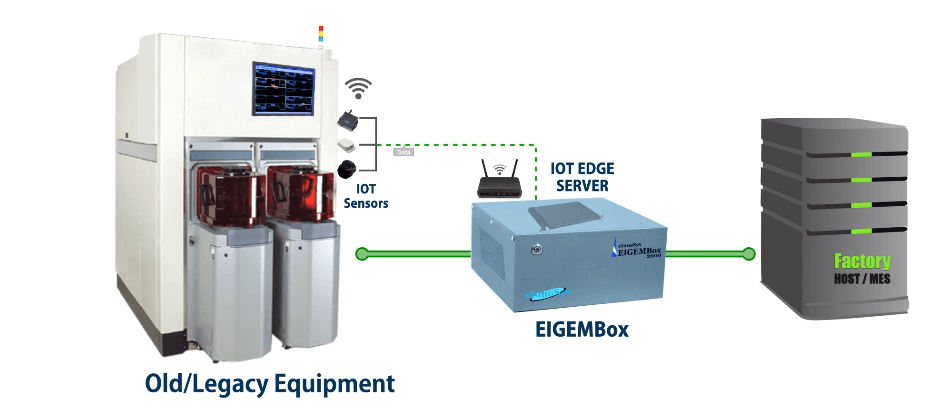
EIGEMBox is a turnkey SECS/GEM interface solution for legacy or non-GEM equipment.

It allows older 150mm/200mm tools to connect to modern factory automation systems without modifying the existing controller software.

Key Features:

  • External hardware/software gateway for SECS/GEM conversion
  • Plug-and-play communication between legacy tools and fab host
  • Supports recipe upload/download, trace data, and alarms
  • Ideal for equipment without native SECS/GEM support
  • Fast deployment and easy configuration
Step-by-Step Guide to Getting Started with a SECS/GEM SDK

Let’s look at how you can set up and start using a SECS/GEM SDK like EIGEMEquipment for your equipment development.

Step-by-Step Guide to Getting Started with a SECS_GEM SDK

Step 1: Understand the Communication Standards

Before coding, familiarize yourself with:

  • SEMI E5 (SECS-II) – Message structure and data format
  • SEMI E30 (GEM) – Equipment communication model
  • SEMI E37 (HSMS) – TCP/IP-based message transport protocol

Understanding these standards ensures correct configuration of messages, variables, and event reports.

Step 2: Install the SECS/GEM SDK

Once you obtain the SDK (e.g., EIGEMEquipment SDK):

  1. Install it on your development machine (Windows/Linux).
  2. Set up the runtime environment and dependencies.
  3. Review the SDK documentation for supported APIs and configuration files.

Einnosys SDKs come with example applications that help you test GEM scenarios right out of the box.

Step 3: Define Equipment Variables and Events

In your tool’s control software:

  • Identify status variables (SVs) (e.g., temperature, pressure, motor state).
  • Define collection events (CEs) (e.g., wafer load, process complete).
  • Configure alarms for fault conditions.

Using the SDK’s configuration editor, you can map each variable/event to the appropriate SECS message format.

Step 4: Implement Communication Logic

Use the SDK’s APIs to:

  • Establish a connection with the Host (via HSMS/TCP).
  • Send and receive SECS messages (SxFy format).
  • Handle host commands and responses.
  • Update status data and report events as they occur.

The EIGEMEquipment SDK simplifies this process with ready-to-use C++/C# interfaces.

Step 5: Test Using a SECS/GEM Simulator

Before deploying to production, test communication using a SECS/GEM simulator like EIGEMSim.

This tool simulates the host system and lets you:

  • Verify SECS messages
  • Test event reporting, variable updates, and recipe transfers
  • Validate your equipment’s GEM compliance

Testing early ensures your equipment passes factory acceptance faster.

Step 6: Integrate and Deploy

Once testing is complete:

  • Deploy your SECS/GEM-enabled software to the equipment controller.
  • Connect to the factory host for real-time validation.
  • Monitor communication logs to ensure reliability and performance.

With Einnosys SDKs, you can scale the integration easily for multiple tools or newer equipment models.

Common Challenges (and How to Avoid Them)
Challenge Solution
Misconfigured SECS message IDs Use the SDK’s message templates for consistency
Data mismatches between host and tool Use real-time logging and event validation tools
Long development cycles Start with prebuilt SDK components and sample code
Legacy tool integration Use EIGEMBox for non-GEM equipment
Benefits of Using a SECS/GEM SDK
  • Faster time to market for new tools
  • Reduced coding and debugging effort
  • Guaranteed SEMI compliance
  • Scalable and maintainable communication layer
  • Simplified testing with host simulation tools
  • Proven reliability (used by global OEMs and fabs)

Getting started with SECS/GEM doesn’t have to be complicated.

With a robust SDK like Einnosys’ EIGEMEquipment and supporting tools such as EIGEMBox and EIGEMSim, equipment developers can easily achieve full SECS/GEM compliance, connect with fab hosts, and accelerate their automation roadmap.

Whether you’re upgrading legacy equipment or developing next-generation 300mm tools, Einnosys provides the complete suite of solutions — SDKs, simulators, and integration expertise — to help you build smart, connected, and factory-ready equipment.

FAQs
  • What programming languages are supported by EIGEMEquipment SDK?

    EIGEMEquipment supports C++, C#, and .NET-based environments on both Windows and Linux platforms.

  • Can I integrate EIGEMBox with third-party equipment?

    EIGEMBox can be connected to any 150mm or 200mm tool lacking SECS/GEM support, providing a plug-and-play communication gateway to the factory host.

  • How long does it take to integrate SECS/GEM using the SDK?

    Most equipment teams can achieve full SECS/GEM integration in 2–4 weeks, compared to several months of manual development.

Alignment Film Coating Equipment SECS/GEM SDK Software Solutions

[vc_row][vc_column][vc_column_text css=””]

In the fast-evolving semiconductor and flat panel display (FPD) industries, precision, automation, and connectivity are the cornerstones of efficient manufacturing. One critical process that demands these qualities is alignment film coating, where even a minor deviation can impact yield and product quality. To ensure smooth communication and compliance with industry standards, equipment manufacturers need robust SECS/GEM SDK software solutions — and that’s where eInnoSys stands out.

[/vc_column_text][/vc_column][/vc_row][vc_row][vc_column width=”1/2″][vc_column_text css=””]Why Software Solutions Matter for Alignment Film Coating Equipment

In today’s smart factories, software is the bridge that connects complex equipment to the host systems, enabling full factory automation and real-time process control. For Alignment Film Coating Equipment, the right software ensures seamless communication, data collection, monitoring, and traceability.

Here’s why software solutions are essential for equipment OEMs and FPD manufacturers:

Factory Integration: Seamlessly connect equipment to factory host systems through SECS/GEM communication standards.

Process Visibility: Monitor and control every step of the film coating process in real-time for enhanced yield and consistency.

Data-Driven Insights: Collect, store, and analyze equipment data to predict maintenance needs and improve uptime.

Faster Time-to-Market: Reduce development time and integration challenges with ready-to-use SDKs that comply with SEMI standards.[/vc_column_text][/vc_column][vc_column width=”1/2″][vc_single_image image=”37850″ img_size=”full” alignment=”center” css=””][/vc_column][/vc_row][vc_row][vc_column width=”1/2″][vc_column_text css=””]Comprehensive Equipment Software Solutions by eInnoSys

eInnoSys offers a full suite of equipment software solutions designed specifically for semiconductor, FPD, and related high-tech manufacturing industries. Our solutions are built to help OEMs easily enable SECS/GEM, GEM300, and EDA (Interface A) communication on their equipment — without spending years on custom software development.

Our SECS/GEM SDK Highlights:

  • Plug-and-Play Integration: Rapidly implement SEMI-compliant host communication.
  • Customizable Framework: Tailor the SDK for the unique process needs of alignment film coating tools.
  • Cross-Platform Support: Compatible with Windows and Linux-based equipment controllers.
  • Comprehensive Documentation: Easy-to-follow integration guides, APIs, and example codes.
  • Global Support: Backed by experienced SECS/GEM engineers who assist in deployment, testing, and certification.

[/vc_column_text][/vc_column][vc_column width=”1/2″][vc_column_text css=””]Why Choose eInnoSys for Alignment Film Coating Equipment SDK Solutions?

When it comes to enabling SECS/GEM connectivity for alignment film coating equipment, choosing the right technology partner makes all the difference. Here’s what sets eInnoSys apart:

✅ Proven Industry Expertise: Decades of experience in semiconductor and FPD automation software development.

✅ End-to-End Solutions: From SECS/GEM SDKs to full equipment control software, eInnoSys covers the complete software stack.

✅ SEMI Standards Compliance: Our SDKs are fully compliant with SEMI E5, E30, E37, E39, and related standards.

✅ Faster Certification: Reduce time and cost of SECS/GEM compliance testing with pre-validated modules.

✅ Scalable Architecture: Our SDKs support future expansion, including EDA, IoT, and AI-driven analytics.[/vc_column_text][/vc_column][/vc_row][vc_row][vc_column width=”1/2″][vc_column_text css=””]With our SDK suite, OEMs and FPD manufacturers can:

  • Easily enable SECS/GEM communication on new or legacy equipment.
  • Improve production efficiency with real-time data exchange.
  • Reduce downtime with predictive maintenance integrations.
  • Shorten development cycles with pre-tested software components.
  • Stay ahead of Industry 4.0 trends with scalable digital solutions.

[/vc_column_text][/vc_column][vc_column width=”1/2″][vc_single_image image=”37849″ img_size=”full” alignment=”center” css=””][/vc_column][/vc_row][vc_row][vc_column][vc_column_text css=””]

As the semiconductor and FPD industries continue to advance, automation and data integration are key to achieving precision, efficiency, and scalability. With eInnoSys SECS/GEM SDK software solutions, Alignment Film Coating Equipment manufacturers can streamline factory connectivity, ensure SEMI compliance, and accelerate innovation.

Whether you’re developing new equipment or upgrading existing systems, eInnoSys provides the reliable, scalable, and smart software foundation you need to succeed in the era of intelligent manufacturing.

[/vc_column_text][/vc_column][/vc_row][vc_row][vc_column][vc_column_text css=””]

Expanded Frequently Asked Questions (FAQs)

[/vc_column_text][vc_toggle title=”What is SECS/GEM and why is it important for alignment film coating equipment?” css=””]SECS/GEM is a set of SEMI standards that define communication between manufacturing equipment and host systems. For film coating tools, it ensures standardized data exchange, process control, and automation.[/vc_toggle][vc_toggle title=”Can eInnoSys SDK integrate with my existing equipment controller?” css=””]Yes, our SECS/GEM SDK supports most industrial controllers, including those running on Windows or Linux platforms.[/vc_toggle][vc_toggle title=”Does eInnoSys provide customization for film coating process control?” css=””]Absolutely. We can tailor our SDK and software modules to support specific alignment and coating process parameters.[/vc_toggle][vc_toggle title=”Is your SDK compatible with Industry 4.0 or smart factory initiatives?” css=””]Yes, our SDKs are Industry 4.0-ready, supporting data analytics, IoT connectivity, and AI/ML integration.[/vc_toggle][vc_toggle title=”What is SECS/GEM and why is it important for alignment film coating equipment?” css=””]SECS/GEM is a SEMI communication standard that enables manufacturing equipment to communicate with factory host systems. For alignment film coating equipment, it ensures smooth automation, consistent data collection, and real-time process control across the production line.[/vc_toggle][vc_toggle title=”Can eInnoSys SDK integrate with my existing equipment controller?” css=””]Yes. eInnoSys SECS/GEM SDK supports major industrial platforms such as Windows, Linux, and embedded controllers, allowing seamless integration with both new and legacy alignment film coating equipment.[/vc_toggle][vc_toggle title=”How long does SECS/GEM integration take using your SDK?” css=””]Most customers achieve complete SECS/GEM integration within a few weeks, thanks to our ready-to-deploy SDK modules, detailed documentation, and expert support.[/vc_toggle][vc_toggle title=”Does eInnoSys provide customization for film coating process control?” css=””]Absolutely. Our SDK and software solutions can be customized to match the specific alignment, film coating, and curing process parameters required by OEMs or manufacturers.[/vc_toggle][vc_toggle title=”Is your SDK compatible with Industry 4.0 or smart factory initiatives?” css=””]Yes. eInnoSys SDKs are Industry 4.0-ready, supporting IoT data integration, AI/ML analytics, and predictive maintenance applications for advanced smart manufacturing.[/vc_toggle][vc_toggle title=”What SEMI standards does the eInnoSys SECS/GEM SDK comply with?” css=””]Our SDK is fully compliant with key SEMI standards including E5 (SECS-II), E30 (GEM), E37 (HSMS), E39 (Object Services), and GEM300 for 300mm equipment support.[/vc_toggle][vc_toggle title=”Does eInnoSys offer support after SDK implementation?” css=””]Yes, we provide comprehensive post-integration support, including troubleshooting, factory acceptance testing, remote assistance, and software updates to ensure long-term reliability.[/vc_toggle][vc_toggle title=”Can I upgrade older alignment film coating tools to be SECS/GEM compliant using your SDK?” css=””]Definitely. Our SDK allows retrofit upgrades for older or legacy equipment, enabling them to meet current SEMI communication and automation standards without full hardware redesign.[/vc_toggle][vc_toggle title=”Is training provided for my engineering or software team?” css=””]Yes. eInnoSys offers hands-on training programs covering SECS/GEM fundamentals, SDK integration, testing procedures, and best practices for film coating equipment developers.[/vc_toggle][vc_toggle title=”How does eInnoSys ensure data security and system reliability?” css=””]Our SDK uses secure communication protocols (HSMS/TCP) and is rigorously tested for fault tolerance, data integrity, and uptime reliability, ensuring consistent factory communication under demanding production environments.[/vc_toggle][/vc_column][/vc_row][vc_row][vc_column][/vc_column][/vc_row]

Flat Panel Display Equipment SECS/GEM SDK Software Solutions

In the ever-evolving semiconductor and display manufacturing industry, precision, automation, and connectivity are essential for achieving high yield and reliability. eInnoSys, a global leader in SECS/GEM software and SDK solutions, offers a comprehensive range of Flat Panel Display Equipment Software Solutions designed to enhance automation, improve process control, and ensure seamless communication across tools and factories.

Why Software Solutions Are Critical for Flat Panel Display (FPD) Equipment

Modern Flat Panel Display Equipment Software enables manufacturers to integrate complex machinery, streamline production, and maintain consistency in large-scale display fabrication. From alignment film coating to laser treatment and sealing processes, every step requires precise coordination and traceability—achievable only through a robust Flat Panel Display Equipment SECS GEM Software Solution.

By implementing eInnoSys SECS/GEM SDK and specialized equipment software development kits (SDKs), manufacturers can achieve:

  • Real-time communication between host and equipment
  • Automated recipe management and monitoring
  • Compliance with SEMI SECS/GEM standards
  • Reduced downtime through predictive and remote diagnostics

Semiconductor Flat Panel Display Equipment Software Soulution

Comprehensive Equipment Software Solutions by eInnoSys

eInnoSys provides specialized Flat Panel Display Equipment SDKs and software solutions for every critical stage of the display manufacturing process. Each SDK is designed to integrate seamlessly with SECS/GEM connectivity and ensure reliable data communication, control, and reporting.

Equipment Type Software Solution Description
Alignment Film Coating Equipment Software Solution Our Alignment Film Coating SDK offers real-time monitoring, coating precision control, and automated data collection. It ensures film uniformity and traceability while supporting Flat Panel Display Equipment SECS GEM SDK integration for host communication.
Anodic Oxidation Equipment Software Solution The Anodic Oxidation Equipment SDK supports advanced oxidation process control with built-in SECS/GEM protocol features. It enhances safety, maintains voltage/current accuracy, and improves production throughput.
Color Pattern Processing Equipment Software Solution With our Color Pattern Processing Equipment SDK, manufacturers gain precision color pattern alignment and defect detection powered by intelligent analytics and GEM SDK integration.
Laser Treatment Cutting Systems for Panels & Photocells Software Solution The Laser Treatment Cutting Systems SDK enables high-speed laser processing with sub-micron accuracy. Combined with Flat Panel Display Equipment SECS GEM SDK, it supports complete process traceability and recipe automation.
Liquid Crystal Injection Equipment Software Solution Our Liquid Crystal Injection SDK ensures perfect fill volume, pressure control, and cycle optimization with SECS/GEM connectivity for quality assurance and process visibility.
Filling Equipment Software Solution The Filling Equipment SDK automates liquid handling, provides alarm management, and supports real-time host communication via SECS/GEM SDK.
Low Pressure Plasma Spray (LPPS) Equipment Software Solution This Low Pressure Plasma Spray SDK controls plasma parameters and ensures consistent coating deposition. It integrates with the Flat Panel Display Equipment Software SDK for smart process control.
Luminous Layer Patterning Equipment Software Solution Our Luminous Layer Patterning Equipment SDK guarantees high precision patterning and uniform illumination layer application, ensuring compliance with SEMI SECS/GEM standards.
Sealing Equipment Software Solution The Sealing Equipment SDK automates sealing processes, controls temperature and pressure, and uses SECS/GEM SDK for monitoring seal integrity and production efficiency.
Panel Alignment Cell Assembly Equipment Software Solution The Panel Alignment Cell Assembly SDK aligns and assembles display panels with micron-level accuracy and integrates with GEM SECS SDK for feedback control and traceability.
Polarizer Sticking Equipment Software Solution Our Polarizer Sticking SDK provides precision adhesive control, tension management, and defect prevention with Flat Panel Display Equipment SECS GEM SDK integration.
Scribe and Break Equipment Software Solution The Scribe and Break Equipment SDK enhances panel cutting accuracy, minimizes edge defects, and supports real-time communication with GEM/SECS protocol.
Seal Patterning Equipment Software Solution The Seal Patterning Equipment SDK controls seal deposition patterns, manages recipes, and supports Flat Panel Display Equipment SECS GEM SDK for uniform sealing quality.
Spacer Spraying Equipment Software Solution Our Spacer Spraying SDK ensures uniform spacer distribution, prevents panel shorting, and integrates seamlessly with SECS GEM Driver for data logging and traceability.

Why Choose eInnoSys for Flat Panel Display Equipment SDK Solutions?

As a trusted embedded software company specializing in factory automation and semiconductor communication standards, eInnoSys provides end-to-end solutions—from SECS/GEM SDKs to complete equipment control systems.

With our SDK suite, OEMs and FPD manufacturers can:

✅ Speed up equipment integration with ready-to-use SECS/GEM libraries
✅ Reduce development time and ensure SEMI compliance
✅ Enable smart data analytics and real-time visibility
✅ Simplify host/equipment connectivity with proven GEM/SECS software architecture

In today’s fast-paced semiconductor and display industry, Flat Panel Display Equipment Software plays a vital role in ensuring performance, traceability, and automation. eInnoSys SECS/GEM SDKs provide the foundation for intelligent manufacturing—offering flexibility, scalability, and precision for every stage of production.

If you’re developing or upgrading display equipment, eInnoSys’s Flat Panel Display Equipment SECS GEM Software Solution and SDKs are your key to achieving next-level factory automation and efficiency.

Frequently Asked Questions (FAQs)

  • What is Flat Panel Display (FPD) Equipment Software?

    Flat Panel Display (FPD) Equipment Software refers to specialized control and automation programs designed for display manufacturing equipment such as coating, oxidation, laser cutting, and sealing systems. It ensures precision, process stability, and real-time communication using SECS/GEM protocols.

  • Why is SECS/GEM protocol important for Flat Panel Display Equipment?

    The SECS/GEM protocol is a SEMI-standard communication interface that enables seamless data exchange between equipment and factory host systems. For Flat Panel Display Equipment Software, SECS/GEM ensures traceability, remote control, alarm management, and automated recipe handling — all crucial for smart manufacturing.

  • What are the key benefits of using eInnoSys SECS/GEM SDK for FPD equipment?

    eInnoSys SECS/GEM SDK provides ready-to-integrate libraries that reduce software development time, ensure SEMI compliance, and enable real-time monitoring. It simplifies equipment connectivity and supports automation, predictive maintenance, and data-driven decision-making.

  • How does eInnoSys support different types of display manufacturing equipment?

    eInnoSys offers SDKs for various equipment types including Alignment Film Coating, Laser Treatment, Liquid Crystal Injection, Sealing, and Panel Assembly. Each SDK is optimized for precise process control, communication, and data acquisition using the Flat Panel Display Equipment SECS GEM SDK.

  • What industries can benefit from Flat Panel Display Equipment Software Solutions?

    These software solutions are primarily designed for semiconductor, LCD, OLED, and microdisplay manufacturers. However, they also benefit solar cell, photonics, and electronic component industries that require precision coating, cutting, or sealing processes.

  • Can eInnoSys SDKs be customized for specific equipment or processes?

    Yes, eInnoSys SDKs are highly customizable. OEMs and equipment manufacturers can adapt the SECS/GEM SDK for unique machine configurations, sensors, or process parameters — ensuring flexibility and seamless integration with factory MES or host systems.

  • How do these software solutions improve yield and efficiency in FPD manufacturing?

    By integrating automation, predictive analytics, and real-time communication, eInnoSys Flat Panel Display Equipment Software helps reduce defects, optimize process timing, and minimize equipment downtime — directly improving yield, throughput, and energy efficiency.

  • What SEMI standards are supported by eInnoSys SECS/GEM SDK?

    The SDK supports multiple SEMI standards including E4 (SECS-I), E5 (SECS-II), E30 (GEM), E37 (HSMS), and E95 (HMI), ensuring complete compliance and interoperability with global semiconductor and display manufacturing systems.

  • How does eInnoSys help OEMs accelerate equipment development?

    eInnoSys provides ready-to-deploy SECS/GEM SDKs with built-in APIs for C#, Java, and .NET, reducing months of development work. This enables OEMs to focus on innovation while ensuring their tools are compliant and production-ready faster.

  • How can I get started with eInnoSys Flat Panel Display Equipment SECS GEM Software Solutions?

    You can contact eInnoSys through newsite.einnosys.com/
    to request a consultation or demo. The team offers guidance on SDK integration, factory automation solutions, and SECS/GEM implementation for any display or semiconductor equipment.

AI/ML for Motor Health Monitoring & Pump Optimization

[vc_row][vc_column][vc_column_text css=””]

In today’s rapidly advancing semiconductor manufacturing environment, precision, uptime, and operational efficiency are critical. Motors and pumps are the heart of semiconductor fabs — driving vacuum systems, cooling systems, and wafer handling equipment. However, frequent breakdowns or unplanned downtime can significantly disrupt production and profitability. This is where Motor Health Monitoring and Pump Optimization, powered by Machine Learning (ML) and AI-driven analytics, play a transformative role.

By leveraging AI-based pump monitoring and machine learning for motor health, semiconductor manufacturers can detect anomalies early, prevent equipment failure, and ensure smooth factory operations. This innovation marks a major shift from reactive maintenance to intelligent, predictive systems — a key step toward achieving a truly smart semiconductor fab.

[/vc_column_text][/vc_column][/vc_row][vc_row][vc_column][vc_column_text css=””]

The Need for Smart Monitoring in Semiconductor Equipment

Traditional monitoring systems often rely on scheduled maintenance or manual inspections. Unfortunately, these approaches are inefficient and prone to human error. In semiconductor fabs, where even a few minutes of downtime can cost thousands of dollars, predictive intelligence has become a necessity.

Motor Health Monitoring systems powered by Machine Learning (ML) continuously analyze vibration patterns, temperature fluctuations, and power consumption data. These insights help identify early signs of wear, misalignment, or imbalance long before a failure occurs.

Similarly, Pump Optimization ensures that vacuum and cooling pumps — vital for cleanroom and process stability — operate at peak efficiency. AI algorithms monitor pump parameters, identify deviations, and automatically recommend optimal operational settings to reduce energy consumption and extend equipment life.

[/vc_column_text][/vc_column][/vc_row][vc_row][vc_column][vc_column_text css=””]How Machine Learning Enables Predictive Maintenance

Machine Learning for Motor Health involves collecting and analyzing massive datasets from sensors and IoT-enabled devices embedded in motors and pumps. Using pattern recognition, anomaly detection, and predictive modeling, ML algorithms can identify subtle variations in performance that indicate potential failures.

Here’s how it works step by step:

  1. Data Collection – IoT sensors capture real-time data such as vibration, current, voltage, pressure, and flow rates.
  2. Data Processing – AI systems clean, normalize, and categorize the data for accurate modeling.
  3. Machine Learning Analysis – Predictive algorithms learn from historical data to identify patterns associated with normal and abnormal conditions.
  4. Alerts and Insights – The system triggers early alerts and provides actionable insights for maintenance teams.

This combination of AI-based pump monitoring and motor health analytics reduces unscheduled downtime, cuts maintenance costs, and enhances process reliability — critical advantages for semiconductor fabs operating 24/7.[/vc_column_text][/vc_column][/vc_row][vc_row][vc_column width=”1/2″][vc_column_text css=””]

Key Benefits of AI-Based Pump Monitoring and Motor Health Systems

✅ Reduced Downtime: Predictive alerts enable maintenance teams to address potential issues before they escalate into costly breakdowns.
✅ Energy Efficiency: Intelligent pump optimization ensures energy usage remains at optimal levels, leading to reduced power consumption.
✅ Extended Equipment Life: By detecting and correcting inefficiencies early, AI and ML technologies extend the lifespan of motors and pumps.
✅ Improved Yield and Productivity: Stable, efficient equipment operation directly translates into consistent product quality and higher throughput.
✅ Data-Driven Decision Making: Engineers can make informed decisions using real-time data analytics and performance metrics.

In semiconductor fabs, these benefits are more than operational improvements — they represent a strategic advantage in a highly competitive industry.

[/vc_column_text][/vc_column][vc_column width=”1/2″][vc_single_image image=”37737″ img_size=”full” css=””][/vc_column][/vc_row][vc_row][vc_column][vc_column_text css=””]

Einnosys: Pioneering Smart Factory Solutions

At Einnosys, we specialize in AI and ML-based Motor Health Monitoring and Pump Optimization systems designed specifically for semiconductor fabs. Our advanced solutions integrate seamlessly with existing factory automation systems to provide real-time insights, predictive alerts, and actionable intelligence.

Whether you’re running 100mm, 150mm, or 200mm equipment, our technologies can help modernize your factory operations and reduce unplanned downtime. With AI-based pump monitoring, you gain precision control, proactive maintenance, and data visibility across your entire manufacturing line.

Our systems use Machine Learning for Motor Health to identify degradation trends, enabling maintenance teams to plan interventions effectively — minimizing production impact and maximizing performance.

[/vc_column_text][/vc_column][/vc_row][vc_row][vc_column][vc_column_text css=””]

The semiconductor industry’s future depends on intelligent automation and predictive insights. Motor Health Monitoring and Pump Optimization powered by AI and Machine Learning represent a vital leap toward achieving the “zero downtime” vision of modern fabs.

By transforming maintenance from reactive to predictive, semiconductor manufacturers can ensure smoother operations, higher yields, and better resource efficiency. As the industry continues to evolve, embracing AI-based pump monitoring and machine learning for motor health will be the key to sustainable innovation and competitiveness.

[/vc_column_text][/vc_column][/vc_row][vc_row][vc_column][vc_column_text css=””]Blog Post:

[/vc_column_text][/vc_column][/vc_row][vc_row][vc_column][vc_toggle title=”What is Motor Health Monitoring in the semiconductor industry?” css=””]Motor Health Monitoring involves using sensors and machine learning algorithms to continuously track motor performance in semiconductor equipment. It helps detect early signs of wear, imbalance, or electrical faults before they cause unplanned downtime.[/vc_toggle][vc_toggle title=”How does Machine Learning improve Motor Health Monitoring?” css=””]Machine Learning enhances Motor Health Monitoring by analyzing large datasets from equipment sensors. It identifies subtle patterns and predicts motor failures more accurately than traditional threshold-based systems, enabling proactive maintenance.[/vc_toggle][vc_toggle title=”What is Pump Optimization, and why is it important?” css=””]Pump Optimization ensures that vacuum and process pumps in semiconductor fabs operate at peak efficiency. Optimized pumps reduce energy consumption, minimize process variation, and extend equipment life — all critical for consistent wafer quality and yield.[/vc_toggle][vc_toggle title=”How does AI-based Pump Monitoring work?” css=””]AI-based Pump Monitoring uses IoT sensors and real-time data analytics to assess pump conditions such as vibration, temperature, and pressure. The AI models predict failures, schedule maintenance at optimal times, and reduce costly unplanned stoppages.[/vc_toggle][vc_toggle title=”What are the key benefits of using AI and Machine Learning for Motor and Pump Monitoring?” css=””]The key benefits include reduced downtime, improved process efficiency, predictive maintenance scheduling, energy savings, and longer equipment lifespan. Semiconductor manufacturers can achieve higher yield and reliability with lower operational costs.[/vc_toggle][vc_toggle title=”Can Machine Learning models be customized for different motor and pump types?” css=””]Yes. Machine Learning algorithms can be trained using historical data specific to each equipment model, process environment, and usage pattern. This customization enhances prediction accuracy and reliability across various semiconductor tools.[/vc_toggle][vc_toggle title=”How does IoT data contribute to Predictive Maintenance in semiconductor fabs?” css=””]IoT sensors collect continuous streams of data — including vibration, power usage, temperature, and flow rate. This data feeds into AI models that predict potential failures, enabling maintenance teams to take corrective actions before breakdowns occur.[/vc_toggle][vc_toggle title=”What future innovations can we expect in AI-driven Pump and Motor Monitoring?” css=””]Future developments include deeper AI integration for self-learning maintenance systems, edge AI for real-time diagnostics, and digital twins for virtual equipment modeling — all designed to push semiconductor automation toward full Industry 4.0 readiness.[/vc_toggle][/vc_column][/vc_row]

SECS/GEM Integration with Canon FPA 5000 ES3

[vc_row][vc_column][vc_column_text css=””]

In the fast-paced semiconductor industry, seamless communication between tools and factory host systems is vital for achieving automation, efficiency, and data-driven decision-making. Many 200 mm fabrication facilities still operate with legacy equipment that lacks native SECS/GEM capabilities. One such example is the Canon FPA 5000 ES3 (248 nm DUV Step-and-Scan Lithography System), a proven and reliable system used worldwide.

To bring this legacy tool into compliance with modern automation requirements, Einnosys successfully implemented its flagship product — EIGEMBox, a turnkey SECS/GEM integration solution.

[/vc_column_text][/vc_column][/vc_row][vc_row][vc_column width=”1/2″][vc_column_text css=””]The Challenge

The Canon FPA 5000 ES3 is a robust lithography tool designed for 200 mm wafer processing, but like many legacy systems, it was not originally equipped with SECS/GEM protocol support.

This limitation created challenges for fabs aiming to:

  • Connect the tool to host automation systems (MES/EAP).
  • Enable data collection, event monitoring, and alarm reporting.
  • Achieve SECS/GEM compliance for uniform fab automation.

Without SECS/GEM communication, the fab’s automation framework could not fully monitor or control the Canon system, leading to manual operations, inefficiencies, and limited data visibility.[/vc_column_text][/vc_column][vc_column width=”1/2″][vc_single_image image=”37712″ img_size=”500X500″ css=””][/vc_column][/vc_row][vc_row][vc_column][vc_column_text css=””]The Solution: EIGEMBox

To address these challenges, Einnosys deployed the EIGEMBox, an advanced and compact SECS/GEM gateway designed to enable communication between legacy equipment and modern host systems.

The EIGEMBox acted as a bridge interface, converting native Canon equipment signals into fully SEMI E4/E5/E30 compliant SECS/GEM messages, without requiring major hardware or software modifications to the tool.

Key implementation highlights:

  • Quick and non-invasive installation.
  • Full support for SECS-I and HSMS-SS (Ethernet) communication.
  • Real-time data, event, and alarm collection.
  • Custom configuration to align with factory EAP/MES protocols.
  • Validation and certification for GEM compliance by the fab’s automation team.

[/vc_column_text][/vc_column][/vc_row][vc_row][vc_column width=”1/2″][vc_single_image image=”37713″ img_size=”full” css=””][/vc_column][vc_column width=”1/2″][vc_column_text css=””]Benefits of EIGEMBox

The integration of EIGEMBox transformed the Canon FPA 5000 ES3 into a fully SECS/GEM-compliant system, delivering multiple operational benefits:

✅ Automation Enablement – The fab achieved seamless host-to-equipment communication, supporting remote control, data collection, and event reporting.
✅ Reduced Manual Intervention – Automated monitoring minimized operator involvement, improving throughput and reducing human error.
✅ Enhanced Data Visibility – Real-time equipment data was now available for predictive maintenance and process optimization.
✅ Cost-Effective Retrofit – No need for expensive equipment replacement or software rewriting.
✅ Faster Time-to-Production – EIGEMBox enabled quick deployment, allowing the fab to achieve compliance in just a few days.

By using EIGEMBox, the fab successfully upgraded its legacy Canon tool to align with modern automation standards, extending its operational life and maximizing ROI.[/vc_column_text][/vc_column][/vc_row][vc_row][vc_column][vc_column_text css=””]

The success of integrating EIGEMBox with the Canon FPA 5000 ES3 exemplifies how legacy tools can be efficiently upgraded for modern fab automation.
EIGEMBox not only enabled SECS/GEM compliance but also empowered the fab with better control, real-time data access, and enhanced productivity — all without replacing the existing tool.

For fabs and OEMs seeking reliable SECS/GEM integration for legacy or new systems, EIGEMBox by Einnosys offers the perfect balance of performance, simplicity, and scalability.

[/vc_column_text][vc_single_image image="37197" img_size="full" alignment="center" style="vc_box_shadow_3d" onclick="custom_link" css="" link="https://newsite.einnosys.com/eigembox/%22][/vc_column][/vc_row][vc_row][vc_column][vc_column_text css=""]About Einnosys

Einnosys is a global technology company specializing in Factory Automation, SECS/GEM integration, AI/ML, IoT, and Industry 4.0 solutions for semiconductor fabs and equipment manufacturers.

With decades of experience in semiconductor automation, Einnosys delivers turnkey SECS/GEM SDKs, integration services, and edge gateway products such as EIGEMBox to enable seamless communication, compliance, and smart manufacturing transformation.[/vc_column_text][/vc_column][/vc_row][vc_row][vc_column][vc_toggle title=”FAQs: SECS/GEM Integration on Canon FPA 5000 ES3 with EIGEMBox” open=”true” css=””]1. What challenge did Einnosys solve with EIGEMBox for the Canon FPA 5000 ES3?

Einnosys addressed the lack of SECS/GEM connectivity in the Canon FPA 5000 ES3 200 mm lithography tool. Using EIGEMBox, the equipment was upgraded to support data collection, event reporting, and host communication, enabling full factory automation compliance.

2. What is EIGEMBox and how does it help in SECS/GEM integration?

EIGEMBox is a plug-and-play middleware solution by Einnosys that enables SECS/GEM functionality on legacy or “dumb” semiconductor tools. It bridges the communication gap between equipment and factory host systems without requiring any hardware modification.

3. Does the Canon FPA 5000 ES3 support SECS/GEM by default?

No, older Canon FPA 5000 ES3 models (especially 200 mm systems) do not natively support SECS/GEM protocol. EIGEMBox provides this functionality externally, making the equipment GEM-compliant.

4. What benefits did the customer achieve after integrating EIGEMBox?

After SECS/GEM integration, the customer gained real-time equipment monitoring, automated data logging, event and alarm collection, and improved OEE (Overall Equipment Effectiveness). It also reduced manual data entry and human intervention in operations.

5. Is EIGEMBox compatible with other Canon lithography tools?

Yes. EIGEMBox can be integrated with various Canon lithography systems, as well as tools from other OEMs. It supports both 200 mm and 300 mm tool generations, making it a universal retrofit solution.

6. How long does it take to deploy EIGEMBox for SECS/GEM integration?

Typical deployment takes between 2 to 4 weeks, depending on tool type, host configuration, and customer requirements. Einnosys provides remote or on-site integration support to ensure smooth implementation.

7. Does EIGEMBox support GEM300 and advanced SECS/GEM features?

Yes, EIGEMBox is designed to comply with SEMI E4, E5, E30 (GEM), and E37 (HSMS) standards. It can also support GEM300 extensions for advanced wafer handling and process automation if required.

8. Why choose Einnosys for SECS/GEM integration services?

Einnosys specializes in factory automation, SECS/GEM solutions, and semiconductor software development. With years of expertise and proven products like EIGEMBox, Einnosys ensures fast, reliable, and compliant integration for both new and legacy tools.[/vc_toggle][/vc_column][/vc_row]

SECS/GEM Messaging in Cloud-Native MES Environments

[vc_row][vc_column width=”1/2″][vc_column_text css=””]

The semiconductor industry is undergoing a significant transformation. As fabs move toward cloud-native MES (Manufacturing Execution Systems), the role of SECS/GEM messaging becomes even more critical in enabling seamless communication between equipment and factory automation systems. With increased demands for efficiency, flexibility, and scalability, choosing the right approach to SECS/GEM integration is vital for modern fabs.

In this blog, we explore how SECS/GEM software supports cloud-native MES, why semiconductor MES automation depends on it, and how both legacy and modern tools can benefit from SECS/GEM protocol in MES environments.

[/vc_column_text][/vc_column][vc_column width=”1/2″][vc_single_image image=”37226″ img_size=”full” alignment=”center” css=””][/vc_column][/vc_row][vc_row][vc_column][vc_column_text css=””]

The Evolution of MES and the Role of SECS/GEM

Traditional MES platforms were designed to operate on-premises, tightly integrated with equipment and host systems. However, as the industry embraces cloud-native MES environments, new challenges emerge around connectivity, scalability, and security.

Here, SECS/GEM integration ensures standardized communication between tools and the MES, regardless of whether the system is running in a data center, private cloud, or hybrid cloud environment.

SECS/GEM software enables equipment to send and receive structured messages.

Cloud-based SECS/GEM communication ensures that the same standards are applied, even in distributed architectures.

MES with SECS/GEM support future-proofs fabs by allowing legacy equipment to operate alongside modern 300mm tools.

Without robust SECS/GEM application development, fabs risk misaligned communication protocols that can lead to downtime, inefficiency, and data loss.[/vc_column_text][/vc_column][/vc_row][vc_row][vc_column][vc_column_text css=””]Why SECS/GEM Integration Matters in Cloud-Native MES

In traditional fabs, SECS/GEM protocols were used to connect equipment directly to on-premises MES or host computers. In cloud-native MES environments, however, connectivity is more complex, involving distributed data flows and multi-cloud systems.

SECS/GEM integration in this context provides several key benefits:

Standardized Messaging – Whether equipment is legacy or modern, SECS/GEM ensures consistent communication.

Real-Time Visibility – With semiconductor MES automation, fabs gain real-time monitoring of process performance, alarms, and yield metrics.

Scalable Data Handling – Cloud-based SECS/GEM communication allows data from multiple sites to be aggregated and analyzed centrally.

Interoperability – MES with SECS/GEM support enables different vendors’ tools to integrate seamlessly.

By leveraging SECS/GEM software, fabs not only streamline operations but also lay the foundation for advanced analytics, predictive maintenance, and AI-driven process control.[/vc_column_text][/vc_column][/vc_row][vc_row][vc_column width=”1/2″][vc_column_text css=””]SECS/GEM Protocol in MES: Practical Applications

Modern fabs are increasingly focused on flexibility—supporting both leading-edge technologies and legacy processes. The SECS/GEM protocol in MES environments addresses this challenge directly by providing a standardized way to manage tool communication.

Some practical applications include:

Remote Equipment Control – Operators can start, stop, and monitor processes from cloud-hosted MES dashboards.

Recipe Management – Equipment automation with SECS/GEM ensures consistency across different tools and production sites.

Data Logging – Centralized data collection improves defect detection and yield tracking.

Custom Applications – Through SECS/GEM application development, fabs can build tailored interfaces, predictive systems, and analytics tools.

This makes SECS/GEM integration not just a technical necessity, but a strategic enabler for modern fab competitiveness.[/vc_column_text][/vc_column][vc_column width=”1/2″][vc_single_image image=”37225″ img_size=”full” alignment=”right” css=””][/vc_column][/vc_row][vc_row][vc_column][vc_column_text css=””]Overcoming Challenges in Cloud-Based SECS/GEM Communication

Moving SECS/GEM messaging into the cloud introduces new complexities. Latency, data security, and integration with legacy equipment must all be addressed.

Latency Control – SECS/GEM software must be optimized to ensure real-time response even in cloud environments.

Data Security – Encryption and access control are critical when implementing cloud-based SECS/GEM communication.

Legacy Integration – Many fabs rely on older tools. With MES with SECS/GEM support, even 200mm equipment can be integrated into cloud MES systems.

Scalability – As fabs grow, semiconductor MES automation powered by SECS/GEM ensures new tools can be added without major reconfiguration.

By deploying the right SECS/GEM integration services, these challenges can be minimized while unlocking the full potential of cloud-native MES.[/vc_column_text][/vc_column][/vc_row][vc_row][vc_column][vc_column_text css=””]Future of SECS/GEM in Cloud MES Environments

The adoption of cloud-native MES represents a fundamental shift for semiconductor manufacturing. SECS/GEM messaging will continue to be the backbone of this transformation, ensuring smooth communication and interoperability.

Key trends to watch include:

AI/ML Integration Using SECS/GEM software data streams for advanced analytics and predictive maintenance.

Multi-Site Automation – Standardized protocols enable global fabs to operate under a unified MES framework.

Hybrid Architectures – Combining on-premises systems with cloud-based SECS/GEM communication for maximum flexibility.

As fabs continue to evolve, SECS/GEM application development will remain central to enabling innovative, efficient, and scalable automation.

The shift to cloud-native MES environments is redefining how fabs approach automation. At the heart of this transformation lies SECS/GEM integration, providing standardized messaging, real-time visibility, and interoperability across diverse equipment.

With the right SECS/GEM software and MES with SECS/GEM support, semiconductor manufacturers can seamlessly integrate legacy and modern tools, improve yields, and reduce downtime.

In short, SECS/GEM messaging is more than a protocol—it is the foundation of semiconductor MES automation in the cloud era, enabling fabs to stay agile, competitive, and future-ready.[/vc_column_text][/vc_column][/vc_row][vc_row][vc_column][vc_column_text css=””]

More Blog Posts

[/vc_column_text][/vc_column][/vc_row]

Success Story: SECS/GEM Integration on Peter Wolters AC 2000-P2 with EIGEMBox

[vc_row][vc_column width=”1/2″][vc_column_text css=””]Introduction

In the semiconductor industry, seamless communication between equipment and host systems is critical for efficiency, traceability, and factory automation. Many legacy tools, however, lack native SECS/GEM interfaces, making integration challenging. One such case was the Peter Wolters AC 2000-P2, a widely used precision lapping and polishing system. Einnosys successfully enabled SECS/GEM connectivity for this equipment using its innovative EIGEMBox solution.[/vc_column_text][vc_column_text css=””]The Challenge

The Peter Wolters AC 2000-P2 was a high-value tool but lacked native SECS/GEM capability. Without standardized communication, the fab struggled with:

  • Limited equipment-to-host connectivity.
  • Manual data logging and recipe management.
  • Difficulty in meeting automation and traceability requirements.
  • High downtime risk during integration attempts with legacy hardware.

The fab needed a non-intrusive, cost-effective, and SEMI-compliant solution that could enable SECS/GEM without impacting existing machine performance.[/vc_column_text][/vc_column][vc_column width=”1/2″][vc_single_image image=”37128″ img_size=”500×500″ alignment=”center” css=””][/vc_column][/vc_row][vc_row][vc_column width=”1/2″][vc_column_text css=””]Benefits of EIGEMBox

By enabling SECS/GEM on the Peter Wolters AC 2000-P2, the fab achieved:

  • Faster Integration: Deployment completed quickly without machine downtime.
  • Standardized Connectivity: Direct host communication via SECS/GEM.
  • Improved Productivity: Automated data collection and recipe management reduced manual effort.
  • Future-Ready Automation: Compatibility with MES, predictive maintenance, and smart manufacturing initiatives.
  • Cost Savings: Extended the life of existing equipment without expensive upgrades.

[/vc_column_text][/vc_column][vc_column width=”1/2″][vc_column_text css=””]The Solution: EIGEMBox

Einnosys deployed its EIGEMBox, a plug-and-play hardware and software solution designed to retrofit legacy equipment with SECS/GEM capability. Key aspects of the solution included:

  • Seamless Retrofit: Integration without altering the machine controller or core software.
  • Full SEMI Compliance: Support for SECS-I, SECS-II, HSMS, and GEM standards.
  • Recipe and Data Handling: Automatic collection of alarms, events, recipes, and process data.
  • Scalable Architecture: Ability to connect multiple legacy tools to the host system.

The implementation was completed in a short timeframe, with minimal disruption to production.[/vc_column_text][/vc_column][/vc_row][vc_row][vc_column][vc_column_text css=””]About Einnosys

Einnosys Technologies is a trusted partner in semiconductor factory automation, offering solutions for fabs, assembly/test/packaging, and OEMs. With products like EIGEMBox and EIGEMEquipment SDK, Einnosys empowers semiconductor companies to achieve seamless equipment integration, predictive maintenance, and AI-driven manufacturing.

Conclusion

This success story highlights how EIGEMBox transformed the Peter Wolters AC 2000-P2 into a fully SECS/GEM-compliant tool, enabling the fab to achieve modern automation goals without replacing existing assets. For fabs looking to bridge the gap between legacy equipment and Industry 4.0, EIGEMBox offers a proven, scalable, and cost-effective path forward.[/vc_column_text][/vc_column][/vc_row]