
Empowering 300mm Automation with GEM300 SDK
EIGEM300Equipment is a plug-and-play, high-performance GEM300 SDK designed for seamless connectivity between semiconductor equipment and factory MES systems. It supports lights-out automation and enables rapid implementation of advanced fab automation capabilities.
Built with ultra-low CPU and memory usage, the SDK preserves resources for core control tasks while delivering complete 300mm automation stack support. With full SEMI standards compliance and proven integration expertise, it ensures reliable host communication for wafer processing, metrology, assembly, and test equipment in modern 300mm fabs.
Customer Value
Time Is Money
EIGEM300Equipment reduces 4–6 months of development by providing ready SECS/GEM and GEM300 building blocks, allowing engineers to focus on equipment functionality and accelerate time-to-market.
Efficient
Lightweight and CPU-optimized, it preserves processing and memory resources for control and GUI tasks, ensuring stable real-time performance.
Future-Ready
Includes full SECS/GEM and GEM300 features with regular updates for SEMI standards compliance, enabling scalable and long-term fab automation support.
Key Features & Capabilities
Full SEMI Suite Compliance
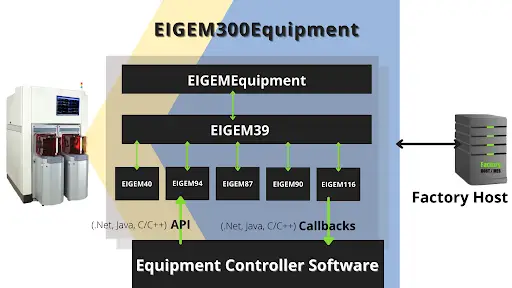
EIGEM300Equipment provides complete 300mm automation stack support with compliance to:
- SEMI E87 – Carrier management, FOUP validation, slot mapping, and lifecycle control
- SEMI E40 & E94 – Process job and control job management with recipe coordination
- SEMI E90 – Real-time substrate tracking and full wafer traceability
- SEMI E116 – Equipment performance tracking with OEE and state reporting

True Multi-Platform Flexibility
Runs natively on Windows, Linux/Unix, and Android. The cross-platform SECS/GEM architecture removes platform-specific development overhead.

Multi-Language APIs
Supports C#.NET, C++, Java, and C, enabling seamless integration with existing controller and GUI software.

Rapid Integration Services
Expert integration support helps reduce development timelines by 4–6 months and ensures successful Factory Acceptance Testing (FAT) with production-ready deployment.

Why Choose EIGEM300Equipment?
Lightweight Architecture
Optimised for high-speed messaging with minimal resource usage, consuming under 50 MB RAM and 5% CPU even during peak activity, ensuring strong equipment software performance.
Cost Efficiency
Saves OEMs over $150,000 by eliminating custom SECS/GEM development, validation cycles, and debugging, delivering immediate ROI.
Field-Proven Reliability
Trusted by Tier-1 fabs for mission-critical production, ensuring stability, interoperability, and standards compliance.
Future-Ready Evolution
Regular updates for SEMI standards and cybersecurity compliance, with expandable capabilities enabled through configuration.
Accelerated Time-to-Market
Reduces development timelines by 4–6 months compared to custom implementations, removing protocol learning and validation delays.
Assured SEMI Compliance
Full conformance to SEMI E39, E40, E87, E90, E94, and E116 standards ensures smooth host acceptance and factory qualification.
Multi-Platform




Supported SEMI Standards
SEMI E39 (Object Services)
Supports object service concepts required for GEM300 workflows, enabling structured equipment modelling and standardised service interactions.
SEMI E90 (Substrate Tracking)
mplements reliable substrate tracking, maintaining wafer identity, location, and processing state throughout equipment workflows.
SEMI E87 (Carrier Management)
Provides full carrier lifecycle management, including slot mapping, substrate association, and automated FOUP handling.
SEMI E40 (Processing Management)
Coordinates recipe selection, processing commands, and material movement for streamlined equipment operation.
SEMI E94 (Control Job Management)
Manages control job scheduling and lifecycle tracking from creation to completion.
SEMI E116 (Equipment Performance Tracking)
Enables equipment performance monitoring, state modelling, and accurate OEE reporting for continuous improvement.
Features of EIGEM300Equipment
Multi-Technology Support
APIs available in C#.Net, C++, Java, and C, allowing teams to integrate the SDK using their preferred controller and GUI technology stack.

Multi-Platform Support
Supports Windows, Linux/Unix, and Android with a single SECS/GEM implementation, reducing development and maintenance effort across platforms.

Ultra Light-Weight & Best Optimised
Consumes minimal CPU and memory, preserving resources for controller and GUI performance while maintaining complete and reliable GEM300 communication functionality.

Technical Specifications
| Source Protocol | Conversion Capability |
|---|---|
| Supported SEMI Standards | SEMI E4 (SECS-I), E5 (SECS-II), E30 (GEM), E37 (HSMS), E39 (Object Services), E40 (Processing Management), E87 (Carrier Management), E90 (Substrate Tracking), E94 (Control Job Management), E116 (Equipment Performance Tracking) |
| Programming Languages | C#.NET, C++, Java, C with native API bindings for each language Operating Systems: Windows (7/8/10/11, Server editions), Linux (Ubuntu, CentOS, RedHat, embedded distributions), Unix variants, Android |
| Deployment Architecture | Supports both in-process and out-of-process architectures for flexible integration with existing equipment software. |
| System Requirements | Minimal resource footprint (typical <50MB RAM, <5% CPU utilisation during normal operation) |
| Testing Tools | Includes a complimentary SECS/GEM Simulator for rigorous pre-shipment validation, enabling comprehensive testing without host system dependency |
| Communication Modes | HSMS Active, HSMS Passive, SECS-I (RS-232) for legacy compatibility |
| Development Support | Comprehensive API documentation, sample code, configuration utilities, debugging tools, and integration guidelines |
How It Works
Step 1: SDK Integration
Integrate EIGEM300Equipment using C#.NET, C++, Java, or C APIs. The GEM300 SDK simplifies protocol complexity through intuitive interfaces and platform-specific libraries.
Step 2: Configuration and Mapping
Configure carrier management, substrate tracking, control jobs, process programs, and performance tracking. Map equipment data to SEMI-compliant messages and define host command handling.
Step 3: Validation and Testing
Use the SECS/GEM Simulator to validate communication, test carrier handling, substrate tracking, and control jobs before host integration, reducing FAT cycle time.
Step 4: Host Integration and Deployment
Connect to factory host systems via HSMS. The SDK manages handshaking, sequencing, timeouts, and error recovery, ensuring smooth MES communication and production deployment.
Your Integration Partner for SECS/GEM
EIGEM300Equipment combined with Einnosys integration services delivers a complete GEM300 solution for equipment manufacturers. The pairing provides the software building blocks and hands-on support needed to integrate, test, and validate GEM300 behaviour for site-ready deployment.
Our partnership approach ensures you’re never alone during implementation. From initial architecture consultation through final Factory Acceptance Testing, Einnosys provides the expertise and support that guarantee successful outcomes. This combination of comprehensive SECS/GEM software and professional integration services minimises risk while maximising return on your fab automation software investment.
Benefits
Accelerated Development
Eliminate 4-6 months of GEM300 protocol development, enabling faster equipment delivery and quicker revenue generation.
Lower Risk
Proven implementation reduces integration failures, host acceptance issues, and post-deployment communication problems that delay custom developments.
Cost Efficiency
Save $150K+ in engineering costs through reusable components, reduced debugging cycles, and eliminated protocol learning curves.
Scalability
Single GEM300 SDK investment supports multiple equipment models, platforms, and generations, maximising ROI across product portfolios.
Expert Support
Access Einnosys integration expertise, avoiding common pitfalls and benefiting from decades of fab automation software experience.
Future Protection
Regular updates maintain compliance with evolving SEMI standards and cybersecurity requirements, protecting your integration investment.
Whitepaper


Schedule Your EIGEM300Equipment Demo Today
Case Studies



Ready to scale your software development bandwidth?
Contact Einnosys today to discuss your staff augmentation requirements and receive customized staffing solutions tailored to your business needs.
Related Products and Services

Frequently Asked Questions.
What makes EIGEM300Equipment different from other GEM300 SDKs?
Ultra-lightweight and complete SEMI support across platforms and languages. Footprint stays under 50MB RAM and ~5% CPU. Full compliance: E39, E40, E87, E90, E94, E116. Includes a SECS/GEM Simulator for pre-shipment validation with no host required. Professional integration services typically shave off 4–6 months versus DIY.
Does EIGEM300Equipment support both in-process and out-of-process deployment?
Yes. Both models are supported. In-process embeds the SDK for minimal latency. Out-of-process runs communications separately for isolation and easier debugging. Use what fits your design.
How long does typical integration take with EIGEM300Equipment?
Most OEMs finish in 2–4 weeks with the GEM300 SDK & Integration Services versus 4–6 months for custom builds. Physical SDK integration takes days; configuration, mapping, and validation take the bulk of time. We handle protocol mapping, state machine setup, and host validation. Customers usually pass Factory Acceptance Tests first try.
Is EIGEM300Equipment compatible with legacy SEMI E4/E5 (SECS-I) communication?
Yes. Optimized for HSMS (SEMI E37) over TCP/IP, yet backward compatible with SECS-I (RS-232). The SDK auto-handles protocol differences so both modern and legacy hosts work without code changes. Your automation investment stays protected.
What ongoing support and updates does Einnosys provide?
Comprehensive support: regular SDK updates for SEMI standards and cybersecurity, technical help, updated docs and sample code, plus optional professional services. The GEM300 SDK gets quarterly updates. Annual support agreements add priority response, on-site help, and a dedicated technical account manager.