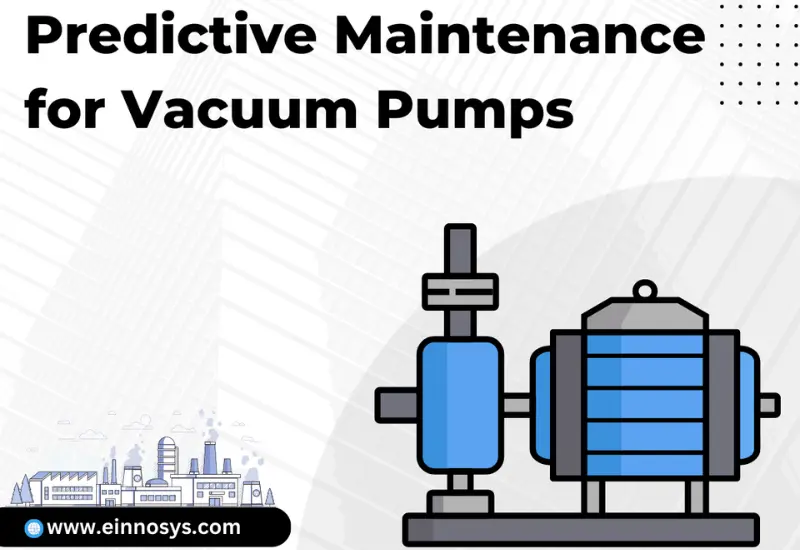
Why Predictive Maintenance Matters for Industrial Vacuum Pumps

Summary

  • Predictive maintenance for vacuum pumps utilizes IIoT sensors and data analytics to detect equipment failures before they occur.
  • Market data shows significant growth in industrial predictive maintenance, driven by the need to reduce unplanned downtime and maintenance costs.
  • Key monitoring parameters include vibration, temperature, and motor current, which provide early warning signs of mechanical wear.
  • Implementing these solutions leads to improved equipment reliability and extended asset lifespans.
  • Transitioning from reactive to condition-based maintenance offers a measurable ROI through energy savings and optimized spare parts inventory.

Introduction

According to Statista (2024), the global market for predictive maintenance is expected to reach approximately $15.9 billion by 2026 as industries seek to eliminate operational inefficiencies. Within high-precision manufacturing and process industries, the health of vacuum systems determines the quality of the final product. Implementing predictive maintenance for vacuum pumps provides a technological shield against the sudden mechanical failures that often lead to cascading production delays.

The shift toward industrial predictive maintenance reflects a broader move away from the “run until failure” mindset. Historically, facilities relied on rigid schedules or reactive repairs, both of which incur unnecessary costs. By integrating smart sensors, plant managers gain a real-time window into the internal health of their machinery.

A vacuum pump that stops working is essentially a silent protest in the middle of a production line, halting everything from semiconductor fabrication to food packaging. Rather than waiting for the protest to begin, modern reliability teams use data to address grievances before the machine decides to go on strike. This proactive approach ensures that equipment reliability remains a constant rather than a variable.

The Financial Impact of Vacuum Pump Failure

When a vacuum pump fails unexpectedly, the cost extends far beyond the price of a replacement unit. McKinsey (2023) reports that digitizing maintenance processes can reduce total maintenance costs by 10% to 40% while decreasing downtime by up to 50%. For a facility relying on continuous vacuum pressure, even an hour of lost suction can result in thousands of dollars in scrapped material.

Hidden Costs of Reactive Maintenance

Reactive maintenance often forces teams to pay premium rates for emergency shipping and overtime labor. These surprise expenses frequently balloon the total cost of ownership for vacuum systems. Furthermore, sudden failures can damage upstream or downstream equipment, creating a ripple effect of mechanical issues across the floor.

Efficiency Losses and Energy Waste

A pump nearing failure usually operates with diminished efficiency. It may draw more power to maintain the same vacuum level, leading to spiked utility bills. Vacuum pump monitoring identifies these efficiency drops early, allowing for minor adjustments that keep energy consumption within optimal ranges.

Mechanics of Predictive Maintenance for Vacuum Pumps

The core of predictive maintenance for vacuum pumps lies in the ability to capture and interpret subtle physical signals. Most mechanical failures leave “fingerprints” in the form of heat, noise, or movement changes long before the hardware actually seizes.

Vibration Analysis as a Diagnostic Tool

Vibration is the most common indicator of bearing wear or rotor imbalance. Specialized transducers attached to the pump housing measure frequency shifts. According to research from the Society for Maintenance & Reliability Professionals (SMRP) (2022), vibration monitoring can detect over 80% of rotating equipment issues before they become critical.

Thermal Monitoring and Lubrication Health

Excessive heat often points to friction caused by lubricant degradation or cooling system clogs. By tracking temperature trends, condition-based maintenance protocols can trigger an oil change exactly when needed. This prevents the “over-maintenance” trap where perfectly good oil is discarded simply because a calendar date was reached.

Motor Current and Pressure Analytics

Monitoring the electrical draw of the pump motor reveals if the system is working harder than intended. If pressure sensors indicate a slow climb in the time required to reach a specific vacuum level, it might suggest a leak or a failing seal. Combining these data points creates a holistic view of the system.

Scaling Reliability with IIoT Maintenance Solutions

The integration of the Industrial Internet of Things (IIoT) has changed how data moves from the machine to the decision-maker. IIoT maintenance solutions act as a central nervous system for the factory, connecting disparate pumps into a single, manageable interface.
Can a machine actually tell you it is tired before it collapses? Through machine learning algorithms, the answer is a resounding yes. These systems compare current performance against historical baselines, identifying anomalies that a human inspector would likely miss during a standard walk-through.

Breaking Down Data Silos

One major hurdle in traditional plants is that maintenance data lives in a paper log while production data lives in a digital PLC. Industrial predictive maintenance bridges this gap. When the maintenance team sees what the production team sees, they can coordinate repairs during scheduled gaps in the manufacturing cycle.

Remote Monitoring and Accessibility

With cloud-based platforms, a reliability engineer can check pump health from a tablet at home or a workstation across the country. This accessibility ensures that critical alerts reach the right people instantly, regardless of their physical location on the plant floor.

Steps to Implementing Condition-Based Maintenance

Transitioning to a predictive model requires more than merely buying a few sensors. It involves a shift in culture and a clear strategy for data management.

  • Criticality Assessment: Identify which vacuum pumps are essential to production and which have redundancies.
  • Sensor Selection: Choose hardware capable of surviving the specific environment, such as high heat or chemical exposure.
  • Baseline Establishment: Run the pumps under normal conditions to define what “healthy” looks like for that specific unit.
  • Alert Logic Configuration: Set thresholds for vibration, temperature, and pressure that trigger maintenance actions.
  • Continuous Improvement: Use failure data to refine the algorithms and improve the accuracy of future predictions.

Overcoming Common Implementation Challenges

Implementing IIoT maintenance solutions is not without its speed bumps. Maintenance managers often treat pumps like that one cousin who solely calls when they need money; you ignore the signs until a full-blown crisis occurs. Breaking this habit requires addressing technical and organizational hurdles.

Managing “Data Drowning”

A common mistake is collecting too much data without a plan to analyze it. Without proper filtering, the sheer volume of sensor readings can overwhelm a team. Effective systems use AI to surface the relevant “exceptions,” allowing engineers to focus on the pumps that actually require attention.

Integration with Legacy Equipment

Not every vacuum pump in a facility is a brand-new, “smart” model. Fortunately, many vacuum pump monitoring sensors can be retrofitted onto older machinery. This allows plants to modernize their reliability programs without a massive capital expenditure on new pumps.

The Future of Vacuum Pump Reliability

As sensor technology becomes more affordable, the barrier to entry for predictive maintenance for vacuum pumps continues to drop. We are moving toward a future where “autonomous maintenance” is the norm. In this scenario, the pump not only reports a fault but also triggers a work order and confirms that the necessary spare parts are in stock.

According to a report by Deloitte (2022), companies that adopt these advanced maintenance strategies see a 10% to 20% increase in equipment uptime. This improvement directly correlates to higher throughput and better profit margins.

Conclusion

Adopting predictive maintenance for vacuum pumps is no longer a luxury for high-tech facilities. It is a necessity for any operation prioritizing equipment reliability. By moving away from reactive “firefighting” and embracing condition-based maintenance, plants can protect their bottom line and ensure consistent production quality.
Contact Us Today

Get a Customized Plan to Monitor Your Industrial Vacuum Pumps

Benefits of Predictive Maintenance for Rotary Devices, Pumps, and Heating Elements

Summary

  • Cost Reduction: Modern maintenance strategies reduce maintenance costs by up to 30% and eliminate 75% of equipment breakdowns.
  • Asset Longevity: Real-time monitoring extends the life of rotating equipment maintenance cycles and heating components.
  • Operational Efficiency: Industrial IoT maintenance allows for planned repairs, preventing the “firefighting” culture in plants.
  • Specific Utility: Tailored approaches for pump predictive maintenance and heating element monitoring ensure specific failure modes like cavitation or burnout are caught early.
  • Data-Driven ROI: Transitioning to condition-based maintenance yields measurable gains in asset reliability and safety.

Introduction

According to a report by Deloitte (2023), poorly maintained industrial assets cost global manufacturers an estimated $50 billion annually. This staggering figure highlights a fundamental shift in how plant engineers view their machinery. Instead of waiting for a bearing to seize or a coil to pop, teams are turning to data to tell them when a failure is imminent.

Integrating predictive maintenance benefits into a facility does more than save a few dollars on spare parts. It fundamentally changes the relationship between the operator and the machine. By using sensors and software, facilities move from a “guess and check” schedule to a precise, data-backed strategy.

This approach is particularly vital for the three workhorses of the industrial world: rotary devices, pumps, and heating elements. These components are the literal heart and lungs of manufacturing. When they stop, everything stops.

The Financial and Operational Impact of Predictive Maintenance Benefits

The primary reason leadership teams greenlight technology investments is the financial return. According to a McKinsey (2022) study, AI-enhanced maintenance can boost production capacity by 20% while cutting inspection costs by 25%. These predictive maintenance benefits aren’t theoretical; they are the result of eliminating “unplanned” from the vocabulary of the plant floor.

Reducing Unplanned Downtime

Unplanned downtime is a silent profit killer. When a critical pump fails, it’s never during a scheduled break. It’s usually at 3:00 AM on a Tuesday during a peak production run. Transitioning to condition-based maintenance allows the team to see that failure coming weeks in advance. This foresight means parts are ordered and labor is scheduled during natural gaps in production.

Optimizing Spare Parts Inventory

Why keep $500,000 in spare motors sitting in a dusty warehouse? With asset reliability data, you know exactly which components are at risk. This allows for a “just-in-time” approach to inventory. You save on capital expenditure and reduce the footprint of your storage facilities.

Mastering Rotating Equipment Maintenance

Rotating equipment, such as motors, gearboxes, and fans, is the most common candidate for monitoring. These devices often signal their distress through vibration and heat long before they actually fail. Effective rotating equipment maintenance relies on catching these subtle hints.

Vibration Analysis: The Heartbeat of Rotary Devices

Every rotating machine has a unique vibration signature. When a bearing begins to pit or a shaft loses alignment, that signature shifts. Using industrial IoT maintenance tools, sensors detect these micro-changes in velocity and acceleration.

  • Early Detection: Catching misalignment before it ruins the bearing housing.
  • Precision Balancing: Identifying when a fan blade is slightly off-weight.
  • Lubrication Management: Knowing when grease is degraded, rather than greasing on a fixed (and often incorrect) calendar.

Case Study: The Paper Mill Motor

A large paper mill recently implemented vibration sensors on its main drive motors. Within three months, the system flagged a high-frequency peak on a specific bearing. Without this data, the motor would have likely seized within 48 hours. Instead, the team swapped the bearing during a shift change, saving an estimated $120,000 in lost production time.

Elevating Pump Predictive Maintenance

Pumps are notoriously difficult to manage because they deal with moving fluids, which introduces variables like pressure, viscosity, and chemistry. However, pump predictive maintenance has evolved to handle these complexities.

Monitoring for Cavitation and Flow Issues

Cavitation is the “pump killer.” It happens when vapor bubbles form and collapse, essentially sandblasting the internal components. By monitoring suction and discharge pressure alongside motor current, systems can alert operators to cavitation before the impeller is destroyed.

Seal Integrity and Leak Prevention

A leaking seal is a safety hazard and an environmental nightmare. Condition-based maintenance systems use ultrasonic sensors to “hear” the high-frequency hiss of a failing seal. This is far more effective than manual inspections, which might miss a small leak until it becomes a visible puddle.

  • Pressure Transducers: Monitoring for drops that indicate internal wear.
  • Current Signature Analysis: Detecting if the motor is working harder than usual to move the same volume of fluid.
  • Temperature Probes: Checking for overheating in the pump housing or motor casing.

Have you ever wondered why the most expensive pump in the building is always the one tucked in the darkest, hardest-to-reach corner? It’s an unwritten law of engineering, which makes remote monitoring even more essential.

Precision in Heating Element Monitoring

Heating elements are often ignored until they burn out. Because they have no moving parts, people assume they don’t need “maintenance.” This is a mistake. In industries like semiconductor manufacturing or food processing, precise temperature control is everything. Heating element monitoring ensures consistency and safety.

Resistance and Current Trends

As a heating element ages, its electrical resistance changes. By tracking the relationship between voltage and current, you can predict the remaining useful life of the coil. If the resistance spikes, a “hot spot” is likely forming, which could lead to a catastrophic burnout or a fire.

Thermal Imaging and IR Sensors

Fixed infrared (IR) sensors provide a 24/7 view of the heat distribution. In a large oven or a multi-zone heater, a single failing element can create “cold zones.” This ruins product quality long before the whole system shuts down. Industrial IoT maintenance platforms can trigger an alert the moment a zone deviates from its setpoint by even a fraction of a percent.

  • Preventing Thermal Runaway: Shutting down power before a fault causes a fire.
  • Energy Efficiency: Identifying elements that are drawing excess power due to scaling or degradation.
  • Quality Assurance: Ensuring every batch is treated with the exact thermal profile required.

The Role of Industrial IoT Maintenance and Data Analytics

The hardware (the sensors) is only half the battle. The real magic of predictive maintenance benefits happens in the software. Modern platforms take raw data—vibration, temperature, pressure—and turn it into actionable insights.

Asset Reliability Through Machine Learning

Machine learning algorithms are exceptionally good at finding patterns. They don’t just look at one sensor; they look at all of them simultaneously. If a pump’s temperature is rising and its vibration is increasing, the system knows that’s a much higher risk than a temperature spike alone. This holistic view is the definition of asset reliability.

Integrating with CMMS

When the IoT system detects a problem, it shouldn’t just send a text to a technician. It should automatically generate a work order in the Computerized Maintenance Management System (CMMS). This creates a seamless loop from “detection” to “fix.”

Overcoming the Challenges of Implementation

While the predictive maintenance benefits are clear, the path to implementation has a few speed bumps. Most of these aren’t technical; they are cultural.

  • Data Overload: Collecting too much data without a plan to analyze it.
  • Legacy Equipment: Retrofitting older machines with modern sensors (this is easier than it sounds with wireless IoT).
  • Skill Gaps: Training the team to trust the data over their “gut feeling.”

Is it better to spend a weekend fixing a machine that might break, or a weekend fixing a machine that is broken? Most engineers would choose the former, but it requires a shift in mindset from the front office to the shop floor.

Future Trends in Asset Reliability

Looking ahead, the integration of “Digital Twins” will further enhance predictive maintenance benefits. A Digital Twin is a virtual replica of your physical pump or motor. By running simulations on the twin, engineers can predict how the machine will react to different loads or environmental conditions without risking the actual equipment.

Furthermore, edge computing is making these systems faster. Instead of sending data to the cloud for analysis, the sensor itself (the “edge”) can make a split-second decision to shut down a machine if it detects a dangerous fault.

Conclusion

Embracing predictive maintenance benefits is no longer a luxury reserved for Fortune 500 companies. As sensor costs drop and AI becomes more accessible, even small-to-mid-sized plants can achieve world-class asset reliability. Whether you are managing complex rotating equipment maintenance, critical pump predictive maintenance, or sensitive heating element monitoring, the data is there for the taking. Moving to a condition-based maintenance model is the single most effective way to protect your equipment, your budget, and your peace of mind.

Contact Us Today

Get Expert Guidance to Prevent Failures in Pumps, Motors & Heating Systems