Predictive Maintenance vs Preventive Maintenance: A Guide for Semi Fabs

Summary

  • Cost Implications: Preventive maintenance often leads to “over-maintenance,” wasting spare parts and technician hours, while predictive strategies target only what is necessary.
  • Downtime Reduction: Predictive methods can reduce machine downtime by 30–50% and increase machine life by 20–40% compared to standard preventive schedules.
  • Data Dependency: While preventive maintenance relies on the calendar, predictive maintenance relies on real-time data integrity, requiring robust predictive maintenance software.
  • Implementation: The transition isn’t binary; a hybrid approach often yields the best ROI for semiconductor manufacturing facilities.
  • The Bottom Line: Moving from “repair when broken” or “repair on schedule” to “repair when needed” is the key to maximizing wafer yield and equipment availability.

Introduction

In the high-stakes world of semiconductor manufacturing, downtime is the ultimate antagonist. It burns money, ruins wafer yields, and gives fab managers gray hairs before their time. According to a recent report by McKinsey (2024), utilizing Industry 4.0 technologies specifically regarding machine health can reduce machine downtime by up to 50% and lower maintenance costs by 10–40%. Yet, many facilities remain stuck in a loop of fixing things that aren’t broken.

This brings us to the central debate in modern reliability engineering: predictive maintenance vs preventive maintenance. While the terms are often tossed around interchangeably in boardrooms, they represent fundamentally different philosophies. One relies on the safety of the calendar; the other trusts the honesty of the data.

For equipment engineers and fab managers, choosing the right path isn’t a philosophical exercise. It is a financial necessity.

The Core Conflict: Calendar vs. Condition

To understand the shift occurring in fabs right now, we have to strip these concepts down to their mechanics.

Predictive Maintenance vs Preventive Maintenance graph

Preventive Maintenance: The Scheduled Pit Stop

Preventive maintenance (PM) is the industry veteran. It is time-based or usage-based. You service the etch tool every 500 RF hours. You replace the vacuum pump seals every six months. You do this regardless of whether the seal is actually worn out.

The logic here is statistical. We assume that because most bearings fail after 10,000 cycles, we should replace all bearings at 9,000 cycles.

The Pros:

  • Easier to budget and plan.
  • Requires less complex technology to implement.
  • Extends equipment life compared to reactive (run-to-failure) maintenance.

The Cons:

  • Labor Drain: Technicians spend time fixing healthy machines.
  • Post-Maintenance Failure: Ironically, human intervention is a leading cause of equipment failure. Opening a chamber to replace a part that didn’t need replacing introduces the risk of particles or vacuum leaks.
  • Unexpected Breakdowns: Machines rarely die on a schedule. Random failures still occur between scheduled intervals.

Predictive Maintenance: The Smart Sensor Approach

Predictive maintenance (PdM) flips the script. Instead of asking “What day is it?”, it asks “How is the equipment feeling?”

By using predictive maintenance tools, engineers monitor the actual condition of the asset in real-time. Sensors track vibration, temperature, acoustic and ultrasonic signatures, and power consumption. The maintenance action is triggered only when parameters drift outside a specific control limit.

The Pros:

  • Maximized Part Life: You use a component until it is actually near the end of its life, not just when the manual says time is up.
  • Reduced Downtime: Maintenance is planned for when it is needed, avoiding unnecessary shutdowns.
  • Root Cause Analysis: The data trail helps pinpoint why a failure is developing.

The Cons:

  • High Upfront Cost: Requires investment in sensors and predictive maintenance software.
  • Data Complexity: You need teams capable of interpreting the noise.

Deep Dive: Predictive Maintenance vs Preventive Maintenance in the Fab

When we look at predictive maintenance vs preventive maintenance specifically through the lens of a semiconductor fab, the stakes change. A pump failure in a water treatment plant is annoying; a pump failure in a CVD process can scrap many valuable wafers.

Here is how the two approaches stack up in a cleanroom environment:

1. The Trigger Mechanism

  • Preventive: A work order is generated automatically by the CMMS (Computerized Maintenance Management System) based on elapsed time or wafer count.
  • Predictive: A work order is generated by the IoT platform or MES (Manufacturing Execution System) when a specific threshold (e.g., vibration on a turbopump) is breached.

2. The Hardware Requirement

Preventive maintenance generally utilizes standard tools. If you have a wrench and a clipboard (or a tablet), you are good to go.

Predictive maintenance requires a digital nervous system. You need vibration sensors on motors, current transducers on power supplies, and particle counters in vacuum lines. This brings us to the realm of predictive vs preventive maintenance infrastructure. You cannot do PdM without the “P” (Predictive) hardware.

3. The Skill Gap

This is often overlooked. Moving to a predictive model requires your maintenance staff to evolve. They stop being just mechanics and start becoming data analysts. They need to understand what an FFT (Fast Fourier Transform) spectrum looks like on a vibration plot.

Note: The goal isn’t to replace technicians with software. It is to give technicians superpowers so they know exactly which screw to turn before they even gown up.

Why Preventive Maintenance Isn’t Enough Anymore

Fab managers are dealing with node sizes that are shrinking faster than a wool sweater in a hot dryer. As we move toward 3nm and 2nm processes, the margin for error effectively vanishes.

Predictive Maintenance vs Preventive Maintenance: The Over-Maintenance Trap

In an effort to avoid downtime, many fabs fall into the trap of over-maintenance. They shorten their PM cycles. Instead of cleaning a chamber every week, they do it every three days.

This kills availability. If your tool is down for scheduled maintenance 20% of the time, that is 20% lost production capacity. Preventive vs predictive maintenance debates often settle here: PdM buys you that time back.

According to the U.S. Department of Energy (2022), a functional predictive maintenance program can yield a 30% to 40% reduction in maintenance costs and a 35% to 45% reduction in downtime. For a high-volume fab, those percentages translate to millions of dollars in recovered revenue.

The Role of Data and Software

You cannot simply “decide” to do predictive maintenance. You need the ecosystem. This is where predictive maintenance software enters the chat.

Connecting the Dots (literally)

Semiconductor equipment is chatty. Through SECS/GEM and Interface A (EDA) standards, tools are constantly broadcasting data. The challenge is catching it.

Robust software solutions act as the aggregator. They pull data from:

  1. FDC (Fault Detection and Classification) Systems: Watching process parameters.
  2. Add-on Sensors: Vibration or thermal monitors retrofitted to older equipment.
  3. Facility Systems: Chiller temps, cleanroom humidity.

Making Sense of the Noise

Raw data is useless. If a graph spikes, does it mean the motor is dying, or did someone just bump the machine?

Advanced predictive maintenance tools use Machine Learning (ML) algorithms to learn the “normal” behavior of a specific tool. They can distinguish between a harmless anomaly and a developing catastrophe.

  • Analogy Time: It is like a doctor listening to your heart. A preventative approach is a checkup once a year. A predictive approach is wearing a smartwatch that alerts you the second your heart rate creates an irregular pattern.

Implementation Challenges (and How to Beat Them)

Switching strategies is not as simple as flipping a switch. If it were easy, everyone would have done it by now.

Challenge 1: The Legacy Equipment Problem

Fabs are a mix of brand-new ASML scanners and 20-year-old wet benches. Older tools often lack the built-in sensors required for deep analytics.

  • Solution: Retrofitting. Utilizing non-intrusive sensors (like clamping current sensors) allows you to extract data from legacy tools without voiding warranties or risking signal interference.

Challenge 2: Data Silos

The vibration data lives in one server; the process data lives in another.

  • Solution: Integration middleware. You need a unified layer that brings OT (Operational Technology) and IT together. This is a core competency for teams working on MES integration.

Challenge 3: Alert Fatigue

If your predictive maintenance software screams “Emergency!” every five minutes, technicians will eventually mute it.

  • Solution: Tuning. The implementation phase requires a period of “training” the model to minimize false positives.

The ROI Equation

When pitching predictive vs preventive maintenance to leadership, speak the language of finance.

Unplanned Downtime Costs

In the semiconductor industry, unplanned downtime is exceptionally expensive due to the WIP (Work in Progress) at risk. If a batch process fails, you don’t just lose time; you might scrap a cassette of wafers that has already accumulated weeks of processing value.

Inventory Reduction

With preventive maintenance, you need a warehouse full of spare parts “just in case.” With predictive strategies, you order parts based on the degradation curve of the component. This creates a Just-In-Time (JIT) maintenance inventory, freeing up capital tied up in stock.

Making the Switch: A Hybrid Approach

Here is the secret that purists might not tell you: You don’t have to choose one or the other exclusively.

The most effective maintenance strategies are hybrid.

  • Run-to-Failure: For cheap, non-critical assets (like lightbulbs in the hallway).
  • Preventive: For assets with strict regulatory requirements or where failure modes are purely age-related and totally predictable.
  • Predictive: For critical assets (Cluster tools, pumps, RF generators) where uptime is revenue.

Understanding the balance of predictive maintenance vs preventive maintenance allows you to allocate resources where they hurt the least and help the most.

Conclusion

The battle of predictive maintenance vs preventive maintenance isn’t about proving one is superior in a vacuum. It is about matching the strategy to the asset. However, as semiconductor manufacturing becomes more automated and data-rich, the scales are tipping heavily toward predictive strategies.

The days of opening up a perfectly good machine just because the calendar says so are numbered. By adopting the right predictive maintenance software and shifting your culture from reactive to proactive, you gain the ultimate competitive advantage: reliability.

Frequently Asked Questions

Q1: How does the cost of predictive maintenance compare to preventive maintenance?

A: Predictive maintenance costs more upfront because of sensors and analytics, but the real difference between preventive vs predictive maintenance is long-term savings. PdM reduces unnecessary scheduled work, cuts unplanned downtime, and delivers higher ROI, especially in semiconductor fabs.

Q2: Which strategy is better for critical semiconductor tools?

A: Predictive maintenance is best for high-value tools like lithography and etch systems, where failures are extremely expensive. Preventive tasks still matter, but the ideal approach is a hybrid model fixed PM cycles supported by real-time condition monitoring to protect yield and extend tool life.

Q3: What are the biggest challenges when moving from preventive to predictive maintenance?

A: The toughest hurdles are cultural, not technical. Teams used to scheduled PM may resist change, and managers may worry about cost. Shifting to a predictive vs preventive maintenance model requires training, clear ROI communication, and strong change management.

Q4: Should I use preventive maintenance for some assets and predictive maintenance for others?

A: Yes. A preventive vs predictive maintenance review usually shows that low-risk, predictable assets work fine with simple time-based PM. Use predictive maintenance for high-impact, complex tools where failures cause major downtime or scrap.

Q5: What data quality does predictive maintenance require?

A: High data quality is critical. Poor sensor data, missing integrations, or siloed systems (FDC, MES, CMMS) lead to false alerts. PdM only works well when data is clean, consistent, and accurate enough for the model to learn normal vs abnormal behavior.

Predictive Maintenance Software: Reduce Downtime with AI

Summary

  • Predictive maintenance software leverages real-time data and AI to forecast equipment failures before they occur, shifting from reactive to proactive maintenance.
  • Adopting these tools can reduce machine downtime by up to 50% and extend machine life by up to 40%, significantly impacting the bottom line.
  • Key technologies driving this shift include IoT predictive maintenance tools, vibration analysis sensors, and machine learning algorithms that detect anomalies early.
  • Successful implementation requires overcoming data silos and cultural resistance, moving away from “run-to-failure” mindsets toward data-driven decision-making.
  • Modern solutions integrate seamlessly with existing maintenance management software (CMMS) to automate work orders and streamline industrial operations.

Introduction

Unplanned downtime is the industrial equivalent of a root canal: painful, expensive, and usually happening at the worst possible moment. According to a report by Aberdeen Strategy & Research (2023), the average cost of unplanned downtime across all manufacturing sectors has surged to roughly $260,000 per hour. That is a staggering figure. For a semiconductor plant or a high-volume automotive line, a single stopped conveyor belt burns through capital faster than a furnace.

This financial hemorrhage explains why reliability engineers are scrambling to adopt predictive maintenance software. The era of crossing your fingers and hoping the motor lasts until the next scheduled shutdown is over. By utilizing advanced algorithms and sensor data, modern platforms provide a window into the future health of your assets. It is no longer about fixing things when they break; it is about knowing they will break three weeks from Tuesday.

The industrial landscape is shifting toward data-driven reliability. Facilities that ignore this transition risk will be left behind with their clipboards and grease guns. This guide explores how predictive maintenance software works, the ROI it delivers, and why it has become the backbone of smart manufacturing.


From Reactive Chaos to Intelligent Prediction

To understand the value of predictive tools, we must look at the evolution of maintenance strategies. For decades, the industry operated on two primary models: reactive and preventive.

The Old Ways: Run-to-Failure and Preventive

Reactive maintenance is simple: run the machine until smoke comes out, then fix it. While this requires zero planning, the catastrophic costs of emergency repairs and lost production make it unsustainable for critical assets.
Preventive maintenance (PM) was the first step toward sanity. This involves servicing equipment on a fixed schedule, like changing your car’s oil every 5,000 miles. It works, but it is inefficient. You might replace a perfectly good bearing simply because the calendar says so. This leads to wasted parts and unnecessary labor.

The New Standard: Condition-Based Maintenance

Predictive maintenance software changes the trigger from “time” to “condition.” It relies on condition monitoring software to assess the actual health of the machine.

Imagine if your car didn’t tell you to change the oil based on mileage, but instead analyzed the viscosity and particulate matter in the oil every second, alerting you the moment it degraded. That is the essence of predictive analytics. It maximizes the useful life of a component while preventing it from failing.

The Mechanics: How the Software Works

It might seem like magic, but it is purely math and physics. The software acts as the central brain, processing streams of data from the factory floor.

The Eyes and Ears IoT and Sensors

The Eyes and Ears: IoT and Sensors

The process begins with IoT predictive maintenance tools. Sensors attached to equipment measure various physical parameters.

Vibration Analysis: The most common method for rotating machinery. Changes in vibration patterns often indicate misalignment or bearing wear weeks before failure.

Thermography: Heat is a telltale sign of friction or electrical faults.

Acoustic Monitoring: Sonic and ultrasonic sensors detect gas leaks or friction sounds inaudible to human ears.
These sensors feed data into industrial asset monitoring systems continuously.

The Brain: AI and Machine Learning

Raw data is useless without interpretation. This is where AI maintenance software steps in. The software establishes a baseline for “normal” operation. When a data point deviates from this baseline, perhaps a motor is vibrating 2% more than usual, the AI flags it.

Sophisticated algorithms compare these anomalies against historical failure data. The system might flag an alert: “85% probability of bearing seizure in Motor 3 within 14 days.”

The Business Case: ROI and Benefits

Why should a CFO sign off on this investment? The answer lies in the numbers. According to Deloitte (2022), predictive maintenance can reduce maintenance costs by 25%, lower breakdowns by 70%, and reduce downtime by 50%.

Slash Unplanned Downtime

The most direct benefit is keeping the line running. By catching issues early, maintenance teams can schedule repairs during planned outages or shift changes. This prevents the “2:00 AM emergency call” that every plant manager dreads.

Optimize Spare Parts Inventory

Maintenance management software linked with predictive tools allows for “just-in-time” inventory. Instead of stocking expensive motors “just in case,” you order them when the software indicates a decline in asset health. This frees up working capital previously tied up in dusty warehouse shelves.

Enhanced Worker Safety

Catastrophic failures are dangerous. A boiler explosion or a high-speed belt snap puts lives at risk. Industrial predictive maintenance keeps equipment within safe operating limits, protecting the workforce from mechanical hazards.

Key Features of Top-Tier Software

When evaluating vendors, look for these specific capabilities to ensure the system can handle the rigors of your facility.

Real-Time Equipment Monitoring and Edge Computing

Cloud processing is great, but latency can be an issue. The best solutions often employ edge computing, processing critical data directly on the device (the “edge”) for instant alerts. Real-time equipment monitoring ensures that if a critical threshold is breached, the shut-off signal is immediate.

Seamless CMMS Integration

Your predictive tool should not be an island. It must talk to your CMMS predictive maintenance module. When an anomaly is detected, the software should automatically generate a work order in the CMMS, complete with the diagnostic data and recommended repair actions. This removes the manual step of a human having to interpret a graph and type out a request.

Scalability and Asset Agility

You might start with ten critical motors, but you will eventually want to monitor hundreds of assets. Ensure the licensing and architecture support scaling without requiring a complete system overhaul.

Challenges in Implementation

Despite the clear benefits, adoption isn’t always smooth. It requires a culture shift as much as technology.

The Data Silo Problem

Many factories suffer from fragmented data. The SCADA system doesn’t talk to the ERP, and the maintenance logs are on paper. Industrial IoT maintenance solutions serve as the bridge, but cleaning and normalizing this data is often the hardest part of the project.

The “Experienced Mechanic” Factor

There is often pushback from veteran staff who prefer “percussive maintenance” (hitting it with a wrench) or who trust their gut over a computer.

Overcoming this requires training and showing the team that the software is a tool to make their lives easier, not a replacement for their expertise.

Industry Use Cases

Semiconductor Manufacturing

In wafer fabrication, precision is everything. A slight vibration in a vacuum pump can ruin a batch of chips worth millions. Einnosys understands that in this sector, machine health monitoring must be hyper-sensitive. Predictive tools track the degradation of electrostatic chucks and robot arms to ensure yield remains high.

Automotive and Heavy Industry

For automotive plants using thousands of robotic arms, maintenance automation software is critical. Predicting servo motor failure on a welding robot prevents the entire assembly line from halting, ensuring the “one car per minute” target remains viable.

The Future: Generative AI and Digital Twins

The next frontier is the integration of Generative AI. Instead of reading a graph, you might soon ask your predictive analytics for maintenance system, “What is the health status of Line 4?” and receive a conversational summary.

Furthermore, Digital Twin technology allows engineers to create a virtual replica of a machine. They can run simulations on the twin to see how increased load might affect lifespan, helping refine maintenance schedules without risking the physical asset.

Conclusion

Ultimately, adopting predictive maintenance software is no longer a futuristic luxury but a fundamental necessity for staying competitive in the modern industrial landscape. By pivoting from reactive “firefighting” to data-driven foresight, manufacturers can unlock massive value, slashing unplanned downtime, extending asset lifecycles, and empowering teams to work smarter, not harder. The days of crossing your fingers and hoping a machine lasts are over; the future belongs to facilities that listen to their data to ensure reliability and operational excellence.

FAQs

  • What is the difference between preventive and predictive maintenance?

    Preventive maintenance is schedule-based (e.g., every month), regardless of the machine’s condition. Predictive maintenance is condition-based, meaning maintenance is performed only when data indicates a decline in performance or an impending failure.

  • Does predictive maintenance software require new sensors?

    Often, yes. While some modern equipment comes with built-in sensors, older legacy machines usually require retrofitting with external vibration, temperature, or acoustic sensors to feed data into the IoT predictive maintenance tools.

  • Can this software integrate with my existing CMMS?

    Yes, most enterprise-grade predictive platforms are designed to integrate via API with major CMMS providers (like SAP, Maximo, or specialized maintenance tools), enabling automated work order generation.

  • What industries benefit most from industrial predictive maintenance?

    Industries with high downtime costs or critical safety requirements benefit most. This includes semiconductor manufacturing, oil and gas, power generation, automotive, and pharmaceutical manufacturing.

Benefits of Predictive Maintenance for Rotary Devices, Pumps, and Heating Elements

Summary

  • Cost Reduction: Modern maintenance strategies reduce maintenance costs by up to 30% and eliminate 75% of equipment breakdowns.
  • Asset Longevity: Real-time monitoring extends the life of rotating equipment maintenance cycles and heating components.
  • Operational Efficiency: Industrial IoT maintenance allows for planned repairs, preventing the “firefighting” culture in plants.
  • Specific Utility: Tailored approaches for pump predictive maintenance and heating element monitoring ensure specific failure modes like cavitation or burnout are caught early.
  • Data-Driven ROI: Transitioning to condition-based maintenance yields measurable gains in asset reliability and safety.

Introduction

According to a report by Deloitte (2023), poorly maintained industrial assets cost global manufacturers an estimated $50 billion annually. This staggering figure highlights a fundamental shift in how plant engineers view their machinery. Instead of waiting for a bearing to seize or a coil to pop, teams are turning to data to tell them when a failure is imminent.

Integrating predictive maintenance benefits into a facility does more than save a few dollars on spare parts. It fundamentally changes the relationship between the operator and the machine. By using sensors and software, facilities move from a “guess and check” schedule to a precise, data-backed strategy.

This approach is particularly vital for the three workhorses of the industrial world: rotary devices, pumps, and heating elements. These components are the literal heart and lungs of manufacturing. When they stop, everything stops.

The Financial and Operational Impact of Predictive Maintenance Benefits

The primary reason leadership teams greenlight technology investments is the financial return. According to a McKinsey (2022) study, AI-enhanced maintenance can boost production capacity by 20% while cutting inspection costs by 25%. These predictive maintenance benefits aren’t theoretical; they are the result of eliminating “unplanned” from the vocabulary of the plant floor.

Reducing Unplanned Downtime

Unplanned downtime is a silent profit killer. When a critical pump fails, it’s never during a scheduled break. It’s usually at 3:00 AM on a Tuesday during a peak production run. Transitioning to condition-based maintenance allows the team to see that failure coming weeks in advance. This foresight means parts are ordered and labor is scheduled during natural gaps in production.

Optimizing Spare Parts Inventory

Why keep $500,000 in spare motors sitting in a dusty warehouse? With asset reliability data, you know exactly which components are at risk. This allows for a “just-in-time” approach to inventory. You save on capital expenditure and reduce the footprint of your storage facilities.

Mastering Rotating Equipment Maintenance

Rotating equipment, such as motors, gearboxes, and fans, is the most common candidate for monitoring. These devices often signal their distress through vibration and heat long before they actually fail. Effective rotating equipment maintenance relies on catching these subtle hints.

Vibration Analysis: The Heartbeat of Rotary Devices

Every rotating machine has a unique vibration signature. When a bearing begins to pit or a shaft loses alignment, that signature shifts. Using industrial IoT maintenance tools, sensors detect these micro-changes in velocity and acceleration.

  • Early Detection: Catching misalignment before it ruins the bearing housing.
  • Precision Balancing: Identifying when a fan blade is slightly off-weight.
  • Lubrication Management: Knowing when grease is degraded, rather than greasing on a fixed (and often incorrect) calendar.

Case Study: The Paper Mill Motor

A large paper mill recently implemented vibration sensors on its main drive motors. Within three months, the system flagged a high-frequency peak on a specific bearing. Without this data, the motor would have likely seized within 48 hours. Instead, the team swapped the bearing during a shift change, saving an estimated $120,000 in lost production time.

Elevating Pump Predictive Maintenance

Pumps are notoriously difficult to manage because they deal with moving fluids, which introduces variables like pressure, viscosity, and chemistry. However, pump predictive maintenance has evolved to handle these complexities.

Monitoring for Cavitation and Flow Issues

Cavitation is the “pump killer.” It happens when vapor bubbles form and collapse, essentially sandblasting the internal components. By monitoring suction and discharge pressure alongside motor current, systems can alert operators to cavitation before the impeller is destroyed.

Seal Integrity and Leak Prevention

A leaking seal is a safety hazard and an environmental nightmare. Condition-based maintenance systems use ultrasonic sensors to “hear” the high-frequency hiss of a failing seal. This is far more effective than manual inspections, which might miss a small leak until it becomes a visible puddle.

  • Pressure Transducers: Monitoring for drops that indicate internal wear.
  • Current Signature Analysis: Detecting if the motor is working harder than usual to move the same volume of fluid.
  • Temperature Probes: Checking for overheating in the pump housing or motor casing.

Have you ever wondered why the most expensive pump in the building is always the one tucked in the darkest, hardest-to-reach corner? It’s an unwritten law of engineering, which makes remote monitoring even more essential.

Precision in Heating Element Monitoring

Heating elements are often ignored until they burn out. Because they have no moving parts, people assume they don’t need “maintenance.” This is a mistake. In industries like semiconductor manufacturing or food processing, precise temperature control is everything. Heating element monitoring ensures consistency and safety.

Resistance and Current Trends

As a heating element ages, its electrical resistance changes. By tracking the relationship between voltage and current, you can predict the remaining useful life of the coil. If the resistance spikes, a “hot spot” is likely forming, which could lead to a catastrophic burnout or a fire.

Thermal Imaging and IR Sensors

Fixed infrared (IR) sensors provide a 24/7 view of the heat distribution. In a large oven or a multi-zone heater, a single failing element can create “cold zones.” This ruins product quality long before the whole system shuts down. Industrial IoT maintenance platforms can trigger an alert the moment a zone deviates from its setpoint by even a fraction of a percent.

  • Preventing Thermal Runaway: Shutting down power before a fault causes a fire.
  • Energy Efficiency: Identifying elements that are drawing excess power due to scaling or degradation.
  • Quality Assurance: Ensuring every batch is treated with the exact thermal profile required.

The Role of Industrial IoT Maintenance and Data Analytics

The hardware (the sensors) is only half the battle. The real magic of predictive maintenance benefits happens in the software. Modern platforms take raw data—vibration, temperature, pressure—and turn it into actionable insights.

Asset Reliability Through Machine Learning

Machine learning algorithms are exceptionally good at finding patterns. They don’t just look at one sensor; they look at all of them simultaneously. If a pump’s temperature is rising and its vibration is increasing, the system knows that’s a much higher risk than a temperature spike alone. This holistic view is the definition of asset reliability.

Integrating with CMMS

When the IoT system detects a problem, it shouldn’t just send a text to a technician. It should automatically generate a work order in the Computerized Maintenance Management System (CMMS). This creates a seamless loop from “detection” to “fix.”

Overcoming the Challenges of Implementation

While the predictive maintenance benefits are clear, the path to implementation has a few speed bumps. Most of these aren’t technical; they are cultural.

  • Data Overload: Collecting too much data without a plan to analyze it.
  • Legacy Equipment: Retrofitting older machines with modern sensors (this is easier than it sounds with wireless IoT).
  • Skill Gaps: Training the team to trust the data over their “gut feeling.”

Is it better to spend a weekend fixing a machine that might break, or a weekend fixing a machine that is broken? Most engineers would choose the former, but it requires a shift in mindset from the front office to the shop floor.

Future Trends in Asset Reliability

Looking ahead, the integration of “Digital Twins” will further enhance predictive maintenance benefits. A Digital Twin is a virtual replica of your physical pump or motor. By running simulations on the twin, engineers can predict how the machine will react to different loads or environmental conditions without risking the actual equipment.

Furthermore, edge computing is making these systems faster. Instead of sending data to the cloud for analysis, the sensor itself (the “edge”) can make a split-second decision to shut down a machine if it detects a dangerous fault.

Conclusion

Embracing predictive maintenance benefits is no longer a luxury reserved for Fortune 500 companies. As sensor costs drop and AI becomes more accessible, even small-to-mid-sized plants can achieve world-class asset reliability. Whether you are managing complex rotating equipment maintenance, critical pump predictive maintenance, or sensitive heating element monitoring, the data is there for the taking. Moving to a condition-based maintenance model is the single most effective way to protect your equipment, your budget, and your peace of mind.

Contact Us Today

Get Expert Guidance to Prevent Failures in Pumps, Motors & Heating Systems

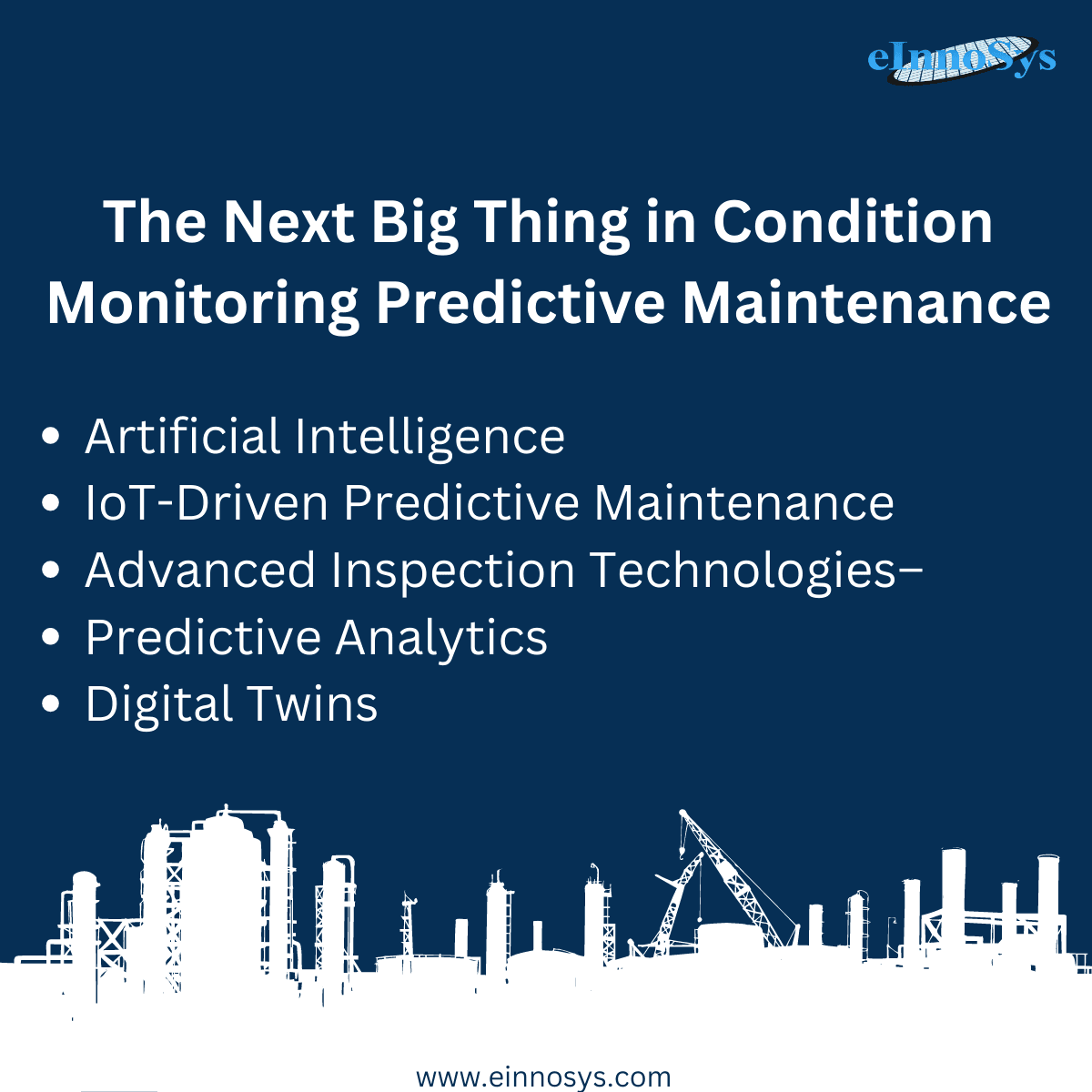
The Next Big Thing in Condition Monitoring Predictive Maintenance

Running a manufacturing unit is challenging due to various external and internal factors. While companies invest in the efficiency of their staff through corporate training, they also need to enhance the efficiency of machines. Therefore, production becomes static at a certain saturation point. Nevertheless, production needs to be improved due to the wear and tear of the machines.

The introduction of predictive maintenance and condition monitoring has changed the scenario drastically, as manufacturing units can now predict the maintenance and repair required for a production unit. According to the reports, the global predictive maintenance market size was 7.3 billion USD in 2022. But, the market size will be around 64.3 billion USD by 2030. So, the huge growth in market size suggests that IoT predictive maintenance and condition monitoring is the next big thing.

Businesses should partner with professional and reliable companies to integrate predictive maintenance and condition monitoring solutions. The experts suggest that predictive maintenance will undergo various changes due to emerging technologies. In the following section, you can find a guide on the upcoming trends in predictive maintenance.

1. Artificial Intelligence

PDM maintenance has started evolving with artificial intelligence. Artificial intelligence (AI), machine learning, and deep learning technologies aim to run specific industrial tasks without human intervention. The AI applications will collect data from different sources and run data analysis simultaneously. As a result, the machine will become self-sufficient to predict its maintenance and repair.

AI-driven predictive maintenance and condition monitoring will be more cost-effective for businesses. Since no humans are involved in data collection and analysis, the process will be cheaper. On the other hand, predictions for maintenance and repair will be more accurate due to machine intelligence.

2. IoT-Driven Predictive Maintenance

One can use IoT predictive maintenance in different ways to establish more efficient predictive maintenance. For example, many businesses have multiple assets, and monitoring the predictive maintenance of those assets is challenging. The job will be much easier when you have a central platform to track and watch the predictive maintenance of all machines.

The Internet of Things (IoT) collects data from different sources and interprets data to create structured analytics. For example, smart sensors collect information such as supply voltage, operating temperature, vibration, etc. IoT-driven applications collect such data and create analytics and insights. Both human operators and machine intelligence can interpret data and make maintenance decisions accordingly.

3. Advanced Inspection Technologies

Condition monitoring maintenance is an integral part of predictive maintenance. Condition monitoring tries to keep machines from breaking down so that a factory can make things without stopping. Introducing advanced inspection technologies can improve the accuracy of preventing machine failure.

Nowadays, predictive maintenance integrates robotic inspection to improve condition monitoring efficiency. Instead of humans, robots inspect and assess the machine’s condition. On the other hand, ultrasonic analysis has also become an advanced inspection technology. The ultrasonic analysis helps identify problems with a machine’s internal parts. The technology can check the condition of even the most fragile parts and give accurate data.

4. Predictive Analytics

The production units are moving from preventative maintenance to predictive maintenance. However, separating preventive maintenance and predictive maintenance often requires more work. Preventative maintenance often becomes a part of predictive maintenance, though preventative maintenance leads to a higher expense for businesses.

PDM solutions are the next big thing in predictive maintenance, as these analytics-driven solutions analyze unstructured data and convert it into structured data. Robust data analytics makes predictive maintenance systems more cost-effective by eliminating preventative maintenance. Therefore, a production unit will only invest in maintenance where it is required. Preventative maintenance proves unnecessary in various scenarios.

5. Digital Twins

The digital twin is one of the trending predictive maintenance technologies. The way we track the changes in industrial equipment could be better with the technology we have now. The digital twin can help businesses overcome such challenges by creating a virtual replica of the physical equipment. As a result, the operators can manage the machines from the virtual platforms. Monitoring the machines from the virtual platforms and scheduling maintenance will save time and hassles.

So, these are the next big things you can expect to see in the predictive maintenance industry 4.0 in the future. Overall, the next-level technologies will be more data-driven to establish automation to eliminate human intervention.

5 Core Benefits of Predictive Maintenance for Smart Manufacturing

Summary

  • Drastic Downtime Reduction: Implementing predictive maintenance can decrease unplanned machine failures by up to 70% (Deloitte, 2022).
  • Financial Optimization: Manufacturers see an average ROI of 10x through reduced repair costs and better spare parts management.
  • Asset Longevity: Real-time monitoring extends the useful life of heavy machinery by preventing “run-to-failure” cycles.
  • Safety & Compliance: Automated alerts prevent catastrophic failures, ensuring a safer work environment and easier regulatory adherence.
  • Operational Excellence: Data-driven insights streamline labor allocation, allowing technicians to focus on high-value tasks rather than routine checks.

Introduction

According to a study by Deloitte (2022), predictive maintenance can reduce maintenance costs by 25%, reduce breakdowns by 70%, and lower equipment downtime by 50%. These figures represent a massive shift in how factory floors function. For decades, maintenance crews operated on a “fix it when it breaks” or a “fix it every six months regardless of health” schedule, neither of which suits the demands of a high-speed production line.

Modern manufacturing thrives on precision. A single bearing failure in a conveyor system can halt an entire facility, leading to thousands of dollars in lost revenue every minute. By using manufacturing predictive maintenance, leaders move away from guesswork. This approach uses sensors and data analytics to determine exactly when a machine requires attention before a problem actually occurs.

The transition toward smart maintenance systems is no longer a luxury for the few. As global competition intensifies, the ability to maintain continuous uptime becomes a primary differentiator. This article explores the specific ways that a data-centric industrial maintenance strategy reshapes the bottom line and improves factory culture.

The Financial Impact of Predictive Maintenance Benefits

The most immediate reason organizations adopt a new industrial maintenance strategy is the impact on the profit and loss statement. Traditional methods often waste money on parts that still have life or, conversely, lose money when an unexpected crash occurs.

Reducing Unplanned Downtime Costs

Unplanned downtime is the “silent killer” of manufacturing profitability. When a machine stops without warning, the costs ripple through the organization: idle labor, missed delivery deadlines, and rush shipping fees for replacement parts. According to Forbes (2022), industrial manufacturers lose an estimated $50 billion annually to downtime. Predictive maintenance mitigates this by providing an early warning system.

Optimizing Spare Parts Inventory

Many facilities keep a “just in case” warehouse full of expensive components. This ties up capital that could be used elsewhere. By understanding the health of assets through condition-based maintenance, managers order parts exactly when needed. This shift toward a “just-in-time” parts model reduces warehouse overhead and minimizes the risk of components becoming obsolete while sitting on a shelf.

Labor Efficiency and Allocation

Instead of sending a technician to check 50 machines that are running perfectly, sensors identify the three that actually require a look. This ensures that the maintenance team is always working on the most critical tasks. It also reduces the need for overtime pay during emergency “all hands on deck” repair scenarios.

Extending Asset Life with Condition-Based Maintenance

Machines are expensive. Whether it is a CNC mill or a robotic arm, these assets represent a significant capital investment. Treating them well is common sense, yet the “run-to-failure” mentality persists in many legacy shops.

Preventing Secondary Damage

When one small component fails, it often triggers a chain reaction. A worn belt might cause a motor to overheat, which then fries the control board. By using predictive maintenance benefits to catch the belt wear early, you save the motor and the electronics. This proactive approach ensures that the “health” of the machine remains high throughout its lifecycle.

Consistent Performance and Quality

Degrading machines rarely produce high-quality parts. A lathe with a slightly vibrating spindle will produce components with poor surface finishes or out-of-spec dimensions. Monitoring the condition of the tool ensures that every piece coming off the line meets quality standards. This reduces the “scrap rate,” which is another hidden cost of poor maintenance.

Enhancing Workplace Safety and Compliance

Safety is paramount in any industrial setting. A sudden mechanical failure is not a mere inconvenience; it is a hazard. According to the Bureau of Labor Statistics (2023), mechanical failures are a contributing factor in thousands of industrial accidents annually.

Mitigating Catastrophic Failures

High-speed rotating equipment or pressurized systems can be dangerous if they fail suddenly. Smart maintenance systems monitor for the precursors of these events, such as abnormal heat or excessive vibration. By shutting down or repairing a machine before a catastrophic failure, companies protect their most valuable asset: their people.

Simplified Regulatory Audits

In regulated industries like aerospace or pharmaceuticals, documentation is everything. Having a digital log of all maintenance activities and sensor data makes compliance audits a breeze. Instead of digging through greasy paper logs, managers present a clean, data-backed report showing that every machine was maintained according to safety standards.

Boosting Total Throughput and Productivity

A factory that never stops is a factory that makes money. The primary goal of an industrial maintenance strategy is to keep the “green lights” on across the floor.

Eliminating the “Maintenance Window” Bottleneck

Traditional preventive maintenance often requires scheduled shutdowns. While these are better than unplanned crashes, they still stop production. Predictive models allow for “opportunistic maintenance.” If a line is down for a product changeover, the system can signal that now is the perfect time to fix a nearing-end-of-life component on a nearby machine.

Energy Efficiency Gains

Worn-out machinery is notoriously inefficient. A motor with bad bearings or a compressor with a small leak consumes significantly more power to do the same amount of work. According to a report by the U.S. Department of Energy (2022), well-maintained industrial equipment can be 15% to 20% more energy-efficient. Lower energy bills are a direct, albeit sometimes overlooked, benefit of staying on top of machine health.

Building a Data-Driven Culture in the Factory

The shift to manufacturing predictive maintenance changes the mindset of the entire organization. It moves the culture from “reactive and stressed” to “proactive and informed.”

Improved Inter-Departmental Communication

When maintenance has data, they can speak the language of the finance and operations departments. Instead of saying, “I think we need to fix this,” they can say, “The data shows an 85% chance of failure within the next 48 hours.” This clarity helps leadership make better decisions regarding production schedules and budget allocations.

Upskilling the Workforce

Adopting smart maintenance systems provides an opportunity for technicians to learn new skills. Moving from turning wrenches to analyzing data dashboards makes the workforce more versatile and valuable. This upskilling is a core component of the Industry 4.0 movement and helps with employee retention in a competitive labor market.

How to Begin Your Predictive Maintenance Journey

Many managers feel overwhelmed by the idea of “going digital.” However, you do not have to automate every single bolt in the building on day one.

  • Step 1: Identify Critical Assets. Start with the “bottleneck” machines—the ones that would cause the most pain if they stopped.
  • Step 2: Choose the Right Sensors. Vibration, temperature, and acoustic sensors are the most common starting points.
  • Step 3: Pilot a Smart Maintenance System. Use a small-scale implementation to prove the ROI before scaling across the entire plant.
  • Step 4: Integrate with Existing Systems. Ensure your maintenance data flows into your ERP or CMMS for a unified view of the facility.

Is it possible to skip these steps? Of course, but doing so is a bit like trying to bake a cake without a recipe. You might end up with something edible, but the kitchen will probably be a mess.

Conclusion

The move toward predictive maintenance represents the natural evolution of the modern factory. By focusing on data rather than dates, manufacturers can protect their equipment, their budgets, and their employees. While the initial setup requires an investment in technology and training, the long-term gains in uptime and efficiency are undeniable. Transitioning to a smarter industrial maintenance strategy is the most effective way to ensure your facility remains competitive in an increasingly automated world.

Contact Us Today

Get Expert Guidance to Reduce Downtime with Smart Maintenance Solutions

Predictive Maintenance Guide: Strategies, Types & ROI

Summary

  • Predictive maintenance uses data-driven insights to forecast equipment failures before they occur, drastically reducing downtime.
  • Market data shows the sector expanding from $5.5 billion in 2021 toward a projected $21 billion by 2028 (Statista — 2021).
  • Transitioning from reactive or preventive models to predictive ones can lower maintenance costs by 10% to 40% (McKinsey, 2023).
  • Effective equipment maintenance planning requires integrating IoT sensors, data analytics, and robust maintenance management systems.
  • Choosing between predictive and preventive maintenance depends on asset criticality, cost of sensors, and operational complexity.

Introduction

According to Statista (2021), the global market for predictive maintenance reached approximately $5.5 billion in 2021 and is expected to climb to $21 billion by 2028. This rapid growth stems from a collective realization among plant managers that fixing machines after they explode is a poor financial strategy. Modern industrial environments require more than a “wait and see” approach to keep production lines moving.

Implementing predictive maintenance allows organizations to transition from firefighting mode to a state of calm, data-backed oversight. Instead of relying on a calendar or a gut feeling, engineers use real-time data to determine exactly when a component will fail. This shift saves money while also extending the lifespan of expensive capital assets.

Reliability is the heartbeat of any manufacturing facility. When that heartbeat falters, the resulting downtime ripples through the entire supply chain, causing missed deadlines and frustrated customers. By adopting advanced industrial maintenance strategies, companies ensure their hardware remains as resilient as their business goals.

Understanding Predictive Maintenance and Its Mechanics

At its core, this strategy involves monitoring the condition of equipment during normal operation to reduce the likelihood of failures. It relies on the Internet of Things (IoT) to gather information from various points on a machine. These sensors track variables like temperature, vibration, and pressure, feeding the information into a central system for analysis.

The process begins with data acquisition, where sensors act as the nervous system of the factory. These devices capture minute changes that a human ear or eye would miss. For instance, a slight increase in the vibration frequency of a motor might signal a bearing failure weeks before the part actually seizes.

Once gathered, the data moves to maintenance management systems for processing. Advanced algorithms compare current readings against historical performance benchmarks to identify anomalies. This allows the system to issue a warning well in advance of a potential breakdown, giving teams ample time to schedule repairs during planned downtime.

The Maintenance Spectrum: 4 Key Strategies

Organizations rarely stick to a single method for every piece of equipment. Most facilities employ a mix of industrial maintenance strategies based on how critical a specific machine is to the overall process. Understanding where each fits helps in creating a balanced equipment maintenance planning document.

Reactive Maintenance (Run-to-Failure)

Reactive maintenance is the “if it broke, fix it” philosophy. It involves zero intervention until a machine stops working entirely. While this avoids upfront costs for sensors or inspections, the eventual repair bill often includes expedited shipping for parts and lost labor hours during the outage.

Preventive Maintenance (Calendar-Based)

This approach involves performing tasks at pre-set intervals, much like changing the oil in a car every 5,000 miles. Preventive maintenance helps avoid many failures but often results in “over-maintenance.” Teams may end up replacing perfectly good parts simply because the calendar said it was time.

Condition-Based Maintenance (CBM)

Condition-based maintenance is a precursor to predictive models. It relies on real-time data but operates on fixed thresholds. If a temperature sensor hits 180°F, an alarm sounds. It is more efficient than calendar-based methods but lacks the “forecasting” element that defines truly predictive systems.

Predictive Maintenance (PdM)

The most advanced tier is predictive maintenance. It uses the same sensors as CBM but adds a layer of predictive modeling. Instead of waiting for a threshold to be breached, it analyzes trends to say, “Based on current wear patterns, this pump will fail in 14 days.” This precision allows for the ultimate optimization of labor and parts.

Predictive vs Preventive Maintenance: Finding the Sweet Spot

The debate of predictive vs preventive maintenance often comes down to a cost-benefit analysis. Preventive measures are relatively easy to set up and require no expensive software. However, Deloitte (2022) notes that predictive models can increase equipment uptime by 10% to 20% compared to traditional preventive schedules.

Is it worth installing $5,000 worth of sensors on a $500 exhaust fan? Probably not. However, for a million-dollar turbine, the investment is a rounding error compared to the cost of a catastrophic failure. Managers must audit their assets to decide which machines deserve the “gold standard” of predictive monitoring and which can survive on a simpler schedule.

Think of preventive maintenance as a strict diet you follow regardless of how you feel. Predictive maintenance is more like having a doctor monitor your vitals 24/7 and telling you exactly when you need a salad. One is a broad rule; the other is personalized care. Who wouldn’t prefer a machine that tells you exactly what it needs?

Core Technologies Powering Predictive Models

To make these predictions, engineers utilize several specialized diagnostic tools. These technologies provide the “vision” required to see inside a machine without tearing it apart.

Vibration Analysis

This remains the most popular tool for rotating equipment. By measuring the frequency and amplitude of vibrations, software can pinpoint issues like misalignment, imbalance, or worn gears. A slight wobble today becomes a broken shaft tomorrow.

Infrared Thermography

Heat is often the first sign of friction or electrical resistance. Thermal cameras allow maintenance teams to scan electrical panels, motors, and bearings to find “hot spots” that indicate impending failure. It is a non-contact method that keeps technicians safe from high-voltage components.

Oil and Fluid Analysis

Analyzing the particulates in a machine’s lubricant is like a blood test for a human. If metal shavings appear in the oil, something is grinding away inside. This method is essential for heavy machinery and engines where internal access is difficult.

Strategic Equipment Maintenance Planning

Successful equipment maintenance planning requires a roadmap that extends beyond simply buying software. It involves a cultural shift within the organization. Workers must trust the data even when a machine appears to be running perfectly.

First, identify the “bad actors” in your facility, the machines that break down most often or cost the most to repair. Focus your initial predictive efforts there to see the fastest return on investment. Once you prove the value on a small scale, you can expand the program across the entire plant.

Second, ensure your maintenance management systems are capable of handling large volumes of data. If your software crashes every time a sensor sends an update, the strategy will fail. Look for platforms that offer clear visualizations and actionable alerts rather than just raw spreadsheets of numbers.

The Role of AI and Machine Learning

Artificial Intelligence (AI) is the “brain” behind the most modern industrial maintenance strategies. While human engineers are great, they struggle to process thousands of data points from hundreds of machines simultaneously. AI excels at this, identifying patterns that are invisible to the naked eye.

According to a McKinsey (2023) report, AI-driven maintenance can reduce breakdown incidents by up to 70%. These systems learn over time, becoming more accurate as they consume more data. If a specific vibration pattern preceded a failure six months ago, the AI remembers and flags it immediately the next time it appears.

Does this mean robots are replacing engineers? Far from it. The AI identifies the problem, but a skilled technician still needs to turn the wrench. The technology simply ensures that the technician is turning the right wrench at the right time.

Benefits of Adopting Predictive Strategies

The advantages of predictive maintenance go far beyond merely avoiding a “bang.” It changes the entire financial profile of a manufacturing operation.

  • Reduced Labor Costs: Technicians spend less time on unnecessary inspections and more time on actual repairs.
  • Inventory Optimization: You only need to stock spare parts when the system predicts a need, freeing up capital tied up in a warehouse.
  • Enhanced Safety: Machines that fail unexpectedly are dangerous. Predicting a failure allows for a controlled shutdown, protecting the workforce.
  • Energy Efficiency: A well-maintained machine runs more smoothly and consumes less power than a struggling, friction-heavy one.

Common Challenges in Implementation

Transitioning to this model is not without its hurdles. The primary obstacle is often the initial cost of sensors and infrastructure. Many legacy machines were never designed to be “smart,” requiring retrofitting that can be tedious and expensive.

Data silos also present a problem. If the maintenance data cannot talk to the production data, the insights remain limited. Integration is key. You need a unified view of the factory floor to understand how production speed affects machine wear and tear.

Finally, there is the “skill gap.” Modern maintenance requires a blend of mechanical knowledge and data literacy. Finding professionals who understand both a hydraulic press and a data dashboard can be a challenge for many HR departments.

The Future of Industrial Maintenance

As sensor costs continue to drop and AI becomes more accessible, the barrier to entry for predictive maintenance will vanish. We are moving toward a future where “unplanned downtime” is a phrase found only in history books. In this future, machines will be self-diagnostic, perhaps even ordering their own replacement parts via an automated supply chain.

Digital twins, virtual replicas of physical assets, will become standard. These models allow engineers to run “what if” scenarios in a safe environment. Want to see what happens if you increase the line speed by 20%? The digital twin will show you the exact impact on machine longevity before you ever touch a physical dial.

Conclusion

The evolution of industrial maintenance strategies has moved us from the era of “fix it when it breaks” to the era of “know before it breaks.” By leveraging predictive maintenance, businesses can safeguard their productivity and bottom line against the high costs of unplanned outages. Whether you are weighing predictive vs preventive maintenance or building a complex equipment maintenance planning framework, the data is clear: those who listen to their machines will always outpace those who wait for them to fail.

Contact Us Today

Get Expert Guidance to Maximize ROI with Predictive Maintenance