Success Story: Revolutionizing Pump Monitoring with Xpump for a Leading Semiconductor Fab in Germany

A leading semiconductor fabrication company based in Germany, renowned globally for its cutting-edge technology and high-precision manufacturing, was facing challenges with unplanned downtime and maintenance inefficiencies related to their vacuum pumps — critical components in semiconductor manufacturing.

The Challenge

The GX Dry Pump GX100L, an essential part of the client’s vacuum system, was experiencing unexpected failures. These failures led to significant production downtime, increased maintenance costs, and quality control concerns. The traditional preventive maintenance approach lacked real-time insights, making it difficult to predict potential failures or detect early warning signs.

The Solution: Xpump by einnosys

einnosys introduced Xpump, a Real-Time Pump Monitoring System powered by AI/ML algorithms, designed for predictive maintenance and early fault detection. Xpump was integrated with the client’s GX Dry Pump GX100L units across critical lines in their fab facility.

Key Features Deployed:

  • Real-time vibration and temperature monitoring
  • AI/ML-based anomaly detection and predictive analytics
  • Custom dashboards for condition-based alerts
  • Historical data trends and failure pattern analysis

The Outcome

The implementation of Xpump delivered impressive results within months:

  • Reduced Unplanned Downtime by 60%
  • Improved Maintenance Scheduling Accuracy by 70%
  • Detected Early-Stage Anomalies that were previously overlooked
  • Extended Pump Life Cycle and reduced spare part costs
  • Seamless Integration with the fab’s existing MES and monitoring systems

Client Feedback

“Xpump has become a critical component of our fab’s predictive maintenance strategy. The real-time monitoring and AI-powered insights have helped us move from reactive to proactive maintenance. We now have greater confidence in our equipment reliability and production efficiency.” – Maintenance Manager

With Xpump, einnosys has demonstrated how smart AI/ML technology can transform equipment monitoring in high-tech manufacturing environments. The success at this German semiconductor fab highlights Xpump’s capability to drive uptime, reduce costs, and enhance operational resilience — all crucial in the highly competitive semiconductor industry.

AI/ML Predictive Maintenance: xPump for Vacuum Booster COBRA

In the fast-paced world of semiconductor manufacturing, equipment reliability is paramount. Unplanned downtime can lead to significant production losses and increased costs. Today, we’re exploring a cutting-edge solution that’s revolutionizing how we approach equipment maintenance: the implementation of xPump, an AI/ML-based pump monitoring and predictive maintenance system, on the Vacuum Booster COBRA DS 0700.

Understanding the Challenge

Before diving into the solution, let’s first understand the critical role of vacuum pumps in semiconductor manufacturing and their challenges.

The Importance of Vacuum Pumps

Vacuum pumps, like the COBRA DS 0700, are essential in various semiconductor manufacturing processes, including:

  • Chemical Vapor Deposition (CVD)
  • Physical Vapor Deposition (PVD)
  • Etching
  • Ion Implantation

These processes require precise control over pressure and gas flow, making the reliability of vacuum pumps crucial for maintaining product quality and production efficiency.

Common Challenges with Vacuum Pumps

Despite their importance, vacuum pumps often face several challenges:

  1. Wear and tear due to continuous operation
  2. Contamination from process gases and byproducts
  3. Overheating issues
  4. Lubricant degradation
  5. Seal failures

These issues can lead to unexpected breakdowns, resulting in costly production halts and potential damage to in-process wafers.

Introducing xPump: A Game-Changing Solution

xPump represents a paradigm shift in how we approach pump maintenance. By leveraging the power of Artificial Intelligence (AI) and Machine Learning (ML), xPump offers a proactive approach to pump monitoring and maintenance.

Key Features of xPump
  1. Real-time Monitoring: Continuous data collection on pump performance parameters.
  2. Predictive Analytics: AI/ML algorithms that predict potential failures before they occur.
  3. Customizable Alerts: Set thresholds for various parameters and receive notifications when they’re exceeded.
  4. Performance Optimization: Suggestions for optimal operating conditions based on historical data.
  5. Maintenance Scheduling: AI-driven recommendations for when to perform maintenance tasks.
Implementing xPump on the Vacuum Booster COBRA DS 0700

Now, let’s explore how xPump can be implemented on the Vacuum Booster COBRA DS 0700, and the benefits this integration can bring.

Step 1: Hardware Installation

The first step in implementing xPump is the installation of necessary sensors on the COBRA DS 0700. These may include:

  • Vibration sensors
  • Temperature sensors
  • Pressure sensors
  • Current sensors

Step 2: Data Integration

Once the sensors are installed, they need to be connected to the xPump system. This typically involves:

  • Setting up a secure network connection
  • Configuring data transmission protocols
  • Ensuring proper data formatting for xPump’s AI/ML algorithms

Step 3: System Training

With the hardware in place and data flowing, the next step is to train xPump’s AI/ML models. This involves:

  1. Collecting baseline data on normal pump operation
  2. Inputting historical maintenance records
  3. Defining key performance indicators (KPIs) for the COBRA DS 0700

The more data provided during this phase, the more accurate xPump’s predictions will be.

Step 4: Alert Configuration

With the system trained, it’s time to set up alerts. This includes:

  1. Defining thresholds for various parameters
  2. Setting up notification channels (email, SMS, integration with existing systems)
  3. Configuring escalation procedures for critical alerts

Step 5: Integration with Maintenance Workflows

To maximize the benefits of xPump, it should be integrated with existing maintenance workflows. This might involve:

  1. Connecting xPump to computerized maintenance management systems (CMMS)
  2. Training maintenance staff on how to interpret and act on xPump’s recommendations
  3. Establishing procedures for scheduled maintenance based on xPump’s predictive analytics
Benefits of xPump Implementation on COBRA DS 0700

The implementation of xPump on the Vacuum Booster COBRA DS 0700 can bring numerous benefits:

1. Reduced Unplanned Downtime

By predicting potential failures before they occur, xPump allows maintenance to be scheduled during planned downtime, significantly reducing unexpected production halts.

2. Extended Equipment Lifespan

Proactive maintenance based on actual equipment condition, rather than fixed schedules, can extend the life of the COBRA DS 0700.

3. Optimized Performance

xPump’s continuous monitoring and AI-driven insights can help optimize the pump’s operation, potentially improving its efficiency and reducing energy consumption.

4. Cost Savings

While there’s an initial investment in implementing xPump, the long-term savings from reduced downtime, extended equipment life, and optimized performance can be substantial.

5. Improved Product Quality

By ensuring the COBRA DS 0700 is always operating at peak performance, xPump helps maintain the precise vacuum conditions required for high-quality semiconductor production.

6. Enhanced Safety

Early detection of potential issues can prevent catastrophic failures, enhancing workplace safety.

Case Study: xPump in Action

To illustrate the real-world impact of xPump, let’s consider a hypothetical case study:

Semiconductor Fab X implemented xPump on their fleet of COBRA DS 0700 vacuum pumps. Within the first six months, they saw:

A 40% reduction in unplanned downtime related to vacuum pump issues
A 25% decrease in energy consumption by the pumps due to optimized operation
A 30% reduction in maintenance costs due to more efficient, targeted maintenance activities

Moreover, the maintenance team reported feeling more confident in their ability to manage the pumps proactively, rather than constantly reacting to unexpected issues.

Challenges and Considerations

While the benefits of implementing xPump are clear, there are some challenges to consider:

  1. Initial Investment: The upfront cost of sensors, software, and integration can be significant.
  2. Data Security: Ensuring the security of the data collected and transmitted by xPump is crucial.
  3. Training: Staff will need training to effectively use and interpret xPump’s insights.
  4. Integration: Seamlessly integrating xPump with existing systems and workflows can be complex.

Future-Proofing Your Fab

Implementing xPump on the Vacuum Booster COBRA DS 0700 is more than just an upgrade to your maintenance procedures—it’s a step towards the future of semiconductor manufacturing. As we move further into the era of Industry 4.0, solutions like xPump will become increasingly crucial for maintaining competitiveness.

By adopting this technology now, you’re not just solving current maintenance challenges; you’re preparing your fab for the future. xPump’s AI/ML capabilities mean it will continue to learn and improve over time, providing increasingly accurate predictions and valuable insights.

Conclusion: Embracing the Future of Maintenance

The implementation of xPump on the Vacuum Booster COBRA DS 0700 represents a significant leap forward in equipment maintenance and reliability. By harnessing the power of AI and ML, xPump transforms how we approach pump maintenance, moving from reactive to proactive strategies.

The benefits—reduced downtime, extended equipment life, optimized performance, and cost savings—make a compelling case for implementation. While there are challenges to overcome, the long-term advantages far outweigh the initial hurdles.

As the semiconductor industry continues to push the boundaries of what’s possible, solutions like xPump will play a crucial role in maintaining the reliability and efficiency necessary for innovation. By implementing xPump on your COBRA DS 0700 pumps, you’re not just improving your current operations—you’re future-proofing your fab for the challenges and opportunities that lie ahead.

Is your fab ready to take the next step in equipment reliability and predictive maintenance? Don’t let unexpected pump failures hold you back from achieving peak efficiency and product quality.

sales@einnosys.com | einnosys.com/xpump

Benefits of Predictive Maintenance for Rotary Devices, Pumps, and Heating Elements

Summary

  • Cost Reduction: Modern maintenance strategies reduce maintenance costs by up to 30% and eliminate 75% of equipment breakdowns.
  • Asset Longevity: Real-time monitoring extends the life of rotating equipment maintenance cycles and heating components.
  • Operational Efficiency: Industrial IoT maintenance allows for planned repairs, preventing the “firefighting” culture in plants.
  • Specific Utility: Tailored approaches for pump predictive maintenance and heating element monitoring ensure specific failure modes like cavitation or burnout are caught early.
  • Data-Driven ROI: Transitioning to condition-based maintenance yields measurable gains in asset reliability and safety.

Introduction

According to a report by Deloitte (2023), poorly maintained industrial assets cost global manufacturers an estimated $50 billion annually. This staggering figure highlights a fundamental shift in how plant engineers view their machinery. Instead of waiting for a bearing to seize or a coil to pop, teams are turning to data to tell them when a failure is imminent.

Integrating predictive maintenance benefits into a facility does more than save a few dollars on spare parts. It fundamentally changes the relationship between the operator and the machine. By using sensors and software, facilities move from a “guess and check” schedule to a precise, data-backed strategy.

This approach is particularly vital for the three workhorses of the industrial world: rotary devices, pumps, and heating elements. These components are the literal heart and lungs of manufacturing. When they stop, everything stops.

The Financial and Operational Impact of Predictive Maintenance Benefits

The primary reason leadership teams greenlight technology investments is the financial return. According to a McKinsey (2022) study, AI-enhanced maintenance can boost production capacity by 20% while cutting inspection costs by 25%. These predictive maintenance benefits aren’t theoretical; they are the result of eliminating “unplanned” from the vocabulary of the plant floor.

Reducing Unplanned Downtime

Unplanned downtime is a silent profit killer. When a critical pump fails, it’s never during a scheduled break. It’s usually at 3:00 AM on a Tuesday during a peak production run. Transitioning to condition-based maintenance allows the team to see that failure coming weeks in advance. This foresight means parts are ordered and labor is scheduled during natural gaps in production.

Optimizing Spare Parts Inventory

Why keep $500,000 in spare motors sitting in a dusty warehouse? With asset reliability data, you know exactly which components are at risk. This allows for a “just-in-time” approach to inventory. You save on capital expenditure and reduce the footprint of your storage facilities.

Mastering Rotating Equipment Maintenance

Rotating equipment, such as motors, gearboxes, and fans, is the most common candidate for monitoring. These devices often signal their distress through vibration and heat long before they actually fail. Effective rotating equipment maintenance relies on catching these subtle hints.

Vibration Analysis: The Heartbeat of Rotary Devices

Every rotating machine has a unique vibration signature. When a bearing begins to pit or a shaft loses alignment, that signature shifts. Using industrial IoT maintenance tools, sensors detect these micro-changes in velocity and acceleration.

  • Early Detection: Catching misalignment before it ruins the bearing housing.
  • Precision Balancing: Identifying when a fan blade is slightly off-weight.
  • Lubrication Management: Knowing when grease is degraded, rather than greasing on a fixed (and often incorrect) calendar.

Case Study: The Paper Mill Motor

A large paper mill recently implemented vibration sensors on its main drive motors. Within three months, the system flagged a high-frequency peak on a specific bearing. Without this data, the motor would have likely seized within 48 hours. Instead, the team swapped the bearing during a shift change, saving an estimated $120,000 in lost production time.

Elevating Pump Predictive Maintenance

Pumps are notoriously difficult to manage because they deal with moving fluids, which introduces variables like pressure, viscosity, and chemistry. However, pump predictive maintenance has evolved to handle these complexities.

Monitoring for Cavitation and Flow Issues

Cavitation is the “pump killer.” It happens when vapor bubbles form and collapse, essentially sandblasting the internal components. By monitoring suction and discharge pressure alongside motor current, systems can alert operators to cavitation before the impeller is destroyed.

Seal Integrity and Leak Prevention

A leaking seal is a safety hazard and an environmental nightmare. Condition-based maintenance systems use ultrasonic sensors to “hear” the high-frequency hiss of a failing seal. This is far more effective than manual inspections, which might miss a small leak until it becomes a visible puddle.

  • Pressure Transducers: Monitoring for drops that indicate internal wear.
  • Current Signature Analysis: Detecting if the motor is working harder than usual to move the same volume of fluid.
  • Temperature Probes: Checking for overheating in the pump housing or motor casing.

Have you ever wondered why the most expensive pump in the building is always the one tucked in the darkest, hardest-to-reach corner? It’s an unwritten law of engineering, which makes remote monitoring even more essential.

Precision in Heating Element Monitoring

Heating elements are often ignored until they burn out. Because they have no moving parts, people assume they don’t need “maintenance.” This is a mistake. In industries like semiconductor manufacturing or food processing, precise temperature control is everything. Heating element monitoring ensures consistency and safety.

Resistance and Current Trends

As a heating element ages, its electrical resistance changes. By tracking the relationship between voltage and current, you can predict the remaining useful life of the coil. If the resistance spikes, a “hot spot” is likely forming, which could lead to a catastrophic burnout or a fire.

Thermal Imaging and IR Sensors

Fixed infrared (IR) sensors provide a 24/7 view of the heat distribution. In a large oven or a multi-zone heater, a single failing element can create “cold zones.” This ruins product quality long before the whole system shuts down. Industrial IoT maintenance platforms can trigger an alert the moment a zone deviates from its setpoint by even a fraction of a percent.

  • Preventing Thermal Runaway: Shutting down power before a fault causes a fire.
  • Energy Efficiency: Identifying elements that are drawing excess power due to scaling or degradation.
  • Quality Assurance: Ensuring every batch is treated with the exact thermal profile required.

The Role of Industrial IoT Maintenance and Data Analytics

The hardware (the sensors) is only half the battle. The real magic of predictive maintenance benefits happens in the software. Modern platforms take raw data—vibration, temperature, pressure—and turn it into actionable insights.

Asset Reliability Through Machine Learning

Machine learning algorithms are exceptionally good at finding patterns. They don’t just look at one sensor; they look at all of them simultaneously. If a pump’s temperature is rising and its vibration is increasing, the system knows that’s a much higher risk than a temperature spike alone. This holistic view is the definition of asset reliability.

Integrating with CMMS

When the IoT system detects a problem, it shouldn’t just send a text to a technician. It should automatically generate a work order in the Computerized Maintenance Management System (CMMS). This creates a seamless loop from “detection” to “fix.”

Overcoming the Challenges of Implementation

While the predictive maintenance benefits are clear, the path to implementation has a few speed bumps. Most of these aren’t technical; they are cultural.

  • Data Overload: Collecting too much data without a plan to analyze it.
  • Legacy Equipment: Retrofitting older machines with modern sensors (this is easier than it sounds with wireless IoT).
  • Skill Gaps: Training the team to trust the data over their “gut feeling.”

Is it better to spend a weekend fixing a machine that might break, or a weekend fixing a machine that is broken? Most engineers would choose the former, but it requires a shift in mindset from the front office to the shop floor.

Future Trends in Asset Reliability

Looking ahead, the integration of “Digital Twins” will further enhance predictive maintenance benefits. A Digital Twin is a virtual replica of your physical pump or motor. By running simulations on the twin, engineers can predict how the machine will react to different loads or environmental conditions without risking the actual equipment.

Furthermore, edge computing is making these systems faster. Instead of sending data to the cloud for analysis, the sensor itself (the “edge”) can make a split-second decision to shut down a machine if it detects a dangerous fault.

Conclusion

Embracing predictive maintenance benefits is no longer a luxury reserved for Fortune 500 companies. As sensor costs drop and AI becomes more accessible, even small-to-mid-sized plants can achieve world-class asset reliability. Whether you are managing complex rotating equipment maintenance, critical pump predictive maintenance, or sensitive heating element monitoring, the data is there for the taking. Moving to a condition-based maintenance model is the single most effective way to protect your equipment, your budget, and your peace of mind.

Contact Us Today

Get Expert Guidance to Prevent Failures in Pumps, Motors & Heating Systems

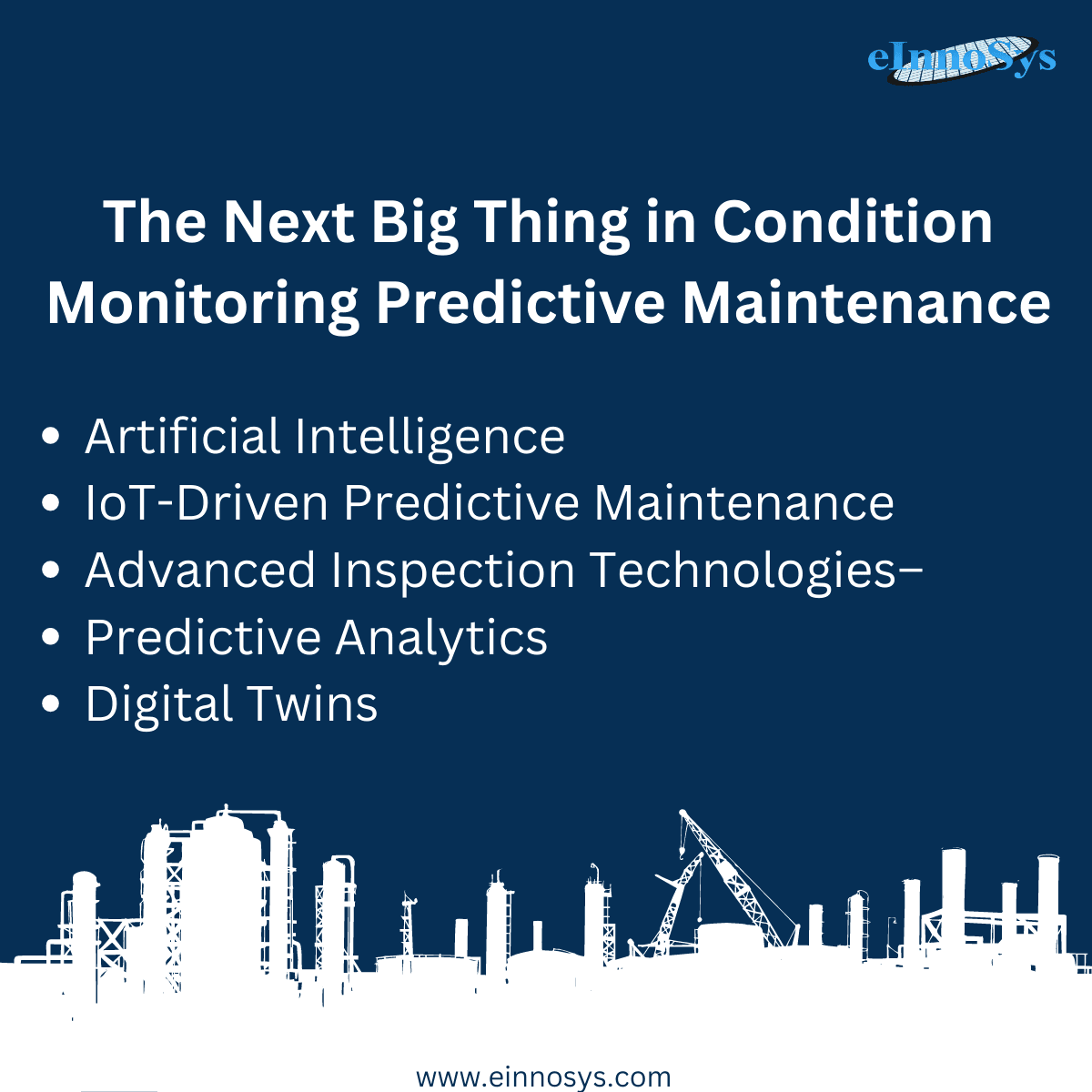
The Next Big Thing in Condition Monitoring Predictive Maintenance

Running a manufacturing unit is challenging due to various external and internal factors. While companies invest in the efficiency of their staff through corporate training, they also need to enhance the efficiency of machines. Therefore, production becomes static at a certain saturation point. Nevertheless, production needs to be improved due to the wear and tear of the machines.

The introduction of predictive maintenance and condition monitoring has changed the scenario drastically, as manufacturing units can now predict the maintenance and repair required for a production unit. According to the reports, the global predictive maintenance market size was 7.3 billion USD in 2022. But, the market size will be around 64.3 billion USD by 2030. So, the huge growth in market size suggests that IoT predictive maintenance and condition monitoring is the next big thing.

Businesses should partner with professional and reliable companies to integrate predictive maintenance and condition monitoring solutions. The experts suggest that predictive maintenance will undergo various changes due to emerging technologies. In the following section, you can find a guide on the upcoming trends in predictive maintenance.

1. Artificial Intelligence

PDM maintenance has started evolving with artificial intelligence. Artificial intelligence (AI), machine learning, and deep learning technologies aim to run specific industrial tasks without human intervention. The AI applications will collect data from different sources and run data analysis simultaneously. As a result, the machine will become self-sufficient to predict its maintenance and repair.

AI-driven predictive maintenance and condition monitoring will be more cost-effective for businesses. Since no humans are involved in data collection and analysis, the process will be cheaper. On the other hand, predictions for maintenance and repair will be more accurate due to machine intelligence.

2. IoT-Driven Predictive Maintenance

One can use IoT predictive maintenance in different ways to establish more efficient predictive maintenance. For example, many businesses have multiple assets, and monitoring the predictive maintenance of those assets is challenging. The job will be much easier when you have a central platform to track and watch the predictive maintenance of all machines.

The Internet of Things (IoT) collects data from different sources and interprets data to create structured analytics. For example, smart sensors collect information such as supply voltage, operating temperature, vibration, etc. IoT-driven applications collect such data and create analytics and insights. Both human operators and machine intelligence can interpret data and make maintenance decisions accordingly.

3. Advanced Inspection Technologies

Condition monitoring maintenance is an integral part of predictive maintenance. Condition monitoring tries to keep machines from breaking down so that a factory can make things without stopping. Introducing advanced inspection technologies can improve the accuracy of preventing machine failure.

Nowadays, predictive maintenance integrates robotic inspection to improve condition monitoring efficiency. Instead of humans, robots inspect and assess the machine’s condition. On the other hand, ultrasonic analysis has also become an advanced inspection technology. The ultrasonic analysis helps identify problems with a machine’s internal parts. The technology can check the condition of even the most fragile parts and give accurate data.

4. Predictive Analytics

The production units are moving from preventative maintenance to predictive maintenance. However, separating preventive maintenance and predictive maintenance often requires more work. Preventative maintenance often becomes a part of predictive maintenance, though preventative maintenance leads to a higher expense for businesses.

PDM solutions are the next big thing in predictive maintenance, as these analytics-driven solutions analyze unstructured data and convert it into structured data. Robust data analytics makes predictive maintenance systems more cost-effective by eliminating preventative maintenance. Therefore, a production unit will only invest in maintenance where it is required. Preventative maintenance proves unnecessary in various scenarios.

5. Digital Twins

The digital twin is one of the trending predictive maintenance technologies. The way we track the changes in industrial equipment could be better with the technology we have now. The digital twin can help businesses overcome such challenges by creating a virtual replica of the physical equipment. As a result, the operators can manage the machines from the virtual platforms. Monitoring the machines from the virtual platforms and scheduling maintenance will save time and hassles.

So, these are the next big things you can expect to see in the predictive maintenance industry 4.0 in the future. Overall, the next-level technologies will be more data-driven to establish automation to eliminate human intervention.