
AI in Semiconductor Equipment Automation: The Future of Fabs

Introduction

According to a report by McKinsey & Company (2022), artificial intelligence and machine learning could generate between $35 billion and $90 billion in annual value for the semiconductor industry. This massive financial potential stems from the way AI in semiconductor equipment automation addresses the extreme complexity of modern chipmaking. As transistors shrink to the size of a few atoms, the margin for error effectively vanishes, leaving human operators and static software unable to keep up.

The shift toward smart semiconductor manufacturing marks a departure from the “if-this-then-that” logic of the previous decade. Modern facilities produce terabytes of data every hour, yet much of that information previously sat idle in databases. Today, sophisticated algorithms digest these data streams to make split-second decisions that preserve wafer integrity and optimize throughput.

Equipment must now possess a level of “awareness” to handle the volatility of global supply chains and the precision required for sub-5nm nodes. By integrating AI-driven fab automation, manufacturers are discovering that they can push their hardware further than ever before. This evolution is less about replacing the equipment and more about giving the machinery a significantly better brain.

The Evolution of Autonomy in the Fab

Historically, semiconductor automation relied on rigid recipes. An engineer would program a tool to perform a specific action, and the tool would repeat that action until told otherwise. If a variable changed—such as a slight fluctuation in gas pressure or a rise in ambient temperature—the system often failed to adapt, resulting in scrapped wafers.

Breaking the Shackle of Static Recipes

The introduction of AI-driven fab automation changes this dynamic by allowing systems to learn from variance. Instead of following a hard-coded path, the equipment uses machine learning models to understand how different variables interact. If the software detects a slight drift in plasma density, it can automatically adjust the RF power in real-time to maintain the etch rate.

This level of flexibility is vital because modern chips are essentially 3D skyscrapers built on a microscopic scale. A single mistake on layer ten can ruin the entire structure by layer sixty. By moving toward smart semiconductor manufacturing, companies ensure that their tools are proactive rather than reactive.

Maximizing Uptime via Predictive Maintenance AI

Unscheduled downtime is the primary villain in any fab manager’s story. When a multi-million-dollar lithography tool goes offline unexpectedly, the cost can reach tens of thousands of dollars per hour. According to a study by Deloitte (2023), AI-based predictive maintenance can increase equipment uptime by up to 20% while reducing maintenance costs by 10%.

Listening to the Machines

Predictive maintenance AI works by analyzing vibration, thermal, and acoustic signatures from tool components. Every pump, motor, and robotic arm has a “healthy” frequency. When a bearing begins to fail, it emits a subtle change in vibration that a human would never notice.

The AI identifies these anomalies weeks before a catastrophic failure occurs. This allows the maintenance team to swap the part during a scheduled break. Have you ever wished your car could tell you exactly when the alternator was going to quit before you ended up stranded on the highway? In the semiconductor world, that wish is a functional reality.

Sensor Fusion and Data Correlation

The true power of predictive maintenance AI lies in sensor fusion. This involves correlating data from hundreds of different sensors to find hidden patterns. For example, a slight increase in power consumption combined with a minor decrease in cooling fluid flow might indicate a clogged filter. By identifying these correlations, equipment automation software prevents small issues from snowballing into factory-wide shutdowns.

AI-Driven Fab Automation and the War on Defects

Yield is the metric that keeps CEOs awake at night. In an industry where a 1% increase in yield can translate to millions in profit, the precision offered by AI in semiconductor equipment automation is indispensable. Automated Defect Classification (ADC) has undergone a radical transformation thanks to deep learning.

Beyond Human Sight

Traditional vision systems used simple pattern matching to find defects. However, as features become smaller, the “noise” in the images increases. AI-driven fab automation utilizes convolutional neural networks (CNNs) to distinguish between a harmless surface particle and a “killer defect” that will short-circuit the chip.

Ever see a grown engineer cry over a wafer scratch? It’s a sad sight, like a dropped ice cream cone, but worth fifty thousand dollars. AI reduces these tragedies by catching errors at the “point of inception,” stopping the production line before more wafers are tainted.

Real-Time Process Control (APC)

Advanced Process Control (APC) is the heart of smart semiconductor manufacturing. It uses AI to create a feedback loop between metrology tools and processing tools. If a measurement tool sees that a layer is slightly too thick, it immediately sends a command to the next tool in the sequence to adjust its timing. This “run-to-run” control ensures that the final product stays within the required specifications even if individual steps have slight variances.

The Core of Connectivity: Equipment Automation Software

No amount of artificial intelligence matters if it cannot talk to the hardware. This is where equipment automation software becomes the unsung hero of the fab. It acts as the translator between the high-level AI models and the low-level machine controllers.

Bridging the Protocol Gap

Most fabs run a mix of brand-new machinery and “vintage” tools that have been in service for decades. These older tools often speak older protocols like SECS/GEM. Modern equipment automation software provides a layer of connectivity that allows AI to extract data from these legacy systems.

Without this bridge, the fab would have “data islands” where information is trapped inside specific tools. By unifying the data stream, manufacturers can apply AI-driven fab automation across the entire production line, regardless of the age of the equipment.

Improving the User Interface

Automation software also simplifies the lives of engineers. Instead of staring at green-on-black terminal screens, they now interact with intuitive dashboards. These displays use AI to highlight the most critical information, ensuring that humans spend their time solving problems rather than hunting for data.

Smart Semiconductor Manufacturing as a Competitive Edge

The global semiconductor market is expected to reach $1 trillion by 2030, according to Statista (2024). In such a massive market, the winners will be those who can produce the highest volume with the lowest waste. Smart semiconductor manufacturing is no longer a luxury; it is a requirement for survival.

Companies that fail to adopt AI in semiconductor equipment automation will struggle with higher overhead and lower yields. The speed of innovation is simply too high for manual processes to remain viable. When your competitor is using AI to optimize their energy consumption and chemical usage, their cost per wafer will naturally be lower than yours.

Overcoming Implementation Hurdles

While the benefits are clear, moving to AI-driven fab automation is rarely a “plug-and-play” experience. It requires a fundamental shift in how data is managed. Many companies find that their data is messy, inconsistent, or stored in silos that the AI cannot access.

The first step is often a “data cleanup” phase. This involves standardizing how measurements are recorded and ensuring that every tool is properly calibrated. Once the foundation is solid, the equipment automation software can begin to feed the AI models the high-quality data they need to function.

Another challenge is the “black box” problem. Some engineers are hesitant to trust an algorithm if they cannot see how it reached a certain conclusion. To solve this, many developers are focusing on “Explainable AI” (XAI), which provides a rationale for the decisions the software makes. This helps build trust between the human operators and their digital partners.

Conclusion

The integration of AI in semiconductor equipment automation represents the most significant shift in chip manufacturing since the introduction of robotics. By embracing predictive maintenance AI and smart semiconductor manufacturing, fabs can achieve levels of efficiency and precision that were previously thought impossible. As the industry marches toward the trillion-dollar mark, the “brainpower” provided by equipment automation software and AI-driven fab automation will be the deciding factor in who leads the market.

Contact Us Today

Get Step-by-Step Guidance to Implement AI in Fab Automation
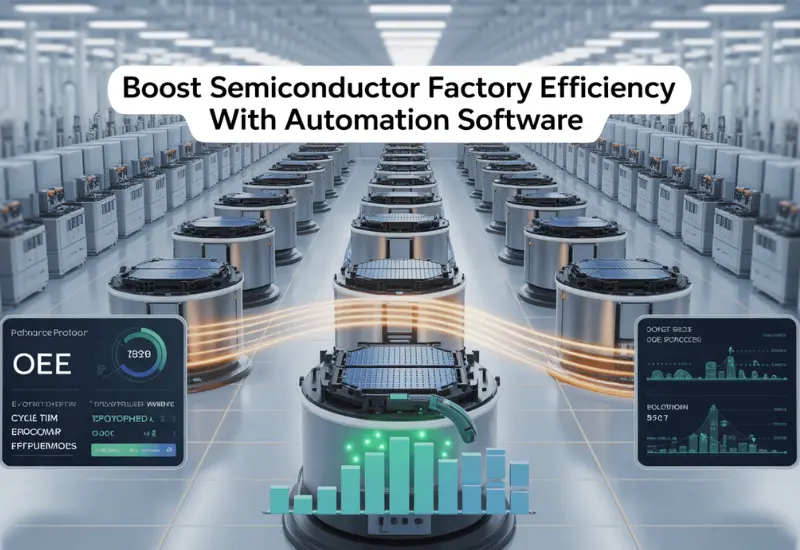
 

Boost Semiconductor Factory Efficiency with Automation Software

Summary

  • Modern semiconductor manufacturing demands extreme precision that manual processes fail to provide.
  • Implementing semiconductor factory automation software can reduce operational costs by up to 20% while increasing throughput (McKinsey, 2023).
  • Key technologies include SECS/GEM protocols, advanced MES integration, and AI-driven predictive maintenance.
  • Automation minimizes human error in cleanroom environments, protecting delicate silicon wafers from contamination.
  • The transition toward “Lights Out” manufacturing is a competitive necessity for 300mm fabs.

Introduction

According to McKinsey & Company (2023), AI and advanced analytics integrated into semiconductor factory automation software can reduce manufacturing costs by 15% to 20% for established fabs. This shift is essential as global demand for chips fluctuates, forcing facilities to find every possible margin for improvement. Efficiency is no longer a goal; it is a requirement for survival in a market where a single speck of dust or a millisecond of lag can ruin a million-dollar batch.

High-volume manufacturing requires a delicate balance of chemical precision, mechanical speed, and digital oversight. The introduction of robust fab automation solutions allows managers to oversee these complexities without constant manual intervention. By digitizing the workflow, companies ensure that every tool in the facility operates at its theoretical limit.

The current landscape of chip production is becoming more crowded and expensive. New facilities often cost upwards of $20 billion, making the software that runs them as valuable as the hardware itself. Adopting semiconductor factory automation software provides the backbone for these massive investments, ensuring that the return on investment remains high even as nodes shrink toward the sub-2nm frontier.

Why Software Defines the Modern Fab

Modern semiconductor manufacturing is less about the physical act of etching silicon and more about the data governing those etches. Human operators are remarkably talented, yet they are also walking biological contamination factories. A single skin cell can terminate a wafer’s journey. Automation software moves the human element away from the delicate front-end processes, placing them in control rooms where they can make strategic decisions rather than manual adjustments.

Eliminating the Human Variable

Does anyone actually miss the days of tracking wafer lots with physical clipboards and pens? Moving to a fully digital environment removes the risk of “fat-finger” errors where a technician might accidentally input the wrong recipe for a photolithography step. Software systems enforce strict compliance, ensuring that a tool will refuse to start unless the parameters match the pre-approved recipe perfectly.

Maximizing Equipment Effectiveness

High-end tools like EUV lithography machines are too expensive to sit idle. Industrial automation software tracks Equipment Health Rating (EHR) and Overall Equipment Effectiveness (OEE) in real-time. If a tool begins to drift from its baseline, the software triggers an alert before the tool fails. This proactive approach changes maintenance from a reactive headache into a scheduled, predictable task.

Core Components of Semiconductor Factory Automation Software

A comprehensive software suite acts as the nervous system for a production facility. It connects the “brains” (the planning systems) to the “muscles” (the robotic arms and process tools). Without a unified layer of semiconductor factory automation software, a fab is simply a collection of expensive machines that speak different languages.

MES Software for Semiconductors

The Manufacturing Execution System (MES) serves as the central hub for all production activities. It tracks every wafer from the moment it enters the fab as a blank slate until it leaves as a finished die. MES software for semiconductors manages lot genealogy, ensuring that if a defect is found later, the team can trace it back to a specific tool or chemical batch.

Inventory and Material Handling

The movement of Front Opening Unified Pods (FOUPs) is a logistical puzzle. Automated Material Handling Systems (AMHS) rely on software to prioritize specific lots. If a high-priority customer order needs to jump the queue, the software reroutes the FOUPs across the ceiling-mounted tracks without causing a traffic jam in the cleanroom.

SECS/GEM and Connectivity

Communication protocols like SECS/GEM allow the software to talk to tools from different vendors. This standardization is what makes fab automation solutions viable. It creates a universal translator so that a South Korean etch tool and a Dutch lithography machine can both report their status to a centralized server in the United States.

Achieving Semiconductor Process Optimization

Efficiency is a game of inches or in this case, nanometers. Semiconductor process optimization involves analyzing thousands of data points per second to find bottlenecks. When software identifies that a specific chemical mechanical planarization (CMP) tool is taking 5% longer than its peers, engineers can intervene before that delay ripples through the entire line.

Real-Time Data Visualization

Data is useless if it stays buried in a database. Modern software provides dashboards that allow fab managers to see the status of the entire floor at a glance. Visualizing these workflows makes it obvious where wafers are stacking up. Often, a simple software tweak to the scheduling algorithm can clear a bottleneck that appeared to be a hardware limitation.

Digital Twins and Simulation

Some automation suites now offer “Digital Twin” capabilities. This allows engineers to test a new process recipe in a virtual environment before applying it to physical silicon. Testing in a sandbox environment prevents costly mistakes and speeds up the time-to-market for new chip designs.

The Role of AI in Industrial Automation Software

Artificial Intelligence is moving past the “hype” phase and into the practical phase. In the context of industrial automation software, AI acts as a 24/7 supervisor that never sleeps or needs a coffee break. It looks for patterns that are too subtle for a human eye to detect, such as a microscopic vibration in a robotic arm that precedes a total failure by three days.

Predictive vs. Preventive Maintenance

Preventive maintenance is like changing your car’s oil every 5,000 miles, regardless of how you drive. Predictive maintenance is like the car telling you exactly when the oil is dirty. By using semiconductor factory automation software with AI, fabs avoid replacing perfectly good parts, which saves money and reduces tool downtime.

Yield Enhancement via Machine Learning

Machine learning models analyze yield maps to find the “signature” of specific faults. If a cluster of dead chips appears on the edge of every wafer, the AI can correlate that pattern with a specific cooling vent in a furnace. This level of insight would take a human engineer weeks to find; the software does it in minutes.

Navigating the Challenges of Implementation

Switching to a new software architecture is a bit like performing heart surgery while the patient is running a marathon. Fabs cannot simply stop production for a month to install new code. The process must be incremental.

  • Legacy Tool Support: Older tools might lack the sensors required for modern data collection.
  • Data Silos: Different departments often use different software, making it hard to get a “single source of truth.”
  • Cybersecurity: As fabs become more connected, they become bigger targets for industrial espionage.
  • Skill Gaps: Automation requires a workforce that is as comfortable with Python as they are with physics.

Despite these hurdles, the cost of staying manual is far higher than the cost of upgrading. A fab that fails to automate will eventually find itself unable to compete with the yields and pricing of “Lights Out” facilities.

Future Trends in Semiconductor Automation

The industry is currently looking toward “Autonomous Labs” and edge computing. As we move closer to the physical limits of silicon, the software must become more autonomous. We are seeing a move toward decentralized control, where individual tools make localized decisions to optimize their own performance without waiting for a command from the central MES.

Visualizing a fab where the machines “negotiate” with each other for priority might sound like science fiction, but it is the logical conclusion of current trends. If an etch tool knows it has a filter change coming up, it can signal the lithography tool to slow down slightly to prevent a pile-up. This level of harmony is the ultimate goal of semiconductor factory automation software.

Conclusion

The complexity of modern chipmaking has surpassed the capacity of manual oversight. Facilities that embrace semiconductor factory automation software gain a massive advantage in yield, speed, and cost-efficiency. By integrating MES, AI, and standardized communication protocols, manufacturers can turn their facilities into highly tuned, data-driven engines of production. If you want to keep your fab competitive in an era of shrinking nodes and rising costs, the software is your most important tool.

Contact Us Today

Get Professional Support to Optimize Production and Reduce Downtime