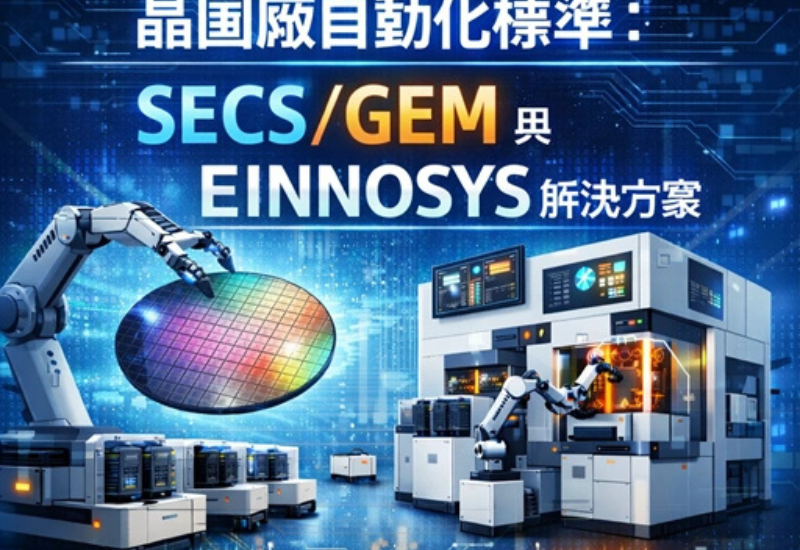
晶圓廠自動化標準:SECS/GEM 與 EINNOSYS 解決方案

概括

  • 核心標準: SEMI E30(GEM)與 E5(SECS-II)仍是現代晶圓製造的基礎骨幹。
  • 市場成長: 隨著晶圓廠邁向工業 4.0,半導體自動化軟體市場持續擴張。
  • 營運效率: 導入標準化通訊協議可將設備整合時間最多縮短 40%。
  • EINNOSYS 優勢: 客製化 SECS/GEM 軟體解決方案,彌合舊式硬體與現代 Fab Host 系統之間的落差。
  • 未來佈局: 對高產量 300mm 晶圓廠而言,轉向 GEM300 與 EDA(Interface A)至關重要。

介紹

全球半導體製造設備市場預計將於 2029 年達到約 1,430 億美元,2024 年起的年複合成長率(CAGR)約為 8%(Fortune Business Insights,2024)。如此龐大的投資突顯一個關鍵現實:隨著晶片幾何尺寸持續縮小,人為錯誤的容忍空間幾乎消失。為了維持良率,晶圓廠必須採用嚴謹的晶圓廠自動化標準,確保所有設備都使用相同的數位語言進行溝通。

在矽產業的早期,設備整合猶如混亂的「西部荒野」,充斥著專有纜線與客製化驅動程式。如今,產業仰賴一套成熟的通訊協議架構,管理從機械手臂到化學氣相沉積腔體的一切。若缺乏這些標準化通道,現代大型晶圓廠將在數分鐘內陷入停擺。

自動化不再只是高階處理器製造的奢侈選項,而是任何追求獲利的晶圓廠的基本要求。無論您管理的是 200mm 類比晶圓廠,或是最先進的 300mm 邏輯製造設施,理解硬體與製造執行系統(MES)之間的互動,都是邁向卓越營運的第一步。

晶圓設備自動化標準架構

每一座智慧晶圓廠的核心,都是 SEMI(半導體設備與材料國際協會)所制定的標準。這些文件定義了設備如何回報狀態、接收配方以及通報警報。對工程師而言,這些標準就像「羅塞塔石碑」,讓日本的微影設備、美國的量測系統,以及歐洲的 MES 能夠無縫協同運作。

SECS/GEM 溝通:基金會

在此生態系中最關鍵的組合便是 SECS/GEM。SECS(半導體設備通訊標準)定義訊息結構,而 GEM(製造設備通訊與控制通用模型)則規範如何利用這些結構來管理設備行為。

可以將 SECS 視為語言的文法與詞彙,而 GEM 則是告訴你何時該說話、該談論什麼主題的禮儀手冊。遵循 SECS/GEM 通訊協議,製造商即可確保任何相容的 Host 系統都能控制任何相容的設備,而無需為每台新機器撰寫客製化程式碼。

SECS-I 和 SECS-II 的作用

SECS-I(E4)傳統上負責實體通訊層,通常使用 RS-232 串列連線。在現代架構中,這多半已被 HSMS(高速 SECS 訊息服務)取代,透過 TCP/IP 在乙太網路上實現更快的資料傳輸。SECS-II(E5)則位於更高層,定義實際的訊息內容,例如「啟動製程」或「回傳溫度資料」。

晶圓廠設備整合的挑戰

將新設備整合至既有產線,幾乎從來不是「即插即用」那麼簡單。即使已有晶圓廠設備整合標準,不同 OEM(原始設備製造商)對 GEM 的實作差異,仍常導致整合困難。

處理舊硬體

許多舊型設備缺乏對現代通訊協議的原生支援。在這種情況下,工程師通常會使用「黑盒子」轉換器或外部控制器,將舊式介面包裝成符合 GEM 的形式。如此一來,晶圓廠便能在不汰換仍具機械壽命的高價設備下,維持製造自動化。

數據過載和頻寬

隨著感測器數量增加,單一設備所產生的資料量可能極為龐大。雖然 SECS/GEM 本身相當高效,但其原始設計並非用於支援現代大數據分析所需的高頻率資料流。這促成了 Interface A(EDA)的發展,與 GEM 並行運作,提供專用資料通道以支援製程優化。

EINNOSYS 智慧製造解決方案

EINNOSYS 已成為因應半導體自動化標準複雜性的關鍵合作夥伴。透過提供軟體產品與整合服務,他們協助晶圓廠將「符合標準」轉化為「可量產」。

實現符合 GEM 標準的設備

對 OEM 而言,使設備達到 GEM 相容是一項重大挑戰。EINNOSYS 提供的 EInnoGEM 軟體 SDK,讓開發者能以最少的程式碼為設備加入 GEM 功能,加速上市時程,並符合全球一線晶圓廠的嚴格要求。

客製化工廠主機通信

在晶圓廠端,最大的挑戰通常是 Fab Host 通訊。EINNOSYS 提供 Host 端解決方案,使 MES 能與多樣化的設備群進行通訊。此集中式控制對於批次追蹤、配方管理,以及實施「違規即停機」邏輯以防止報廢至關重要。

自動化對產量和投資報酬率的影響

根據 McKinsey & Company(2023)報告,成功導入進階分析與自動化的半導體公司,其製造吞吐量可提升 10% 至 15%。這不僅是讓晶圓移動更快,而是降低錯誤發生率。

半導體自動化的未來趨勢

產業正邁向「無人化晶圓廠」,將人員在產線上的存在降至最低。既然人類本質上是會產生污染、偶爾還會掉東西的來源,為何還要留在無塵室?標準化的晶圓廠設備軟體正是實現此轉型的關鍵。

過渡至 GEM300

對 300mm 晶圓廠而言,基本 GEM 已不足夠,必須導入 GEM300 標準,包括 E39(物件服務)、E40(製程管理)與 E94(控制工作管理)。這些標準負責管理 AMHS,確保正確的 FOUP 在正確的時間抵達正確的 Load Port。

人工智慧和預測性維護

透過晶圓廠自動化標準所提供的高品質資料,AI 模型已能預測真空幫浦何時可能失效,或電漿蝕刻製程是否偏離規格。這讓維護模式從「預防性」轉向「預測性」,大幅減少非計畫性停機。

結論

現代半導體產業的核心不僅是矽,而是流經其中的資料。導入完善的晶圓廠自動化標準,確保資料準確、可用且可存取。EINNOSYS 在此生態系中扮演關鍵角色,提供必要的工具與專業,將零散硬體轉化為高良率的整合生產引擎。展望未來,對 SECS/GEM 及其後續標準的掌握,將持續決定晶圓廠的競爭力。

Contact Us Today

獲得關於 Einnosys 晶圓廠自動化解決方案的專家指導


EDA vs SECS/GEM

Introduction

The semiconductor industry relies on sophisticated technologies at every stage—from initial chip design to final manufacturing. Two acronyms frequently appear in industry discussions: EDA (Electronic Design Automation) and SECS/GEM (SEMI Equipment Communications Standard/Generic Equipment Model). While both are essential to semiconductor operations, they serve fundamentally different purposes and operate at completely different stages of the production lifecycle.

Understanding the distinction between EDA and SECS/GEM isn’t just academic—it’s critical for professionals working across the semiconductor value chain, from design engineers to fab operators. This comparison explores what each technology does, where it fits in the semiconductor workflow, and why both remain indispensable despite their different roles.

What Is EDA

What Is EDA?

Electronic Design Automation (EDA) refers to software tools used to design electronic systems, particularly integrated circuits and printed circuit boards. EDA tools enable engineers to design, simulate, verify, and optimize complex semiconductor devices before any physical manufacturing occurs.

The EDA process encompasses several critical functions:

Design Entry: Engineers use schematic capture tools or hardware description languages (HDL) like Verilog and VHDL to describe circuit functionality. These tools allow designers to work at high abstraction levels, defining what a chip should do rather than manually placing every transistor.

Simulation and Verification: Before committing to expensive manufacturing, designers simulate circuit behavior under various conditions. Functional simulation verifies logical correctness, while timing simulation ensures the design meets performance requirements. Verification tools check that designs match specifications and don’t contain errors that could cause manufacturing failures.

Physical Design: Once verified, placement and routing tools determine where components sit on the chip and how connections between them are formed. This stage considers manufacturing constraints, heat dissipation, signal integrity, and power consumption.

Design for Manufacturing (DFM): Modern EDA tools analyze designs for manufacturability, identifying potential problems that could reduce yields or cause manufacturing failures. They ensure designs comply with foundry process rules and optimize layouts for better production outcomes.

Major EDA vendors include Synopsys, Cadence Design Systems, and Siemens EDA (formerly Mentor Graphics). These companies provide comprehensive tool suites covering the entire design process from concept to tape-out—the point where designs are ready for fabrication.

What Is SECS GEM

What Is SECS/GEM?

SECS/GEM operates in a completely different domain: manufacturing execution and equipment communication. While EDA focuses on designing chips, SECS/GEM enables communication between manufacturing equipment and factory automation systems during actual production.

SECS (SEMI Equipment Communications Standard) defines the message format and transport protocol for equipment communication. GEM (Generic Equipment Model) specifies the behavioral model—what states equipment can be in, what events it reports, and how it responds to commands.

The SECS/GEM framework enables several critical manufacturing functions:

Equipment Status Monitoring: Factory systems receive real-time updates on equipment states—idle, processing, maintenance, or alarmed. This visibility allows operators to manage production flow and respond quickly to issues.

Data Collection: Equipment reports process parameters, measurement results, and production data to Manufacturing Execution Systems (MES). This data drives quality control, yield analysis, and process optimization.

Remote Control: Host systems can send commands to equipment—loading recipes, starting processes, changing parameters—enabling automated factory operations.
Alarm Management: When equipment detects problems, it generates alarms that notify operators and factory systems. Quick alarm response prevents minor issues from becoming major disruptions.

Material Tracking: SECS/GEM supports tracking wafers and other materials through the manufacturing process, ensuring traceability and preventing mix-ups.

Unlike EDA, which involves software engineers and chip designers, SECS/GEM involves automation engineers, equipment manufacturers, and fab operations teams implementing and maintaining communication between hundreds of manufacturing tools and factory systems.

Key Differences Between EDA and SECS/GEM

Lifecycle Stage

EDA operates during the design phase, before manufacturing begins. Engineers use EDA tools to create chip designs that foundries will later manufacture.

SECS/GEM operates during manufacturing. It’s the communication backbone enabling factories to run production equipment efficiently.

Primary Users
EDA serves chip designers, verification engineers, and physical design specialists working for fabless semiconductor companies, integrated device manufacturers, and design service firms.
SECS/GEM serves equipment manufacturers (OEMs) building semiconductor tools, fab automation teams integrating equipment into production lines, and process engineers optimizing manufacturing operations.

Objective

EDA aims to create functional, manufacturable chip designs that meet performance, power, and cost targets while minimizing design time and reducing errors.

SECS/GEM aims to enable seamless communication between equipment and factory systems, supporting automated operations, data collection, and efficient production management.

Why Both Matter

Despite their differences, EDA and SECS/GEM represent complementary aspects of semiconductor production. Effective chip designs created with EDA tools must be manufactured efficiently using equipment that communicates via SECS/GEM. Neither technology can substitute for the other—they operate in different domains addressing different challenges.

Modern semiconductor manufacturing increasingly connects these domains through Design for Manufacturing (DFM) feedback loops. Manufacturing data collected via SECS/GEM informs design decisions made with EDA tools. Yield information, defect patterns, and process variations observed in fabs flow back to designers, allowing them to optimize future designs for better manufacturability.

Conclusion

EDA and SECS/GEM serve distinct, non-overlapping roles in semiconductor operations. EDA enables engineers to design complex chips efficiently, while SECS/GEM enables factories to manufacture those chips efficiently. Understanding both technologies—and how they complement each other—provides essential context for anyone working in the semiconductor industry.

For organizations building semiconductor capabilities, investments in both domains prove necessary. Design excellence enabled by EDA must be matched with manufacturing excellence enabled by robust equipment communication and factory automation. The most successful semiconductor companies excel at both, recognizing that great designs require great manufacturing, and vice versa.

FAQs

  • What is the main difference between EDA and SECS/GEM?

    EDA (Electronic Design Automation) is used in the chip design phase to create, simulate, and verify semiconductor designs before manufacturing.

    SECS/GEM, on the other hand, is used during the manufacturing phase for equipment communication, automation, data collection, and factory integration.

  • Are EDA and SECS/GEM used in the same part of the semiconductor process?

    No. EDA is used early in the lifecycle, during chip design and verification.

    SECS/GEM is used later in the fab, enabling real-time communication between manufacturing tools and MES systems.

  • Who uses EDA tools and SECS/GEM systems?

    EDA tools are used by chip designers, verification engineers, and layout engineers in fabless companies or IDMs.

    SECS/GEM is used by OEMs, automation engineers, integration teams, and fab operations staff responsible for equipment connectivity and production control.

  • Why is SECS/GEM important for semiconductor manufacturing?

    SECS/GEM ensures standardized communication between equipment and factory systems. It supports recipe control, alarms, data collection, equipment states, and remote command execution—critical for automated fab operations.

  • Why is EDA essential in chip design?

    EDA tools help engineers simulate, verify, and optimize complex chip architectures before fabrication. This reduces errors, improves performance, and avoids costly silicon failures during manufacturing.

SECS/GEM Integration Guide: Compliance Testing & Implementation

Connectivity is power in semiconductor and electronics manufacturing. Each machine, process, and data item is part of the bigger picture of attaining a seamless automation process, as well as intelligent decision making. The SECS/GEM integration is one of the most significant frameworks that helps to make this transformation and it is a standardized communication protocol that allows closing the gap between equipment and factory automation systems.

You may be updating old systems or establishing a new production facility, but you need to understand how to be able to test compliance with the SECS/GEM and deploy SECS/GEM software and SECS/GEM host integration to make sure that your manufacturing processes are not obsolete in the future

Step 1: Evaluating Equipment Fit

Assessment of the current setup is the first process towards a successful integration of SECS/GEM equipment. The equipment you are using should be able to communicate on SEMI SECS/GEM standard (E5/E30). Most of the modern tools are already equipped with built-in SECS/GEM features, yet older systems may need some of the following elements: communication gateways, or adapter software.

Unless your old machine is native SECS/GEM, there may be a need to use specialized SDKs or middleware, which translates proprietary protocols into SECS-II messages that can be used in the GEM model. This will make all your data, process parameters as well as alarm reports available under one integrated automation platform.

An extensive compatibility test eliminates future delays at great expense and makes sure that your SECS/GEM protocol implementation has a firm foundation.

Step 2: Selecting the SDK and Development Tools of the SECS/GEM

The proper SDK and development tools of SECS/GEM are the next step after compatibility has been checked. A sound SDK makes it easier to cope with command processing, message decoding and event handling.

SECS/GEM software libraries have been written in different programming environments, including .NET, C++, or Java. These devices enable developers to develop layers of communication that are effective in managing both the host (factory) and equipment end.

Further, a SECS/GEM simulator can be used in the development phase to exchange messages without connecting to real hardware to save time and resources. The correct tools minimize the complexity, accelerate integration and assure that your system passes all areas of testing in the SECS/GEM compliance test.

Step 3: Implement SECS/GEM Interface

The SECS/GEM interface is used to provide the interface between the host system and the equipment.

In implementation, specify all pertinent data variables, state models and event reports which represent the behavior of your machine. They need to be defined in terms of the SEMI E5 (SECS-II message format) and E30 (GEM model) specifications in order to become consistent and interoperable.
Every message transaction, such as equipment status, start process, etc., has to fit in the conventional GEM event objects. The well-designed interface can facilitate the SECS/GEM communication as well as reduce downtime and improve traceability and the use of equipment.

Step 4: Integration by Testing and Validating

It is testing that gives theory reality. SECS/GEM interface testing should be done comprehensively before deployment so that the accuracy of messages, their synchronized performance, and their synchronization are all deliberated.

Test benches or leverage SECS/GEM simulation tools to determine the interactions between the host and the equipment in different conditions: normal operations, alarm, disconnection, and recovery sequences. This assists you in identifying the irregularities before their impact to production.

SECS/GEM full compliance testing ensures that the implementation you have made is compliant to the SEMI standards, communicates correctly, and reacts predictably in a real world situation.

Step 5: Deploy, Monitor, and Maintain

After being tested, it is now time to put your SECS/GEM host integration into production. Long-term reliability depends on continuous monitoring and updating on a regular basis.

The proactive maintenance plan should be included to maintain stable communication links and all SEMI standard changes or firmware updates should be installed beforehand. Having an expert like eInnoSys assist you in maintaining your system to be compliant, scalable, and optimised with regards to performance.

Constant updates also enable the integration to keep up with newly added equipment, automation frameworks or cloud-based analytics tools without interfering with any of the current workflows.

The Role of SECS/GEM in Smart Manufacturing in the Present Day

SECS/GEM protocol is not merely a communication layer, it is the core of Industry 4.0 in the manufacturing of semiconductors and electronics.

Allowing standardized data exchange, SECS/GEM will allow factories to have all the data on equipment performance, production measures as well as quality trends. Such visibility drives predictive maintenance, live analytics, and artificial intelligence-based decision-making which eventually results in less downtime and higher yield.

Current smart factories have developed SECS/GEM software to integrate machines with, and connect to MES (Manufacturing Execution Systems), ERP systems and cloud-based dashboards — forming a single digital ecosystem.

The Reasons eInnoSys is the Best SECS/GEM Integration Partner

We think that real automation is based on perfect communication, which is the starting point at eInnoSys. Having years of experience in SECS/GEM equipment integration, we assist semiconductor and electronics manufacturers in the integration of legacy equipment into the digital age, fast, safely, and effectively.

This is what is unique about eInnoSys:

  • SECS/GEM Solutions — Our engineers will guarantee complete SECS/GEM compliance testing with SECS/GEM interface design through verification and backward SECS/GEM communication.
  • High Simulation Tools — Our own SECS/GEM simulator enables you to be able to test and verify integrations prior to live deployment in order to minimize downtime.
  • Tailored Integration Method — We will tailor the SECS/GEM host integration to your current infrastructure and there will be minimal disturbance to the running operations.
  • Long-Term Support — We monitor, update, and optimize your automation environment in addition to first deployment to ensure that it is at its best.

We are committed to ensuring that SECS/GEM software implementation is hassle-free and scalable — so that your factory can be able to achieve increased throughput, reduced costs and smarter automation.

Conclusion

Unlike a technical upgrade, the incorporation of SECS/GEM with your current manufacturing equipment is a strategic position that will lead to a smarter and data-driven future.

Using a systematic methodology — checking the compatibility, selecting the optimal tools, creating a compliant interface, testing hard and finally maintaining the situation — manufacturers would open up new horizons of visibility and control in their operations.

Having an appropriate crisis communication plan among your host and equipment, you will minimize errors, increase efficiency, and make faster and more informed decisions.

Make your automation systems future-proof with the help of eInnoSys and become the full potential of SECS/GEM integration because in the age of smart manufacturing, the interconnected equipment implies the interconnected success.

Frequently Asked Questions About SECS/GEM Integration

  • 1. How do I know if my equipment supports SECS/GEM?

    SECS/GEM (SEMI E5 & E30 standards) is a communication protocol that connects manufacturing equipment with factory automation systems like MES or ERP. It standardizes data exchange across different machines, enabling real-time monitoring, predictive maintenance, and smart manufacturing efficiency.

  • 2. What is SECS/GEM and why is it important?

    Check your equipment’s specs for SEMI E5 (SECS-II) and E30 (GEM) support. Most modern tools include SECS/GEM by default, while older systems may require a communication gateway or middleware. eInnoSys offers compatibility assessments for legacy equipment integration.

  • 3. What is a SECS/GEM simulator?

    A SECS/GEM simulator mimics equipment or host communication, allowing developers to test integrations without using real machines. It’s used for testing, training, and troubleshooting—saving time and reducing production risks.

  • 4. What are the steps in SECS/GEM compliance testing?

    Compliance testing includes verifying SECS-II message formatting, equipment state transitions, event reporting, synchronization, and stress testing. Proper validation ensures reliable communication and SEMI standard compliance.

  • 5. How does SECS/GEM enable smart manufacturing?

    SECS/GEM forms the backbone of Industry 4.0 by enabling standardized, real-time data exchange. It supports AI-driven analytics, predictive maintenance, and improved equipment utilization—helping manufacturers cut downtime and improve yield.

Alignment Film Coating Equipment SECS/GEM SDK Software Solutions

[vc_row][vc_column][vc_column_text css=””]

In the fast-evolving semiconductor and flat panel display (FPD) industries, precision, automation, and connectivity are the cornerstones of efficient manufacturing. One critical process that demands these qualities is alignment film coating, where even a minor deviation can impact yield and product quality. To ensure smooth communication and compliance with industry standards, equipment manufacturers need robust SECS/GEM SDK software solutions — and that’s where eInnoSys stands out.

[/vc_column_text][/vc_column][/vc_row][vc_row][vc_column width=”1/2″][vc_column_text css=””]Why Software Solutions Matter for Alignment Film Coating Equipment

In today’s smart factories, software is the bridge that connects complex equipment to the host systems, enabling full factory automation and real-time process control. For Alignment Film Coating Equipment, the right software ensures seamless communication, data collection, monitoring, and traceability.

Here’s why software solutions are essential for equipment OEMs and FPD manufacturers:

Factory Integration: Seamlessly connect equipment to factory host systems through SECS/GEM communication standards.

Process Visibility: Monitor and control every step of the film coating process in real-time for enhanced yield and consistency.

Data-Driven Insights: Collect, store, and analyze equipment data to predict maintenance needs and improve uptime.

Faster Time-to-Market: Reduce development time and integration challenges with ready-to-use SDKs that comply with SEMI standards.[/vc_column_text][/vc_column][vc_column width=”1/2″][vc_single_image image=”37850″ img_size=”full” alignment=”center” css=””][/vc_column][/vc_row][vc_row][vc_column width=”1/2″][vc_column_text css=””]Comprehensive Equipment Software Solutions by eInnoSys

eInnoSys offers a full suite of equipment software solutions designed specifically for semiconductor, FPD, and related high-tech manufacturing industries. Our solutions are built to help OEMs easily enable SECS/GEM, GEM300, and EDA (Interface A) communication on their equipment — without spending years on custom software development.

Our SECS/GEM SDK Highlights:

  • Plug-and-Play Integration: Rapidly implement SEMI-compliant host communication.
  • Customizable Framework: Tailor the SDK for the unique process needs of alignment film coating tools.
  • Cross-Platform Support: Compatible with Windows and Linux-based equipment controllers.
  • Comprehensive Documentation: Easy-to-follow integration guides, APIs, and example codes.
  • Global Support: Backed by experienced SECS/GEM engineers who assist in deployment, testing, and certification.

[/vc_column_text][/vc_column][vc_column width=”1/2″][vc_column_text css=””]Why Choose eInnoSys for Alignment Film Coating Equipment SDK Solutions?

When it comes to enabling SECS/GEM connectivity for alignment film coating equipment, choosing the right technology partner makes all the difference. Here’s what sets eInnoSys apart:

✅ Proven Industry Expertise: Decades of experience in semiconductor and FPD automation software development.

✅ End-to-End Solutions: From SECS/GEM SDKs to full equipment control software, eInnoSys covers the complete software stack.

✅ SEMI Standards Compliance: Our SDKs are fully compliant with SEMI E5, E30, E37, E39, and related standards.

✅ Faster Certification: Reduce time and cost of SECS/GEM compliance testing with pre-validated modules.

✅ Scalable Architecture: Our SDKs support future expansion, including EDA, IoT, and AI-driven analytics.[/vc_column_text][/vc_column][/vc_row][vc_row][vc_column width=”1/2″][vc_column_text css=””]With our SDK suite, OEMs and FPD manufacturers can:

  • Easily enable SECS/GEM communication on new or legacy equipment.
  • Improve production efficiency with real-time data exchange.
  • Reduce downtime with predictive maintenance integrations.
  • Shorten development cycles with pre-tested software components.
  • Stay ahead of Industry 4.0 trends with scalable digital solutions.

[/vc_column_text][/vc_column][vc_column width=”1/2″][vc_single_image image=”37849″ img_size=”full” alignment=”center” css=””][/vc_column][/vc_row][vc_row][vc_column][vc_column_text css=””]

As the semiconductor and FPD industries continue to advance, automation and data integration are key to achieving precision, efficiency, and scalability. With eInnoSys SECS/GEM SDK software solutions, Alignment Film Coating Equipment manufacturers can streamline factory connectivity, ensure SEMI compliance, and accelerate innovation.

Whether you’re developing new equipment or upgrading existing systems, eInnoSys provides the reliable, scalable, and smart software foundation you need to succeed in the era of intelligent manufacturing.

[/vc_column_text][/vc_column][/vc_row][vc_row][vc_column][vc_column_text css=””]

Expanded Frequently Asked Questions (FAQs)

[/vc_column_text][vc_toggle title=”What is SECS/GEM and why is it important for alignment film coating equipment?” css=””]SECS/GEM is a set of SEMI standards that define communication between manufacturing equipment and host systems. For film coating tools, it ensures standardized data exchange, process control, and automation.[/vc_toggle][vc_toggle title=”Can eInnoSys SDK integrate with my existing equipment controller?” css=””]Yes, our SECS/GEM SDK supports most industrial controllers, including those running on Windows or Linux platforms.[/vc_toggle][vc_toggle title=”Does eInnoSys provide customization for film coating process control?” css=””]Absolutely. We can tailor our SDK and software modules to support specific alignment and coating process parameters.[/vc_toggle][vc_toggle title=”Is your SDK compatible with Industry 4.0 or smart factory initiatives?” css=””]Yes, our SDKs are Industry 4.0-ready, supporting data analytics, IoT connectivity, and AI/ML integration.[/vc_toggle][vc_toggle title=”What is SECS/GEM and why is it important for alignment film coating equipment?” css=””]SECS/GEM is a SEMI communication standard that enables manufacturing equipment to communicate with factory host systems. For alignment film coating equipment, it ensures smooth automation, consistent data collection, and real-time process control across the production line.[/vc_toggle][vc_toggle title=”Can eInnoSys SDK integrate with my existing equipment controller?” css=””]Yes. eInnoSys SECS/GEM SDK supports major industrial platforms such as Windows, Linux, and embedded controllers, allowing seamless integration with both new and legacy alignment film coating equipment.[/vc_toggle][vc_toggle title=”How long does SECS/GEM integration take using your SDK?” css=””]Most customers achieve complete SECS/GEM integration within a few weeks, thanks to our ready-to-deploy SDK modules, detailed documentation, and expert support.[/vc_toggle][vc_toggle title=”Does eInnoSys provide customization for film coating process control?” css=””]Absolutely. Our SDK and software solutions can be customized to match the specific alignment, film coating, and curing process parameters required by OEMs or manufacturers.[/vc_toggle][vc_toggle title=”Is your SDK compatible with Industry 4.0 or smart factory initiatives?” css=””]Yes. eInnoSys SDKs are Industry 4.0-ready, supporting IoT data integration, AI/ML analytics, and predictive maintenance applications for advanced smart manufacturing.[/vc_toggle][vc_toggle title=”What SEMI standards does the eInnoSys SECS/GEM SDK comply with?” css=””]Our SDK is fully compliant with key SEMI standards including E5 (SECS-II), E30 (GEM), E37 (HSMS), E39 (Object Services), and GEM300 for 300mm equipment support.[/vc_toggle][vc_toggle title=”Does eInnoSys offer support after SDK implementation?” css=””]Yes, we provide comprehensive post-integration support, including troubleshooting, factory acceptance testing, remote assistance, and software updates to ensure long-term reliability.[/vc_toggle][vc_toggle title=”Can I upgrade older alignment film coating tools to be SECS/GEM compliant using your SDK?” css=””]Definitely. Our SDK allows retrofit upgrades for older or legacy equipment, enabling them to meet current SEMI communication and automation standards without full hardware redesign.[/vc_toggle][vc_toggle title=”Is training provided for my engineering or software team?” css=””]Yes. eInnoSys offers hands-on training programs covering SECS/GEM fundamentals, SDK integration, testing procedures, and best practices for film coating equipment developers.[/vc_toggle][vc_toggle title=”How does eInnoSys ensure data security and system reliability?” css=””]Our SDK uses secure communication protocols (HSMS/TCP) and is rigorously tested for fault tolerance, data integrity, and uptime reliability, ensuring consistent factory communication under demanding production environments.[/vc_toggle][/vc_column][/vc_row][vc_row][vc_column][/vc_column][/vc_row]

SECS/GEM Integration on Applied Materials P-5000 CVD SACVD Through EIGEMBox

[vc_row][vc_column][vc_column_text css=””]Client: One of the Leading Electronics Manufacturers in the Philippines
Industry: Semiconductor Manufacturing

A leading electronics manufacturer in the Philippines faced a major challenge—their Applied Materials P-5000 CVD SACVD system lacked SECS/GEM connectivity, preventing seamless integration with their factory automation system. Without real-time SECS/GEM Communication, they struggled with manual data collection, inefficient monitoring, and limited automation.

Einnosys provided the perfect solution: EIGEMBox, a plug-and-play SECS/GEM interface that enabled SECS/GEM protocol communication without modifying the legacy equipment. The implementation was smooth, allowing the client to establish real-time equipment monitoring, automated data collection, and seamless MES connectivity.[/vc_column_text][/vc_column][/vc_row][vc_row][vc_column width=”1/2″][vc_column_text css=””]Challenge

The client, a leading electronics manufacturer in the Philippines, was using Applied Materials P-5000 CVD SACVD for semiconductor fabrication. However, the equipment lacked SECS/GEM connectivity, making it difficult to integrate with their factory automation system.

Without SECS/GEM communication, the client faced challenges in:

✅ Real-time equipment monitoring
✅ Automated data collection and reporting
✅ Minimizing manual intervention
✅ Improving production efficiency

The client needed a cost-effective and scalable SECS/GEM solution to enable automation and SECS/GEM integration without modifying their legacy equipment.

Solution: EIGEMBox for Seamless SECS/GEM Communication

Einnosys provided its EIGEMBox, a plug-and-play SECS/GEM interface solution, to enable SECS/GEM protocol communication on the Applied Materials P-5000 CVD SACVD system.[/vc_column_text][/vc_column][vc_column width=”1/2″][vc_column_text css=””]Key Features of EIGEMBox Implementation:

✔️ Seamless SECS/GEM software integration without hardware modifications
✔️ Real-time SECS/GEM communication with the factory host system
✔️ Fully compliant with GEM300 standards for automated semiconductor manufacturing
✔️ Remote equipment control and data collection through the SECS GEM protocol

Implementation Process

📌 Step 1: Installed EIGEMBox on the P-5000 CVD SACVD system
📌 Step 2: Configured the SECS/GEM communication protocol to establish connectivity with the host system
📌 Step 3: Enabled real-time SECS/GEM data exchange for process monitoring and control
📌 Step 4: Validated compliance with SECS/GEM standards through successful SECS/GEM transactions[/vc_column_text][/vc_column][/vc_row][vc_row][vc_column width=”1/2″][vc_column_text css=””]Results & Benefits

With EIGEMBox, the client successfully transformed their Applied Materials P-5000 CVD SACVD into a SECS/GEM-compliant system.

📈 Key Benefits Achieved:

✔️ 100% automated data collection and monitoring
✔️ 50% reduction in manual intervention and errors
✔️ Improved production efficiency with real-time SECS/GEM integration
✔️ Seamless connectivity with the factory’s MES (Manufacturing Execution System)[/vc_column_text][/vc_column][vc_column width=”1/2″][vc_single_image image=”35322″ img_size=”full” alignment=”center” css=””][/vc_column][/vc_row][vc_row][vc_column][vc_column_text css=””]By integrating SECS/GEM on Applied Materials P-5000 CVD SACVD through EIGEMBox, the client achieved factory automation, improved process efficiency, and seamless data communication without replacing legacy equipment.

🚀 Looking to enable SECS/GEM on your semiconductor equipment?

Contact Einnosys today to explore SECS/GEM Solutions for your manufacturing needs![/vc_column_text][/vc_column][/vc_row]

Modern SECS/GEM Solutions: Flexible SDKs for Seamless Software Integration

[vc_row][vc_column][vc_column_text css=””]The semiconductor manufacturing industry relies heavily on automation and communication standards to ensure efficiency and precision. One of the most widely adopted protocols is SECS/GEM (Semiconductor Equipment Communication Standard/Generic Equipment Model). This standard has become essential for integrating equipment and systems, enabling seamless communication across diverse platforms. With the rise of modern SECS/GEM solutions, flexible SDKs (Software Development Kits) are now paving the way for easier and more effective SECS/GEM integration. This blog explores the evolution and advantages of these modern tools, emphasizing how they revolutionize the use of SECS/GEM software in manufacturing environments.[/vc_column_text][vc_column_text css=””]Understanding the SECS/GEM Protocol

The SECS/GEM protocol serves as the backbone of communication between manufacturing equipment and host systems. It establishes a standardized method for exchanging data, executing commands, and monitoring processes. As a key component of semiconductor manufacturing, the SECS/GEM communication protocol enables automation and facilitates the implementation of GEM300 standards, which are vital for advanced fabs.

Modern SECS/GEM communication solutions offer robust SDKs that simplify the complexities of integrating the SECS/GEM interface into various software systems. These SDKs come with pre-built libraries, documentation, and examples, making it easier for developers to implement SECS/GEM communication without requiring in-depth expertise in the protocol itself. The result is a faster development cycle and a more streamlined manufacturing process.[/vc_column_text][vc_column_text css=””]Why Modern SDKs are Game-Changers

Enhanced Flexibility

Traditional SECS/GEM integration often required extensive coding and a deep understanding of the protocol. Modern SDKs, however, offer enhanced flexibility by providing ready-to-use modules and APIs. These tools allow developers to implement SECS/GEM communication protocols with minimal effort, ensuring compatibility with existing systems while reducing development time.

The flexibility of these SDKs also enables their use in various applications, from legacy equipment to cutting-edge GEM300-compliant machines. By supporting a wide range of scenarios, these SDKs facilitate the seamless integration of SECS/GEM interfaces, empowering manufacturers to adopt new technologies without overhauling their infrastructure.[/vc_column_text][vc_column_text css=””]Improved Usability

One of the most significant benefits of modern SECS/GEM software is its user-friendly design. SDKs are now equipped with intuitive interfaces, comprehensive documentation, and real-world examples that guide developers through the integration process. This user-centric approach not only simplifies SECS/GEM integration but also reduces the learning curve for engineers who may be new to the SECS/GEM protocol.

Scalability and Reliability

As manufacturing demands grow, so does the need for scalable solutions. Modern SECS/GEM communication SDKs are designed with scalability in mind, allowing manufacturers to expand their operations without compromising performance. Additionally, these SDKs offer reliable communication channels that ensure accurate data exchange, even in high-demand environments.[/vc_column_text][/vc_column][/vc_row][vc_row][vc_column width=”1/2″][vc_column_text css=””]Applications of SECS/GEM Integration

The applications of SECS/GEM integration extend far beyond basic communication. With modern SDKs, manufacturers can achieve:

Real-time monitoring: By integrating SECS/GEM communication protocols, fabs can monitor equipment status and process parameters in real time, enabling proactive maintenance and minimizing downtime.

Enhanced automation: SECS/GEM software supports automation by enabling hosts to send commands directly to equipment, streamlining production workflows.

Data-driven decision-making: The data collected through SECS/GEM interfaces can be analyzed to identify trends, optimize processes, and improve overall efficiency.

Compliance with GEM300 standards: For advanced fabs, adhering to GEM300 requirements is critical. Modern SDKs ensure that SECS/GEM communication aligns with these standards, enabling seamless equipment integration in high-tech environments.[/vc_column_text][/vc_column][vc_column width=”1/2″][vc_single_image image=”35263″ img_size=”full” alignment=”center” css=””][/vc_column][/vc_row][vc_row][vc_column][vc_column_text css=””]The evolution of SECS/GEM solutions has transformed how semiconductor manufacturers approach equipment integration. Modern SDKs offer unparalleled flexibility, usability, and scalability, making SECS/GEM integration more accessible than ever before. By leveraging these advanced tools, manufacturers can optimize their operations, enhance automation, and stay competitive in an increasingly demanding industry.

As the semiconductor industry continues to evolve, the importance of robust SECS/GEM communication protocols and software cannot be overstated. Whether you’re working with legacy systems or implementing GEM300-compliant solutions, modern SECS/GEM SDKs provide the foundation for seamless software integration and long-term success.

Incorporating SECS/GEM into your operations has never been easier, thanks to these innovative solutions. Embrace the future of manufacturing with modern SECS/GEM software and unlock the full potential of your production line.[/vc_column_text][/vc_column][/vc_row]

SECS/GEM Communication Software Reference Manual for GEM300.

Summary

  • Connectivity Standards: Highlighting the transition from legacy SECS-I to high-speed HSMS (SEMI E37) for modern 300mm fabs.
  • GEM Compliance: Detailed overview of SEMI E30 requirements, including state models, event reporting, and remote control capabilities.
  • GEM300 Protocols: Technical breakdown of E87 (Carrier Management), E90 (Substrate Tracking), E94 (Control Job), and E40 (Process Job).
  • Implementation Efficiency: Guidance for OEMs to reduce development time while meeting strict fab validation requirements.
  • Future Readiness: Integrating SECS/GEM data with MES for advanced AI-driven yield optimization and predictive maintenance.

Introduction

According to SEMI (2024), global 300mm fab equipment spending is projected to reach a record $137 billion by 2027. This massive investment underscores the necessity for flawless integration between multi-million dollar tools and the factory’s central brain. High-performance SECS/GEM communication software serves as the vital digital handshake that allows disparate machines to function as a unified, automated organism.

Modern semiconductor manufacturing leaves zero room for error. A single communication breakdown during a 300mm wafer transfer can lead to catastrophic material loss and hours of expensive downtime. To mitigate these risks, the industry relies on a rigid set of protocols that govern every interaction, from basic status updates to complex robotic handoffs.

Developing a robust interface requires more than a simple understanding of code. It demands a deep familiarity with the SECS/GEM standards that have defined cleanroom automation for decades. This manual serves as a technical roadmap for engineers and architects tasked with building or maintaining the software layers that keep the world’s most advanced factories running.

Understanding the SECS/GEM Communication Software Stack

The architecture of semiconductor communication is built in layers, each adding a new level of intelligence to the equipment. At its core, the software must handle the physical transport of data, the structure of the message, and the logic of the equipment’s behavior.

The Transport Layer: From SECS-I to HSMS

Historically, equipment relied on SECS-I (SEMI E4) for serial communication. In the modern 300mm era, this has been replaced by High-Speed SECS Message Services, or HSMS (SEMI E37). HSMS utilizes TCP/IP over Ethernet, providing the bandwidth necessary for the high-volume data streams required by modern metrology and lithography tools.

Connectivity State Machine

The HSMS protocol manages the connection state between the equipment and the host. The software must transition through various states, such as “NOT CONNECTED,” “CONNECTED,” and “SELECTED.” A failure to manage these transitions correctly results in a “dead” tool that the factory host cannot see.

The Message Structure: SECS-II (SEMI E5)

If HSMS is the phone line, SECS-II is the language spoken over that line. SECS-II defines the format of every message, known as Streams and Functions. For example, Stream 1, Function 1 (S1F1) is the standard way a host asks, “Are you there?” and the equipment responds with its identity.

Data Item Definitions

Each message contains specific data items like integers, floats, and strings. The SECS/GEM communication software must strictly adhere to these types to prevent parsing errors at the host level. Even a minor discrepancy in data format can halt an entire production line.

Implementing the Generic Equipment Model (GEM)

GEM, defined by the SEMI E30 standard, provides the behavioral logic for the equipment. It ensures that a tool from Vendor A behaves exactly like a tool from Vendor B when the factory host sends a command.

Control States and Host Authority

The GEM control state determines who has authority over the tool. Is a technician at the tool’s keyboard making changes, or is the factory MES in charge?

  • Offline: The tool has no communication with the host.
  • Online/Local: The host can monitor data but cannot initiate movements or start processes.
  • Online/Remote: The host has full control, allowing for “lights-out” manufacturing.

Variable and Event Management

According to a study by Gartner (2024), data-driven decision-making in manufacturing can improve operational efficiency by up to 25%. In the SECS/GEM world, this data is managed through Status Variables (SVs) and Collection Events (CEs).

Dynamic Event Reporting

A primary strength of GEM is that the host can dynamically define which events it wants to hear about. Instead of a tool constantly broadcasting every tiny movement, the host can request a notification only when a process starts, stops, or fails. This flexibility keeps the network from becoming saturated with irrelevant noise.

The Complexity of GEM300 Standards

While basic GEM is sufficient for older 200mm fabs, 300mm facilities require a much more sophisticated suite of protocols. This collection, known as GEM300, manages the logistics of Automated Material Handling Systems (AMHS).

Carrier Management Services (SEMI E87)

In a 300mm fab, wafers are moved in Front Opening Unified Pods (FOUPs). SEMI E87 defines how the tool handles these carriers. When a robot drops a FOUP on a load port, the SECS/GEM communication software must verify the carrier ID, check its content, and ensure the tool is ready to receive it.

Job Management: SEMI E40 and E94

The orchestration of work is divided into Process Jobs and Control Jobs. This distinction allows for high levels of flexibility in how wafers are processed.

  • SEMI E40 (Process Job): Defines what happens to the wafers—the recipe, the specific slots to be processed, and the destination.
  • SEMI E94 (Control Job): Acts as the supervisor, managing a sequence of one or more Process Jobs. It handles the queuing and prioritization of work on the tool.

Substrate Tracking (SEMI E90)

Every single wafer (substrate) must be tracked as it moves through the internal chambers of the tool. SEMI E90 provides the host with real-time visibility into the exact location of every wafer, which is essential for yield analysis if a tool malfunction occurs mid-cycle.

Developing and Validating the Software

For an Original Equipment Manufacturer (OEM), the decision to build or buy a SECS/GEM stack is a critical business choice. Writing a compliant stack from scratch is a monumental task that often takes years of refinement.

Why Pre-Validated Stacks Win

Most successful OEMs utilize a commercial SDK. This approach allows the software team to focus on the equipment’s core functionality rather than the nuances of protocol handshakes. Is it worth risking a launch delay to build a custom transport layer when proven solutions exist? Most industry leaders say no.

Passing the Fab Acceptance Test (FAT)

Before a tool is allowed on the fab floor, it must pass a rigorous validation process. Fabs often have their own internal “GEM Manual” that adds specific requirements to the SEMI standards. Validation software simulates the host and subjects the tool to hundreds of “what-if” scenarios, such as network drops, power flickers, and invalid commands.

SECS/GEM in the Age of Industry 4.0

The cleanroom is a place of absolute precision, where even a microscopic dust particle is treated like a home intruder. In this environment, the data generated by SECS/GEM communication software is more valuable than ever.

High-Bandwidth Data with EDA (Interface A)

While SECS/GEM is excellent for control and status reporting, it was never designed for high-frequency sensor data. This has led to the rise of Equipment Data Acquisition (EDA), also known as Interface A. Modern tools often run SECS/GEM for control and EDA for massive data harvesting, which feeds AI models for predictive maintenance.

Integrating with the MES

The data doesn’t stop at the tool. It flows into the Manufacturing Execution System (MES), which acts as the fab’s central nervous system. This integration allows for a “digital twin” of the production process. If a batch of chips fails final testing, engineers can rewind the SECS/GEM logs to see exactly what happened during the chemical vapor deposition process three weeks earlier.

Best Practices for System Integrators

Integrating a new tool into an existing fab network is a delicate operation. Small mistakes in the SECS/GEM communication software configuration can lead to “ghost” errors that are notoriously difficult to debug.

Documentation and the SEDD File

The SEMI E172 standard introduced the SEMI Equipment Communication Standard (SECS) Equipment Data Documentation (SEDD). This is an XML file that describes the tool’s SECS/GEM interface in a machine-readable format. Providing a clean, accurate SEDD file to the fab’s automation team can reduce integration time by weeks.

Error Handling and Recovery

A robust software implementation must be pessimistic. It should assume the network will fail, the host will send garbage data, and the robot will get stuck. How the software recovers from these states determines its reliability. Does it crash and require a hard reboot, or does it gracefully transition to a safe state and notify the host?

Conclusion

The path to a fully automated, high-yield fab is paved with reliable code. Mastering SECS/GEM communication software is no longer an optional skill for equipment OEMs; it is a fundamental requirement for survival in the 300mm era. By adhering to the GEM300 standards and implementing a robust, pre-validated communication stack, manufacturers can ensure their tools are ready for the intelligence-driven future of semiconductor fabrication.

Contact Us Today

Get Help to Integrate GEM300 SECS/GEM with Your Equipment

SECS/GEM Standaarddiensten voor Efficiënte Fabrieksautomatisering

Summary

Standardization benefits: Het implementeren van SECS/GEM verkort de integratietijd van apparatuur met wel 40% en waarborgt tegelijkertijd leveranciersneutrale communicatie.

Data Accuracy: Real-time dataverzameling elimineert fouten door handmatige logging en biedt één “single source of truth” voor MES- en ERP-systemen.

Compliance: Het bereiken van volledige GEM-compliance is verplicht voor moderne semiconductor-OEM’s om concurrerend te blijven op wereldwijde markten.

Efficiency Gains: Geautomatiseerd receptbeheer en mogelijkheden voor afstandsbediening verhogen de Overall Equipment Effectiveness (OEE) aanzienlijk.

Scalability: Deskundige integratiediensten stellen fabs in staat om hun activiteiten op te schalen zonder maatwerkcode voor elk nieuw hulpmiddel dat aan de productievloer wordt toegevoegd.

Introduction

Volgens Statista (2024) zal de wereldwijde markt voor semiconductorproductieapparatuur dit jaar naar verwachting een duizelingwekkende $122,8 miljard bereiken. Naarmate fabs uitbreiden om te voldoen aan de honger naar AI-chips en autosensoren, is de druk om maximale uptime te handhaven onverbiddelijk. Deze groei vereist naadloze communicatie tussen complexe machines en de hostsystemen die ze beheren. SECS/GEM-standaarddiensten bieden het essentiële raamwerk dat dit hightech gesprek zonder haperingen mogelijk maakt.

Handmatige gegevensinvoer en gefragmenteerde communicatieprotocollen zijn de vijanden van een moderne fab. Wanneer tools verschillende talen spreken, wordt de productievloer een chaotische toren van Babel. Door gestandaardiseerde protocollen te adopteren, kunnen fabrikanten de kloof tussen hardware en software overbruggen. Deze diensten zorgen ervoor dat elk stuk apparatuur, ongeacht de fabrikant, zich houdt aan één uniforme communicatielogica.

Efficiëntie in een semiconductoromgeving is afhankelijk van snelheid en precisie. Elke seconde stilstand vertaalt zich in duizenden dollars aan verloren inkomsten. Einnosys biedt gespecialiseerde SECS/GEM-standaarddiensten om apparatuurproducenten en fabs te helpen hun datapijplijnen te stroomlijnen en hun meest kritieke workflows te automatiseren.

The Foundation of Modern Factory Automation Services

De SEMI Equipment Communications Standard/Generic Equipment Model (SECS/GEM) vormt de ruggengraat van slimme productie. Het definieert hoe apparatuur communiceert met het Manufacturing Execution System (MES). Zonder deze standaarden blijft een fabriek een verzameling geïsoleerde machines in plaats van een samenhangend, intelligent organisme.

Why Standardization Trumps Custom Scripts

In de beginjaren van automatisering schreven ingenieurs vaak maatwerkdrivers voor elk nieuw hulpmiddel. Deze aanpak is fragiel en kostbaar om te onderhouden. Gestandaardiseerde communicatie zorgt ervoor dat, zodra een hostsysteem is geconfigureerd, het kan communiceren met elk GEM-compatibel hulpmiddel. Deze plug-and-play-mogelijkheid maakt moderne fabrieksautomatiseringsdiensten zo effectief.

The Role of SEMI Standards (E5, E30, E37)

Om de efficiëntiewinsten te begrijpen, moet men kijken naar de specifieke betrokken standaarden.

  • SEMI E5 (SECS-II): Definieert de berichtstructuur en -inhoud.
  • SEMI E30 (GEM): Definieert welke SECS-II-berichten in specifieke situaties moeten worden gebruikt.
  • SEMI E37 (HSMS): Biedt het hogesnelheidstransportprotocol over Ethernet.

Enhancing OEE Through SECS GEM Integration Services

Overall Equipment Effectiveness (OEE) is de gouden standaard voor het meten van fabproductiviteit. Een hoge OEE vereist hoge beschikbaarheid, prestaties en kwaliteit. Onze SECS GEM-integratiediensten hebben rechtstreeks invloed op deze metrics door dataverzameling en toolbesturing te automatiseren.

Wanneer een operator handmatig een receptnaam moet invoeren, is het risico op een typefout groot. Eén verkeerd teken kan leiden tot een afgekeurde batch wafers ter waarde van een klein fortuin. Geautomatiseerd receptbeheer via GEM-protocollen zorgt ervoor dat het MES de juiste parameters rechtstreeks naar de tool stuurt.

Real-Time Monitoring and Error Detection

Wachten tot een technicus opmerkt dat een tool is gestopt, is een luxe die geen enkele fab zich kan veroorloven. SECS/GEM maakt onmiddellijke alarmering mogelijk. Op het moment dat een sensor een afwijking detecteert, ontvangt het MES een melding. Deze directe feedbacklus maakt “lights-out”-productie mogelijk, waarbij het systeem sneller op problemen reageert dan een mens ooit zou kunnen.

Data Collection for Predictive Maintenance

Geavanceerde semiconductorsoftwarediensten gebruiken de datastromen die door GEM worden geleverd om te voorspellen wanneer een onderdeel mogelijk zal falen. Door variabelen zoals vacuümdruk of motortemperatuur in de tijd te volgen, kunnen fabs onderhoud plannen voordat een storing optreedt. Deze verschuiving van reactief naar proactief onderhoud bespaart miljoenen aan ongeplande stilstand.

Navigating the Path to GEM Compliance

Voor Original Equipment Manufacturers (OEM’s) is het leveren van een tool zonder GEM-compliance een breekpunt. De meeste Tier-1-fabs weigeren zelfs apparatuur te bekijken die niet kan integreren met hun bestaande automatiseringshost. Het vanaf nul opbouwen van deze mogelijkheden is echter een ontmoedigende taak voor een hardwaregerichte organisatie.

Simplifying the OEM Journey

Wil uw engineeringteam echt zes maanden besteden aan het lezen van SEMI-handleidingen, of richten ze zich liever op het perfectioneren van het fysieke proces van de tool? De meesten kiezen voor het laatste. Onze diensten bieden een “black box”-oplossing waarbij we uw bestaande hardware en software omhullen met een GEM-compatibele laag. Hierdoor kan uw tool met minimale wijzigingen aan uw kernlogica deelnemen aan het fabnetwerk.

Testing and Validation

Compliance is meer dan een vinkje; het vereist rigoureus testen. Wij gebruiken geavanceerde simulatietools om te garanderen dat uw apparatuur correct reageert op hostcommando’s. Dit verificatieproces voorkomt gênante en kostbare integratieproblemen tijdens de eerste installatie van de tool bij een klant.

The Impact of Equipment Communication Services on Labor Costs

Arbeid blijft een van de hoogste kostenposten in chipproductie. Automatisering helpt het aantal medewerkers dat nodig is om apparatuur te monitoren te verminderen, maar alleen als die apparatuur eenvoudig te beheren is. Uitgebreide apparatuurcommunicatiediensten maken monitoring op afstand mogelijk, waardoor één engineer tientallen tools vanuit een centrale controlekamer kan overzien.

Reducing Human Intervention

Elke keer dat een mens een cleanroom betreedt, brengt hij deeltjes met zich mee. Het verminderen van de noodzaak voor fysieke interactie met de tool verbetert de yield. GEM-ondersteunde afstandsbediening maakt het starten, stoppen en pauzeren van batches mogelijk via de MES-interface. Dit houdt de cleanroom schoner en het personeel veiliger.

Streamlined Training and Onboarding

Wanneer communicatie gestandaardiseerd is, wordt de interface voor verschillende tools consistenter. Operators en softwareteams besteden minder tijd aan het leren van de eigenaardigheden van propriëtaire software van een specifieke leverancier. Deze consistentie versnelt de “time-to-productivity” voor nieuw fabpersoneel.

Future-Proofing with Advanced Semiconductor Software Services

De industrie beweegt momenteel richting GEM300-standaarden, die nog robuuster zijn. Deze standaarden, zoals E40 (Process Management) en E94 (Control Job Management), bieden nog fijnmazigere controle over het productieproces.

Is Your Fab Ready for Industry 4.0?

De overgang naar “Smart Manufacturing” of Industry 4.0 is onmogelijk zonder een solide datafundament. SECS/GEM biedt dat fundament. Als uw data vastzit in een propriëtaire silo, kunt u geen AI of machine learning gebruiken om uw yields te optimaliseren.

Scalability and Flexibility

Een belangrijk voordeel van onze SECS/GEM-standaarddiensten is de mogelijkheid om op te schalen. Of u nu een klein R&D-lab runt of een enorme 300 mm-volume fab, het protocol blijft hetzelfde. U kunt nieuwe apparatuurtypen toevoegen of uw MES upgraden zonder u zorgen te maken dat de onderliggende communicatielaag faalt.

Conclusion

Efficiëntie in de moderne fab is geen luxe; het is een vereiste om te overleven. Naarmate de industrie richting de biljoen-dollargrens groeit, zullen de bedrijven die floreren degenen zijn die standaardisatie omarmen. Door SECS/GEM-standaarddiensten te gebruiken, zorgt u ervoor dat uw fabriek wendbaar blijft, uw data nauwkeurig blijft en uw apparatuur op topprestaties blijft draaien.
Met jarenlange ervaring in de semiconductorloopgraven weet Einnosys dat “goed genoeg” niet overleeft in high-pressure fabs. Waarom worstelen we met protocol-time-outs wanneer onze specialisten alles afhandelen, van initiële consultancy tot site acceptance testing? Wij zorgen ervoor dat uw apparatuur slim en communicatief is en vereenvoudigen zo het pad door de toenemende complexiteit van de industrie. Door robuuste SECS/GEM-standaarddiensten te leveren, helpen wij u technische hoofdpijn te omzeilen en uw productievloer om te vormen tot een echt efficiënte, datagedreven krachtpatser.

Contact Us Today

Krijg stapsgewijze hulp bij het implementeren van SECS/GEM-standaarden in uw fabriek

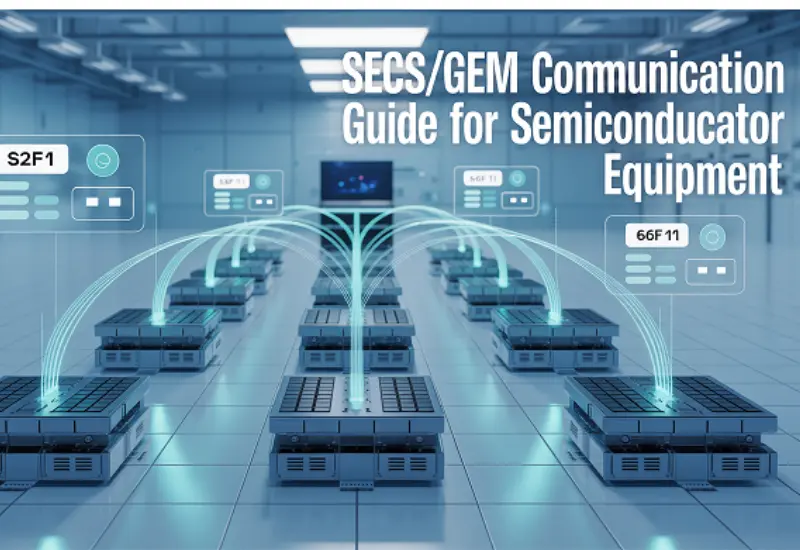
半導體設備的 SECS/GEM 通訊指南

摘要

  • SECS/GEM 通訊作為現代半導體製造的主要骨幹,實現設備與主機系統之間的資料交換。 
  • 該通訊協定套件包含 SEMI E4、E5、E30 及 E37 標準,用以規範訊息結構與設備行為邏輯。 
  • 其實作可在生產環境中實現遠端控制、即時監控以及自動化資料收集。 
  • 高速 SECS 訊息服務(HSMS)已在很大程度上取代舊有的序列連線,以提供更快的資料傳輸量。 
  • 透過 SECS/GEM 架構的標準化,可降低整合成本並加速設備製造商的上市時程。

介紹

根據 Statista(2024)資料,全球半導體市場的估值已超過 6,000 億美元,其中僅設備支出就超過 1,000 億美元。隨著晶片複雜度不斷提升、製程節點持續縮小,完美的機器對機器互動變得至關重要。高產量製造環境仰賴精準度,完全無法容忍人工資料輸入或彼此孤立的硬體。

有效的 SECS/GEM 通訊仍然是連接先進工廠主機系統與現場複雜設備的主要解決方案。此一標準化介面確保無論設備來自小型 OEM 還是全球大廠,都能使用工廠「大腦」能理解的語言進行溝通。沒有這種共同語言,現代的「無人化」晶圓廠仍將只是遙不可及的夢想。

整合穩健的 SECS GEM 介面可透過自動化配方與狀態追蹤,協助工廠提升良率並降低停機時間。儘管其底層技術已有數十年歷史,但其演進仍持續滿足工業 4.0 的需求。對工程師與 OEM 而言,精通這些通訊協定仍然是半導體產業中不可妥協的關鍵技能。

SECS/GEM 通訊的起源與演進

半導體設備材料國際組織(SEMI)於 1980 年代制定這些標準,以解決當時日益嚴重的問題。在標準化之前,每一家設備供應商都使用專有通訊協定。這種碎片化迫使晶圓廠業主為每一台設備撰寫客製化驅動程式,過程既昂貴又容易出錯。

SECS/GEM 通訊架構因而成為最終的解決方案。SECS 代表 Semiconductor Equipment Communication Standard(半導體設備通訊標準),而 GEM 則是 Generic Model for Communications and Control of Manufacturing Equipment(製造設備通訊與控制通用模型)。兩者共同定義了資料如何在線路中傳輸,以及設備在接收到資料後的行為方式。

核心標準:E4、E5 與 E37

要理解 SECS GEM 通訊協定,必須從其分層式架構著手。最底層是 SEMI E4(SECS-I),其定義了序列通訊方式。雖然今日已較少使用,但它為 RS-232 纜線上位元與位元組的傳輸方式奠定了基礎。

現代化工廠更偏好 SEMI E37,也就是 HSMS(High-Speed SECS Message Services)。此標準將 SECS 訊息映射至 TCP/IP 網路之上。根據 SEMI(2024)資料,由於在長距離傳輸中具備更佳的速度與可靠性,HSMS 已成為 300mm 晶圓廠中主流的傳輸層。

SEMI E5(SECS-II)

在傳輸層之上的是 SEMI E5,即 SECS-II。此標準定義了通訊協定的實際「詞彙」。它將訊息組織為「串流(Stream)」與「功能(Function)」。例如,Stream 1 包含設備狀態相關的訊息,而 Stream 2 則負責設備控制。這種邏輯分組使主機能夠提出具體問題,例如「目前使用的是哪一個配方?」並接收結構化且可預期的回應。

了解 GEM 層(SEMI E30)

如果說 SECS-II 提供了詞彙,那麼 SEMI E30(GEM)則提供了文法與禮儀。GEM 標準定義了必須實作哪些 SECS-II 訊息,以及設備狀態機應如何運作。它確保不同供應商的設備在控制方式上具有一致的「外觀與操作感」。

若沒有 GEM,即使兩台設備都使用 SECS-II,其實作方式仍可能差異甚大,導致主機系統無法有效通訊。GEM 強制規範事件回報、警報管理以及遠端指令執行的特定行為。它是讓 SECS/GEM 通訊真正實現即插即用的「黏著劑」。

狀態模型與控制

SECS GEM 介面中的一個基本概念是狀態模型。設備會處於特定狀態,例如「Communicating」或「Not Communicating」,以及「Remote」或「Local」控制。

當設備處於「Local」模式時,設備端操作人員具有優先權;在「Remote」模式下,則由工廠主機系統主導控制。這種層級關係可避免衝突指令,否則可能損壞晶圓或硬體。一座價值數十億美元的晶圓廠,若遠端主機與現場操作人員爭奪機械手臂的控制權,真的能安全運作嗎?多半只會以一堆昂貴的矽粉作為結局。

事件回報與變數收集

GEM 允許主機「訂閱」特定事件。設備不必讓主機不斷輪詢(這會浪費頻寬),而是在發生重要事件時主動傳送訊息,例如製程開始、晶圓交接或製程完成。

系統同時也處理各類變數,包括狀態變數(SV)、設備常數(EC)以及資料變數(DV)。這些變數讓晶圓廠能追蹤從腔體溫度到設備上執行的軟體版本等各項資訊。

深入解析訊息結構與串流功能

要真正理解 SECS GEM 通訊協定的複雜性,必須檢視訊息的結構方式。每一則訊息都由標頭與本文組成。標頭包含路由資訊,以確保訊息能抵達正確的目的地;本文則包含資料,並以樹狀結構的清單與項目形式進行格式化。

串流(Stream)用來分組相關活動。例如,Stream 7 專注於製程程式管理,允許主機上傳或下載配方。在每日有數千片晶圓流動的工廠中,確保正確的配方位於正確的設備上至關重要。只要一個錯誤,就可能造成巨大的財務損失。

警報管理(Stream 5)

警報對安全性與良率至關重要。當設備偵測到錯誤時,會傳送一則 Stream 5 訊息。GEM 要求對這些警報進行分類:它只是輕微警告,還是需要立即停機的致命錯誤?SECS GEM 介面確保主機系統能即時接收此資訊,從而迅速進行人工介入或自動化復原流程。

暫存(Spooling)能力

如果網路中斷會發生什麼事?在高產量晶圓廠中,資料遺失是不可接受的。GEM 透過「Spooling」機制解決此問題。當連線中斷時,設備會將訊息儲存在本地緩衝區;一旦連線恢復,設備便會依時間順序將資料解除暫存並傳送至主機。這確保即使在基礎設施出現短暫問題時,每一片晶圓的處理紀錄仍然完整。

設備 OEM 的實作挑戰

對設備 OEM 而言,提供高品質的 SECS/GEM 通訊介面是一項重要的競爭優勢。多數一線半導體製造商拒絕採購缺乏 GEM 相容介面的設備,這已成為進入高階市場的入場門檻。

即使有標準可循,實作也很少是「一鍵完成」。每一台設備都有其獨特能力,將這些能力映射至 SECS-II 訊息需要深厚的領域專業知識。OEM 經常在撰寫能準確反映設備行為的 GEM Manual 時遭遇挑戰。

嚴格的測試與驗證

介面測試至關重要。一台聲稱符合 GEM 標準,但在高訊息負載下失效的設備,可能造成整個工廠的延誤。工程師使用專用模擬器來模擬工廠主機,並驗證設備是否能正確回應所有指令與錯誤狀態。

連接既有硬體

許多 200mm 晶圓廠中的舊設備並未原生支援 SECS/GEM。在這些情況下,整合團隊會使用「GEM 啟用」軟體或硬體橋接器。這些轉接器位於舊控制器與工廠網路之間,將專有訊號轉換為標準 SECS 訊息,從而延長高價資產的使用壽命。

SECS/GEM 在先進製程控制(APC)中的角色

根據 Gartner(2023),資料驅動製造仍是資本密集型產業提升營運效率的首要任務。SECS GEM 通訊協定提供了實現先進製程控制(APC)所需的可視性。透過即時收集高保真資料,工程師能在製程偏移毀壞整批晶圓之前即時發現問題。

APC 仰賴設備在製程期間傳送詳細的感測器資料,例如氣體流量、壓力數值或 RF 功率水準。主機系統將這些資料與「黃金模型」比對;若設備產生漂移,主機便透過 SECS GEM 介面傳送修正指令,即時調整參數以維持製程穩定。

資料量與介面 A(EDA)的演進

隨著設備日益複雜,資料量可能超出標準 GEM 連線的處理能力,這促成了設備資料擷取(EDA),亦稱為介面 A 的發展。GEM 仍是控制標準,而 EDA 則提供一條獨立的高速通道,用於大量資料收集。現代晶圓廠多採用混合式架構:GEM 負責「握手」,EDA 負責「大數據」。

成功整合的最佳實務

成功部署 SECS/GEM 通訊解決方案取決於清楚的文件與嚴格的測試。應從完整的 GEM Manual 著手,定義每一個變數 ID(VID)、收集事件 ID(CEID)與警報 ID(ALID)。

  • Standardize Early: 在設備設計初期即定義訊息集合。
  • Use Proven Toolkits: 避免自行從零撰寫 SECS 驅動程式,使用成熟 SDK 以確保相容性。
  • Test Connectivity: 確保 HSMS 設定(T3、T5、T6 計時器)符合工廠主機需求。
  • Validate Data: 確保設備送出的數值真實反映硬體的實際物理狀態。

自動化很少仰賴單一「英雄式」設備,而是一項所有元件都必須完美協作的集體成果。SECS GEM 通訊協定正是這場高科技交響樂的指揮。

未來展望與產業穩定性

隨著產業邁向「智慧晶圓廠」,有人質疑 OPC UA 或 MQTT 等新通訊協定是否會取代 SECS GEM。儘管這些網路導向協定更具彈性,但半導體產業向來保守。龐大的既有基礎設施建立在 SECS/GEM 之上,確保其在可預見的未來仍將持續成為標準。

AI 與機器學習的整合同樣仰賴 SECS/GEM 通訊所奠定的基礎。這些模型需要乾淨且具情境的資料,而 GEM 提供結構化資料模型,使其成為設備故障預測與製程最佳化的理想資料來源。

結論

SECS/GEM 通訊的複雜性或許令人卻步,但它們正是串聯現代半導體晶圓廠的核心結構。從 HSMS 傳輸層到 GEM 行為邏輯,這些標準為高產量自動化製造提供了穩健框架。隨著產業持續挑戰物理極限,對穩定且標準化通訊的需求只會不斷提升。無論你是在打造新型蝕刻設備,或是優化整條產線,深入理解 SECS/GEM 通訊套件,都是確保設備成為全球矽供應鏈中關鍵節點的必要條件。

Contact Us Today

獲得專家協助,導入 SECS/GEM 設備連線方案