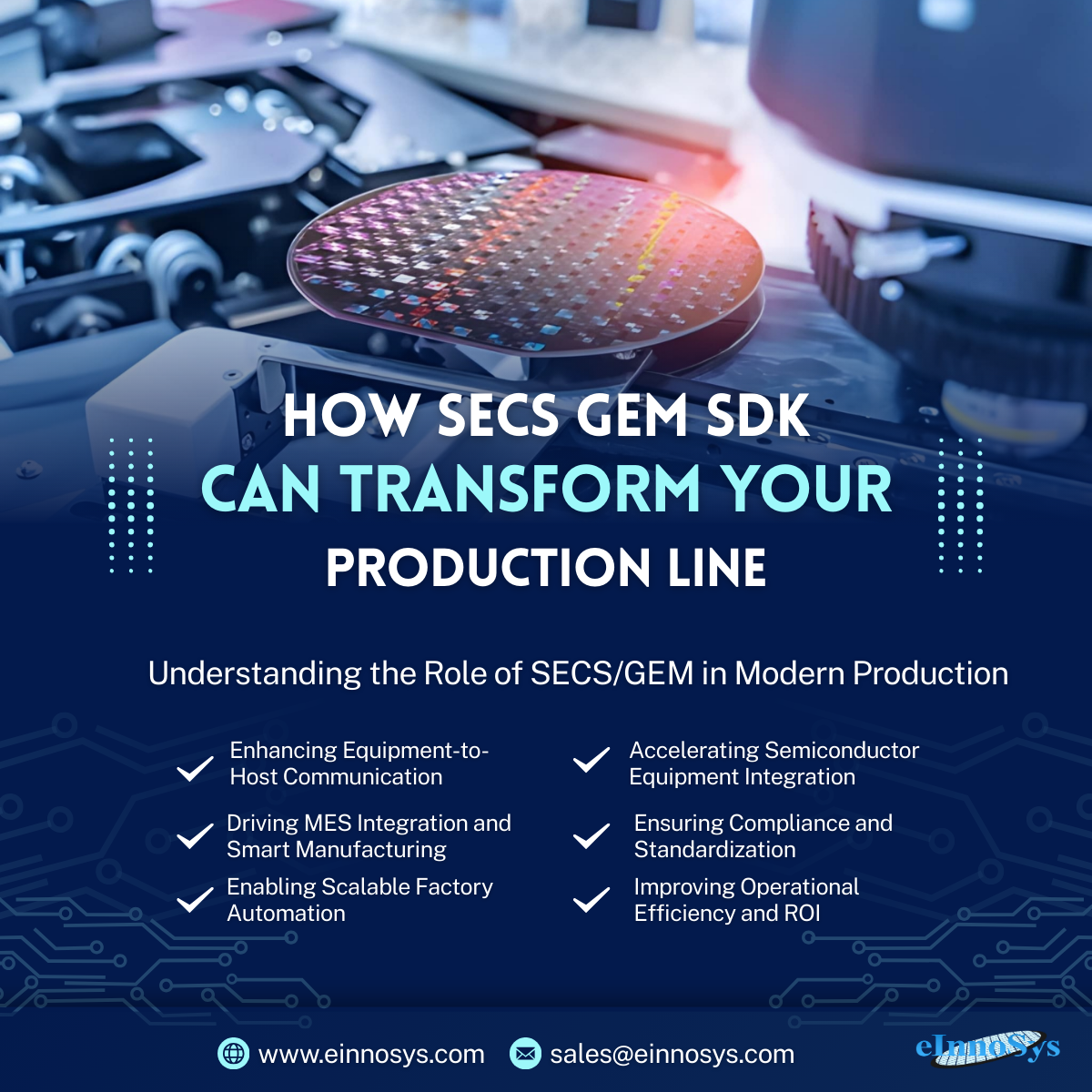
How SECS GEM SDK Can Transform Your Production Line

In today’s highly competitive semiconductor landscape, production efficiency, equipment connectivity, and real-time data visibility are no longer optional—they are essential. As fabs and OEMs move toward smarter and more connected environments, SECS/GEM for Semiconductor Manufacturing has become the backbone of reliable communication between equipment and host systems. At the center of this transformation lies the SECS/GEM SDK, a powerful toolkit that enables seamless equipment connectivity, automation, and compliance.

Whether you are modernizing legacy tools or deploying new manufacturing lines, investing in SECS GEM SDK Development can dramatically improve operational efficiency. From enabling structured Equipment to Host Communication to supporting full-scale Semiconductor Factory Automation, the right SDK simplifies SECS/GEM Integration, ensures protocol compliance, and accelerates time-to-market.

This blog explores how implementing a robust SECS/GEM Communication Software solution can transform your production line and future-proof your manufacturing strategy.

Understanding the Role of SECS/GEM in Modern Production

The SECS/GEM SDK is built on the globally recognized SEMI SECS/GEM Standard, which defines communication between semiconductor manufacturing equipment and host systems such as MES. It provides a structured framework for SECS GEM Protocol Implementation, enabling standardized data exchange and remote equipment control.

At its core, SECS/GEM Software Development enables manufacturers to implement consistent messaging using the SECS II and HSMS Protocol, ensuring reliable and secure communication. This structured communication enables real-time monitoring, recipe management, alarm reporting, and equipment state tracking.

By adopting SECS/GEM for Semiconductor Manufacturing, companies eliminate manual interventions and enable automated workflows. This strengthens Semiconductor Equipment Connectivity, reduces errors, and enhances productivity across the production floor.

Enhancing Equipment-to-Host Communication

One of the biggest advantages of deploying a SECS/GEM SDK is its ability to streamline Equipment to Host Communication. In traditional manufacturing setups, disparate systems often operate in silos. With proper SECS GEM Equipment Integration, production tools can communicate directly with MES, EAP, and other factory systems.

Through structured SECS/GEM Host Integration, fabs can:

  • Collect real-time production data
  • Automate recipe downloads and uploads
  • Monitor alarms and equipment states
  • Improve traceability and reporting

By leveraging advanced SECS GEM Automation Software, manufacturers can create a synchronized production environment where data flows seamlessly between tools and control systems. This strengthens Factory Automation Software strategies and drives measurable gains in OEE and yield.

Accelerating Semiconductor Equipment Integration

As fabs expand or upgrade production lines, integrating new equipment quickly becomes critical. SECS GEM SDK Development simplifies Semiconductor Equipment Integration by offering reusable libraries and prebuilt protocol stacks.

Instead of building communication layers from scratch, engineers can use a validated SECS/GEM Communication Software framework to accelerate deployment. This approach ensures compliance with the SEMI SECS/GEM Standard while reducing development time and risk.

For manufacturers dealing with older tools, a Legacy Equipment SECS/GEM Upgrade becomes essential. Modern SDK solutions allow legacy systems to be retrofitted with standardized communication capabilities, bringing them into modern Semiconductor Factory Automation environments without replacing expensive hardware.

This capability not only reduces capital expenditure but also ensures long-term scalability through structured SECS GEM Protocol Implementation.

Driving MES Integration and Smart Manufacturing

A production line truly transforms when equipment communication integrates seamlessly with Manufacturing Execution Systems. Through MES Integration with SECS/GEM, manufacturers gain centralized control over scheduling, tracking, and quality management.

The SECS/GEM SDK plays a pivotal role in enabling smooth SECS/GEM Integration between tools and MES platforms. It ensures consistent data exchange, supports event reporting, and facilitates recipe verification.

With strong SECS/GEM Host Integration, manufacturers can:

  • Enable automated lot start and stop
  • Implement advanced traceability
  • Reduce cycle time
  • Improve compliance reporting

Modern SECS GEM Automation Software also supports predictive analytics by feeding structured equipment data into AI and monitoring systems. This integration strengthens Semiconductor Equipment Connectivity while supporting Industry 4.0 initiatives.

Ensuring Compliance and Standardization

Compliance with industry standards is critical for global semiconductor operations. A professionally designed SECS/GEM Software Development solution ensures alignment with GEM Compliance Software requirements and global SEMI specifications.

Using a reliable SECS GEM SDK Development approach helps manufacturers:

  • Maintain consistent message structures
  • Validate equipment behavior
  • Ensure standardized alarm handling
  • Achieve smooth customer acceptance testing

With proper SECS GEM Equipment Integration, equipment suppliers can confidently deliver tools that meet customer expectations across international markets.

Standardized SECS GEM Protocol Implementation also simplifies audits and accelerates deployment in multi-fab environments, reducing operational complexity.

Enabling Scalable Factory Automation

As semiconductor manufacturing becomes more advanced, scalability is essential. A flexible SECS/GEM SDK provides the foundation for building robust Factory Automation Software ecosystems.

Through seamless SECS/GEM Integration, manufacturers can integrate:

The use of modern SECS/GEM Communication Software ensures consistent performance across different equipment vendors. This strengthens overall Semiconductor Factory Automation architecture and enables centralized monitoring and control.

Additionally, strong SECS/GEM Host Integration allows production lines to scale without major reconfiguration. Whether expanding a single tool cluster or deploying a new fabrication line, the SDK ensures standardized connectivity.

Improving Operational Efficiency and ROI

Implementing SECS/GEM for Semiconductor Manufacturing directly impacts operational performance. By enabling structured Semiconductor Equipment Connectivity, fabs gain real-time visibility into tool performance and production metrics.

With comprehensive SECS GEM Automation Software, manufacturers can:

  • Reduce downtime through proactive alerts
  • Improve yield through automated recipe validation
  • Minimize human error
  • Enhance data-driven decision-making

Furthermore, investing in SECS GEM SDK Development significantly reduces custom coding requirements. Pre-tested libraries streamline SECS GEM Protocol Implementation, lowering engineering costs and speeding up deployment.

By modernizing infrastructure through Legacy Equipment SECS/GEM Upgrade, manufacturers extend equipment lifespan while aligning with modern automation strategies.

Future-Proofing Your Production Line

The semiconductor industry continues to evolve rapidly, with increasing demand for high-mix, low-volume production and advanced nodes. A scalable SECS/GEM SDK ensures your production line remains adaptable to changing requirements.

Through robust SECS/GEM Software Development, manufacturers can integrate new tools, expand MES capabilities, and implement AI-driven monitoring systems without disrupting existing operations.

With standardized SECS GEM Equipment Integration, global fabs can maintain consistency across multiple sites. Combined with strong SECS/GEM Communication Software, this ensures seamless interoperability and reduced integration risk.

Ultimately, embracing SECS/GEM Integration is not just about connectivity—it’s about building a resilient, data-driven production ecosystem powered by reliable SECS GEM Automation Software.

Conclusion

Transforming a semiconductor production line requires more than upgrading equipment—it demands a strategic approach to connectivity, compliance, and automation. Implementing a powerful SECS/GEM SDK provides the technological foundation needed for scalable growth and operational excellence.

Through structured SECS GEM SDK Development, reliable SECS GEM Protocol Implementation, and seamless SECS/GEM Host Integration, manufacturers can achieve true Semiconductor Factory Automation. From enabling advanced MES Integration with SECS/GEM to modernizing systems through Legacy Equipment SECS/GEM Upgrade, the benefits are measurable and long-lasting.

By investing in robust SECS/GEM Software Development and advanced SECS GEM Automation Software, your production line becomes smarter, more efficient, and fully aligned with global SEMI SECS/GEM Standard requirements.

In a world where precision, speed, and data visibility define success, the right SECS/GEM SDK doesn’t just support your production line—it transforms it.

10 Common Mistakes to Avoid When Using SECS GEM SDK

Introduction

As semiconductor manufacturing continues to evolve toward fully connected, smart fabs, SECS/GEM has become a critical standard for reliable equipment communication. Whether you are an OEM building new tools or a fab integrating equipment into MES, the SECS GEM SDK plays a central role in achieving compliant and stable automation.

However, many teams underestimate the complexity of SECS/GEM implementation. Missteps during development or integration often lead to certification delays, unstable communication, or recurring production issues. This blog highlights 10 common mistakes to avoid when using a SECS GEM SDK, helping you reduce integration risks and improve overall semiconductor equipment automation

1. Not Fully Understanding SEMI Standards

One of the most common mistakes is assuming that SECS/GEM is just a messaging protocol. In reality, SECS/GEM is built on multiple SEMI standards such as E4, E5, E30, and often GEM300. Using a SECS GEM SDK without understanding these standards can lead to incomplete or non-compliant implementations.

2. Ignoring Proper State Model Implementation

Incorrect control and process state handling is a frequent cause of SECS/GEM communication errors. Many developers hardcode states or skip edge cases, which leads to unpredictable behavior during production. A robust SECS/GEM implementation must strictly follow defined state transitions.

3. Hardcoding SVIDs, CEIDs, and Alarms

Hardcoding variables, events, and alarms reduces flexibility and makes future updates difficult. A good SECS GEM SDK should allow configuration-driven management of SVIDs, CEIDs, and alarm definitions to support scalable SECS/GEM integration.

4. Poor Error and Exception Handling

Ignoring timeout handling, retry mechanisms, or invalid message scenarios is a major risk. SECS/GEM communication operates in real-time production environments, and poor error handling can cause equipment downtime or MES disconnections.

5. Incomplete Alarm and Event Reporting

Many tools technically “support” alarms but fail to provide meaningful context. In semiconductor equipment automation, alarms should be clear, traceable, and actionable. Improper alarm reporting weakens the value of SECS/GEM data for operators and engineers.

6. Skipping Host Simulation and Testing

Relying solely on on-site testing is a costly mistake. Every SECS GEM SDK integration should be validated using host simulators before fab deployment. This helps identify SECS/GEM communication errors early and reduces commissioning time.

7. Treating SECS/GEM as an Afterthought

Some OEMs add SECS/GEM implementation late in the development cycle. This often leads to rushed design, missing features, or failed certifications. SECS/GEM should be considered a core part of equipment architecture from day one.

8. Lack of Version and Configuration Management

Without proper version control and configuration tracking, changes to SECS/GEM integration can introduce regressions. Maintaining configuration history is essential for audits, troubleshooting, and long-term support.

9. Limited Performance and Load Testing

High message volumes, especially in advanced semiconductor equipment automation, can stress communication layers. Failing to test performance under load may result in delays, message drops, or unstable host connections when production scales.

10. Choosing the Wrong SECS GEM SDK

Not all SDKs are created equal. A weak or poorly supported SECS GEM SDK can limit flexibility, increase maintenance effort, and slow down integration. Choosing a mature, configurable, and well-supported SDK is critical for long-term success with SECS/GEM.

Conclusion

Avoiding these common mistakes can dramatically improve the success of your SECS/GEM implementation. A well-designed SECS GEM SDK integration leads to faster equipment qualification, fewer communication issues, and more reliable semiconductor equipment automation. By focusing on standards compliance, testing, scalability, and long-term maintainability, OEMs and fabs can unlock the full value of SECS/GEM connectivity.

Planning a SECS/GEM integration or struggling with communication issues?

Our experts specialize in SECS GEM SDK integration, troubleshooting, and compliance testing for OEMs and fabs.

Contact us today to schedule a consultation and ensure your equipment is fully SECS/GEM compliant, production-ready, and future-proof.

More Blog Post:

FAQ

What is a SECS GEM SDK and why is it important?

A SECS GEM SDK is a software development kit that helps semiconductor equipment communicate with factory host systems using the SECS/GEM standard. It is essential for achieving reliable automation, real-time monitoring, and compliance with SEMI standards in semiconductor equipment automation.

What are the most common SECS/GEM communication errors?

Common SECS/GEM communication errors include incorrect state model handling, message timeouts, improper alarm reporting, and mismatched SVIDs or CEIDs. These issues usually arise from incomplete SECS/GEM implementation or insufficient testing during integration.

How long does SECS/GEM integration typically take?

The timeline for SECS/GEM integration depends on tool complexity and readiness. A well-planned SECS GEM SDK integration usually takes a few weeks, while advanced tools or GEM300 implementations may take several months.

Can SECS/GEM be added to existing semiconductor equipment?

Yes, SECS/GEM can be retrofitted into existing equipment using a compatible SECS GEM SDK. However, older systems may require additional customization to meet modern SECS/GEM implementation and automation requirements.

How do I choose the right SECS GEM SDK?

The right SECS GEM SDK should be standards-compliant, configurable, scalable, and well-supported. It should simplify SECS/GEM integration, reduce communication errors, and support long-term semiconductor equipment automation needs.

SECS/GEM Integration Guide: Compliance Testing & Implementation

Connectivity is power in semiconductor and electronics manufacturing. Each machine, process, and data item is part of the bigger picture of attaining a seamless automation process, as well as intelligent decision making. The SECS/GEM integration is one of the most significant frameworks that helps to make this transformation and it is a standardized communication protocol that allows closing the gap between equipment and factory automation systems.

You may be updating old systems or establishing a new production facility, but you need to understand how to be able to test compliance with the SECS/GEM and deploy SECS/GEM software and SECS/GEM host integration to make sure that your manufacturing processes are not obsolete in the future

Step 1: Evaluating Equipment Fit

Assessment of the current setup is the first process towards a successful integration of SECS/GEM equipment. The equipment you are using should be able to communicate on SEMI SECS/GEM standard (E5/E30). Most of the modern tools are already equipped with built-in SECS/GEM features, yet older systems may need some of the following elements: communication gateways, or adapter software.

Unless your old machine is native SECS/GEM, there may be a need to use specialized SDKs or middleware, which translates proprietary protocols into SECS-II messages that can be used in the GEM model. This will make all your data, process parameters as well as alarm reports available under one integrated automation platform.

An extensive compatibility test eliminates future delays at great expense and makes sure that your SECS/GEM protocol implementation has a firm foundation.

Step 2: Selecting the SDK and Development Tools of the SECS/GEM

The proper SDK and development tools of SECS/GEM are the next step after compatibility has been checked. A sound SDK makes it easier to cope with command processing, message decoding and event handling.

SECS/GEM software libraries have been written in different programming environments, including .NET, C++, or Java. These devices enable developers to develop layers of communication that are effective in managing both the host (factory) and equipment end.

Further, a SECS/GEM simulator can be used in the development phase to exchange messages without connecting to real hardware to save time and resources. The correct tools minimize the complexity, accelerate integration and assure that your system passes all areas of testing in the SECS/GEM compliance test.

Step 3: Implement SECS/GEM Interface

The SECS/GEM interface is used to provide the interface between the host system and the equipment.

In implementation, specify all pertinent data variables, state models and event reports which represent the behavior of your machine. They need to be defined in terms of the SEMI E5 (SECS-II message format) and E30 (GEM model) specifications in order to become consistent and interoperable.
Every message transaction, such as equipment status, start process, etc., has to fit in the conventional GEM event objects. The well-designed interface can facilitate the SECS/GEM communication as well as reduce downtime and improve traceability and the use of equipment.

Step 4: Integration by Testing and Validating

It is testing that gives theory reality. SECS/GEM interface testing should be done comprehensively before deployment so that the accuracy of messages, their synchronized performance, and their synchronization are all deliberated.

Test benches or leverage SECS/GEM simulation tools to determine the interactions between the host and the equipment in different conditions: normal operations, alarm, disconnection, and recovery sequences. This assists you in identifying the irregularities before their impact to production.

SECS/GEM full compliance testing ensures that the implementation you have made is compliant to the SEMI standards, communicates correctly, and reacts predictably in a real world situation.

Step 5: Deploy, Monitor, and Maintain

After being tested, it is now time to put your SECS/GEM host integration into production. Long-term reliability depends on continuous monitoring and updating on a regular basis.

The proactive maintenance plan should be included to maintain stable communication links and all SEMI standard changes or firmware updates should be installed beforehand. Having an expert like eInnoSys assist you in maintaining your system to be compliant, scalable, and optimised with regards to performance.

Constant updates also enable the integration to keep up with newly added equipment, automation frameworks or cloud-based analytics tools without interfering with any of the current workflows.

The Role of SECS/GEM in Smart Manufacturing in the Present Day

SECS/GEM protocol is not merely a communication layer, it is the core of Industry 4.0 in the manufacturing of semiconductors and electronics.

Allowing standardized data exchange, SECS/GEM will allow factories to have all the data on equipment performance, production measures as well as quality trends. Such visibility drives predictive maintenance, live analytics, and artificial intelligence-based decision-making which eventually results in less downtime and higher yield.

Current smart factories have developed SECS/GEM software to integrate machines with, and connect to MES (Manufacturing Execution Systems), ERP systems and cloud-based dashboards — forming a single digital ecosystem.

The Reasons eInnoSys is the Best SECS/GEM Integration Partner

We think that real automation is based on perfect communication, which is the starting point at eInnoSys. Having years of experience in SECS/GEM equipment integration, we assist semiconductor and electronics manufacturers in the integration of legacy equipment into the digital age, fast, safely, and effectively.

This is what is unique about eInnoSys:

  • SECS/GEM Solutions — Our engineers will guarantee complete SECS/GEM compliance testing with SECS/GEM interface design through verification and backward SECS/GEM communication.
  • High Simulation Tools — Our own SECS/GEM simulator enables you to be able to test and verify integrations prior to live deployment in order to minimize downtime.
  • Tailored Integration Method — We will tailor the SECS/GEM host integration to your current infrastructure and there will be minimal disturbance to the running operations.
  • Long-Term Support — We monitor, update, and optimize your automation environment in addition to first deployment to ensure that it is at its best.

We are committed to ensuring that SECS/GEM software implementation is hassle-free and scalable — so that your factory can be able to achieve increased throughput, reduced costs and smarter automation.

Conclusion

Unlike a technical upgrade, the incorporation of SECS/GEM with your current manufacturing equipment is a strategic position that will lead to a smarter and data-driven future.

Using a systematic methodology — checking the compatibility, selecting the optimal tools, creating a compliant interface, testing hard and finally maintaining the situation — manufacturers would open up new horizons of visibility and control in their operations.

Having an appropriate crisis communication plan among your host and equipment, you will minimize errors, increase efficiency, and make faster and more informed decisions.

Make your automation systems future-proof with the help of eInnoSys and become the full potential of SECS/GEM integration because in the age of smart manufacturing, the interconnected equipment implies the interconnected success.

Frequently Asked Questions About SECS/GEM Integration

  • 1. How do I know if my equipment supports SECS/GEM?

    SECS/GEM (SEMI E5 & E30 standards) is a communication protocol that connects manufacturing equipment with factory automation systems like MES or ERP. It standardizes data exchange across different machines, enabling real-time monitoring, predictive maintenance, and smart manufacturing efficiency.

  • 2. What is SECS/GEM and why is it important?

    Check your equipment’s specs for SEMI E5 (SECS-II) and E30 (GEM) support. Most modern tools include SECS/GEM by default, while older systems may require a communication gateway or middleware. eInnoSys offers compatibility assessments for legacy equipment integration.

  • 3. What is a SECS/GEM simulator?

    A SECS/GEM simulator mimics equipment or host communication, allowing developers to test integrations without using real machines. It’s used for testing, training, and troubleshooting—saving time and reducing production risks.

  • 4. What are the steps in SECS/GEM compliance testing?

    Compliance testing includes verifying SECS-II message formatting, equipment state transitions, event reporting, synchronization, and stress testing. Proper validation ensures reliable communication and SEMI standard compliance.

  • 5. How does SECS/GEM enable smart manufacturing?

    SECS/GEM forms the backbone of Industry 4.0 by enabling standardized, real-time data exchange. It supports AI-driven analytics, predictive maintenance, and improved equipment utilization—helping manufacturers cut downtime and improve yield.

Semiconductors Bumping System Process Equipment SECS/GEM SDK

In the ever-evolving world of semiconductor manufacturing, Bumping System Process Equipment plays a crucial role in wafer-level packaging and advanced interconnect processes. As the industry continues to move toward automation, real-time monitoring, and precision control, equipment-to-host communication has become a core requirement for every fab.

That’s where the Bumping System Process Equipment SECS/GEM SDK from Einnosys makes a real difference.

The SECS/GEM (SEMI Equipment Communication Standard / Generic Equipment Model) protocol defines a unified framework that allows semiconductor equipment to communicate efficiently with factory host systems. By adopting this standard, fabs and OEMs can achieve consistent equipment integration, streamlined data collection, and improved process automation. Developing SECS/GEM functionality internally, however, can be highly complex — it demands deep understanding of SEMI standards, specialized engineering skills, and significant development time. That’s why using a proven SECS/GEM SDK is the smarter and faster approach to enable reliable equipment-to-host connectivity.

Einnosys bridges this gap with its Process Equipment SECS/GEM SDK — a ready-to-use, SEMI-compliant, and fully customizable software toolkit designed for equipment manufacturers (OEMs) and fabs that want to accelerate connectivity and improve automation efficiency.

Bumping System Process Equipment SECS GEM SDK

The Power of Einnosys SECS/GEM SDK

The Bumping System Process Equipment SECS GEM SDK from Einnosys provides a complete framework to integrate SECS-II, HSMS, and GEM functionalities directly into semiconductor tools. In bumping systems — where solder bumps or copper pillars are precisely formed on wafers — accuracy and stability are non-negotiable. The Einnosys SDK enables your equipment to exchange SECS-II messages seamlessly, manage alarms and events, and maintain GEM state models with minimal development effort.

A key advantage of using our Process Equipment SECS/GEM SDK is its GEM300 Compliance, which ensures your equipment remains compatible with automation environments in both 200 mm and 300 mm fabs. The SDK also includes advanced modules such as a SECS GEM Test Tool and a SECS GEM Message Library, allowing developers to validate communication scenarios quickly and efficiently. This helps shorten integration timelines and ensures your system is production-ready faster.

Purpose-Built for Semiconductor OEMs

For OEMs building or upgrading Bumping System Process Equipment, the SECS GEM SDK for Semiconductor Equipment offers exceptional flexibility. Through its HSMS SECS GEM SDK communication layer, equipment can connect over TCP/IP with high-speed and reliable message transfer — eliminating data delays and connection instability during intensive process cycles.

The SECS GEM SDK for Bumping Equipment is engineered to make communication simple, even for teams without deep SECS/GEM expertise. With an intuitive SECS GEM API, engineers can define variables, events, and reports through graphical interfaces — no need to manually code complex SECS-II message structures.

In addition, the SDK comes with an integrated Equipment Data Collection SDK module that empowers equipment to continuously track process parameters in real time, identify deviations, and communicate critical performance metrics to the fab’s MES or host system. It supports both automatic and host-initiated data collection, allowing fabs to implement advanced analytics, predictive maintenance, and yield optimization with ease. This capability forms the backbone of smart manufacturing and ensures complete visibility into every stage of the production process.

Reliable SECS/GEM Host Communication

At the heart of the Einnosys SDK lies its SECS GEM Host Communication module, which manages all interactions between the host and equipment controller. Whether it’s S1F1 (Are You There Request), S6F11 (Event Report), or S2F41 (Remote Command), the SDK ensures smooth, standards-compliant communication — a must-have for any fab moving toward Industry 4.0 automation.

The pre-built SECS GEM Message Library helps developers accelerate integration across multiple tool types by providing ready-to-use SECS-II message templates. Combined with the SECS GEM Test Tool, your team can simulate host-equipment communication, validate message flows, and ensure SEMI standard compliance before deployment.

Designed for Future Ready Fabs

Designed for Future-Ready Fabs

Einnosys understands the importance of GEM300 Compliance and consistent communication behavior across tools. Our Process Equipment SECS/GEM SDK ensures your bumping or process equipment integrates seamlessly into fully automated 200 mm and 300 mm fabs. With real-time diagnostics, advanced logging, and error handling tools, your engineering team can quickly identify communication issues and maintain uptime with confidence.

As a result, OEMs and fabs benefit from:

Faster integration cycles

Reduced development cost

Improved reliability and data traceability

Compliance with SEMI E5, E30, E37, and GEM300 standards

In the semiconductor industry, precision, speed, and automation define success. The Bumping System Process Equipment SECS/GEM SDK by Einnosys has become an essential enabler for manufacturers who aim to build smarter, more connected, and more reliable tools.

Whether you are developing new equipment or upgrading legacy systems, Einnosys provides a robust Process Equipment SECS/GEM SDK that includes everything you need — from SECS GEM Host Communication, HSMS SECS GEM SDK, and SECS GEM Message Library to SECS GEM Test Tools and GEM300 Compliance modules.

By leveraging Einnosys SECS GEM SDK for Bumping Equipment and Semiconductor Equipment SDK, fabs and OEMs can streamline integration, enhance traceability, and accelerate their journey toward smart manufacturing and predictive maintenance.

At Einnosys, we don’t just provide tools — we build the foundation for a connected, efficient, and future-ready semiconductor ecosystem.

Blog Post:
FAQs
  • What is the SECS/GEM SDK and why is it important for semiconductor equipment?

    The SECS/GEM SDK (Software Development Kit) is a ready-to-use framework that enables semiconductor equipment to communicate with factory host systems using the SEMI E5/E30 communication standards. It is essential for Bumping System Process Equipment because it ensures smooth data exchange, host control, and equipment monitoring — key elements for achieving full fab automation.

  • How does Einnosys SECS/GEM SDK benefit Bumping System Process Equipment?

    The Einnosys Bumping System Process Equipment SECS GEM SDK simplifies the integration of SECS-II, HSMS, and GEM protocols. It allows your equipment to exchange messages, manage alarms, monitor process data, and maintain GEM state models with minimal coding. This leads to faster deployment, better equipment reliability, and seamless GEM300 compliance for both 200 mm and 300 mm wafer fabs.

  • Does the Einnosys SECS/GEM SDK support GEM300 compliance?

    Yes, the Einnosys Process Equipment SECS/GEM SDK is fully compliant with GEM300 standards, ensuring compatibility with modern fabs and automation systems. This compliance guarantees consistent communication behavior across different tools and supports advanced manufacturing automation processes.

  • Can the SECS/GEM SDK be integrated into existing or legacy equipment?

    Absolutely. The Einnosys SECS/GEM SDK for Semiconductor Equipment can be retrofitted into older or legacy process equipment to make them SECS/GEM-ready. It provides all the necessary software modules — including SECS GEM Host Communication, HSMS SECS GEM SDK, and SECS GEM Message Library — without requiring any major hardware redesign.

  • What tools and features are included in the Einnosys SECS/GEM SDK?

    The SDK includes all the components required for full SEMI E5/E30 compliance:

    • SECS GEM Host Communication Module for message handling
    • SECS GEM API for easy customization
    • SECS GEM Test Tool for validation
    • SECS GEM Message Library with pre-built message templates
    • Equipment Data Collection SDK for real-time process monitoring and predictive maintenance
  • How does the Equipment Data Collection SDK enhance fab efficiency?

    The built-in Equipment Data Collection SDK enables real-time monitoring of process variables such as temperature, pressure, or vacuum level. It supports both automatic and host-triggered data collection, allowing fabs to perform predictive maintenance, detect anomalies, and optimize yield — a critical component of smart manufacturing.

SECS/GEM Integration with Canon FPA 5000 ES3

[vc_row][vc_column][vc_column_text css=””]

In the fast-paced semiconductor industry, seamless communication between tools and factory host systems is vital for achieving automation, efficiency, and data-driven decision-making. Many 200 mm fabrication facilities still operate with legacy equipment that lacks native SECS/GEM capabilities. One such example is the Canon FPA 5000 ES3 (248 nm DUV Step-and-Scan Lithography System), a proven and reliable system used worldwide.

To bring this legacy tool into compliance with modern automation requirements, Einnosys successfully implemented its flagship product — EIGEMBox, a turnkey SECS/GEM integration solution.

[/vc_column_text][/vc_column][/vc_row][vc_row][vc_column width=”1/2″][vc_column_text css=””]The Challenge

The Canon FPA 5000 ES3 is a robust lithography tool designed for 200 mm wafer processing, but like many legacy systems, it was not originally equipped with SECS/GEM protocol support.

This limitation created challenges for fabs aiming to:

  • Connect the tool to host automation systems (MES/EAP).
  • Enable data collection, event monitoring, and alarm reporting.
  • Achieve SECS/GEM compliance for uniform fab automation.

Without SECS/GEM communication, the fab’s automation framework could not fully monitor or control the Canon system, leading to manual operations, inefficiencies, and limited data visibility.[/vc_column_text][/vc_column][vc_column width=”1/2″][vc_single_image image=”37712″ img_size=”500X500″ css=””][/vc_column][/vc_row][vc_row][vc_column][vc_column_text css=””]The Solution: EIGEMBox

To address these challenges, Einnosys deployed the EIGEMBox, an advanced and compact SECS/GEM gateway designed to enable communication between legacy equipment and modern host systems.

The EIGEMBox acted as a bridge interface, converting native Canon equipment signals into fully SEMI E4/E5/E30 compliant SECS/GEM messages, without requiring major hardware or software modifications to the tool.

Key implementation highlights:

  • Quick and non-invasive installation.
  • Full support for SECS-I and HSMS-SS (Ethernet) communication.
  • Real-time data, event, and alarm collection.
  • Custom configuration to align with factory EAP/MES protocols.
  • Validation and certification for GEM compliance by the fab’s automation team.

[/vc_column_text][/vc_column][/vc_row][vc_row][vc_column width=”1/2″][vc_single_image image=”37713″ img_size=”full” css=””][/vc_column][vc_column width=”1/2″][vc_column_text css=””]Benefits of EIGEMBox

The integration of EIGEMBox transformed the Canon FPA 5000 ES3 into a fully SECS/GEM-compliant system, delivering multiple operational benefits:

✅ Automation Enablement – The fab achieved seamless host-to-equipment communication, supporting remote control, data collection, and event reporting.
✅ Reduced Manual Intervention – Automated monitoring minimized operator involvement, improving throughput and reducing human error.
✅ Enhanced Data Visibility – Real-time equipment data was now available for predictive maintenance and process optimization.
✅ Cost-Effective Retrofit – No need for expensive equipment replacement or software rewriting.
✅ Faster Time-to-Production – EIGEMBox enabled quick deployment, allowing the fab to achieve compliance in just a few days.

By using EIGEMBox, the fab successfully upgraded its legacy Canon tool to align with modern automation standards, extending its operational life and maximizing ROI.[/vc_column_text][/vc_column][/vc_row][vc_row][vc_column][vc_column_text css=””]

The success of integrating EIGEMBox with the Canon FPA 5000 ES3 exemplifies how legacy tools can be efficiently upgraded for modern fab automation.
EIGEMBox not only enabled SECS/GEM compliance but also empowered the fab with better control, real-time data access, and enhanced productivity — all without replacing the existing tool.

For fabs and OEMs seeking reliable SECS/GEM integration for legacy or new systems, EIGEMBox by Einnosys offers the perfect balance of performance, simplicity, and scalability.

[/vc_column_text][vc_single_image image="37197" img_size="full" alignment="center" style="vc_box_shadow_3d" onclick="custom_link" css="" link="https://newsite.einnosys.com/eigembox/%22][/vc_column][/vc_row][vc_row][vc_column][vc_column_text css=""]About Einnosys

Einnosys is a global technology company specializing in Factory Automation, SECS/GEM integration, AI/ML, IoT, and Industry 4.0 solutions for semiconductor fabs and equipment manufacturers.

With decades of experience in semiconductor automation, Einnosys delivers turnkey SECS/GEM SDKs, integration services, and edge gateway products such as EIGEMBox to enable seamless communication, compliance, and smart manufacturing transformation.[/vc_column_text][/vc_column][/vc_row][vc_row][vc_column][vc_toggle title=”FAQs: SECS/GEM Integration on Canon FPA 5000 ES3 with EIGEMBox” open=”true” css=””]1. What challenge did Einnosys solve with EIGEMBox for the Canon FPA 5000 ES3?

Einnosys addressed the lack of SECS/GEM connectivity in the Canon FPA 5000 ES3 200 mm lithography tool. Using EIGEMBox, the equipment was upgraded to support data collection, event reporting, and host communication, enabling full factory automation compliance.

2. What is EIGEMBox and how does it help in SECS/GEM integration?

EIGEMBox is a plug-and-play middleware solution by Einnosys that enables SECS/GEM functionality on legacy or “dumb” semiconductor tools. It bridges the communication gap between equipment and factory host systems without requiring any hardware modification.

3. Does the Canon FPA 5000 ES3 support SECS/GEM by default?

No, older Canon FPA 5000 ES3 models (especially 200 mm systems) do not natively support SECS/GEM protocol. EIGEMBox provides this functionality externally, making the equipment GEM-compliant.

4. What benefits did the customer achieve after integrating EIGEMBox?

After SECS/GEM integration, the customer gained real-time equipment monitoring, automated data logging, event and alarm collection, and improved OEE (Overall Equipment Effectiveness). It also reduced manual data entry and human intervention in operations.

5. Is EIGEMBox compatible with other Canon lithography tools?

Yes. EIGEMBox can be integrated with various Canon lithography systems, as well as tools from other OEMs. It supports both 200 mm and 300 mm tool generations, making it a universal retrofit solution.

6. How long does it take to deploy EIGEMBox for SECS/GEM integration?

Typical deployment takes between 2 to 4 weeks, depending on tool type, host configuration, and customer requirements. Einnosys provides remote or on-site integration support to ensure smooth implementation.

7. Does EIGEMBox support GEM300 and advanced SECS/GEM features?

Yes, EIGEMBox is designed to comply with SEMI E4, E5, E30 (GEM), and E37 (HSMS) standards. It can also support GEM300 extensions for advanced wafer handling and process automation if required.

8. Why choose Einnosys for SECS/GEM integration services?

Einnosys specializes in factory automation, SECS/GEM solutions, and semiconductor software development. With years of expertise and proven products like EIGEMBox, Einnosys ensures fast, reliable, and compliant integration for both new and legacy tools.[/vc_toggle][/vc_column][/vc_row]

 SEMICON Europa 2025

📅 Date: November 18–21, 2025
📍 Location: Helmholtzstrasse 2-9, House D / 3rd Floor, 10587 Berlin, Germany
📌 Booth: B1151

Explore the Future of Semiconductor Automation with eInnoSys

eInnoSys is excited to announce our participation in SEMICON Europa 2025, the premier global event for semiconductor innovation and smart manufacturing. Visit us at Booth #B1151 to experience live demonstrations of our cutting-edge Smart Factory Automation solutions designed specifically for fabs, assembly/test houses, and OEMs.

From SECS/GEM integration to AI/ML-powered analytics, eInnoSys is redefining how semiconductor factories operate — smarter, faster, and more connected than ever before.

What You’ll Discover at Our Booth

✅ SECS/GEM Integration

Seamless host-to-tool communication made simple with our patented EIGEMBox. Designed for legacy equipment, it enables plug-n-play SECS/GEM connectivity without any hardware or software installation on the tool. Experience true Industry 4.0 automation—instantly.

✅ AI/ML for Predictive Maintenance

Meet XPump, our real-time pump and motor monitoring system powered by AI/ML. Track key parameters like vibration, temperature, and voltage to predict potential failures before they occur—reducing downtime and maximizing equipment uptime.

✅ Smart Visual Inspection

Discover EIGaugeMonitor, our automated visual inspection solution that uses image capture and AI algorithms to detect macro defects, analog gauge readings, and particle contamination on robotic components. Improve quality and yield with visual intelligence.

✅ Industry 4.0 Solutions

Explore scalable, cloud-ready automation platforms that seamlessly connect equipment, data, and analytics across your fab. From edge computing to cloud dashboards, eInnoSys brings digital transformation to life for semiconductor manufacturers.

Book Your In-Person Meeting at SEMICON Europa 2025

Meet the eInnoSys team and see our live product demos in action.

Our semiconductor automation experts will be available throughout the event to:

  • Demonstrate real-time use cases of our SECS/GEM, AI/ML, and IoT solutions
  • Discuss your fab’s unique automation challenges
  • Share strategies to accelerate digital transformation in semiconductor manufacturing

Schedule your personalized session now and discover how eInnoSys can help you achieve true Smart Factory excellence.

Why Visit eInnoSys at SEMICON Europa 2025?

⭐ Pioneers in SECS/GEM connectivity for legacy tools
⭐ AI/ML-driven predictive analytics for fabs
⭐ Smart factory solutions tailored for semiconductor automation
⭐ Trusted by leading fabs and OEMs worldwide

Contact Us

📧 Email: sales@einnosys.com
🌐 Website: newsite.einnosys.com/
📞 Call (USA): +1 805 334 0710

SECS/GEM Messaging in Cloud-Native MES Environments

[vc_row][vc_column width=”1/2″][vc_column_text css=””]

The semiconductor industry is undergoing a significant transformation. As fabs move toward cloud-native MES (Manufacturing Execution Systems), the role of SECS/GEM messaging becomes even more critical in enabling seamless communication between equipment and factory automation systems. With increased demands for efficiency, flexibility, and scalability, choosing the right approach to SECS/GEM integration is vital for modern fabs.

In this blog, we explore how SECS/GEM software supports cloud-native MES, why semiconductor MES automation depends on it, and how both legacy and modern tools can benefit from SECS/GEM protocol in MES environments.

[/vc_column_text][/vc_column][vc_column width=”1/2″][vc_single_image image=”37226″ img_size=”full” alignment=”center” css=””][/vc_column][/vc_row][vc_row][vc_column][vc_column_text css=””]

The Evolution of MES and the Role of SECS/GEM

Traditional MES platforms were designed to operate on-premises, tightly integrated with equipment and host systems. However, as the industry embraces cloud-native MES environments, new challenges emerge around connectivity, scalability, and security.

Here, SECS/GEM integration ensures standardized communication between tools and the MES, regardless of whether the system is running in a data center, private cloud, or hybrid cloud environment.

SECS/GEM software enables equipment to send and receive structured messages.

Cloud-based SECS/GEM communication ensures that the same standards are applied, even in distributed architectures.

MES with SECS/GEM support future-proofs fabs by allowing legacy equipment to operate alongside modern 300mm tools.

Without robust SECS/GEM application development, fabs risk misaligned communication protocols that can lead to downtime, inefficiency, and data loss.[/vc_column_text][/vc_column][/vc_row][vc_row][vc_column][vc_column_text css=””]Why SECS/GEM Integration Matters in Cloud-Native MES

In traditional fabs, SECS/GEM protocols were used to connect equipment directly to on-premises MES or host computers. In cloud-native MES environments, however, connectivity is more complex, involving distributed data flows and multi-cloud systems.

SECS/GEM integration in this context provides several key benefits:

Standardized Messaging – Whether equipment is legacy or modern, SECS/GEM ensures consistent communication.

Real-Time Visibility – With semiconductor MES automation, fabs gain real-time monitoring of process performance, alarms, and yield metrics.

Scalable Data Handling – Cloud-based SECS/GEM communication allows data from multiple sites to be aggregated and analyzed centrally.

Interoperability – MES with SECS/GEM support enables different vendors’ tools to integrate seamlessly.

By leveraging SECS/GEM software, fabs not only streamline operations but also lay the foundation for advanced analytics, predictive maintenance, and AI-driven process control.[/vc_column_text][/vc_column][/vc_row][vc_row][vc_column width=”1/2″][vc_column_text css=””]SECS/GEM Protocol in MES: Practical Applications

Modern fabs are increasingly focused on flexibility—supporting both leading-edge technologies and legacy processes. The SECS/GEM protocol in MES environments addresses this challenge directly by providing a standardized way to manage tool communication.

Some practical applications include:

Remote Equipment Control – Operators can start, stop, and monitor processes from cloud-hosted MES dashboards.

Recipe Management – Equipment automation with SECS/GEM ensures consistency across different tools and production sites.

Data Logging – Centralized data collection improves defect detection and yield tracking.

Custom Applications – Through SECS/GEM application development, fabs can build tailored interfaces, predictive systems, and analytics tools.

This makes SECS/GEM integration not just a technical necessity, but a strategic enabler for modern fab competitiveness.[/vc_column_text][/vc_column][vc_column width=”1/2″][vc_single_image image=”37225″ img_size=”full” alignment=”right” css=””][/vc_column][/vc_row][vc_row][vc_column][vc_column_text css=””]Overcoming Challenges in Cloud-Based SECS/GEM Communication

Moving SECS/GEM messaging into the cloud introduces new complexities. Latency, data security, and integration with legacy equipment must all be addressed.

Latency Control – SECS/GEM software must be optimized to ensure real-time response even in cloud environments.

Data Security – Encryption and access control are critical when implementing cloud-based SECS/GEM communication.

Legacy Integration – Many fabs rely on older tools. With MES with SECS/GEM support, even 200mm equipment can be integrated into cloud MES systems.

Scalability – As fabs grow, semiconductor MES automation powered by SECS/GEM ensures new tools can be added without major reconfiguration.

By deploying the right SECS/GEM integration services, these challenges can be minimized while unlocking the full potential of cloud-native MES.[/vc_column_text][/vc_column][/vc_row][vc_row][vc_column][vc_column_text css=””]Future of SECS/GEM in Cloud MES Environments

The adoption of cloud-native MES represents a fundamental shift for semiconductor manufacturing. SECS/GEM messaging will continue to be the backbone of this transformation, ensuring smooth communication and interoperability.

Key trends to watch include:

AI/ML Integration Using SECS/GEM software data streams for advanced analytics and predictive maintenance.

Multi-Site Automation – Standardized protocols enable global fabs to operate under a unified MES framework.

Hybrid Architectures – Combining on-premises systems with cloud-based SECS/GEM communication for maximum flexibility.

As fabs continue to evolve, SECS/GEM application development will remain central to enabling innovative, efficient, and scalable automation.

The shift to cloud-native MES environments is redefining how fabs approach automation. At the heart of this transformation lies SECS/GEM integration, providing standardized messaging, real-time visibility, and interoperability across diverse equipment.

With the right SECS/GEM software and MES with SECS/GEM support, semiconductor manufacturers can seamlessly integrate legacy and modern tools, improve yields, and reduce downtime.

In short, SECS/GEM messaging is more than a protocol—it is the foundation of semiconductor MES automation in the cloud era, enabling fabs to stay agile, competitive, and future-ready.[/vc_column_text][/vc_column][/vc_row][vc_row][vc_column][vc_column_text css=””]

More Blog Posts

[/vc_column_text][/vc_column][/vc_row]

Success Story: SECS/GEM Integration on Peter Wolters AC 2000-P2 with EIGEMBox

[vc_row][vc_column width=”1/2″][vc_column_text css=””]Introduction

In the semiconductor industry, seamless communication between equipment and host systems is critical for efficiency, traceability, and factory automation. Many legacy tools, however, lack native SECS/GEM interfaces, making integration challenging. One such case was the Peter Wolters AC 2000-P2, a widely used precision lapping and polishing system. Einnosys successfully enabled SECS/GEM connectivity for this equipment using its innovative EIGEMBox solution.[/vc_column_text][vc_column_text css=””]The Challenge

The Peter Wolters AC 2000-P2 was a high-value tool but lacked native SECS/GEM capability. Without standardized communication, the fab struggled with:

  • Limited equipment-to-host connectivity.
  • Manual data logging and recipe management.
  • Difficulty in meeting automation and traceability requirements.
  • High downtime risk during integration attempts with legacy hardware.

The fab needed a non-intrusive, cost-effective, and SEMI-compliant solution that could enable SECS/GEM without impacting existing machine performance.[/vc_column_text][/vc_column][vc_column width=”1/2″][vc_single_image image=”37128″ img_size=”500×500″ alignment=”center” css=””][/vc_column][/vc_row][vc_row][vc_column width=”1/2″][vc_column_text css=””]Benefits of EIGEMBox

By enabling SECS/GEM on the Peter Wolters AC 2000-P2, the fab achieved:

  • Faster Integration: Deployment completed quickly without machine downtime.
  • Standardized Connectivity: Direct host communication via SECS/GEM.
  • Improved Productivity: Automated data collection and recipe management reduced manual effort.
  • Future-Ready Automation: Compatibility with MES, predictive maintenance, and smart manufacturing initiatives.
  • Cost Savings: Extended the life of existing equipment without expensive upgrades.

[/vc_column_text][/vc_column][vc_column width=”1/2″][vc_column_text css=””]The Solution: EIGEMBox

Einnosys deployed its EIGEMBox, a plug-and-play hardware and software solution designed to retrofit legacy equipment with SECS/GEM capability. Key aspects of the solution included:

  • Seamless Retrofit: Integration without altering the machine controller or core software.
  • Full SEMI Compliance: Support for SECS-I, SECS-II, HSMS, and GEM standards.
  • Recipe and Data Handling: Automatic collection of alarms, events, recipes, and process data.
  • Scalable Architecture: Ability to connect multiple legacy tools to the host system.

The implementation was completed in a short timeframe, with minimal disruption to production.[/vc_column_text][/vc_column][/vc_row][vc_row][vc_column][vc_column_text css=””]About Einnosys

Einnosys Technologies is a trusted partner in semiconductor factory automation, offering solutions for fabs, assembly/test/packaging, and OEMs. With products like EIGEMBox and EIGEMEquipment SDK, Einnosys empowers semiconductor companies to achieve seamless equipment integration, predictive maintenance, and AI-driven manufacturing.

Conclusion

This success story highlights how EIGEMBox transformed the Peter Wolters AC 2000-P2 into a fully SECS/GEM-compliant tool, enabling the fab to achieve modern automation goals without replacing existing assets. For fabs looking to bridge the gap between legacy equipment and Industry 4.0, EIGEMBox offers a proven, scalable, and cost-effective path forward.[/vc_column_text][/vc_column][/vc_row]

Step-by-Step: How to Integrate SECS/GEM with Leading Cloud Platforms

[vc_row][vc_column width=”1/2″][vc_column_text css=””]Introduction

The semiconductor industry is undergoing a digital transformation, driven by the need for real-time analytics, predictive maintenance, and global visibility. At the core of this evolution lies SECS/GEM integration, a standard that enables semiconductor equipment to communicate seamlessly with factory systems. Traditionally, SECS/GEM has been used for on-premise automation, but the rise of cloud platforms such as AWS, Azure, and Google Cloud has created new opportunities.

By enabling SECS GEM cloud integration, manufacturers can scale data processing, leverage advanced AI/ML capabilities, and gain centralized monitoring across fabs. This article provides a step-by-step approach to achieving HSMS SS to cloud / SECS-II to cloud connectivity, ensuring smooth semiconductor equipment cloud connectivity for future-ready factory automation.[/vc_column_text][/vc_column][vc_column width=”1/2″][vc_single_image image=”37060″ img_size=”full” alignment=”center” css=””][/vc_column][/vc_row][vc_row][vc_column][vc_column_text css=””]Step 1: Understand SECS/GEM and Its Relevance

SECS/GEM, defined by the SEMI E30 standard, is a widely adopted communication protocol in semiconductor fabs. It allows tools to send events, alarms, and process data to a host system, while also supporting commands such as recipe downloads and trace data collection. In today’s digital era, Factory automation cloud integration extends these capabilities beyond local MES systems to global, cloud-based infrastructures.

The shift is particularly important for MES integration SECS/GEM, where Manufacturing Execution Systems need real-time insights across multiple fabs. By connecting SECS/GEM directly to cloud environments, companies can achieve predictive analytics, centralized yield management, and secure global monitoring.[/vc_column_text][vc_column_text css=””]Step 2: Choose Your Cloud Platform and Architecture

The most common path to the cloud is through SECS/GEM AWS integration. AWS provides services like IoT Core, Kinesis, S3, and Lambda that can handle streaming data, storage, and real-time event processing. For example, an adapter can bridge HSMS to AWS IoT Core, enabling equipment data to flow securely into AWS. Once ingested, developers can route SECS-II to AWS Lambda for on-demand processing or stream GEM to Amazon Kinesis / S3 for long-term storage and advanced analytics.

Similarly, Azure and Google Cloud provide equivalents such as IoT Hub, Event Hubs, and Pub/Sub. Regardless of the platform, the goal remains the same—enable reliable semiconductor equipment cloud connectivity.[/vc_column_text][vc_single_image image=”37059″ img_size=”full” alignment=”center” css=””][vc_column_text css=””]Step 3: Deploy an Edge Gateway or Adapter

Direct equipment-to-cloud connectivity is often impractical due to network and security limitations. Instead, an edge gateway converts HSMS SS to cloud / SECS-II to cloud messages into lightweight formats like JSON, MQTT, or Kafka. These gateways ensure secure encryption, message buffering, and local failover.

For fabs that already rely on MES, MES integration SECS/GEM through cloud gateways allows both on-premise and remote systems to access the same data. This hybrid approach supports gradual migration to the cloud while maintaining compliance with SEMI standards.[/vc_column_text][vc_column_text css=””]Step 4: Build the Cloud Data Pipeline

Once data is flowing, the next step is building a robust data pipeline. On AWS, HSMS to AWS IoT Core serves as the ingestion layer, while SECS-II to AWS Lambda performs transformations and routing. Historical data can be stored in Amazon S3, while real-time traces and alarms are streamed via GEM to Amazon Kinesis.

This architecture not only supports Factory automation on AWS, but also prepares fabs for AI-driven insights. Cloud-native services like SageMaker (AWS) or Azure Machine Learning can analyze SVID traces for predictive maintenance, yield optimization, and root-cause analysis. For advanced fabs, SEMI EDA on AWS extends integration further by combining SECS/GEM with richer Interface A standards for high-volume data collection.[/vc_column_text][vc_column_text css=””]Step 5: Enable Analytics, Visualization, and Security

With the pipeline in place, engineers can build dashboards for semiconductor equipment cloud connectivity using tools like Grafana, Power BI, or Tableau. Alarms and events can be visualized in real time, while historical data is mined for yield insights. Security is equally important: VPN tunnels, TLS encryption, and role-based access ensure compliance with SEMI security guidelines.

Following these practices ensures that Factory automation cloud integration is both reliable and secure.

SECS/GEM integration with cloud platforms represents a major leap forward for semiconductor fabs. By following a structured approach—assessing equipment, deploying gateways, building data pipelines, and enabling analytics—manufacturers can achieve robust SECS GEM cloud integration.[/vc_column_text][vc_column_text css=””]Whether through HSMS SS to cloud / SECS-II to cloud or hybrid models, fabs can ensure seamless semiconductor equipment cloud connectivity. With the flexibility of SECS/GEM AWS integration, services like HSMS to AWS IoT Core, SECS-II to AWS Lambda, and GEM to Amazon Kinesis / S3 unlock scalable architectures for Factory automation on AWS. The future extends further with SEMI EDA on AWS, offering richer data and advanced analytics.

By moving SECS/GEM data to the cloud, fabs can transform their operations—gaining real-time visibility, predictive maintenance, and AI-driven optimization. Cloud-connected automation is no longer optional; it is the foundation of competitive semiconductor manufacturing.[/vc_column_text][/vc_column][/vc_row]

Success Story: SECS/GEM Integration on Disco DFG8560 Using EIGEMBox

[vc_row][vc_column width=”1/2″][vc_column_text css=””]Client: Leading Semiconductor Fab, Philippines
Industry: Semiconductor Manufacturing
Product Used: EIGEMBox by eInnoSys
Equipment: Disco DFG8560 Back Grinder[/vc_column_text][/vc_column][vc_column width=”1/2″][vc_single_image image=”36675″ img_size=”full” alignment=”center” css=””][/vc_column][/vc_row][vc_row][vc_column][vc_column_text css=””]The client, a major semiconductor manufacturer in the Philippines, faced a critical automation bottleneck. Their Disco DFG8560 Back Grinder, a high-performance wafer thinning tool, lacked native SECS/GEM communication capabilities. This limitation hindered integration with the fab’s MES (Manufacturing Execution System) and AMHS (Automated Material Handling System), resulting in:

  • Manual data logging and recipe management
  • Increased risk of human error
  • Limited remote monitoring and control
  • Reduced overall equipment efficiency (OEE)

Upgrading the equipment or replacing it with newer models was not financially viable, with estimated costs exceeding $3 million.[/vc_column_text][vc_row_inner][vc_column_inner width=”1/2″][vc_column_text css=””]

Solution

The fab partnered with eInnoSys to deploy EIGEMBox. This patented plug-and-play solution adds SECS/GEM capability to legacy equipment without any hardware or software installation on the tool itself.

Using only the display output (HDMI) and optional keyboard/mouse ports, EIGEMBox captured the machine’s GUI and translated it into SECS/GEM-compatible signals. This enabled:

  • Full host communication
  • Remote start/stop and recipe download
  • Real-time data collection and fault detection
  • Seamless AMHS integration using E84/E87 protocols

Setup took less than an hour, with zero downtime or risk to the grinder’s operation.[/vc_column_text][/vc_column_inner][vc_column_inner width=”1/2″][vc_column_text css=””]

Testing & Validation

The integration was validated through a series of rigorous tests:

  • Recipe Management: Verified remote recipe download and execution.
  • Data Logging: Confirmed real-time parameter exchange and historical data capture.
  • Automation: Enabled remote start/stop and alarm monitoring.
  • AMHS Compatibility: Successfully integrated with the fab’s E84/E87-based material handling system.

All tests passed with high reliability, and no adverse effects were observed on the grinder’s performance.[/vc_column_text][/vc_column_inner][/vc_row_inner][/vc_column][/vc_row][vc_row][vc_column][vc_column_text css=””]

Results
  • 100% SECS/GEM Compliance achieved on a previously non-compliant tool.
  • Zero Equipment Downtime during deployment.
  • Improved OEE through automation and reduced manual intervention.
  • Cost Savings: Over $3 million saved by avoiding equipment replacement.
  • Enhanced Yield: Prevented scrapping of ~194 wafers annually due to improved process control.

[/vc_column_text][/vc_column][/vc_row][vc_row][vc_column][vc_column_text css=””]Client Feedback

“EIGEMBox transformed our legacy Disco DFG8560 into a fully automated, SECS/GEM-compliant tool in under an hour. The integration was seamless, and the impact on our fab’s efficiency was immediate. We’re now rolling this out across other legacy tools.”

— Fab Automation Lead, Semiconductor Manufacturer, Philippines[/vc_column_text][/vc_column][/vc_row][vc_row][vc_column][vc_column_text css=””]Ready to modernize your legacy semiconductor tools without costly upgrades?

Discover how EIGEMBox can instantly enable SECS/GEM compliance and boost fab automation.
📞 Contact us today for a free consultation or demo.

🔗 Visit eInnoSys.com | ✉️ sales@einnosys.com[/vc_column_text][/vc_column][/vc_row]