Success Story: SECS/GEM Integration on DISCO DFD640 Dicing Saw Through EIGEMBox

[vc_row][vc_column][vc_column_text css=””]Facing operational inefficiencies and communication challenges with their DISCO DFD640 dicing saw, a prominent semiconductor supplier turned to EIGEMBox for a solution. Discover how seamless SECS/GEM integration powered by Einnosys improved productivity and reduced downtime.

Client Overview

Our client, a global leader in semiconductor manufacturing, specializes in advanced wafer processing and microelectronics. With a commitment to precision and innovation, they rely on state-of-the-art equipment like the DISCO DFD640 dicing saw to meet the ever-increasing demands for quality and efficiency in their production processes. Facing industry challenges such as tight deadlines and the need for robust equipment communication, they sought a reliable solution to enhance their operational capabilities.[/vc_column_text][/vc_column][/vc_row][vc_row][vc_column width=”1/2″][vc_column_text css=””]The Challenge

The DISCO DFD640 dicing saw is a critical component in the client’s wafer dicing process. However, the lack of SECS/GEM integration limited its ability to communicate seamlessly with the Manufacturing Execution System (MES). This led to:

  • Manual monitoring and data collection, increasing the risk of errors.
  • Inefficient workflow due to a lack of real-time communication.
  • Reduced equipment uptime and operational efficiency.
  • The client required a cost-effective, scalable solution to overcome these challenges and optimize their equipment’s performance.

[/vc_column_text][/vc_column][vc_column width=”1/2″][vc_single_image image=”35419″ img_size=”full” alignment=”center” css=””][/vc_column][/vc_row][vc_row][vc_column width=”1/2″][vc_column_text css=””]The Solution: EIGEMBox

The EIGEMBox, a plug-and-play device designed for SECS/GEM integration, emerged as the ideal solution. Tailored to enable seamless communication between legacy equipment and modern MES systems, the EIGEMBox provided the client with a streamlined integration process and immediate benefits.

Key Features of the EIGEMBox

Real-Time Communication: This enabled the DISCO DFD640 to send and receive data directly to and from the MES.

Plug-and-Play Architecture: Simplified the integration process, minimizing installation time and disruptions.

Comprehensive Monitoring: Provided visibility into equipment performance, enabling predictive maintenance.

Scalability: This allowed for easy implementation across other legacy equipment.

User-Friendly Interface: Simplified the process for operators, reducing the learning curve.[/vc_column_text][/vc_column][vc_column width=”1/2″][vc_column_text css=””]Implementation Process

The integration process was conducted in three streamlined phases:

Assessment: The Einnosys team evaluated the client’s existing setup and identified specific requirements for SECS/GEM integration.

Installation: The EIGEMBox was installed on the DISCO DFD640 dicing saw with minimal disruption to the client’s operations.

Testing and Optimization: Comprehensive testing was performed to ensure seamless communication and optimal performance. Adjustments were made to align with the client’s specific needs.

The implementation was completed within a few days, ensuring minimal downtime and immediate operational improvements.[/vc_column_text][/vc_column][/vc_row][vc_row][vc_column][vc_column_text css=””]The Results

The integration of the EIGEMBox delivered significant improvements:

Enhanced Operational Efficiency: Real-time communication eliminated manual data entry, reducing errors and saving time.

Improved Equipment Uptime: Predictive maintenance and proactive alerts minimized unexpected downtimes.

Streamlined Workflow: Seamless SECS/GEM communication allowed for better coordination with the MES, improving overall productivity.

Cost Savings: The client experienced lower operational costs due to reduced errors and maintenance.

Scalability: The client plans to extend the EIGEMBox integration to other legacy equipment.[/vc_column_text][vc_column_text css=””]Client Feedback

“The EIGEMBox transformed how we operate our DISCO DFD640 dicing saw. The seamless SECS/GEM integration not only improved our efficiency but also set the stage for future automation. The team at Einnosys delivered exceptional service, ensuring a smooth and hassle-free implementation. We’re excited to expand this solution across our other equipment.”[/vc_column_text][/vc_column][/vc_row][vc_row][vc_column][vc_column_text css=””]Unlock the potential of your legacy equipment with EIGEMBox and transform your manufacturing operations. Whether you’re looking to enhance efficiency, reduce downtime, or achieve seamless SECS/GEM integration, Einnosys has the expertise and solutions you need.

Contact us today to learn more about how EIGEMBox can revolutionize your manufacturing processes![/vc_column_text][/vc_column][/vc_row]

Success Story: SECS/GEM Integration on Disco DAD6450 Dicing and Handler Through EIGEMBox

[vc_row][vc_column width=”2/3″][vc_column_text css=””]Client: One of the leading semiconductor manufacturing companies in South Asia
Industry: Semiconductor Manufacturing[/vc_column_text][vc_column_text css=””]Challenge

The client, a prominent semiconductor manufacturing company, sought to optimize and automate their Disco DAD6450 dicing and handler equipment. However, the absence of SECS/GEM communication created significant operational inefficiencies, including:

Manual data entry leading to errors and delays.

  • Limited ability to monitor equipment performance in real time.
  • Challenges in integrating the equipment with the existing MES (Manufacturing Execution System).
  • Increased downtime due to lack of automated alerts and diagnostics.

[/vc_column_text][/vc_column][vc_column width=”1/3″][vc_single_image image=”35348″ img_size=”full” css=””][/vc_column][/vc_row][vc_row][vc_column width=”1/2″][vc_column_text css=””]Key Features of EIGEMBox Implementation

To address these challenges, EIGEMBox was implemented, providing:

  • Seamless SECS/GEM Communication: Full compliance with SEMI standards for equipment communication.
  • Real-Time Data Exchange: Automatic data collection and transfer to the MES.
  • Customizable Event Notifications: Automated alerts for process deviations and equipment status changes.
  • User-Friendly Interface: Simplified setup and monitoring of equipment parameters.
  • Robust Integration: Compatibility with Disco DAD6450 and easy adaptation to the client’s existing infrastructure.

[/vc_column_text][/vc_column][vc_column width=”1/2″][vc_column_text css=””]Implementation Process

Assessment and Planning: A detailed analysis of the existing equipment and workflow was conducted to identify specific integration requirements.

EIGEMBox Configuration: Tailored configurations were created to ensure seamless communication between Disco DAD6450 and the MES.

Testing and Validation: Comprehensive testing was performed to ensure reliability and performance.

Deployment and Training: EIGEMBox was deployed, and the client’s team was trained for optimal utilization.[/vc_column_text][/vc_column][/vc_row][vc_row][vc_column][vc_column_text css=””]Solution: EIGEMBox for Seamless SECS/GEM Communication

EIGEMBox acted as a bridge between the client’s Disco DAD6450 equipment and their MES. By enabling SECS/GEM communication, EIGEMBox provided real-time equipment monitoring, automated data handling, and enhanced process control. This eliminated the need for manual interventions, minimized errors, and improved overall equipment efficiency.

Results & Benefits

The implementation of EIGEMBox resulted in significant improvements:

Key Benefits Achieved:

Enhanced Efficiency: Real-time communication reduced operational delays and errors.

Improved Productivity: Automated data handling freed up resources for other critical tasks.

Minimized Downtime: Predictive maintenance alerts and diagnostics reduced unexpected equipment failures.

Better Process Control: Enhanced visibility into equipment performance and process parameters.

Seamless MES Integration: Streamlined operations and improved data accuracy.

The EIGEMBox implementation transformed the client’s operational capabilities, setting a new standard for efficiency and reliability in their semiconductor manufacturing processes.[/vc_column_text][/vc_column][/vc_row]

SECS/GEM Integration on Applied Materials P-5000 CVD SACVD Through EIGEMBox

[vc_row][vc_column][vc_column_text css=””]Client: One of the Leading Electronics Manufacturers in the Philippines
Industry: Semiconductor Manufacturing

A leading electronics manufacturer in the Philippines faced a major challenge—their Applied Materials P-5000 CVD SACVD system lacked SECS/GEM connectivity, preventing seamless integration with their factory automation system. Without real-time SECS/GEM Communication, they struggled with manual data collection, inefficient monitoring, and limited automation.

Einnosys provided the perfect solution: EIGEMBox, a plug-and-play SECS/GEM interface that enabled SECS/GEM protocol communication without modifying the legacy equipment. The implementation was smooth, allowing the client to establish real-time equipment monitoring, automated data collection, and seamless MES connectivity.[/vc_column_text][/vc_column][/vc_row][vc_row][vc_column width=”1/2″][vc_column_text css=””]Challenge

The client, a leading electronics manufacturer in the Philippines, was using Applied Materials P-5000 CVD SACVD for semiconductor fabrication. However, the equipment lacked SECS/GEM connectivity, making it difficult to integrate with their factory automation system.

Without SECS/GEM communication, the client faced challenges in:

✅ Real-time equipment monitoring
✅ Automated data collection and reporting
✅ Minimizing manual intervention
✅ Improving production efficiency

The client needed a cost-effective and scalable SECS/GEM solution to enable automation and SECS/GEM integration without modifying their legacy equipment.

Solution: EIGEMBox for Seamless SECS/GEM Communication

Einnosys provided its EIGEMBox, a plug-and-play SECS/GEM interface solution, to enable SECS/GEM protocol communication on the Applied Materials P-5000 CVD SACVD system.[/vc_column_text][/vc_column][vc_column width=”1/2″][vc_column_text css=””]Key Features of EIGEMBox Implementation:

✔️ Seamless SECS/GEM software integration without hardware modifications
✔️ Real-time SECS/GEM communication with the factory host system
✔️ Fully compliant with GEM300 standards for automated semiconductor manufacturing
✔️ Remote equipment control and data collection through the SECS GEM protocol

Implementation Process

📌 Step 1: Installed EIGEMBox on the P-5000 CVD SACVD system
📌 Step 2: Configured the SECS/GEM communication protocol to establish connectivity with the host system
📌 Step 3: Enabled real-time SECS/GEM data exchange for process monitoring and control
📌 Step 4: Validated compliance with SECS/GEM standards through successful SECS/GEM transactions[/vc_column_text][/vc_column][/vc_row][vc_row][vc_column width=”1/2″][vc_column_text css=””]Results & Benefits

With EIGEMBox, the client successfully transformed their Applied Materials P-5000 CVD SACVD into a SECS/GEM-compliant system.

📈 Key Benefits Achieved:

✔️ 100% automated data collection and monitoring
✔️ 50% reduction in manual intervention and errors
✔️ Improved production efficiency with real-time SECS/GEM integration
✔️ Seamless connectivity with the factory’s MES (Manufacturing Execution System)[/vc_column_text][/vc_column][vc_column width=”1/2″][vc_single_image image=”35322″ img_size=”full” alignment=”center” css=””][/vc_column][/vc_row][vc_row][vc_column][vc_column_text css=””]By integrating SECS/GEM on Applied Materials P-5000 CVD SACVD through EIGEMBox, the client achieved factory automation, improved process efficiency, and seamless data communication without replacing legacy equipment.

🚀 Looking to enable SECS/GEM on your semiconductor equipment?

Contact Einnosys today to explore SECS/GEM Solutions for your manufacturing needs![/vc_column_text][/vc_column][/vc_row]

Seamless SECS/GEM Integration: Successful Deployment on KOKUSAI DD-823V-8PL H2 Anneal with EIGEMBox

[vc_row][vc_column][vc_column_text css=””]One of the largest semiconductor fabrication (fab) manufacturers in the United States faced significant challenges in their production line. Their legacy systems lacked seamless communication between factory control systems and processing equipment, resulting in inefficiencies, increased downtime, and manual intervention for data exchange. To modernize their operations and optimize their processes, they turned to Einnosys for a robust solution.[/vc_column_text][vc_row_inner][vc_column_inner width=”1/2″][vc_column_text css=””]The Challenge:

The fab manufacturer encountered several operational bottlenecks, including:

Manual Data Exchange: Operators had to manually input and transfer process data, increasing the risk of human errors.

Limited Equipment Communication: The factory’s existing infrastructure struggled to enable seamless connectivity between different machines and control systems.

Production Inefficiencies: Due to unoptimized workflows, the factory experienced slow wafer tracking and unplanned downtime, affecting yield and throughput.

To overcome these hurdles, they needed a standardized communication solution that could integrate with their KOKUSAI DD-823V-8PL H2 Anneal system and enable real-time data exchange.[/vc_column_text][vc_column_text css=””]The Results

The implementation of EIGEMBox with SECS/GEM integration delivered measurable improvements:

20% Increase in Factory Efficiency: Automated data exchange led to faster decision-making and process optimization.

Reduced Human Errors: Eliminating manual data handling minimized inaccuracies and improved wafer tracking.

Real-Time Monitoring & Reporting: Operators gained better visibility into production metrics, ensuring proactive maintenance and reduced downtime.

Faster Production Cycles: Optimized automation enhanced wafer movement and reduced processing time.[/vc_column_text][/vc_column_inner][vc_column_inner width=”1/2″][vc_column_text css=””]The Solution

After evaluating multiple solutions, the manufacturer chose EIGEMBox by Einnosys to integrate SECS/GEM protocols for seamless equipment communication and automation. The deployment included:

SECS/GEM Interface: Implementing the EIGEMBox, a plug-and-play SECS/GEM solution that facilitates real-time data communication.

Automated Equipment Monitoring: Enabling real-time tracking of wafers and optimizing production cycles.

SECS/GEM Software Integration: Ensuring compliance with SEMI Standards, allowing smooth communication between factory systems and the KOKUSAI system.

Enhanced Data Exchange: Eliminating the need for manual data input and reducing human errors in production workflows.[/vc_column_text][vc_single_image image=”35303″ img_size=”medium” alignment=”center” css=””][vc_single_image image=”30733″ img_size=”medium” alignment=”center” css=””][/vc_column_inner][/vc_row_inner][vc_column_text css=””]Client Testimonial

“Our factory now runs 20% faster with fewer errors! The seamless integration of SECS/GEM with EIGEMBox has transformed our production efficiency, enabling us to focus on innovation rather than operational challenges.”[/vc_column_text][vc_column_text css=””]Future Plans

Encouraged by the success of this integration, the fab manufacturer plans to expand SECS/GEM deployment across additional tools and production lines. By leveraging Einnosys’ expertise, they aim to further automate their workflows and enhance operational efficiency across their entire semiconductor manufacturing ecosystem.[/vc_column_text][vc_column_text css=””]About Einnosys & Our SECS/GEM Solutions:

Einnosys specializes in semiconductor automation, offering industry-leading solutions like:

[/vc_column_text][vc_column_text css=””]Looking to enhance factory automation with seamless SECS/GEM integration? Contact Einnosys today to learn how our EIGEMBox and SECS/GEM solutions can optimize your semiconductor manufacturing operations![/vc_column_text][/vc_column][/vc_row]

Modern SECS/GEM Solutions: Flexible SDKs for Seamless Software Integration

[vc_row][vc_column][vc_column_text css=””]The semiconductor manufacturing industry relies heavily on automation and communication standards to ensure efficiency and precision. One of the most widely adopted protocols is SECS/GEM (Semiconductor Equipment Communication Standard/Generic Equipment Model). This standard has become essential for integrating equipment and systems, enabling seamless communication across diverse platforms. With the rise of modern SECS/GEM solutions, flexible SDKs (Software Development Kits) are now paving the way for easier and more effective SECS/GEM integration. This blog explores the evolution and advantages of these modern tools, emphasizing how they revolutionize the use of SECS/GEM software in manufacturing environments.[/vc_column_text][vc_column_text css=””]Understanding the SECS/GEM Protocol

The SECS/GEM protocol serves as the backbone of communication between manufacturing equipment and host systems. It establishes a standardized method for exchanging data, executing commands, and monitoring processes. As a key component of semiconductor manufacturing, the SECS/GEM communication protocol enables automation and facilitates the implementation of GEM300 standards, which are vital for advanced fabs.

Modern SECS/GEM communication solutions offer robust SDKs that simplify the complexities of integrating the SECS/GEM interface into various software systems. These SDKs come with pre-built libraries, documentation, and examples, making it easier for developers to implement SECS/GEM communication without requiring in-depth expertise in the protocol itself. The result is a faster development cycle and a more streamlined manufacturing process.[/vc_column_text][vc_column_text css=””]Why Modern SDKs are Game-Changers

Enhanced Flexibility

Traditional SECS/GEM integration often required extensive coding and a deep understanding of the protocol. Modern SDKs, however, offer enhanced flexibility by providing ready-to-use modules and APIs. These tools allow developers to implement SECS/GEM communication protocols with minimal effort, ensuring compatibility with existing systems while reducing development time.

The flexibility of these SDKs also enables their use in various applications, from legacy equipment to cutting-edge GEM300-compliant machines. By supporting a wide range of scenarios, these SDKs facilitate the seamless integration of SECS/GEM interfaces, empowering manufacturers to adopt new technologies without overhauling their infrastructure.[/vc_column_text][vc_column_text css=””]Improved Usability

One of the most significant benefits of modern SECS/GEM software is its user-friendly design. SDKs are now equipped with intuitive interfaces, comprehensive documentation, and real-world examples that guide developers through the integration process. This user-centric approach not only simplifies SECS/GEM integration but also reduces the learning curve for engineers who may be new to the SECS/GEM protocol.

Scalability and Reliability

As manufacturing demands grow, so does the need for scalable solutions. Modern SECS/GEM communication SDKs are designed with scalability in mind, allowing manufacturers to expand their operations without compromising performance. Additionally, these SDKs offer reliable communication channels that ensure accurate data exchange, even in high-demand environments.[/vc_column_text][/vc_column][/vc_row][vc_row][vc_column width=”1/2″][vc_column_text css=””]Applications of SECS/GEM Integration

The applications of SECS/GEM integration extend far beyond basic communication. With modern SDKs, manufacturers can achieve:

Real-time monitoring: By integrating SECS/GEM communication protocols, fabs can monitor equipment status and process parameters in real time, enabling proactive maintenance and minimizing downtime.

Enhanced automation: SECS/GEM software supports automation by enabling hosts to send commands directly to equipment, streamlining production workflows.

Data-driven decision-making: The data collected through SECS/GEM interfaces can be analyzed to identify trends, optimize processes, and improve overall efficiency.

Compliance with GEM300 standards: For advanced fabs, adhering to GEM300 requirements is critical. Modern SDKs ensure that SECS/GEM communication aligns with these standards, enabling seamless equipment integration in high-tech environments.[/vc_column_text][/vc_column][vc_column width=”1/2″][vc_single_image image=”35263″ img_size=”full” alignment=”center” css=””][/vc_column][/vc_row][vc_row][vc_column][vc_column_text css=””]The evolution of SECS/GEM solutions has transformed how semiconductor manufacturers approach equipment integration. Modern SDKs offer unparalleled flexibility, usability, and scalability, making SECS/GEM integration more accessible than ever before. By leveraging these advanced tools, manufacturers can optimize their operations, enhance automation, and stay competitive in an increasingly demanding industry.

As the semiconductor industry continues to evolve, the importance of robust SECS/GEM communication protocols and software cannot be overstated. Whether you’re working with legacy systems or implementing GEM300-compliant solutions, modern SECS/GEM SDKs provide the foundation for seamless software integration and long-term success.

Incorporating SECS/GEM into your operations has never been easier, thanks to these innovative solutions. Embrace the future of manufacturing with modern SECS/GEM software and unlock the full potential of your production line.[/vc_column_text][/vc_column][/vc_row]

SECS/GEM Protocol: The Ultimate Guide to Fab Equipment Integration

Summary

  • The SECS/GEM protocol acts as the universal language for semiconductor manufacturing, enabling machines and host systems to talk.
  • It relies on SEMI E5 (SECS-II) for message syntax and SEMI E30 (GEM) for defining equipment behavior and state models.
  • Automation through this standard reduces manual errors, optimizes wafer throughput, and supports real-time data collection.
  • Key components include HSMS for high-speed Ethernet communication and complex message streams for alarm handling and recipe management.
  • Integration challenges often involve legacy hardware, custom software wrappers, and strict compliance requirements.

Introduction

According to SEMI (2024), global semiconductor equipment sales are projected to reach a record $124 billion by 2025. This massive investment highlights a critical reality: building chips requires more than advanced lithography. It demands flawless coordination between thousands of robotic units and the central nervous system of the factory.

At the heart of this mechanical choreography lies the SECS/GEM protocol. This standard ensures that an etching tool from Japan, a metrology station from the US, and a sorter from Europe can all communicate with a single Manufacturing Execution System (MES). Without it, modern fabs would be a chaotic collection of expensive, silent machines rather than an integrated production powerhouse.

Implementation of these semiconductor communication standards allows for a “lights-out” manufacturing environment. By standardizing how data moves, fabs achieve the precision necessary for sub-5nm process nodes, where even a microsecond of lag can ruin a batch of wafers.

What Exactly is the SECS/GEM Protocol?

To understand this technology, we must look at it as a two-part harmony. SECS stands for Semiconductor Equipment Communication Standard, while GEM refers to the Generic Model for Communications and Control of Manufacturing Equipment. They are essentially the grammar and the social etiquette of the cleanroom.

The SECS/GEM protocol evolved from a need to replace manual data entry with automated machine-to-host links. In the early days of the industry, equipment was often an island. Today, every movement—from the pressure in a vacuum chamber to the exact timestamp a wafer enters a pod—is broadcast over the network.

The SEMI E5 Standard (SECS-II)

Think of SEMI E5 as the dictionary. It defines the SECS/GEM messages that travel back and forth. This standard organizes communication into “Streams” and “Functions.” For example, Stream 1 covers equipment status, while Stream 6 handles data collection. Each message is structured so the host knows precisely which byte represents an alarm and which represents a temperature reading.

The SEMI E30 Standard (GEM)

While E5 provides the words, SEMI E30 provides the script. The GEM standard defines how the equipment should behave in specific scenarios. It dictates how the machine starts, how it handles a remote command to stop, and how it reports its internal state. Without GEM, every equipment manufacturer would have a unique way of saying “I am busy,” making fab equipment integration a nightmare for software engineers.

Anatomy of the SECS/GEM Stack

The protocol operates on a layered architecture. Much like the internet uses TCP/IP, the semiconductor world uses a specific stack to move data from the hardware level up to the server room.

HSMS (SEMI E37)

High-Speed SECS Message Services (HSMS) is the modern transport layer. Historically, the industry used SECS-I (E4), which relied on slower RS-232 serial connections. HSMS transitioned the industry to TCP/IP over Ethernet. This shift was vital because the volume of data generated by modern tools would choke an old serial cable. HSMS ensures that messages are delivered with the speed and reliability required for high-volume manufacturing.

Data Collection and Variable Handling

A core strength of the protocol is its ability to handle dynamic data. Equipment can be configured to report “Status Variables” (SVs), which are ongoing values like gas flow, and “Data Variables” (DVs), which are snapshots taken during a specific event. This allows the MES to monitor the health of the process without needing to poll the machine every millisecond.

Common SECS/GEM Messages in Action

Communication isn’t a one-way street. It is a constant dialogue between the “Host” (the factory’s brain) and the “Equipment” (the factory’s muscle). These SECS/GEM messages follow a strict request-response pattern to ensure no data is lost in the digital void.

  • S1F1 (Are You There?): A simple handshake to verify the connection is active.
  • S2F21 (Remote Command): The host tells the machine to “Start,” “Stop,” or “Select Recipe.”
  • S5F1 (Alarm Report): The equipment screams for help when a sensor detects an anomaly.
  • S6F11 (Event Report): This is the workhorse of the protocol, notifying the host that a specific milestone—like finishing a wafer—has been reached.

Is it possible for a fab to run without these messages? Technically, yes, if you enjoy hiring hundreds of people to manually type numbers into spreadsheets. But in a world where a single minute of downtime can cost $30,000, manual labor is a luxury no one can afford.

The Role of Fab Equipment Integration

Integrating a new tool into a fab is like trying to teach a new musician to join an orchestra mid-performance. The fab equipment integration process ensures the new machine follows the conductor (the MES) without missing a beat. This involves mapping the tool’s internal parameters to the standardized GEM interface.

Benefits for OEMs

For Equipment Manufacturers (OEMs), providing a robust SECS/GEM interface is no longer optional. It is a prerequisite for doing business with major foundries. A clean implementation allows their customers to automate data collection for Statistical Process Control (SPC), which is essential for maintaining high yields.

Benefits for Fab Operators

For the fab, the goal is “Operational Awareness.” When all tools use the same semiconductor communication standards, the facility can implement advanced analytics. If a particular tool starts showing a slight drift in temperature, the system can flag it for maintenance before it starts producing defective chips.

Implementation and Integration Challenges

If this standard is so great, why isn’t it easy? The truth is that implementing the SECS/GEM protocol involves significant hurdles that can trip up even experienced development teams.

  • Legacy Hardware: Some older tools were built before HSMS was standard. These require “wrappers” or signal converters to translate serial data into something a modern MES can understand.
  • Non-Standard Implementations: While SEMI provides the guidelines, there is still room for interpretation. One vendor might implement an alarm under a different Stream than another, requiring the integration team to write custom logic.
  • Data Overload: Modern tools can report thousands of parameters. If not managed correctly, the sheer volume of SECS/GEM messages can saturate the network or overwhelm the MES database.
  • State Machine Complexity: Mapping the physical reality of a robot arm to a logical GEM state model requires a deep understanding of both mechanical engineering and software logic.

Do you ever wonder why software engineers in this field look so tired? It is likely because they spent all night debugging a race condition in a Stream 9 message.

SECS/GEM vs. Other Standards (OPC UA and EDA)

While SECS/GEM is the king of the fab, other standards are carving out their own niches. Equipment Data Acquisition (EDA), also known as Interface A, is gaining traction. Unlike SECS/GEM, which is used for “control,” EDA is used exclusively for “data.”

According to McKinsey (2022), the use of digital twins in manufacturing can increase production throughput by up to 20%. EDA supports this by providing a high-bandwidth pipe for sensor data that doesn’t interfere with the control messages of the SECS/GEM protocol. However, for the foreseeable future, SECS/GEM remains the mandatory standard for equipment control and basic reporting.

Why SECS/GEM Still Rules

The longevity of this standard is due to its reliability. It is a “binary” protocol, meaning it is incredibly efficient in terms of bandwidth. In a fab with 5,000 tools, using a heavy, text-based protocol like JSON or XML would require a massive increase in network infrastructure. SECS/GEM keeps things lean and mean.

Best Practices for MES Integration Teams

Successful fab equipment integration requires a structured approach. It isn’t something you can “bolt on” at the end of a project.

  1. Define a GEM Manual Early: Ensure the equipment vendor provides a detailed document mapping every variable and event.
  2. Use Simulation Tools: Don’t wait for the multi-million dollar machine to arrive. Use SECS/GEM simulators to test your MES logic against a virtual tool.
  3. Prioritize Alarm Management: Not every alarm is a crisis. Categorize them so the MES only alerts human operators when a genuine “tool down” event occurs.
  4. Validate Compliance: Use third-party testing software to ensure the equipment strictly adheres to SEMI E5 and E30.

The Future of Semiconductor Communication Standards

As we move toward “Industry 4.0,” the SECS/GEM protocol is evolving. We are seeing a move toward more secure communication. While the original standards had little in the way of encryption, modern implementations are beginning to incorporate TLS and other security layers to protect sensitive intellectual property from cyber threats.

Automation is the only path forward. As chip architectures become more complex, the margin for error shrinks to zero. The ability to remotely monitor and control equipment through standardized protocols is the only way to maintain the pace of Moore’s Law.

Conclusion

The SECS/GEM protocol remains the indispensable foundation of semiconductor manufacturing. Bridging the gap between sophisticated hardware and high-level software, it enables the level of automation required for the modern digital era. Whether you are an OEM developing a new tool or an engineer managing a global fab, mastering these semiconductor communication standards is the key to operational excellence.

Contact Us Today

Get Professional Support to Connect Your Tools with SECS/GEM


👉 Contact us today to explore how SECS/GEM can revolutionize your production processes!

Understanding SEMI, SECS, and GEM Standards in Semiconductor Manufacturing

In the world of semiconductor manufacturing, communication between equipment and factory systems is critical for efficiency, automation, and cost control. To make this communication seamless, the industry relies on well-defined standards known as SEMI, SECS, and GEM. Let’s take a closer look at what these terms mean and why they matter.

What Do SEMI, SECS, and GEM Stand For?

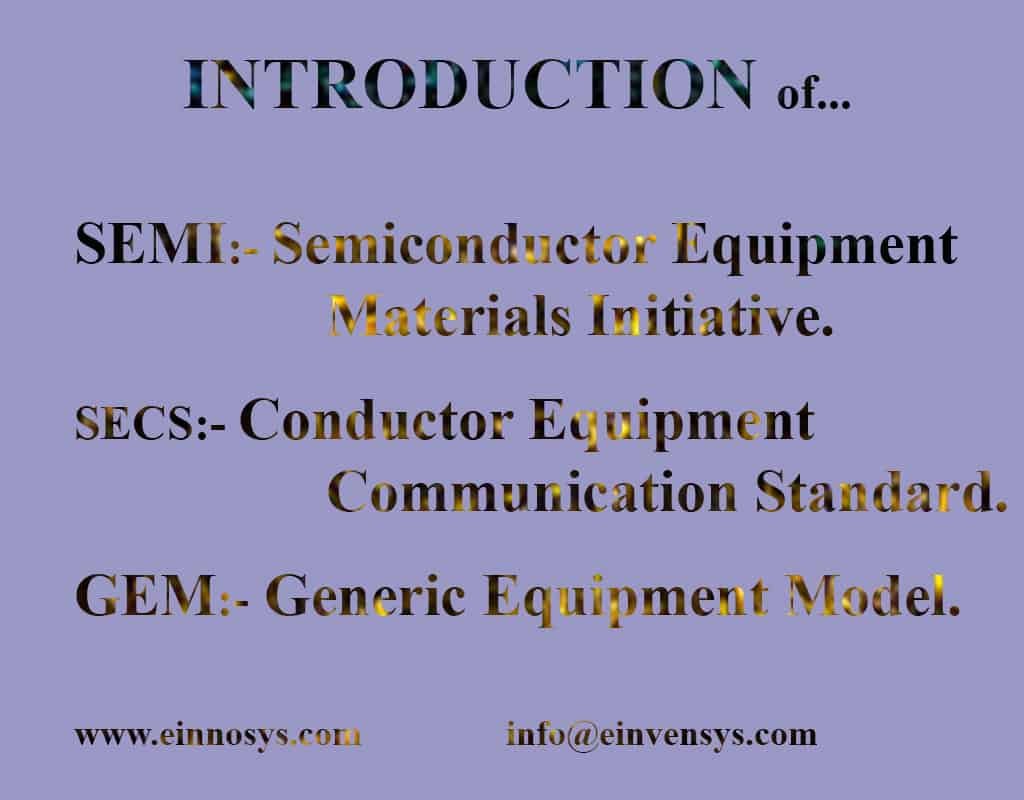
SEMI – Semiconductor Equipment and Materials International, an organization that develops global standards for semiconductor and electronics industries.

SECS – Semiconductor Equipment Communication Standard, which defines how semiconductor equipment communicates with host systems.

GEM – Generic Equipment Model, a set of guidelines for communications and control of manufacturing equipment.

Together, SECS/GEM standards ensure a common “language” for equipment-to-host communication in fabs and assembly facilities.[/vc_column_text][/vc_column][vc_column width=”1/2″][vc_column_text css=””]Why Were SECS/GEM Standards Introduced?

The semiconductor industry began adopting automation standards in the 1970s. At that time, communication between equipment and factory hosts was often proprietary, inconsistent, and expensive to implement.

Without a standard, every equipment manufacturer had to design unique communication protocols for each fab, leading to:

High development and integration costs

Performance issues

Longer equipment setup times

SEMI addressed this by introducing SECS/GEM standards—a unified way for equipment and hosts to exchange information. Much like how TCP/IP standardizes network communication or RS232 standardizes serial communication, SECS/GEM created a universal framework for semiconductor automation.

How Do SECS/GEM Standards Work?

The SECS/GEM standard must be implemented on both sides of the communication:

On the Equipment Side – The equipment’s computer runs SECS/GEM software that complies with SEMI standards such as E30, E4, E5, and E37. This software manages message formats, event reporting, and remote commands.

On the Host Side – The factory host software also implements the same SEMI standards. This ensures that the host can send commands, receive data, and control the equipment reliably.

By ensuring both sides “speak the same language,” fabs and equipment manufacturers achieve seamless interoperability.[/vc_column_text][/vc_column][/vc_row][vc_row][vc_column][vc_column_text css=””]Benefits of SECS/GEM Standards

Implementing SECS/GEM provides significant advantages to both fabs and OEMs:

Interoperability – Equipment from different vendors can easily integrate with fab automation systems.

Reduced Costs – No need for custom protocols or one-off integrations.

Faster Deployment – Standardized communication shortens installation and validation time.

Improved Efficiency – Consistent data collection, event reporting, and control functions enhance overall manufacturing productivity.

Scalability – As fabs adopt more automation, SECS/GEM ensures that new equipment fits into the existing ecosystem.[/vc_column_text][/vc_column][/vc_row][vc_row][vc_column][vc_column_text css=””]Why SECS/GEM Matters Today

Even decades after its introduction, SECS/GEM remains the foundation of smart manufacturing in semiconductors. Modern fabs are highly automated, with thousands of tools connected to centralized host systems. Without a standard protocol, this level of integration would be impossible.

As factories adopt AI, predictive maintenance, and advanced analytics, reliable and standardized data from equipment becomes even more important. SECS/GEM ensures that this data flows consistently, enabling fabs to optimize yield, reduce downtime, and stay competitive.

Conclusion

The SEMI SECS/GEM standards transformed semiconductor manufacturing by creating a universal framework for equipment and host communication. By eliminating proprietary protocols, these standards reduced costs, improved efficiency, and paved the way for today’s advanced automation.

For fabs and OEMs, adopting SECS/GEM isn’t just about compliance—it’s about ensuring smooth integration, scalability, and long-term success in a rapidly evolving industry.

To learn more about SECS/GEM integration solutions, explore Einnosys SECS/GEM products and services[/vc_column_text][/vc_column][/vc_row]