SECS/GEM Integration Guide: Compliance Testing & Implementation

Connectivity is power in semiconductor and electronics manufacturing. Each machine, process, and data item is part of the bigger picture of attaining a seamless automation process, as well as intelligent decision making. The SECS/GEM integration is one of the most significant frameworks that helps to make this transformation and it is a standardized communication protocol that allows closing the gap between equipment and factory automation systems.

You may be updating old systems or establishing a new production facility, but you need to understand how to be able to test compliance with the SECS/GEM and deploy SECS/GEM software and SECS/GEM host integration to make sure that your manufacturing processes are not obsolete in the future

Step 1: Evaluating Equipment Fit

Assessment of the current setup is the first process towards a successful integration of SECS/GEM equipment. The equipment you are using should be able to communicate on SEMI SECS/GEM standard (E5/E30). Most of the modern tools are already equipped with built-in SECS/GEM features, yet older systems may need some of the following elements: communication gateways, or adapter software.

Unless your old machine is native SECS/GEM, there may be a need to use specialized SDKs or middleware, which translates proprietary protocols into SECS-II messages that can be used in the GEM model. This will make all your data, process parameters as well as alarm reports available under one integrated automation platform.

An extensive compatibility test eliminates future delays at great expense and makes sure that your SECS/GEM protocol implementation has a firm foundation.

Step 2: Selecting the SDK and Development Tools of the SECS/GEM

The proper SDK and development tools of SECS/GEM are the next step after compatibility has been checked. A sound SDK makes it easier to cope with command processing, message decoding and event handling.

SECS/GEM software libraries have been written in different programming environments, including .NET, C++, or Java. These devices enable developers to develop layers of communication that are effective in managing both the host (factory) and equipment end.

Further, a SECS/GEM simulator can be used in the development phase to exchange messages without connecting to real hardware to save time and resources. The correct tools minimize the complexity, accelerate integration and assure that your system passes all areas of testing in the SECS/GEM compliance test.

Step 3: Implement SECS/GEM Interface

The SECS/GEM interface is used to provide the interface between the host system and the equipment.

In implementation, specify all pertinent data variables, state models and event reports which represent the behavior of your machine. They need to be defined in terms of the SEMI E5 (SECS-II message format) and E30 (GEM model) specifications in order to become consistent and interoperable.
Every message transaction, such as equipment status, start process, etc., has to fit in the conventional GEM event objects. The well-designed interface can facilitate the SECS/GEM communication as well as reduce downtime and improve traceability and the use of equipment.

Step 4: Integration by Testing and Validating

It is testing that gives theory reality. SECS/GEM interface testing should be done comprehensively before deployment so that the accuracy of messages, their synchronized performance, and their synchronization are all deliberated.

Test benches or leverage SECS/GEM simulation tools to determine the interactions between the host and the equipment in different conditions: normal operations, alarm, disconnection, and recovery sequences. This assists you in identifying the irregularities before their impact to production.

SECS/GEM full compliance testing ensures that the implementation you have made is compliant to the SEMI standards, communicates correctly, and reacts predictably in a real world situation.

Step 5: Deploy, Monitor, and Maintain

After being tested, it is now time to put your SECS/GEM host integration into production. Long-term reliability depends on continuous monitoring and updating on a regular basis.

The proactive maintenance plan should be included to maintain stable communication links and all SEMI standard changes or firmware updates should be installed beforehand. Having an expert like eInnoSys assist you in maintaining your system to be compliant, scalable, and optimised with regards to performance.

Constant updates also enable the integration to keep up with newly added equipment, automation frameworks or cloud-based analytics tools without interfering with any of the current workflows.

The Role of SECS/GEM in Smart Manufacturing in the Present Day

SECS/GEM protocol is not merely a communication layer, it is the core of Industry 4.0 in the manufacturing of semiconductors and electronics.

Allowing standardized data exchange, SECS/GEM will allow factories to have all the data on equipment performance, production measures as well as quality trends. Such visibility drives predictive maintenance, live analytics, and artificial intelligence-based decision-making which eventually results in less downtime and higher yield.

Current smart factories have developed SECS/GEM software to integrate machines with, and connect to MES (Manufacturing Execution Systems), ERP systems and cloud-based dashboards — forming a single digital ecosystem.

The Reasons eInnoSys is the Best SECS/GEM Integration Partner

We think that real automation is based on perfect communication, which is the starting point at eInnoSys. Having years of experience in SECS/GEM equipment integration, we assist semiconductor and electronics manufacturers in the integration of legacy equipment into the digital age, fast, safely, and effectively.

This is what is unique about eInnoSys:

  • SECS/GEM Solutions — Our engineers will guarantee complete SECS/GEM compliance testing with SECS/GEM interface design through verification and backward SECS/GEM communication.
  • High Simulation Tools — Our own SECS/GEM simulator enables you to be able to test and verify integrations prior to live deployment in order to minimize downtime.
  • Tailored Integration Method — We will tailor the SECS/GEM host integration to your current infrastructure and there will be minimal disturbance to the running operations.
  • Long-Term Support — We monitor, update, and optimize your automation environment in addition to first deployment to ensure that it is at its best.

We are committed to ensuring that SECS/GEM software implementation is hassle-free and scalable — so that your factory can be able to achieve increased throughput, reduced costs and smarter automation.

Conclusion

Unlike a technical upgrade, the incorporation of SECS/GEM with your current manufacturing equipment is a strategic position that will lead to a smarter and data-driven future.

Using a systematic methodology — checking the compatibility, selecting the optimal tools, creating a compliant interface, testing hard and finally maintaining the situation — manufacturers would open up new horizons of visibility and control in their operations.

Having an appropriate crisis communication plan among your host and equipment, you will minimize errors, increase efficiency, and make faster and more informed decisions.

Make your automation systems future-proof with the help of eInnoSys and become the full potential of SECS/GEM integration because in the age of smart manufacturing, the interconnected equipment implies the interconnected success.

Frequently Asked Questions About SECS/GEM Integration

  • 1. How do I know if my equipment supports SECS/GEM?

    SECS/GEM (SEMI E5 & E30 standards) is a communication protocol that connects manufacturing equipment with factory automation systems like MES or ERP. It standardizes data exchange across different machines, enabling real-time monitoring, predictive maintenance, and smart manufacturing efficiency.

  • 2. What is SECS/GEM and why is it important?

    Check your equipment’s specs for SEMI E5 (SECS-II) and E30 (GEM) support. Most modern tools include SECS/GEM by default, while older systems may require a communication gateway or middleware. eInnoSys offers compatibility assessments for legacy equipment integration.

  • 3. What is a SECS/GEM simulator?

    A SECS/GEM simulator mimics equipment or host communication, allowing developers to test integrations without using real machines. It’s used for testing, training, and troubleshooting—saving time and reducing production risks.

  • 4. What are the steps in SECS/GEM compliance testing?

    Compliance testing includes verifying SECS-II message formatting, equipment state transitions, event reporting, synchronization, and stress testing. Proper validation ensures reliable communication and SEMI standard compliance.

  • 5. How does SECS/GEM enable smart manufacturing?

    SECS/GEM forms the backbone of Industry 4.0 by enabling standardized, real-time data exchange. It supports AI-driven analytics, predictive maintenance, and improved equipment utilization—helping manufacturers cut downtime and improve yield.

8 Reasons to Use SECS GEM SDK in Your Automation Solutions

Quick Summary
  • The SECS GEM SDK significantly accelerates equipment integration, reducing development time by up to 70% (TechInsights, 2023).
  • It offers pre-built, production-ready modules that handle the complex HSMS SECS GEM communication stack.
  • An SDK ensures GEM300 Compliance, a critical requirement for modern factory automation software in the semiconductor industry.
  • By abstracting low-level message handling, developers can focus purely on the equipment’s unique control logic.
  • It drastically lowers the risk of communication errors and field issues through rigorous pre-validation.
  • The SDK provides essential SECS GEM developer tools for logging, testing, and debugging.
  • It supports various programming languages, offering flexibility for equipment integration SDK across different platforms.
  • Implementing a robust, off-the-shelf solution future-proofs the equipment for evolving smart factory solutions standards.

The relentless pursuit of efficiency in manufacturing, particularly in the semiconductor and electronics industries, has made seamless equipment communication non-negotiable. Connecting manufacturing equipment to the host system is a complex, time-consuming process that often requires specialized domain knowledge. But what if there was a way to bypass much of the heavy lifting?

According to TechInsights (2023), the global semiconductor equipment market size is projected to grow at a Compound Annual Growth Rate (CAGR) of 6.3% between 2023 and 2028. This rapid expansion demands faster, more reliable, and more standardized methods for bringing new manufacturing tools online. A key enabler for this acceleration is the SECS GEM protocol, the bedrock of equipment-to-host communication.

Adopting a robust SECS GEM SDK (Software Development Kit) is the answer for software managers and senior software engineers looking to shorten their development cycles and enhance reliability. An SDK provides the production-ready framework to implement this critical communication standard quickly and correctly, transforming a potential multi-month project into a matter of weeks.

The Business Case for a SECS GEM SDK

Why reinvent the wheel when a perfectly engineered one is available? Building a full SECS GEM implementation from scratch is an expensive, high-risk endeavor. It demands deep understanding of SEMI standards E5 (SECS-II), E30 (GEM), E37 (HSMS), and E39 (Object Services), among others. Most engineering teams have core competencies in equipment control, not esoteric communication protocols.

Cutting Development Time and Cost

The most immediate benefit is the massive reduction in the software development lifecycle. By using a pre-validated SECS GEM SDK, engineering teams avoid spending months writing, debugging, and testing the intricate communication layer. The SDK handles the heavy lifting of message parsing, session management, and error handling, allowing developers to focus on integrating the equipment’s unique process data and control logic.

Comparison: In-House Development vs Using SECS GEM SDK
Metric In-House Development (Estimate) Using SECS GEM SDK (Estimate)
Initial Setup Time 6–10 Weeks 1–3 Days
Full Implementation & Testing 4–6 Months 4–8 Weeks
Cost (Labor & Resources) High Medium (License + Integration)
Time to Market Slow Fast
Ensuring Out-of-the-Box Compliance

GEM300 Compliance is the gold standard for equipment used in automated wafer fabrication facilities (fabs). Fabs will simply reject any equipment that doesn’t meet these stringent standards. A high-quality SECS GEM Software SDK is pre-engineered to meet standards like E40 (Processing Management), E90 (Substrate Tracking), and E94 (Control Job Management) without requiring your team to become SEMI standard experts. This drastically reduces the risk of expensive compliance failures down the line.

8 Essential Reasons to Choose a SECS GEM SDK

8 Essential Reasons to Choose a SECS GEM SDK

For software engineering managers and directors of technology, the decision to use a SECS GEM SDK is a strategic one, offering a clear path to faster time-to-market, higher reliability, and lower long-term maintenance costs.

1. Accelerated Time-to-Market with Pre-built Modules

A full-featured SDK isn’t just a library; it’s a production-ready framework. It includes pre-built state machines for the GEM state model, handling all required primary and secondary message pairs (e.g., S1F1/S1F2 for establishing communication). This means engineers skip the tedious work of standard implementation and move straight to defining the equipment’s specific Variables (ECVs), Events (CEIDs), and Alarms (ALIDs). This is the core of equipment integration SDK efficiency.

2. Robust and Reliable HSMS Implementation

The high-speed communication backbone is the HSMS SECS GEM protocol (SEMI E37). Implementing a reliable, persistent HSMS layer that correctly handles connection, disconnection, and message interleaving is notoriously difficult. A professional SDK has this communication stack battle-tested and optimized for performance, virtually eliminating low-level communication errors before they even reach the application layer.

3. Focus on Core Competency, Not Protocol Plumbing

Your team’s expertise is in the specific physics and control systems of your equipment, whether it’s a PVD tool or a chemical vapor deposition system. Do you really want your senior software engineer spending weeks debugging S5F1 (Alarm Report Send) messages? By utilizing a pre-built SECS GEM SDK , your valuable engineering talent is freed to optimize the core process, adding business value instead of fixing protocol plumbing. It’s a fundamental question of resource allocation, isn’t it?

4. Built-in Tools for Debugging and Validation

One of the most valuable aspects of an SDK is the associated SECS GEM developer tools. These often include:

  • Log Viewers: Detailed logging of all SECS II Communication messages for easy tracing.
  • Message Simulators: Tools to simulate the host or the equipment, enabling isolated testing.
  • Compliance Testers: Utilities that automatically check if the equipment acts according to the GEM standard.

These tools are essential for SECS GEM Compliance Testing and dramatically shorten the debug cycle, especially when dealing with complex S9 (Exception) or S6 (Data Transfer) messages.

5. Simplified SECS GEM Message Handling

The SDK abstracts the complex S-F (Stream and Function) message structure into intuitive, developer-friendly methods. Instead of manually constructing a raw byte array for an S6F11 (Establish Communication Event), a developer can simply call a function like SendEquipmentEvent(eventID, data). This simplifies the SECS GEM Message Library interface, reducing the learning curve for new developers and lowering the chance of integration bugs. For more on cutting-edge integration solutions, check out the SECS GEM SDK available at Einnosys.

6. Platform and Language Flexibility

Good Equipment Controller Software development requires flexibility. A well-designed SDK supports multiple operating systems (Windows, Linux) and popular development languages (C#, Java, Python). This allows application engineering teams to integrate the protocol using their preferred environment, ensuring maximum compatibility and developer efficiency across the entire factory automation software landscape.

7. Future-Proofing for Smart Factory Solutions

The industry is rapidly moving towards Smart Factory Solutions and advanced analytics. Modern standards like E148 (Time Synchronization) and E164 (Specific Equipment Model) build upon a solid SECS GEM Protocol foundation. Implementing a commercial SDK means you are leveraging a product that is continually updated by domain experts to align with the latest SEMI standards, ensuring your equipment remains relevant and compliant for years to come. This provides a significant advantage in Semiconductor Equipment Communication.

8. Robust Error Handling and Session Management

A major headache in SECS GEM Host Communication is handling unexpected network drops, timeouts, and session management. The SDK’s built-in logic automatically manages these edge cases—reconnecting sessions, resuming data transfers, and notifying the host of communication errors according to the E30 standard. This level of autonomous reliability is nearly impossible to replicate perfectly in a DIY solution.

For software and technology leaders tasked with equipment integration, the choice is clear: attempting to build and maintain a proprietary SECS GEM implementation is a costly distraction. A professional SECS GEM SDK provides a vetted, reliable, and compliant framework, allowing your engineering team to focus their energy where it matters most—the unique value and functionality of your equipment. It accelerates development, ensures compliance, and offers the reliability necessary for the demanding world of automated manufacturing. Ready to fast-track your equipment integration?

To learn more about how a professional SECS GEM SDK can transform your automation software development process, contact our team for a demo today.

Frequently Asked Questions (FAQ)

  • 1. What is the primary difference between SECS I and HSMS?

    SECS I (SEMI E4) uses an older, slower communication method over an RS-232 serial interface. While still used in some legacy equipment, it has largely been replaced. HSMS SECS GEM (SEMI E37) stands for High-Speed SECS Message Services. It runs over a standard TCP/IP network, offering vastly higher speeds and more robust reliability, making it the required standard for modern factory automation.

  • 2. Does an SDK handle both the host and the equipment side of communication?

    Generally, a single SECS GEM Software SDK is designed to be used by either the equipment manufacturer (to make the equipment talk to the factory host) or by a host system developer (to create a host application that monitors and controls the equipment). However, most commercial SDKs offer separate components or libraries optimized for the specific requirements of the Equipment (GEM) side and the Host side.

  • 3. How does an SDK simplify regulatory compliance like GEM300?

    GEM300 Compliance isn’t a single switch; it’s a suite of standards (E40, E87, E90, E94, etc.). A good SECS GEM SDK will incorporate the state machines, message structures, and data handling requirements for these standards directly into its core design. It provides the boilerplate implementation for substrate handling, control job management, and process state tracking, ensuring that when the developer connects their specific equipment logic, the overall communication system is already compliant with the most complex regulatory requirements.

Success Story: SECS/GEM Integration on CANON FPA 2500 I3 Stepper Equipment Using EIGEMBox

[vc_row][vc_column width=”1/2″][vc_column_text css=””]Client Profile
Client: Leading Semiconductor Manufacturer
Location: California, United States
Industry: Semiconductor Manufacturing[/vc_column_text][/vc_column][vc_column width=”1/2″][vc_single_image image=”35663″ img_size=”full” css=””][/vc_column][/vc_row][vc_row][vc_column width=”1/2″][vc_column_text css=””]Challenges

The client, a prominent semiconductor manufacturer, faced critical challenges in integrating their Canon FPA 2500 I3 stepper equipment with their factory automation system using SECS/GEM protocols. The primary issues included:

Non-compliance with SEMI Standards: The equipment lacked seamless compatibility with SEMI-compliant SECS/GEM communication protocols, creating bottlenecks in automation processes.

Inefficient Data Communication: There was difficulty in achieving efficient, real-time communication between the equipment and the factory’s host system, leading to delays in production cycles.

High Integration Costs: Customizing software solutions for their unique requirements was proving to be both expensive and time-consuming.

Scalability Concerns: The existing setup was not future-proof, limiting the client’s ability to scale operations effectively.[/vc_column_text][/vc_column][vc_column width=”1/2″][vc_column_text css=””]Solution

To address these challenges, the client adopted EIGEMBox, a robust SECS/GEM solution offered by eInnoSys. EIGEMBox provided an out-of-the-box integration platform to ensure seamless communication between the Canon FPA 2500 I3 stepper and the factory host system.

Key Features of EIGEMBox:

SEMI Standards Compliance: Fully compliant with SECS/GEM protocols, ensuring compatibility with the factory automation environment.

User-Friendly Interface: Simplified configuration of SECS messages with an intuitive user interface.

Plug-and-Play Solution: Quick and hassle-free integration without the need for extensive coding or modifications to the equipment.

Scalable Architecture: Designed to adapt to future requirements, enabling smooth scaling of operations.[/vc_column_text][/vc_column][/vc_row][vc_row][vc_column width=”1/2″][vc_column_text css=””]Implementation Process

Assessment: The eInnoSys team conducted an in-depth analysis of the client’s current setup and challenges.

Configuration: EIGEMBox was configured to simulate both the factory host system and equipment, ensuring end-to-end testing of SECS/GEM communication.

Customization: The solution was tailored to accommodate the unique functionalities of the Canon FPA 2500 I3 stepper equipment.

Testing and Validation: Comprehensive testing was performed to validate the integration, including stress tests and real-time scenario simulations.

Deployment: EIGEMBox was deployed into the production environment, followed by extensive training sessions for the client’s team.[/vc_column_text][/vc_column][vc_column width=”1/2″][vc_column_text css=””]Results

The integration of EIGEMBox significantly enhanced the client’s operational efficiency:

Seamless Communication: Achieved real-time SECS/GEM communication between the equipment and factory host system.

Reduced Downtime: Automation bottlenecks were eliminated, reducing equipment downtime by 30%.

Cost Savings: The plug-and-play nature of EIGEMBox eliminated the need for expensive customizations, saving the client thousands of dollars.

Future-Ready System: The scalable design of EIGEMBox ensured the client could easily incorporate additional equipment into their automation setup.[/vc_column_text][/vc_column][/vc_row][vc_row][vc_column][vc_column_text css=””]Client Feedback

“EIGEMBox has been a game-changer for our production line. The seamless integration it provided for our Canon FPA 2500 I3 stepper has not only resolved our communication challenges but also paved the way for scalable growth. The team at eInnoSys has been incredibly supportive and proactive throughout the process.”

— Automation Manager, Leading Semiconductor Manufacturer[/vc_column_text][vc_column_text css=””]Are you facing challenges with SECS/GEM integration? Let eInnoSys transform your automation journey with EIGEMBox.

Visit eInnoSys or contact us today for a personalized consultation and experience the benefits of seamless factory automation![/vc_column_text][/vc_column][/vc_row]

Success Story: SECS/GEM Integration on DISCO DFD640 Dicing Saw Through EIGEMBox

[vc_row][vc_column][vc_column_text css=””]Facing operational inefficiencies and communication challenges with their DISCO DFD640 dicing saw, a prominent semiconductor supplier turned to EIGEMBox for a solution. Discover how seamless SECS/GEM integration powered by Einnosys improved productivity and reduced downtime.

Client Overview

Our client, a global leader in semiconductor manufacturing, specializes in advanced wafer processing and microelectronics. With a commitment to precision and innovation, they rely on state-of-the-art equipment like the DISCO DFD640 dicing saw to meet the ever-increasing demands for quality and efficiency in their production processes. Facing industry challenges such as tight deadlines and the need for robust equipment communication, they sought a reliable solution to enhance their operational capabilities.[/vc_column_text][/vc_column][/vc_row][vc_row][vc_column width=”1/2″][vc_column_text css=””]The Challenge

The DISCO DFD640 dicing saw is a critical component in the client’s wafer dicing process. However, the lack of SECS/GEM integration limited its ability to communicate seamlessly with the Manufacturing Execution System (MES). This led to:

  • Manual monitoring and data collection, increasing the risk of errors.
  • Inefficient workflow due to a lack of real-time communication.
  • Reduced equipment uptime and operational efficiency.
  • The client required a cost-effective, scalable solution to overcome these challenges and optimize their equipment’s performance.

[/vc_column_text][/vc_column][vc_column width=”1/2″][vc_single_image image=”35419″ img_size=”full” alignment=”center” css=””][/vc_column][/vc_row][vc_row][vc_column width=”1/2″][vc_column_text css=””]The Solution: EIGEMBox

The EIGEMBox, a plug-and-play device designed for SECS/GEM integration, emerged as the ideal solution. Tailored to enable seamless communication between legacy equipment and modern MES systems, the EIGEMBox provided the client with a streamlined integration process and immediate benefits.

Key Features of the EIGEMBox

Real-Time Communication: This enabled the DISCO DFD640 to send and receive data directly to and from the MES.

Plug-and-Play Architecture: Simplified the integration process, minimizing installation time and disruptions.

Comprehensive Monitoring: Provided visibility into equipment performance, enabling predictive maintenance.

Scalability: This allowed for easy implementation across other legacy equipment.

User-Friendly Interface: Simplified the process for operators, reducing the learning curve.[/vc_column_text][/vc_column][vc_column width=”1/2″][vc_column_text css=””]Implementation Process

The integration process was conducted in three streamlined phases:

Assessment: The Einnosys team evaluated the client’s existing setup and identified specific requirements for SECS/GEM integration.

Installation: The EIGEMBox was installed on the DISCO DFD640 dicing saw with minimal disruption to the client’s operations.

Testing and Optimization: Comprehensive testing was performed to ensure seamless communication and optimal performance. Adjustments were made to align with the client’s specific needs.

The implementation was completed within a few days, ensuring minimal downtime and immediate operational improvements.[/vc_column_text][/vc_column][/vc_row][vc_row][vc_column][vc_column_text css=””]The Results

The integration of the EIGEMBox delivered significant improvements:

Enhanced Operational Efficiency: Real-time communication eliminated manual data entry, reducing errors and saving time.

Improved Equipment Uptime: Predictive maintenance and proactive alerts minimized unexpected downtimes.

Streamlined Workflow: Seamless SECS/GEM communication allowed for better coordination with the MES, improving overall productivity.

Cost Savings: The client experienced lower operational costs due to reduced errors and maintenance.

Scalability: The client plans to extend the EIGEMBox integration to other legacy equipment.[/vc_column_text][vc_column_text css=””]Client Feedback

“The EIGEMBox transformed how we operate our DISCO DFD640 dicing saw. The seamless SECS/GEM integration not only improved our efficiency but also set the stage for future automation. The team at Einnosys delivered exceptional service, ensuring a smooth and hassle-free implementation. We’re excited to expand this solution across our other equipment.”[/vc_column_text][/vc_column][/vc_row][vc_row][vc_column][vc_column_text css=””]Unlock the potential of your legacy equipment with EIGEMBox and transform your manufacturing operations. Whether you’re looking to enhance efficiency, reduce downtime, or achieve seamless SECS/GEM integration, Einnosys has the expertise and solutions you need.

Contact us today to learn more about how EIGEMBox can revolutionize your manufacturing processes![/vc_column_text][/vc_column][/vc_row]

Modern SECS/GEM Solutions: Flexible SDKs for Seamless Software Integration

[vc_row][vc_column][vc_column_text css=””]The semiconductor manufacturing industry relies heavily on automation and communication standards to ensure efficiency and precision. One of the most widely adopted protocols is SECS/GEM (Semiconductor Equipment Communication Standard/Generic Equipment Model). This standard has become essential for integrating equipment and systems, enabling seamless communication across diverse platforms. With the rise of modern SECS/GEM solutions, flexible SDKs (Software Development Kits) are now paving the way for easier and more effective SECS/GEM integration. This blog explores the evolution and advantages of these modern tools, emphasizing how they revolutionize the use of SECS/GEM software in manufacturing environments.[/vc_column_text][vc_column_text css=””]Understanding the SECS/GEM Protocol

The SECS/GEM protocol serves as the backbone of communication between manufacturing equipment and host systems. It establishes a standardized method for exchanging data, executing commands, and monitoring processes. As a key component of semiconductor manufacturing, the SECS/GEM communication protocol enables automation and facilitates the implementation of GEM300 standards, which are vital for advanced fabs.

Modern SECS/GEM communication solutions offer robust SDKs that simplify the complexities of integrating the SECS/GEM interface into various software systems. These SDKs come with pre-built libraries, documentation, and examples, making it easier for developers to implement SECS/GEM communication without requiring in-depth expertise in the protocol itself. The result is a faster development cycle and a more streamlined manufacturing process.[/vc_column_text][vc_column_text css=””]Why Modern SDKs are Game-Changers

Enhanced Flexibility

Traditional SECS/GEM integration often required extensive coding and a deep understanding of the protocol. Modern SDKs, however, offer enhanced flexibility by providing ready-to-use modules and APIs. These tools allow developers to implement SECS/GEM communication protocols with minimal effort, ensuring compatibility with existing systems while reducing development time.

The flexibility of these SDKs also enables their use in various applications, from legacy equipment to cutting-edge GEM300-compliant machines. By supporting a wide range of scenarios, these SDKs facilitate the seamless integration of SECS/GEM interfaces, empowering manufacturers to adopt new technologies without overhauling their infrastructure.[/vc_column_text][vc_column_text css=””]Improved Usability

One of the most significant benefits of modern SECS/GEM software is its user-friendly design. SDKs are now equipped with intuitive interfaces, comprehensive documentation, and real-world examples that guide developers through the integration process. This user-centric approach not only simplifies SECS/GEM integration but also reduces the learning curve for engineers who may be new to the SECS/GEM protocol.

Scalability and Reliability

As manufacturing demands grow, so does the need for scalable solutions. Modern SECS/GEM communication SDKs are designed with scalability in mind, allowing manufacturers to expand their operations without compromising performance. Additionally, these SDKs offer reliable communication channels that ensure accurate data exchange, even in high-demand environments.[/vc_column_text][/vc_column][/vc_row][vc_row][vc_column width=”1/2″][vc_column_text css=””]Applications of SECS/GEM Integration

The applications of SECS/GEM integration extend far beyond basic communication. With modern SDKs, manufacturers can achieve:

Real-time monitoring: By integrating SECS/GEM communication protocols, fabs can monitor equipment status and process parameters in real time, enabling proactive maintenance and minimizing downtime.

Enhanced automation: SECS/GEM software supports automation by enabling hosts to send commands directly to equipment, streamlining production workflows.

Data-driven decision-making: The data collected through SECS/GEM interfaces can be analyzed to identify trends, optimize processes, and improve overall efficiency.

Compliance with GEM300 standards: For advanced fabs, adhering to GEM300 requirements is critical. Modern SDKs ensure that SECS/GEM communication aligns with these standards, enabling seamless equipment integration in high-tech environments.[/vc_column_text][/vc_column][vc_column width=”1/2″][vc_single_image image=”35263″ img_size=”full” alignment=”center” css=””][/vc_column][/vc_row][vc_row][vc_column][vc_column_text css=””]The evolution of SECS/GEM solutions has transformed how semiconductor manufacturers approach equipment integration. Modern SDKs offer unparalleled flexibility, usability, and scalability, making SECS/GEM integration more accessible than ever before. By leveraging these advanced tools, manufacturers can optimize their operations, enhance automation, and stay competitive in an increasingly demanding industry.

As the semiconductor industry continues to evolve, the importance of robust SECS/GEM communication protocols and software cannot be overstated. Whether you’re working with legacy systems or implementing GEM300-compliant solutions, modern SECS/GEM SDKs provide the foundation for seamless software integration and long-term success.

Incorporating SECS/GEM into your operations has never been easier, thanks to these innovative solutions. Embrace the future of manufacturing with modern SECS/GEM software and unlock the full potential of your production line.[/vc_column_text][/vc_column][/vc_row]

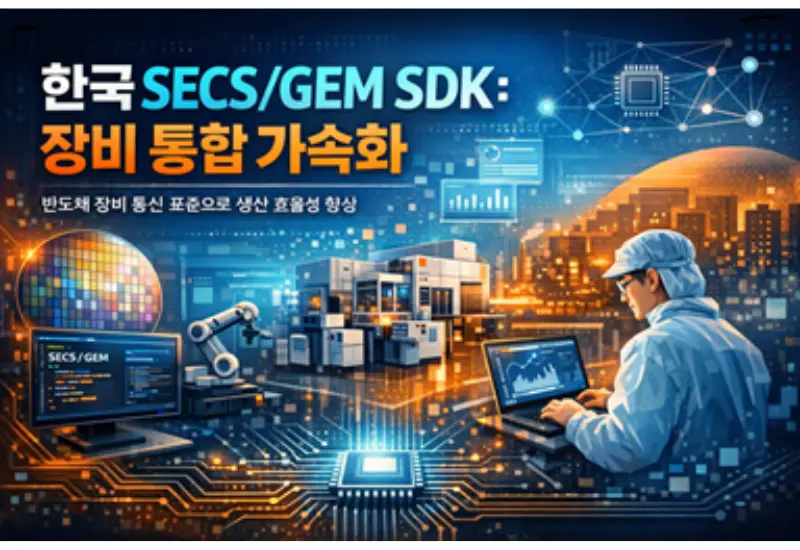
한국 SECS/GEM SDK: 장비 통합 가속화

요약

과제: 반도체 제조업체들은 점점 더 복잡해지는 장비를 자동화된 스마트 팹 환경에 통합해야 하며, 동시에 엄격한 SEMI 표준을 충족해야 하는 압박을 받고 있습니다.

해결책: 전문 SECS/GEM 소프트웨어 SDK를 활용하면, OEM은 수개월에 달하는 수작업 코딩을 피하고 사전 검증된 통신 계층을 바로 사용할 수 있습니다.

핵심 이점: 신뢰성 향상, 장비 출시 시간 단축, 글로벌 제조 실행 시스템(MES)과의 네이티브 호환성 확보.

산업적 영향: 한국이 ‘메가 클러스터’를 확장함에 따라, 고성능 로컬 SDK는 글로벌 반도체 공급망의 핵심 인프라로 자리 잡고 있습니다.

소개

SEMI(2024)에 따르면, 글로벌 반도체 장비 시장은 2025년까지 1,240억 달러에 이를 것으로 전망됩니다. 이는 동아시아 지역의 첨단 로직 및 메모리 팹 확장에 크게 기인합니다. 이러한 환경에서 장비와 호스트 시스템 간의 표준화된 통신은 그 어느 때보다 중요해졌습니다. 고성능 SECS/GEM 소프트웨어 SDK는 디지털 팹의 ‘통역기’ 역할을 수행합니다.

강력한 통신 프레임워크가 없다면, 수백만 달러짜리 노광 장비나 식각 장비도 단절된 섬에 불과합니다. 장비가 아무리 잘 작동하더라도 상태를 보고하거나 레시피 명령을 수신하지 못한다면 생산 시스템의 일부가 될 수 없습니다. 특히 3nm, 2nm 공정 시대에는 높은 OEE(종합 설비 효율)를 유지하기 위해 플러그 앤 플레이 수준의 연결성이 필수입니다.

Industry 4.0으로의 전환 속에서 SECS/GEM은 장비-호스트 통신의 선택이 아닌 필수 표준이 되었습니다. 한국을 포함한 글로벌 개발자들에게 적절한 SDK 선택은 단순한 개발 편의성을 넘어 장비 전체 생명주기에 영향을 미치는 전략적 결정입니다.

현대 팹에서의 SECS/GEM 표준 이해

SECS(GEM)는 장비와 공장 중앙 시스템 간의 통신 방식을 정의합니다. SEMI가 관리하는 이 표준은 한국의 중소 장비 업체부터 글로벌 대기업 장비까지 동일한 MES와 통신할 수 있도록 합니다.

통신 계층 구조

SECS-I(E4)HSMS(E37)는 전송 계층을 담당하며, SECS-II(E5)는 메시지 구조를 정의합니다. 그 위에 위치한 GEM(E30)은 장비의 동작 규칙을 정의하며, 상태 변경 및 알람 처리 방식을 규정합니다.

자체 개발보다 SDK가 유리한 이유

GEM 통신 스택을 처음부터 직접 개발하는 것은 가정용 인터넷을 구축하기 위해 광케이블을 직접 제조하는 것과 같습니다. 기술적으로 가능하지만 비효율적입니다. 상용 SDK는 이미 검증된 통신 로직과 핸드셰이크, 데이터 포맷을 제공하여 개발 리스크를 크게 줄여줍니다.

한국 기반 SDK 솔루션의 전략적 가치

한국은 2047년까지 약 4,710억 달러 규모의 세계 최대 반도체 메가 클러스터 구축을 목표로 하고 있습니다(산업통상자원부, 2024). 이러한 환경 속에서 국내 장비 소프트웨어 업체들은 대량 생산 환경에 최적화된 기술력을 축적해 왔습니다.

로컬 지원과 글로벌 규격의 공존

국내 OEM은 삼성전자, SK하이닉스와 같은 고객을 대응함과 동시에 미국·유럽 시장도 고려해야 합니다. 한국 기반 SECS/GEM SDK는 로컬 기술 지원과 동시에 SEMI E4, E5, E30, E37, E173 등 국제 표준을 충족합니다.

성능과 확장성

고속 생산 환경에서 지연(latency)은 곧 손실입니다. 최신 SDK는 CPU 부하를 최소화하여 통신이 모션 제어나 실시간 제어에 영향을 주지 않도록 설계되어 있습니다.

고성능 SECS/GEM SDK의 핵심 기능

SDK를 평가할 때 중요한 것은 단순한 통신 성공 여부가 아닙니다. 극한 상황에서도 안정적으로 작동하는지가 핵심입니다.

멀티 호스트 지원: 하나의 장비가 여러 호스트 또는 진단 시스템과 동시에 통신 가능
동적 설정 변경: 소프트웨어 재시작 없이 변수 및 리포트 정의 변경
컴플라이언스 테스트 도구: 실제 팹 반입 전 검증 가능한 로그 및 시뮬레이터 제공
언어 지원: C++, C#, Java 등 다양한 개발 환경 지원

팹 자동화 소프트웨어 통합 가속화

SDK를 사용하면 개발자는 프로토콜 구현이 아닌, 장비 로직 자체에 집중할 수 있습니다. 즉, “어떤 데이터를 보낼 것인가”에 집중하고 “어떻게 보내는가”는 SDK에 맡길 수 있습니다.

데이터 분석과 SDK 도입의 ROI

SDK 도입의 핵심 가치는 ‘출시 시간 단축(Time to Market)’입니다. 반도체 산업에서 3개월의 지연은 수백만 달러의 기회 손실로 이어질 수 있습니다.

통합 과정에서의 일반적인 문제 해결

아무리 좋은 도구라도 완벽하지는 않습니다. 장비가 “Processing” 상태라고 인식하는데 MES는 “Idle”로 인식한다면 전체 라인이 멈출 수 있습니다. 이런 문제는 대부분 상태 모델 매핑 오류에서 발생합니다.

고급 SECS/GEM SDK는 시각적 상태 모델링 도구를 제공하여 이러한 논리 충돌을 사전에 방지합니다.

대용량 데이터 처리

현대 센서는 막대한 양의 데이터를 생성합니다. 기존 SECS/GEM은 이를 고려하지 않았지만, 최신 SDK는 DCP(Data Collection Plan) 같은 기능을 통해 대역폭을 효율적으로 관리합니다.

미래 전망 – GEM을 넘어 EDA로

300mm 웨이퍼 시대로 진입하면서 GEM300(E40, E87, E90, E94 등)이 등장했습니다. 이는 캐리어 관리와 슬롯 맵 등 고급 자동화를 지원합니다.

EDA(Interface A)의 부상

GEM이 제어 중심이라면, EDA는 데이터 중심입니다. 한국의 선도적인 SDK 업체들은 GEM과 EDA를 동시에 지원하는 하이브리드 솔루션을 제공하며, 미래 대응력을 강화하고 있습니다.

AI와 예지보전

표준화된 데이터가 확보되면 AI 기반 예지보전이 가능해집니다. 양질의 데이터 없이는 머신러닝도 무용지물입니다.

결론

완전 자율화된 팹으로 가는 길은 표준화된 데이터에서 시작됩니다. 장비 제조사 입장에서 선택지는 명확합니다.
1년 동안 프로토콜을 직접 개발할 것인가,
아니면 검증된 SECS/GEM SDK를 활용해 즉시 양산에 진입할 것인가.
SECS/GEM 통합을 우선시하는 기업만이 글로벌 반도체 시장에서 경쟁력을 유지할 수 있습니다.

Contact Us Today

귀사의 팹에서 SECS/GEM SDK를 더 빠르게 구현할 수 있도록 전문가의 지원을 받으세요