How SECS GEM SDK Can Transform Your Production Line

In today’s highly competitive semiconductor landscape, production efficiency, equipment connectivity, and real-time data visibility are no longer optional—they are essential. As fabs and OEMs move toward smarter and more connected environments, SECS/GEM for Semiconductor Manufacturing has become the backbone of reliable communication between equipment and host systems. At the center of this transformation lies the SECS/GEM SDK, a powerful toolkit that enables seamless equipment connectivity, automation, and compliance.

Whether you are modernizing legacy tools or deploying new manufacturing lines, investing in SECS GEM SDK Development can dramatically improve operational efficiency. From enabling structured Equipment to Host Communication to supporting full-scale Semiconductor Factory Automation, the right SDK simplifies SECS/GEM Integration, ensures protocol compliance, and accelerates time-to-market.

This blog explores how implementing a robust SECS/GEM Communication Software solution can transform your production line and future-proof your manufacturing strategy.

Understanding the Role of SECS/GEM in Modern Production

The SECS/GEM SDK is built on the globally recognized SEMI SECS/GEM Standard, which defines communication between semiconductor manufacturing equipment and host systems such as MES. It provides a structured framework for SECS GEM Protocol Implementation, enabling standardized data exchange and remote equipment control.

At its core, SECS/GEM Software Development enables manufacturers to implement consistent messaging using the SECS II and HSMS Protocol, ensuring reliable and secure communication. This structured communication enables real-time monitoring, recipe management, alarm reporting, and equipment state tracking.

By adopting SECS/GEM for Semiconductor Manufacturing, companies eliminate manual interventions and enable automated workflows. This strengthens Semiconductor Equipment Connectivity, reduces errors, and enhances productivity across the production floor.

Enhancing Equipment-to-Host Communication

One of the biggest advantages of deploying a SECS/GEM SDK is its ability to streamline Equipment to Host Communication. In traditional manufacturing setups, disparate systems often operate in silos. With proper SECS GEM Equipment Integration, production tools can communicate directly with MES, EAP, and other factory systems.

Through structured SECS/GEM Host Integration, fabs can:

  • Collect real-time production data
  • Automate recipe downloads and uploads
  • Monitor alarms and equipment states
  • Improve traceability and reporting

By leveraging advanced SECS GEM Automation Software, manufacturers can create a synchronized production environment where data flows seamlessly between tools and control systems. This strengthens Factory Automation Software strategies and drives measurable gains in OEE and yield.

Accelerating Semiconductor Equipment Integration

As fabs expand or upgrade production lines, integrating new equipment quickly becomes critical. SECS GEM SDK Development simplifies Semiconductor Equipment Integration by offering reusable libraries and prebuilt protocol stacks.

Instead of building communication layers from scratch, engineers can use a validated SECS/GEM Communication Software framework to accelerate deployment. This approach ensures compliance with the SEMI SECS/GEM Standard while reducing development time and risk.

For manufacturers dealing with older tools, a Legacy Equipment SECS/GEM Upgrade becomes essential. Modern SDK solutions allow legacy systems to be retrofitted with standardized communication capabilities, bringing them into modern Semiconductor Factory Automation environments without replacing expensive hardware.

This capability not only reduces capital expenditure but also ensures long-term scalability through structured SECS GEM Protocol Implementation.

Driving MES Integration and Smart Manufacturing

A production line truly transforms when equipment communication integrates seamlessly with Manufacturing Execution Systems. Through MES Integration with SECS/GEM, manufacturers gain centralized control over scheduling, tracking, and quality management.

The SECS/GEM SDK plays a pivotal role in enabling smooth SECS/GEM Integration between tools and MES platforms. It ensures consistent data exchange, supports event reporting, and facilitates recipe verification.

With strong SECS/GEM Host Integration, manufacturers can:

  • Enable automated lot start and stop
  • Implement advanced traceability
  • Reduce cycle time
  • Improve compliance reporting

Modern SECS GEM Automation Software also supports predictive analytics by feeding structured equipment data into AI and monitoring systems. This integration strengthens Semiconductor Equipment Connectivity while supporting Industry 4.0 initiatives.

Ensuring Compliance and Standardization

Compliance with industry standards is critical for global semiconductor operations. A professionally designed SECS/GEM Software Development solution ensures alignment with GEM Compliance Software requirements and global SEMI specifications.

Using a reliable SECS GEM SDK Development approach helps manufacturers:

  • Maintain consistent message structures
  • Validate equipment behavior
  • Ensure standardized alarm handling
  • Achieve smooth customer acceptance testing

With proper SECS GEM Equipment Integration, equipment suppliers can confidently deliver tools that meet customer expectations across international markets.

Standardized SECS GEM Protocol Implementation also simplifies audits and accelerates deployment in multi-fab environments, reducing operational complexity.

Enabling Scalable Factory Automation

As semiconductor manufacturing becomes more advanced, scalability is essential. A flexible SECS/GEM SDK provides the foundation for building robust Factory Automation Software ecosystems.

Through seamless SECS/GEM Integration, manufacturers can integrate:

The use of modern SECS/GEM Communication Software ensures consistent performance across different equipment vendors. This strengthens overall Semiconductor Factory Automation architecture and enables centralized monitoring and control.

Additionally, strong SECS/GEM Host Integration allows production lines to scale without major reconfiguration. Whether expanding a single tool cluster or deploying a new fabrication line, the SDK ensures standardized connectivity.

Improving Operational Efficiency and ROI

Implementing SECS/GEM for Semiconductor Manufacturing directly impacts operational performance. By enabling structured Semiconductor Equipment Connectivity, fabs gain real-time visibility into tool performance and production metrics.

With comprehensive SECS GEM Automation Software, manufacturers can:

  • Reduce downtime through proactive alerts
  • Improve yield through automated recipe validation
  • Minimize human error
  • Enhance data-driven decision-making

Furthermore, investing in SECS GEM SDK Development significantly reduces custom coding requirements. Pre-tested libraries streamline SECS GEM Protocol Implementation, lowering engineering costs and speeding up deployment.

By modernizing infrastructure through Legacy Equipment SECS/GEM Upgrade, manufacturers extend equipment lifespan while aligning with modern automation strategies.

Future-Proofing Your Production Line

The semiconductor industry continues to evolve rapidly, with increasing demand for high-mix, low-volume production and advanced nodes. A scalable SECS/GEM SDK ensures your production line remains adaptable to changing requirements.

Through robust SECS/GEM Software Development, manufacturers can integrate new tools, expand MES capabilities, and implement AI-driven monitoring systems without disrupting existing operations.

With standardized SECS GEM Equipment Integration, global fabs can maintain consistency across multiple sites. Combined with strong SECS/GEM Communication Software, this ensures seamless interoperability and reduced integration risk.

Ultimately, embracing SECS/GEM Integration is not just about connectivity—it’s about building a resilient, data-driven production ecosystem powered by reliable SECS GEM Automation Software.

Conclusion

Transforming a semiconductor production line requires more than upgrading equipment—it demands a strategic approach to connectivity, compliance, and automation. Implementing a powerful SECS/GEM SDK provides the technological foundation needed for scalable growth and operational excellence.

Through structured SECS GEM SDK Development, reliable SECS GEM Protocol Implementation, and seamless SECS/GEM Host Integration, manufacturers can achieve true Semiconductor Factory Automation. From enabling advanced MES Integration with SECS/GEM to modernizing systems through Legacy Equipment SECS/GEM Upgrade, the benefits are measurable and long-lasting.

By investing in robust SECS/GEM Software Development and advanced SECS GEM Automation Software, your production line becomes smarter, more efficient, and fully aligned with global SEMI SECS/GEM Standard requirements.

In a world where precision, speed, and data visibility define success, the right SECS/GEM SDK doesn’t just support your production line—it transforms it.
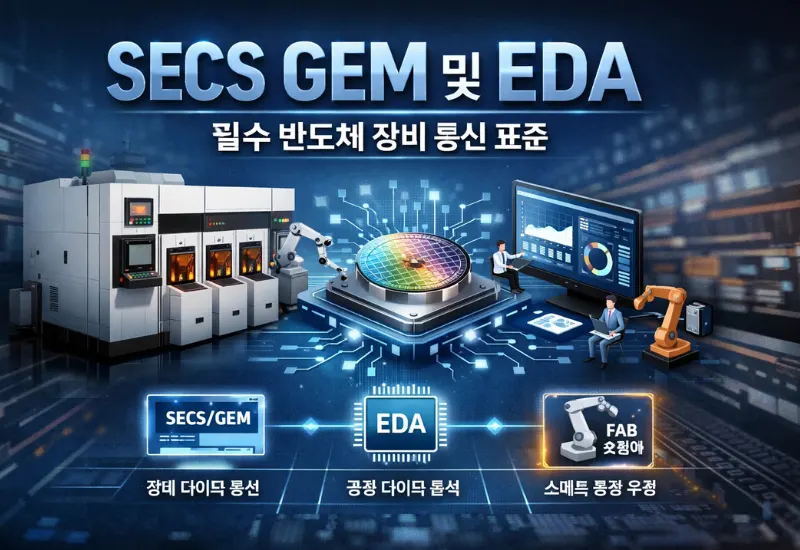
SECS GEM 및 EDA: 필수 반도체 장비 통신 표준

요약

SECS(반도체 장비 통신 표준)*와 *GEM(일반 장비 모델)*은 웨이퍼 팹에서 제조 장비와 공장 호스트 간의 원활한 데이터 교환을 보장하는 핵심 통신 프로토콜이다.

SECS/GEM은 장비 제어, 공정 레시피 관리, 자재 추적, 데이터 수집을 가능하게 하여 대량 생산 반도체 제조의 필수 기반을 제공한다.

반도체 산업은 지속적으로 진화하고 있으며, Interface A 계열 표준(예: EDA, SEMI E134, GEM 300)은 첨단 팹에서 요구되는 고속·대용량 데이터 수집 문제를 해결한다.

이러한 SEMI 통신 프로토콜을 정확히 이해하고 올바르게 구현하는 것은 장비 통합 엔지니어와 팹 IT 팀이 효율적이고 지능적이며 완전 자동화된 반도체 자동화 환경과 MES를 구축하는 데 필수적이다.

소개

SEMI(2024)에 따르면 전 세계 반도체 제조 장비 시장은 매출 기준 1,240억 달러에 이를 것으로 전망되며, 이는 공장 인프라에 대한 막대한 지속적 투자를 의미합니다. 이러한 급속한 확장 속에서 수백만 달러 규모의 복잡한 장비와 공장 제어 시스템 간의 견고하고 표준화되며 신뢰성 높은 통신에 대한 필요성은 절대적입니다. 바로 이 지점에서 반도체 장비 통신 표준이 핵심 역할을 합니다.

현대 팹 연결성의 근간은 SEMI(Semiconductor Equipment and Materials International)가 개발·유지하는 일련의 규격입니다. 이 규격들은 신뢰성 있고 효율적인 장비–호스트 통신을 위해 필요한 언어, 구조, 동작 방식을 정의하여, 서로 다른 벤더의 장비를 하나의 통합된 제조 환경으로 연결할 수 있도록 합니다.

수십 년 동안 SECS/GEM 표준 조합이 업계의 기준이었지만, 고급 분석과 인공지능에 의해 공정 데이터 수요가 폭증하면서 EDA와 같은 새로운 프로토콜이 빠르게 확산되고 있습니다. 이러한 진화를 이해하는 것은 차세대 운영 효율성을 추구하는 모든 팹 연결성 엔지니어와 MES 개발자에게 매우 중요합니다.

기반 개념 – SECS와 GEM 이해하기


자동화 팹을 구축하는 초기 과제는 단순했습니다. 서로 다른 벤더의 리소그래피 장비를 어떻게 중앙 공장 호스트와 의미 있게 “대화”하게 할 것인가? 이에 대한 해답은 SEMI E5와 E30 규격에서 나왔습니다.

SECS – 통신 파이프라인

반도체 장비 통신 표준(SECS)은 단일 프로토콜이 아니라 메시지 전송 및 구조를 정의하는 표준 집합입니다.

SECS-I (SEMI E4)

SECS-I는 RS-232 직렬 통신을 기반으로 물리 계층과 링크 계층을 정의한 레거시 표준입니다. 현재는 대부분 대체되었지만, 메시지 교환의 기본 구조를 확립한 중요한 토대였습니다. 메시지는 스트림(Stream)과 함수(Function) 구조로 정의되며, 일반적으로 SxFy 형식으로 표현됩니다(예: S1F1은 “Are You There 요청”).

H4: SECS-II (SEMI E5)

실제 통신 “언어”가 정의되는 부분입니다. SECS-II는 장비와 호스트 간에 교환되는 메시지의 구조와 의미를 규정합니다. 메시지는 정수, ASCII 문자열, 불리언과 같은 데이터 요소(Item)로 구성되며, 복잡한 구조를 위해 리스트(List)로 묶입니다.
Streams: 특정 기능과 관련된 메시지 그룹(예: 스트림 1 – 장비 상태, 스트림 6 – 데이터 수집)

Functions: 각 스트림 내의 개별 메시지(예: S1F1 Are You There 요청, S1F13 통신 설정 요청)

이 구조를 통해 벤더와 무관하게 호스트와 장비가 동일한 데이터를 일관되게 해석할 수 있습니다.

GEM – 동작 계약(Behavioral Contract)

SECS-II가 메시지를 어떻게 교환하는지를 정의한다면, 언제·왜 교환해야 하는지는 GEM(Generic Equipment Model, SEMI E30)이 담당합니다. GEM은 장비가 “GEM 준수”로 인정받기 위해 반드시 따라야 하는 필수 동작 요구사항 집합입니다.
GEM은 장비의 동작 상태와 메시지 처리 방식을 표준화하는 규칙서라고 볼 수 있으며, 이는 장비 통합 엔지니어의 통합 부담을 크게 줄여줍니다.

핵심 요구사항:

장비 상태 모델: IDLE, SETUP, PROCESSING, FAULT 등 표준 상태 정의

이벤트 보고: 장비 이벤트를 호스트에 보고하는 메커니즘

알람 관리: 중요·비중요 알람의 표준화된 처리 및 보고

레시피 관리: 공정 레시피 업로드, 다운로드, 선택 절차

원격 제어: 호스트에서 공정 시작, 정지, 일시정지 가능

GEM이 없다면 모든 장비마다 개별 통신 드라이버가 필요해지며, 완전 자동화 팹은 사실상 불가능합니다.

진화 – Interface A(EDA/GEM 300)의 부상

웨이퍼 크기 증가, 미세 공정 진화, 공정 복잡도 상승으로 데이터 수집 요구는 폭발적으로 증가했습니다. 트랜잭션 기반 요청–응답 모델에 의존하는 기존 SECS/GEM은 초당 수천 개 센서 데이터를 요구하는 환경에서 병목이 될 수 있습니다.
이 문제를 해결하기 위해 등장한 것이 Interface A, 즉 장비 데이터 수집(EDA)입니다.

EDA – 대용량 데이터 스트리밍

EDA는 현대 팹의 대용량 데이터 수집 한계를 해결하기 위해 설계된 표준 집합입니다. 핵심 규격은 SEMI E125, E134, E138입니다.

표준 명칭 주요 기능 핵심 기술
SEMI E125 장비 자기 기술 규격 장비 내부 구조 및 데이터 수집 능력 정의 XML over HTTP/S
SEMI E134 데이터 수집 관리 규격 호스트의 데이터·이벤트 구독 관리 SOAP/XML
SEMI E138 이산 시계열 데이터 수집 규격 타임스탬프 데이터 전송 정의 SOAP/XML

SECS/GEM이 제어와 데이터를 하나의 연결에서 처리하는 것과 달리, EDA는 데이터 수집 전용 통신 채널(XML/TCP-IP 기반)을 사용합니다. 이는 제어 명령과 대용량 데이터가 서로 간섭하지 않도록 하는 결정적 차별점입니다.

GEM 300 계열

GEM 300은 SECS/GEM 기반 위에 구축된 SEMI 표준 집합으로, 특히 300mm 및 450mm 팹의 자동 자재 처리와 고급 공정 실행을 다룹니다.

  • SEMI E40 (Processing Management): 공정 작업 및 스케줄 관리
  • SEMI E87 (Carrier Management): FOUP 등 캐리어 관리 표준
  • SEMI E90 (Substrate Tracking): 개별 웨이퍼 식별 및 추적

현대 고자동화 팹은 SECS/GEM을 제어 기반으로 사용하고, GEM 300을 통해 자재 처리와 고급 실행을 구현하는 계층적 접근이 필요합니다.

팹 연결성 구현 과제와 모범 사례

규격 준수와 통합 문제

  • 비표준 알람 보고
  • 이벤트 과다 또는 부족 정의
  • SECS-II 데이터 구조 오류

이를 방지하기 위해 규격 준수 체크리스트와 FAT/SAT 테스트는 필수입니다.

성능 최적화와 데이터 무결성

  • EDA 구독 최적화: 필요한 데이터만 선택적으로 수집
  • 네트워크 지연 관리: 저지연 전용 네트워크 권장
  • 타임스탬프 무결성: 시간 동기화 오류는 분석 무효화로 이어짐

정확한 타임스탬프가 없는 테라바이트급 데이터는 의미가 없습니다.

SECS/GEM을 넘어서 – 반도체 통신의 미래

업계는 단순 모니터링을 넘어 AI 기반 자율 제어로 이동하고 있습니다.

  • SEMI E171: 맥락 정보를 포함한 고급 데이터 교환
  • 표준화된 REST API: 비핵심 서비스 통합 단순화
  • 디지털 트윈: 고정밀 실시간 데이터 기반 가상 팹 구현

결론

SECS/GEM부터 EDA/Interface A에 이르기까지의 반도체 장비 통신 표준은 대량 생산을 가능하게 하는 보이지 않는 핵심 인프라입니다. 표준을 정확하고 성능 저하 없이 구현하는 것이 차세대 자동화 팹의 경쟁력을 결정합니다.

Contact Us Today

SECS/GEM 및 EDA 표준 구현을 위한 단계별 지원 받기


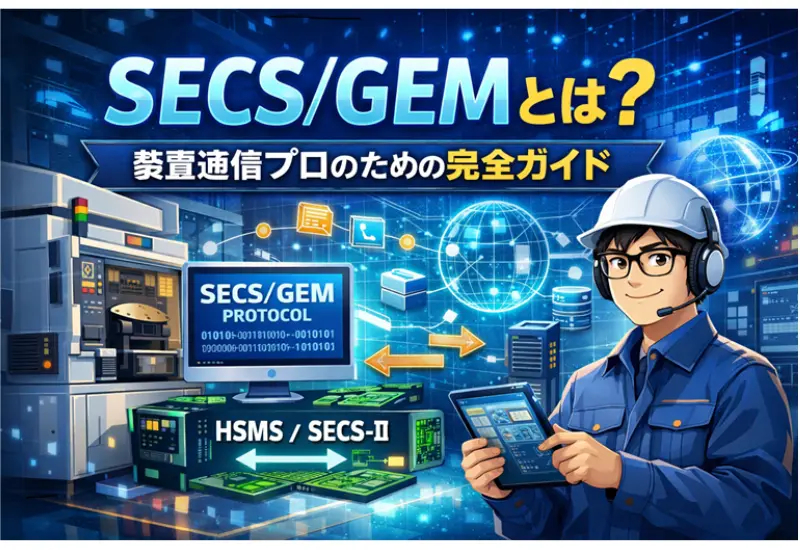
SECS/GEMとは?装置通信プロのための完全ガイド

要約

  • SECS/GEMは、製造装置と工場のホストシステム間の「ユニバーサルな握手(ハンドシェイク)」として機能します。
  • データ交換を標準化し、リアルタイム監視、レシピ管理、および装置のリモート制御を可能にします。
  • このプロトコルスイートには、メッセージ構造のためのSECS-IIと、高速イーサネット転送のためのHSMSが含まれます。
  • 半導体製造におけるSECS GEMは、統合の複雑さを軽減し、高コストなダウンタイムを防止します。
  • 現代の実装では、サイバーセキュリティと堅牢なデータ収集戦略への注力が不可欠です。
  • 適切なインターフェース設計は、インダストリー4.0の取り組みと、世界のチップ生産における予知保全を支えています。

はじめに

フォーチュン ビジネス インサイト(2024年)のレポートによると、世界の半導体市場は2024年に6,810億5,000万ドルに達し、2025年には7,552億8,000万ドルにまで上昇すると予測されています。このような極めてリスクの高い環境では、装置のダウンタイムが1秒発生するごとに、膨大な経済的損失が生じます。Siemens(2024年)の推定では、大規模な製造プラントは計画外の停止により年間平均2億5,300万ドルを失っており、特殊な設備では装置の故障により1時間あたり125,000ドルを超えるコストが発生する場合もあります。

これらのリスクを軽減するために、業界は安定した高性能な通信フレームワークに依存しています。ここで重要になるのがSECS/GEMです。これは、製造実行システム(MES)などの工場ホストシステムが、多様な製造装置と対話するための重要なリンクとして機能します。統一された言語がなければ、現代のファブ(半導体工場)は同期された生産拠点ではなく、沈黙した機械の無秩序な集まりになってしまうでしょう。

本記事では、SECS GEM通信のメカニズム、規格の進化、そして最新およびレガシーな環境で信頼性の高いSECS/GEMインターフェースを実装するための実践的な戦略について解説します。300mmのメガファブを管理している方も、ニッチな組立ラインを担当している方も、運用効率を極める上でこれらのプロトコルを理解することは不可欠です。

SECS GEMとは何か?

この用語は、SEMI(半導体製造装置・材料インターナショナル)が策定した、密接に関連する2つの規格を組み合わせた略称です。本質的には、装置がどのように振る舞い、どのようにデータを転送すべきかを定義する通信インターフェースを指します。これらのプロトコルは、公式のSEMI通信規格に基づいて構築されており、現代のあらゆる製造施設の「デジタル神経系」の技術的基盤となっています。

GEM (SEMI E30) – 振る舞いモデル

GEM(汎用機器モデル)は、SECS-IIの上位に位置します。これは装置の状態遷移(ステートマシン)と期待される振る舞いを定義します。SECS-IIが単語の辞書であるなら、GEMはエチケットのマナー本と言えるでしょう。装置がどのようにステータスを報告し、アラームを処理し、レシピを管理すべきかを概説しています。SECS GEM規格に従うことで、メーカーは自社の装置が工場の自動化ソフトウェアと「プラグアンドプレイ」で互換性を持つことを保証できます。

SECS GEM通信の進化

通信プロトコルは、それが支えるハードウェアと共に進化しなければなりません。初期のチップ製造では装置は比較的単純で、データ要件も控えめでした。しかし、トランジスタの微細化が進み、ウェーハ径が拡大するにつれて、データ量は爆発的に増加しました。

シリアル(SECS-I)から高速(HSMS)へ

初期の転送レイヤーであるSECS-I(SEMI E4)は、RS-232シリアル接続に依存していました。機能的ではありましたが、低速で通信距離にも制限がありました。ファブが完全自動化へと向かう中で、業界はHSMS(高速SECSメッセージサービス、SEMI E37)へと移行しました。HSMSはTCP/IPイーサネットを利用し、リアルタイムのトレースデータや高頻度のセンサー監視に必要な帯域幅を提供します。

現在のほとんどの施設ではHSMSが独占的に使用されていますが、レガシーな装置では依然としてシリアル・イーサネット変換アダプタが必要な場合があります。この移行により、より高速なハンドシェイクと堅牢なエラーリカバリが可能になり、数百台の装置を同時に管理する上で極めて重要になっています。

GEM 300とその先

300mmウェーハの処理では、さらに複雑さが増します。SEMIは「GEM 300」として知られる一連の規格(E39、E40、E87、E94など)を導入しました。これらは、自動搬送、キャリア管理、およびジョブスケジューリングのための特定の機能を追加するものです。これらの拡張により、SECS/GEMインターフェースは、世界最先端の製造施設における特殊なニーズにも対応できるようになっています。

なぜ半導体製造におけるSECS GEMが「王道」であり続けるのか

MQTTやREST APIのような現代的なプロトコルが、いずれこれらのレガシー規格に取って代わるのではないかと疑問に思うかもしれません。しかし、それらの技術は一般的なIoTアプリケーションには優れていますが、半導体の世界が求める決定論的な動作やプロセス特有のモデリングを提供することはできません。

データ収集とトレーサビリティ

データは歩留まり向上のための生命線です。SECS GEMプロトコルを通じて、ホストシステムは「収集イベント(コレクションイベント)」をサブスクライブできます。これらは、ウェーハの完了やガス流量の偏差など、装置にデータレポートの送信を促す特定のトリガーです。トレースデータ収集により、ホストはチャンバーの圧力やランプの電力などの変数を、10Hz以上の高頻度でサンプリングするよう要求できます。

この粒度の細かさにより、統計的工程管理(SPC)や欠陥検出・分類(FDC)が可能になります。プロセスエンジニアが歩留まりの低下に気づいた際、ログを使用して故障の瞬間に各センサーが何をしていたかを正確に把握できるのです。

リモート制御と安全性

自動化されたファブでは、オペレーターがすべての装置の開始ボタンを押すわけにはいきません。SECS/GEMインターフェースを使用すると、ホストの開始、停止、一時停止、中止などのリモートコマンドを送信できます。ただし、安全性が最優先です。GEMは厳格な状態モデルを定義しており、安全インターロックが開いている場合などは装置がコマンドを拒否するように設計されています。

修辞的な問い:なぜ、数千億円規模の施設が、標準化されたプロトコルで安全と精度を確保できるのに、手動操作によるミスのリスクを冒す必要があるのでしょうか?

実装に向けた実践的なステップ

レガシー装置を改造する場合でも、新規装置を構築する場合でも、機能的なインターフェースへの道のりは予測可能な順序をたどります。

  • スコープと要件の定義: どのGEM機能が必須かを特定します。レシピ管理やリモート制御が必要かどうかを判断します。
  • 機能テンプレートの作成: サポートされているすべてのメッセージと変数をリスト化した「GEMマニュアル」を作成します。これがMESチームの参照資料となります。
  • 接続テスト: HSMSリンクを確立します。ファイアウォールが指定されたポート(通常は5000または8000)の通信を許可していることを確認します。
  • ロジックの統合: ドライバーを装置のPLCまたはコントローラーに接続します。センサーが異常を検知した際、即座に正しいアラームメッセージを発信できるようにします。
  • シミュレーションと検証: 本番のウェーハでテストしないでください。シミュレーターを使用してホストの動作を模倣し、装置があらゆるコマンドに正しく応答することを確認します。

よくある落とし穴とサイバーセキュリティ

経験豊富なエンジニアであっても、導入時に障害に直面することがあります。よくある問題の一つは、装置が短時間に大量の情報を送信しすぎてネットワークを圧迫してしまう「データストーム」です。

ネットワークトラフィックの管理

ボトルネックを避けるために、エンジニアは収集イベントのフィルターを設定する必要があります。すべての変数を毎秒送信するのではなく、状態変化が発生したときにのみ重要なパラメータを送信するようにします。これによりネットワークを軽量に保ち、重要なアラームが遅延なくホストに届くようになります。

サイバーセキュリティのギャップ

SECS GEM規格の顕著な特徴は、ネイティブな暗号化や認証機能が欠けていることです。サイバー攻撃が想定されていなかった時代に設計されたため、信頼されたネットワークであることを前提としています。

TXOne Networks(2024年)によると、半導体セクターはランサムウェアの標的として価値が高まっています。インターフェースを保護するために、施設は「多層防御」を実装しなければなりません。これには、ファブネットワークの隔離、産業用ファイアウォールの使用、厳格なアクセス制御が含まれます。

ちょっとした冗談を一つ:もし装置の唯一のセキュリティが「筐体の物理的な南京錠」だけで、暗号化されていないデータを流しているとしたら、それは泥棒に玄関のドアを開け放しているのと同じようなものです。

結論

SECS/GEMスイートが工場自動化の根幹であり続けるのには理由があります。それは、グローバルメーカーが厳格な品質基準を維持しながら生産を拡大することを可能にする、高度な標準化を提供しているからです。ハードウェアとソフトウェアのギャップを埋めることで、これらのプロトコルは個々の機械をインテリジェントなシステムへと変貌させます。
業界が年間売上高1兆ドルに向かって突き進む中で、装置データを収集、分析、そして活用する能力が、グローバルなチップ競争における勝者を決定づけるでしょう。施設の近代化を検討している場合でも、自社装置のファブ対応を確実にしたい場合でも、堅牢なSECS/GEM戦略を立てることが、効率的な未来への第一歩となります。

Contact Us Today

SECS/GEM統合を専門家と一緒に進める

What Is the SECS/GEM Protocol? A Complete Guide to Semiconductor Automation

Introduction to SECS/GEM in Semiconductor Manufacturing

Modern semiconductor fabrication relies heavily on automation to achieve predictable processes, maximize throughput, and maintain world-class yield. Every manufacturing step—from wafer loading to deposition, etching, metrology, and packaging—depends on precise coordination between equipment and the factory’s host systems. This coordination is made possible through one of the most important communication standards in the industry: the SECS/GEM protocol.

SECS/GEM (SEMI Equipment Communications Standard / Generic Equipment Model) is the universal language that allows semiconductor tools to communicate with manufacturing execution systems (MES), factory hosts, and automation software. Without SECS/GEM, fabs would require custom communication for each tool type, making integration slow, expensive, and nearly impossible to scale.

This complete beginner’s guide explains what SECS/GEM is, how it works, and why it remains the backbone of semiconductor automation—even as the industry rapidly advances toward Industry 4.0, digital twins, and AI-driven manufacturing.

Why the SECS/GEM Protocol Matters in Modern Semiconductor Fabs

Standardizing Equipment Communication Across the Fab

Before SECS/GEM, equipment vendors each had their own proprietary communication formats. Integrating a new tool could take months of engineering work. SECS/GEM standardizes message structures, events, commands, status reporting, alarms, and behaviors so that all tools from lithography to packaging communicate uniformly.

This standardization allows fabs to:

  • Reduce integration complexity
  • Achieve faster tool qualification
  • Maintain consistent automation logic across hundreds of machines

Reducing Integration Time and Engineering Effort

Because SECS/GEM defines predictable equipment behavior, factories no longer need to build custom drivers for every tool. Integrators simply connect the equipment to the host via HSMS (Ethernet) or SECS-I (serial), configure event reports, and begin automation.

The result:

  • Shorter installation and ramp-up time
  • Lower engineering cost
  • Fewer communication-related errors

Enabling Reliable Equipment Monitoring and Control

SECS/GEM supports near real-time Equipment Monitoring, alarm reporting, and status changes, giving engineers complete visibility into production lines.
 

It also enables remote operations through standardized Remote Commands (RCMD). This makes automation scalable, safer, and more efficient.

How SECS/GEM Works: Key Components Explained

SECS Message Structure (SxFy Format)

SECS messages follow a structured format: Stream x, Function y (SxFy).
For example:

  • S1F1 — Are You There?
  • S6F11 — Event Report
  • S2F41 — Remote Command

This structured messaging ensures tools behave predictably in all factories globally.

HSMS vs SECS-I: Communication Layers and Transport Protocols

SECS-I (RS-232 serial) was the original method of communication, but most fabs today use HSMS (SEMI E37)—a high-speed Ethernet-based transport.

HSMS advantages:

  • Reliable networking
  • Higher data throughput
  • Better support for factory-wide automation

Event Reporting, Data Collection, and Alarm Handling

Key structures include:

  • Data Collection Events (DCEs)
  • Event IDs (CEIDs)
  • Status Variables (SVs)
  • Equipment Constants (ECs)
  • Alarms (ALIDs)

This rich dataset feeds into supervisory control, analytics systems, yield management tools (YMS), and AI/ML platforms.

SECS/GEM Data Analytics for Real-Time Insights

Using SECS/GEM Data for Trend Analysis and Process Stability

Fabs use SECS/GEM data to track:

  • Chamber temperature
  • Pressure stability
  • Motor torque
  • Recipe parameters
  • Wafer movement timing

Analyzing this data helps detect early process drift and maintain stability across high-volume production.

Role of SECS/GEM Data in Semiconductor Yield Optimization

Yield strongly depends on equipment health and process consistency.

SECS/GEM enables:

  • Rapid root-cause analysis
  • Correlation of equipment parameters to wafer defects
  • Faster identification of out-of-control (OOC) conditions

Yield management teams rely on clean, structured SECS/GEM data to drive consistent output quality.

Integrating SECS/GEM Data With AI/ML and Predictive Models

Modern fabs connect SECS/GEM data streams to:

  • Predictive maintenance systems
  • Fault detection and classification (FDC)
  • Machine learning-based anomaly detection

The result is fewer unexpected tool failures and significantly improved uptime.

Equipment Monitoring Through SECS/GEM

Tracking Status Variables (SVs) for Tool Health

Status Variables are real-time data points that describe machine conditions, such as:

  • Machine state
  • Substate
  • Carrier positions
  • Material handling status

These are essential for production monitoring and automated decision-making.

Using Data Collection Events (DCEs) for Performance Monitoring

DCEs trigger when key events occur—wafer load, vacuum start, recipe completion, or process errors. This allows factories to trace every part of the manufacturing process.

Alarm Management and Fault Detection

Alarms are automatically reported with:

  • Alarm ID
  • Description
  • Timestamp
  • Severity

This supports fast troubleshooting, root-cause identification, and reduced downtime.

SECS/GEM for Automation Engineers: Practical Use Cases

Remote Commands (RCMD) for Recipe and Job Control

Hosts can remotely send commands such as:

  • Start
  • Stop
  • Pause
  • Resume
  • Select Recipe

This eliminates the need for manual operator intervention.

Material Handling and Wafer Tracking Through SECS/GEM

The protocol supports automated material flow by reporting:

  • Carrier load/unload
  • Wafer count
  • Slot mapping
  • Robot errors

MES Integration and Factory Host Connectivity

SECS/GEM connects directly to:

It is the foundation of end-to-end digital manufacturing.

Comparing SECS/GEM With Other Semiconductor Communication Standards

SECS/GEM vs GEM300

GEM300 builds on SECS/GEM to support:

  • Wafer-level tracking
  • Carrier management
  • Durable handling
    Material transport automation
SECS/GEM vs SECS-II
  • SECS-II defines message structure
  • GEM defines behavior models (automation rules)

Together, they form the complete standard.

HSMS vs SECS I

Where EDA/Interface A Fits in Modern Fabs

EDA (Interface A) is used for high-frequency, high-volume data acquisition like fault detection and real-time analytics. SECS/GEM is still required for control, events, and commands.

Common Challenges When Implementing the SECS/GEM Protocol

Handling Custom Equipment Variations

Even with standardization, vendors may customize GEM implementations.
This requires careful mapping and validation.

Ensuring Robust Connection and Message Handling

HSMS sessions need reliable handling of:

  • Heartbeats
  • Reconnect logic
  • Message buffering
Maintaining Data Quality for Analytics Platforms

Poorly defined event reports or SVs degrade data analytics.
Standardized naming and timestamp accuracy are critical.

Future of SECS/GEM in Industry 4.0 Semiconductor Manufacturing

Integration With Digital Twin and AI Systems

SECS/GEM data is essential for the digital thread—from real-time digital twins to predictive process simulations.

Expanding SECS/GEM Data for Predictive Maintenance

AI-driven monitoring can detect anomalies before failures occur.

How Standards Will Evolve in Next-Gen Fabs

Future trends include:

  • Hybrid SECS/GEM + EDA architectures
  • Greater interoperability
  • Enhanced data models for robotics and automation

Conclusion

The SECS/GEM protocol is the foundation of semiconductor automation, enabling seamless communication between thousands of tools and factory systems. Even as the industry moves toward AI, real-time analytics, and hyper-automated fabs, SECS/GEM remains essential due to its reliability, consistency, and global adoption.

For beginners, mastering SECS/GEM opens doors to careers in equipment integration, automation engineering, and data-driven manufacturing—fields central to the future of semiconductor production.

FAQ Section

  • What is SECS/GEM?

    SECS/GEM is the global communication standard that connects semiconductor equipment to factory host systems.

  • Why is SECS/GEM important?

    It standardizes automation, event reporting, remote control, and data collection across fabs.

  • What does SECS stand for?

    SEMI Equipment Communications Standard.

  • What does GEM stand for?

    Generic Equipment Model.

  • What is the difference between SECS-I and HSMS?

    SECS-I uses serial communication; HSMS uses high-speed Ethernet.

  • How does SECS/GEM support equipment monitoring?

    Through status variables (SVs), alarms, and event reporting.

  • Can SECS/GEM be used for data analytics?

    Yes—SECS/GEM Data Analytics is widely used for yield improvement and predictive maintenance.

  • What is GEM300?

    An extension of SECS/GEM used for 300mm wafer automation.

  • Does SECS/GEM work with AI/ML platforms?

    Yes, SECS/GEM data is often fed into ML models for process optimization.

  • Is SECS/GEM still relevant with newer standards like EDA?

    Yes—SECS/GEM is essential for control and automation; EDA complements it for high-volume data.

EDA vs SECS/GEM

Introduction

The semiconductor industry relies on sophisticated technologies at every stage—from initial chip design to final manufacturing. Two acronyms frequently appear in industry discussions: EDA (Electronic Design Automation) and SECS/GEM (SEMI Equipment Communications Standard/Generic Equipment Model). While both are essential to semiconductor operations, they serve fundamentally different purposes and operate at completely different stages of the production lifecycle.

Understanding the distinction between EDA and SECS/GEM isn’t just academic—it’s critical for professionals working across the semiconductor value chain, from design engineers to fab operators. This comparison explores what each technology does, where it fits in the semiconductor workflow, and why both remain indispensable despite their different roles.

What Is EDA

What Is EDA?

Electronic Design Automation (EDA) refers to software tools used to design electronic systems, particularly integrated circuits and printed circuit boards. EDA tools enable engineers to design, simulate, verify, and optimize complex semiconductor devices before any physical manufacturing occurs.

The EDA process encompasses several critical functions:

Design Entry: Engineers use schematic capture tools or hardware description languages (HDL) like Verilog and VHDL to describe circuit functionality. These tools allow designers to work at high abstraction levels, defining what a chip should do rather than manually placing every transistor.

Simulation and Verification: Before committing to expensive manufacturing, designers simulate circuit behavior under various conditions. Functional simulation verifies logical correctness, while timing simulation ensures the design meets performance requirements. Verification tools check that designs match specifications and don’t contain errors that could cause manufacturing failures.

Physical Design: Once verified, placement and routing tools determine where components sit on the chip and how connections between them are formed. This stage considers manufacturing constraints, heat dissipation, signal integrity, and power consumption.

Design for Manufacturing (DFM): Modern EDA tools analyze designs for manufacturability, identifying potential problems that could reduce yields or cause manufacturing failures. They ensure designs comply with foundry process rules and optimize layouts for better production outcomes.

Major EDA vendors include Synopsys, Cadence Design Systems, and Siemens EDA (formerly Mentor Graphics). These companies provide comprehensive tool suites covering the entire design process from concept to tape-out—the point where designs are ready for fabrication.

What Is SECS GEM

What Is SECS/GEM?

SECS/GEM operates in a completely different domain: manufacturing execution and equipment communication. While EDA focuses on designing chips, SECS/GEM enables communication between manufacturing equipment and factory automation systems during actual production.

SECS (SEMI Equipment Communications Standard) defines the message format and transport protocol for equipment communication. GEM (Generic Equipment Model) specifies the behavioral model—what states equipment can be in, what events it reports, and how it responds to commands.

The SECS/GEM framework enables several critical manufacturing functions:

Equipment Status Monitoring: Factory systems receive real-time updates on equipment states—idle, processing, maintenance, or alarmed. This visibility allows operators to manage production flow and respond quickly to issues.

Data Collection: Equipment reports process parameters, measurement results, and production data to Manufacturing Execution Systems (MES). This data drives quality control, yield analysis, and process optimization.

Remote Control: Host systems can send commands to equipment—loading recipes, starting processes, changing parameters—enabling automated factory operations.
Alarm Management: When equipment detects problems, it generates alarms that notify operators and factory systems. Quick alarm response prevents minor issues from becoming major disruptions.

Material Tracking: SECS/GEM supports tracking wafers and other materials through the manufacturing process, ensuring traceability and preventing mix-ups.

Unlike EDA, which involves software engineers and chip designers, SECS/GEM involves automation engineers, equipment manufacturers, and fab operations teams implementing and maintaining communication between hundreds of manufacturing tools and factory systems.

Key Differences Between EDA and SECS/GEM

Lifecycle Stage

EDA operates during the design phase, before manufacturing begins. Engineers use EDA tools to create chip designs that foundries will later manufacture.

SECS/GEM operates during manufacturing. It’s the communication backbone enabling factories to run production equipment efficiently.

Primary Users
EDA serves chip designers, verification engineers, and physical design specialists working for fabless semiconductor companies, integrated device manufacturers, and design service firms.
SECS/GEM serves equipment manufacturers (OEMs) building semiconductor tools, fab automation teams integrating equipment into production lines, and process engineers optimizing manufacturing operations.

Objective

EDA aims to create functional, manufacturable chip designs that meet performance, power, and cost targets while minimizing design time and reducing errors.

SECS/GEM aims to enable seamless communication between equipment and factory systems, supporting automated operations, data collection, and efficient production management.

Why Both Matter

Despite their differences, EDA and SECS/GEM represent complementary aspects of semiconductor production. Effective chip designs created with EDA tools must be manufactured efficiently using equipment that communicates via SECS/GEM. Neither technology can substitute for the other—they operate in different domains addressing different challenges.

Modern semiconductor manufacturing increasingly connects these domains through Design for Manufacturing (DFM) feedback loops. Manufacturing data collected via SECS/GEM informs design decisions made with EDA tools. Yield information, defect patterns, and process variations observed in fabs flow back to designers, allowing them to optimize future designs for better manufacturability.

Conclusion

EDA and SECS/GEM serve distinct, non-overlapping roles in semiconductor operations. EDA enables engineers to design complex chips efficiently, while SECS/GEM enables factories to manufacture those chips efficiently. Understanding both technologies—and how they complement each other—provides essential context for anyone working in the semiconductor industry.

For organizations building semiconductor capabilities, investments in both domains prove necessary. Design excellence enabled by EDA must be matched with manufacturing excellence enabled by robust equipment communication and factory automation. The most successful semiconductor companies excel at both, recognizing that great designs require great manufacturing, and vice versa.

FAQs

  • What is the main difference between EDA and SECS/GEM?

    EDA (Electronic Design Automation) is used in the chip design phase to create, simulate, and verify semiconductor designs before manufacturing.

    SECS/GEM, on the other hand, is used during the manufacturing phase for equipment communication, automation, data collection, and factory integration.

  • Are EDA and SECS/GEM used in the same part of the semiconductor process?

    No. EDA is used early in the lifecycle, during chip design and verification.

    SECS/GEM is used later in the fab, enabling real-time communication between manufacturing tools and MES systems.

  • Who uses EDA tools and SECS/GEM systems?

    EDA tools are used by chip designers, verification engineers, and layout engineers in fabless companies or IDMs.

    SECS/GEM is used by OEMs, automation engineers, integration teams, and fab operations staff responsible for equipment connectivity and production control.

  • Why is SECS/GEM important for semiconductor manufacturing?

    SECS/GEM ensures standardized communication between equipment and factory systems. It supports recipe control, alarms, data collection, equipment states, and remote command execution—critical for automated fab operations.

  • Why is EDA essential in chip design?

    EDA tools help engineers simulate, verify, and optimize complex chip architectures before fabrication. This reduces errors, improves performance, and avoids costly silicon failures during manufacturing.

SECS/GEM Integration Guide: Compliance Testing & Implementation

Connectivity is power in semiconductor and electronics manufacturing. Each machine, process, and data item is part of the bigger picture of attaining a seamless automation process, as well as intelligent decision making. The SECS/GEM integration is one of the most significant frameworks that helps to make this transformation and it is a standardized communication protocol that allows closing the gap between equipment and factory automation systems.

You may be updating old systems or establishing a new production facility, but you need to understand how to be able to test compliance with the SECS/GEM and deploy SECS/GEM software and SECS/GEM host integration to make sure that your manufacturing processes are not obsolete in the future

Step 1: Evaluating Equipment Fit

Assessment of the current setup is the first process towards a successful integration of SECS/GEM equipment. The equipment you are using should be able to communicate on SEMI SECS/GEM standard (E5/E30). Most of the modern tools are already equipped with built-in SECS/GEM features, yet older systems may need some of the following elements: communication gateways, or adapter software.

Unless your old machine is native SECS/GEM, there may be a need to use specialized SDKs or middleware, which translates proprietary protocols into SECS-II messages that can be used in the GEM model. This will make all your data, process parameters as well as alarm reports available under one integrated automation platform.

An extensive compatibility test eliminates future delays at great expense and makes sure that your SECS/GEM protocol implementation has a firm foundation.

Step 2: Selecting the SDK and Development Tools of the SECS/GEM

The proper SDK and development tools of SECS/GEM are the next step after compatibility has been checked. A sound SDK makes it easier to cope with command processing, message decoding and event handling.

SECS/GEM software libraries have been written in different programming environments, including .NET, C++, or Java. These devices enable developers to develop layers of communication that are effective in managing both the host (factory) and equipment end.

Further, a SECS/GEM simulator can be used in the development phase to exchange messages without connecting to real hardware to save time and resources. The correct tools minimize the complexity, accelerate integration and assure that your system passes all areas of testing in the SECS/GEM compliance test.

Step 3: Implement SECS/GEM Interface

The SECS/GEM interface is used to provide the interface between the host system and the equipment.

In implementation, specify all pertinent data variables, state models and event reports which represent the behavior of your machine. They need to be defined in terms of the SEMI E5 (SECS-II message format) and E30 (GEM model) specifications in order to become consistent and interoperable.
Every message transaction, such as equipment status, start process, etc., has to fit in the conventional GEM event objects. The well-designed interface can facilitate the SECS/GEM communication as well as reduce downtime and improve traceability and the use of equipment.

Step 4: Integration by Testing and Validating

It is testing that gives theory reality. SECS/GEM interface testing should be done comprehensively before deployment so that the accuracy of messages, their synchronized performance, and their synchronization are all deliberated.

Test benches or leverage SECS/GEM simulation tools to determine the interactions between the host and the equipment in different conditions: normal operations, alarm, disconnection, and recovery sequences. This assists you in identifying the irregularities before their impact to production.

SECS/GEM full compliance testing ensures that the implementation you have made is compliant to the SEMI standards, communicates correctly, and reacts predictably in a real world situation.

Step 5: Deploy, Monitor, and Maintain

After being tested, it is now time to put your SECS/GEM host integration into production. Long-term reliability depends on continuous monitoring and updating on a regular basis.

The proactive maintenance plan should be included to maintain stable communication links and all SEMI standard changes or firmware updates should be installed beforehand. Having an expert like eInnoSys assist you in maintaining your system to be compliant, scalable, and optimised with regards to performance.

Constant updates also enable the integration to keep up with newly added equipment, automation frameworks or cloud-based analytics tools without interfering with any of the current workflows.

The Role of SECS/GEM in Smart Manufacturing in the Present Day

SECS/GEM protocol is not merely a communication layer, it is the core of Industry 4.0 in the manufacturing of semiconductors and electronics.

Allowing standardized data exchange, SECS/GEM will allow factories to have all the data on equipment performance, production measures as well as quality trends. Such visibility drives predictive maintenance, live analytics, and artificial intelligence-based decision-making which eventually results in less downtime and higher yield.

Current smart factories have developed SECS/GEM software to integrate machines with, and connect to MES (Manufacturing Execution Systems), ERP systems and cloud-based dashboards — forming a single digital ecosystem.

The Reasons eInnoSys is the Best SECS/GEM Integration Partner

We think that real automation is based on perfect communication, which is the starting point at eInnoSys. Having years of experience in SECS/GEM equipment integration, we assist semiconductor and electronics manufacturers in the integration of legacy equipment into the digital age, fast, safely, and effectively.

This is what is unique about eInnoSys:

  • SECS/GEM Solutions — Our engineers will guarantee complete SECS/GEM compliance testing with SECS/GEM interface design through verification and backward SECS/GEM communication.
  • High Simulation Tools — Our own SECS/GEM simulator enables you to be able to test and verify integrations prior to live deployment in order to minimize downtime.
  • Tailored Integration Method — We will tailor the SECS/GEM host integration to your current infrastructure and there will be minimal disturbance to the running operations.
  • Long-Term Support — We monitor, update, and optimize your automation environment in addition to first deployment to ensure that it is at its best.

We are committed to ensuring that SECS/GEM software implementation is hassle-free and scalable — so that your factory can be able to achieve increased throughput, reduced costs and smarter automation.

Conclusion

Unlike a technical upgrade, the incorporation of SECS/GEM with your current manufacturing equipment is a strategic position that will lead to a smarter and data-driven future.

Using a systematic methodology — checking the compatibility, selecting the optimal tools, creating a compliant interface, testing hard and finally maintaining the situation — manufacturers would open up new horizons of visibility and control in their operations.

Having an appropriate crisis communication plan among your host and equipment, you will minimize errors, increase efficiency, and make faster and more informed decisions.

Make your automation systems future-proof with the help of eInnoSys and become the full potential of SECS/GEM integration because in the age of smart manufacturing, the interconnected equipment implies the interconnected success.

Frequently Asked Questions About SECS/GEM Integration

  • 1. How do I know if my equipment supports SECS/GEM?

    SECS/GEM (SEMI E5 & E30 standards) is a communication protocol that connects manufacturing equipment with factory automation systems like MES or ERP. It standardizes data exchange across different machines, enabling real-time monitoring, predictive maintenance, and smart manufacturing efficiency.

  • 2. What is SECS/GEM and why is it important?

    Check your equipment’s specs for SEMI E5 (SECS-II) and E30 (GEM) support. Most modern tools include SECS/GEM by default, while older systems may require a communication gateway or middleware. eInnoSys offers compatibility assessments for legacy equipment integration.

  • 3. What is a SECS/GEM simulator?

    A SECS/GEM simulator mimics equipment or host communication, allowing developers to test integrations without using real machines. It’s used for testing, training, and troubleshooting—saving time and reducing production risks.

  • 4. What are the steps in SECS/GEM compliance testing?

    Compliance testing includes verifying SECS-II message formatting, equipment state transitions, event reporting, synchronization, and stress testing. Proper validation ensures reliable communication and SEMI standard compliance.

  • 5. How does SECS/GEM enable smart manufacturing?

    SECS/GEM forms the backbone of Industry 4.0 by enabling standardized, real-time data exchange. It supports AI-driven analytics, predictive maintenance, and improved equipment utilization—helping manufacturers cut downtime and improve yield.

SECS/GEM Integration with Canon FPA 5000 ES3

[vc_row][vc_column][vc_column_text css=””]

In the fast-paced semiconductor industry, seamless communication between tools and factory host systems is vital for achieving automation, efficiency, and data-driven decision-making. Many 200 mm fabrication facilities still operate with legacy equipment that lacks native SECS/GEM capabilities. One such example is the Canon FPA 5000 ES3 (248 nm DUV Step-and-Scan Lithography System), a proven and reliable system used worldwide.

To bring this legacy tool into compliance with modern automation requirements, Einnosys successfully implemented its flagship product — EIGEMBox, a turnkey SECS/GEM integration solution.

[/vc_column_text][/vc_column][/vc_row][vc_row][vc_column width=”1/2″][vc_column_text css=””]The Challenge

The Canon FPA 5000 ES3 is a robust lithography tool designed for 200 mm wafer processing, but like many legacy systems, it was not originally equipped with SECS/GEM protocol support.

This limitation created challenges for fabs aiming to:

  • Connect the tool to host automation systems (MES/EAP).
  • Enable data collection, event monitoring, and alarm reporting.
  • Achieve SECS/GEM compliance for uniform fab automation.

Without SECS/GEM communication, the fab’s automation framework could not fully monitor or control the Canon system, leading to manual operations, inefficiencies, and limited data visibility.[/vc_column_text][/vc_column][vc_column width=”1/2″][vc_single_image image=”37712″ img_size=”500X500″ css=””][/vc_column][/vc_row][vc_row][vc_column][vc_column_text css=””]The Solution: EIGEMBox

To address these challenges, Einnosys deployed the EIGEMBox, an advanced and compact SECS/GEM gateway designed to enable communication between legacy equipment and modern host systems.

The EIGEMBox acted as a bridge interface, converting native Canon equipment signals into fully SEMI E4/E5/E30 compliant SECS/GEM messages, without requiring major hardware or software modifications to the tool.

Key implementation highlights:

  • Quick and non-invasive installation.
  • Full support for SECS-I and HSMS-SS (Ethernet) communication.
  • Real-time data, event, and alarm collection.
  • Custom configuration to align with factory EAP/MES protocols.
  • Validation and certification for GEM compliance by the fab’s automation team.

[/vc_column_text][/vc_column][/vc_row][vc_row][vc_column width=”1/2″][vc_single_image image=”37713″ img_size=”full” css=””][/vc_column][vc_column width=”1/2″][vc_column_text css=””]Benefits of EIGEMBox

The integration of EIGEMBox transformed the Canon FPA 5000 ES3 into a fully SECS/GEM-compliant system, delivering multiple operational benefits:

✅ Automation Enablement – The fab achieved seamless host-to-equipment communication, supporting remote control, data collection, and event reporting.
✅ Reduced Manual Intervention – Automated monitoring minimized operator involvement, improving throughput and reducing human error.
✅ Enhanced Data Visibility – Real-time equipment data was now available for predictive maintenance and process optimization.
✅ Cost-Effective Retrofit – No need for expensive equipment replacement or software rewriting.
✅ Faster Time-to-Production – EIGEMBox enabled quick deployment, allowing the fab to achieve compliance in just a few days.

By using EIGEMBox, the fab successfully upgraded its legacy Canon tool to align with modern automation standards, extending its operational life and maximizing ROI.[/vc_column_text][/vc_column][/vc_row][vc_row][vc_column][vc_column_text css=””]

The success of integrating EIGEMBox with the Canon FPA 5000 ES3 exemplifies how legacy tools can be efficiently upgraded for modern fab automation.
EIGEMBox not only enabled SECS/GEM compliance but also empowered the fab with better control, real-time data access, and enhanced productivity — all without replacing the existing tool.

For fabs and OEMs seeking reliable SECS/GEM integration for legacy or new systems, EIGEMBox by Einnosys offers the perfect balance of performance, simplicity, and scalability.

[/vc_column_text][vc_single_image image="37197" img_size="full" alignment="center" style="vc_box_shadow_3d" onclick="custom_link" css="" link="https://newsite.einnosys.com/eigembox/%22][/vc_column][/vc_row][vc_row][vc_column][vc_column_text css=""]About Einnosys

Einnosys is a global technology company specializing in Factory Automation, SECS/GEM integration, AI/ML, IoT, and Industry 4.0 solutions for semiconductor fabs and equipment manufacturers.

With decades of experience in semiconductor automation, Einnosys delivers turnkey SECS/GEM SDKs, integration services, and edge gateway products such as EIGEMBox to enable seamless communication, compliance, and smart manufacturing transformation.[/vc_column_text][/vc_column][/vc_row][vc_row][vc_column][vc_toggle title=”FAQs: SECS/GEM Integration on Canon FPA 5000 ES3 with EIGEMBox” open=”true” css=””]1. What challenge did Einnosys solve with EIGEMBox for the Canon FPA 5000 ES3?

Einnosys addressed the lack of SECS/GEM connectivity in the Canon FPA 5000 ES3 200 mm lithography tool. Using EIGEMBox, the equipment was upgraded to support data collection, event reporting, and host communication, enabling full factory automation compliance.

2. What is EIGEMBox and how does it help in SECS/GEM integration?

EIGEMBox is a plug-and-play middleware solution by Einnosys that enables SECS/GEM functionality on legacy or “dumb” semiconductor tools. It bridges the communication gap between equipment and factory host systems without requiring any hardware modification.

3. Does the Canon FPA 5000 ES3 support SECS/GEM by default?

No, older Canon FPA 5000 ES3 models (especially 200 mm systems) do not natively support SECS/GEM protocol. EIGEMBox provides this functionality externally, making the equipment GEM-compliant.

4. What benefits did the customer achieve after integrating EIGEMBox?

After SECS/GEM integration, the customer gained real-time equipment monitoring, automated data logging, event and alarm collection, and improved OEE (Overall Equipment Effectiveness). It also reduced manual data entry and human intervention in operations.

5. Is EIGEMBox compatible with other Canon lithography tools?

Yes. EIGEMBox can be integrated with various Canon lithography systems, as well as tools from other OEMs. It supports both 200 mm and 300 mm tool generations, making it a universal retrofit solution.

6. How long does it take to deploy EIGEMBox for SECS/GEM integration?

Typical deployment takes between 2 to 4 weeks, depending on tool type, host configuration, and customer requirements. Einnosys provides remote or on-site integration support to ensure smooth implementation.

7. Does EIGEMBox support GEM300 and advanced SECS/GEM features?

Yes, EIGEMBox is designed to comply with SEMI E4, E5, E30 (GEM), and E37 (HSMS) standards. It can also support GEM300 extensions for advanced wafer handling and process automation if required.

8. Why choose Einnosys for SECS/GEM integration services?

Einnosys specializes in factory automation, SECS/GEM solutions, and semiconductor software development. With years of expertise and proven products like EIGEMBox, Einnosys ensures fast, reliable, and compliant integration for both new and legacy tools.[/vc_toggle][/vc_column][/vc_row]

Success Story: SECS/GEM Integration on Peter Wolters AC 2000-P2 with EIGEMBox

[vc_row][vc_column width=”1/2″][vc_column_text css=””]Introduction

In the semiconductor industry, seamless communication between equipment and host systems is critical for efficiency, traceability, and factory automation. Many legacy tools, however, lack native SECS/GEM interfaces, making integration challenging. One such case was the Peter Wolters AC 2000-P2, a widely used precision lapping and polishing system. Einnosys successfully enabled SECS/GEM connectivity for this equipment using its innovative EIGEMBox solution.[/vc_column_text][vc_column_text css=””]The Challenge

The Peter Wolters AC 2000-P2 was a high-value tool but lacked native SECS/GEM capability. Without standardized communication, the fab struggled with:

  • Limited equipment-to-host connectivity.
  • Manual data logging and recipe management.
  • Difficulty in meeting automation and traceability requirements.
  • High downtime risk during integration attempts with legacy hardware.

The fab needed a non-intrusive, cost-effective, and SEMI-compliant solution that could enable SECS/GEM without impacting existing machine performance.[/vc_column_text][/vc_column][vc_column width=”1/2″][vc_single_image image=”37128″ img_size=”500×500″ alignment=”center” css=””][/vc_column][/vc_row][vc_row][vc_column width=”1/2″][vc_column_text css=””]Benefits of EIGEMBox

By enabling SECS/GEM on the Peter Wolters AC 2000-P2, the fab achieved:

  • Faster Integration: Deployment completed quickly without machine downtime.
  • Standardized Connectivity: Direct host communication via SECS/GEM.
  • Improved Productivity: Automated data collection and recipe management reduced manual effort.
  • Future-Ready Automation: Compatibility with MES, predictive maintenance, and smart manufacturing initiatives.
  • Cost Savings: Extended the life of existing equipment without expensive upgrades.

[/vc_column_text][/vc_column][vc_column width=”1/2″][vc_column_text css=””]The Solution: EIGEMBox

Einnosys deployed its EIGEMBox, a plug-and-play hardware and software solution designed to retrofit legacy equipment with SECS/GEM capability. Key aspects of the solution included:

  • Seamless Retrofit: Integration without altering the machine controller or core software.
  • Full SEMI Compliance: Support for SECS-I, SECS-II, HSMS, and GEM standards.
  • Recipe and Data Handling: Automatic collection of alarms, events, recipes, and process data.
  • Scalable Architecture: Ability to connect multiple legacy tools to the host system.

The implementation was completed in a short timeframe, with minimal disruption to production.[/vc_column_text][/vc_column][/vc_row][vc_row][vc_column][vc_column_text css=””]About Einnosys

Einnosys Technologies is a trusted partner in semiconductor factory automation, offering solutions for fabs, assembly/test/packaging, and OEMs. With products like EIGEMBox and EIGEMEquipment SDK, Einnosys empowers semiconductor companies to achieve seamless equipment integration, predictive maintenance, and AI-driven manufacturing.

Conclusion

This success story highlights how EIGEMBox transformed the Peter Wolters AC 2000-P2 into a fully SECS/GEM-compliant tool, enabling the fab to achieve modern automation goals without replacing existing assets. For fabs looking to bridge the gap between legacy equipment and Industry 4.0, EIGEMBox offers a proven, scalable, and cost-effective path forward.[/vc_column_text][/vc_column][/vc_row]

SECS/GEM Integration on Innolas ILS 700P with EIGEMBox

[vc_row][vc_column width=”1/2″][vc_column_text css=””]Client Profile Client: A leading semiconductor manufacturing company based in Singapore
Industry: Semiconductor Manufacturing[/vc_column_text][/vc_column][vc_column width=”1/2″][vc_single_image image=”36331″ img_size=”full” css=””][/vc_column][/vc_row][vc_row][vc_column width=”1/2″][vc_column_text css=””]Challenges

The client operates a high-mix, high-throughput semiconductor fab where equipment interoperability and factory automation are essential. While the Innolas ILS 700P laser tool played a critical role in solar cell edge isolation, it lacked native support for SEMI-compliant communication. The absence of SECS/GEM protocol integration limited the tool’s ability to communicate with the host MES, monitor job execution, and transmit trace data for engineering analysis.

Specific challenges included:

  • No SECS/GEM interface for host tool control and monitoring
  • Manual recipe loading and result collection
  • Limited visibility into equipment status and alarms
  • Increased downtime due to reactive troubleshooting

With strict fab automation standards and growing traceability demands, the client needed a scalable, non-invasive solution that could bring the Innolas tool up to SECS/GEM compliance without costly retrofitting or long development cycles.[/vc_column_text][/vc_column][vc_column width=”1/2″][vc_column_text css=””]

Solution

The client selected EIGEMBox by eInnosys—a compact, plug-and-play hardware gateway that enables SECS/GEM compliance on legacy and non-SEMI tools. EIGEMBox supports configurable I/O and PLC integration, making it ideal for tools like the ILS 700P that lack native GEM interfaces.

The integration process involved:

  • Connecting EIGEMBox to the ILS 700P via digital I/O and serial communication
  • Mapping tool events (e.g., job start/stop, recipe ID, alarm status) into GEM-compliant messages
  • Configuring GEM state models, alarms, and variable reporting within the SECS GEM SDK
  • Interfacing the EIGEMBox with the factory host using standard SECS-II over HSMS

The solution required no modification of the tool’s core software, ensuring business continuity and minimal downtime. Using the EIGEMBox console, tool engineers could easily configure, monitor, and log GEM events without writing custom code.[/vc_column_text][/vc_column][/vc_row][vc_row][vc_column width=”1/2″][vc_column_text css=””]

Testing & Validation

A phased validation plan was executed in coordination with the factory automation and tool qualification teams. Key focus areas included:

  • SEMI E30 compliance testing using the fab’s host simulator
  • Validation of critical SECS/GEM features such as S1F1 (Are You There), S2F41 (Remote Commands), and S6F11 (Event Reports)
  • Alarm and status condition mapping with corresponding host acknowledgments
  • Recipe name verification and job execution traceability

Factory acceptance testing confirmed seamless SECS/GEM protocol integration, with the tool now capable of supporting remote commands, recipe validation, equipment status polling, and historical data logging.[/vc_column_text][/vc_column][vc_column width=”1/2″][vc_column_text css=””]

Results

Post-integration, the ILS 700P tool became fully GEM-compliant and connected to the fab-wide MES system. Measurable improvements included:

  • 100% automation readiness, with host-side job control and alarm handling
  • Faster troubleshooting, enabled by detailed event logs and status messaging
  • Improved engineering analysis, thanks to real-time trace data and alarm context
  • Reduced human error, as recipe management and result reporting were fully automated
  • Standardized compliance, aligning the legacy tool with fab-wide automation protocols

With EIGEMBox, the client extended the lifecycle of its ILS 700P tool while bringing it into the smart manufacturing fold—no firmware rewrite or expensive upgrades required.[/vc_column_text][/vc_column][/vc_row]

Success Story: SECS/GEM Integration on Hitachi S-9220 DC SEM Through EIGEMBox

[vc_row][vc_column][vc_column_text css=””]In the fast-paced semiconductor industry, efficiency and reliability are paramount. US-based companies are continuously seeking advanced solutions to enhance their manufacturing processes. This success story highlights how one of the leading American semiconductor suppliers achieved seamless SECS/GEM integration on their Hitachi S-9220 DC Scanning Electron Microscope (SEM) using the innovative EIGEMBox. This integration not only improved operational efficiency but also set a new benchmark for process automation and equipment communication.[/vc_column_text][/vc_column][/vc_row][vc_row][vc_column width=”1/2″][vc_column_text css=””]Client Overview:

The client, a prominent American semiconductor supplier, specializes in high-performance semiconductor solutions. They operate in a highly competitive environment where precision, quality, and time-to-market are critical. With an expanding global customer base, the client’s manufacturing facilities are equipped with state-of-the-art technologies, including the Hitachi S-9220 DC SEM, which plays a crucial role in wafer inspection and defect analysis.

The Solution: EIGEMBox

The EIGEMBox, a revolutionary product designed for easy SECS/GEM integration, emerged as the ideal solution. With its plug-and-play architecture, the EIGEMBox seamlessly connected the Hitachi S-9220 DC SEM to the client’s MES, enabling real-time communication and control.[/vc_column_text][/vc_column][vc_column width=”1/2″][vc_column_text css=””]The Challenge:

While the Hitachi S-9220 DC SEM is renowned for its precision and reliability, it lacked native SECS/GEM compliance. This limitation presented significant challenges for the client, including:

Inconsistent Communication: The SEM’s inability to seamlessly communicate with the Manufacturing Execution System (MES).

Limited Automation: Manual intervention was required for data collection and process control, leading to inefficiencies.

Integration Complexity: Custom solutions to achieve SECS/GEM compliance were expensive and time-consuming to implement.

The client needed a cost-effective, scalable, and reliable solution to enable SECS/GEM communication for the Hitachi S-9220 DC SEM without disrupting their existing operations.[/vc_column_text][/vc_column][/vc_row][vc_row][vc_column width=”1/2″][vc_column_text css=””]Key Features of the EIGEMBox:

Rapid Deployment: Minimal setup time with no need for extensive reconfiguration of existing equipment.

Scalability: Supports integration with multiple equipment types, making it future-proof.

User-Friendly Interface: Simplifies configuration and monitoring, even for non-technical users.

High Reliability: Ensures robust and secure data exchange between equipment and MES.[/vc_column_text][/vc_column][vc_column width=”1/2″][vc_column_text css=””]Implementation Process

The integration process was meticulously planned and executed in collaboration with the client’s technical team:

Assessment: The EIGEMBox was assessed for compatibility with the Hitachi S-9220 DC SEM and the client’s MES.

Installation: The device was installed and connected to the SEM with minimal downtime.

Configuration: Parameters were configured to ensure seamless communication and adherence to SECS/GEM standards.

Testing: Comprehensive testing was conducted to validate data accuracy, communication reliability, and operational efficiency.

Deployment: The system was deployed into the production environment, delivering immediate results.[/vc_column_text][/vc_column][/vc_row][vc_row][vc_column width=”1/2″][vc_column_text css=””]The Results

The EIGEMBox delivered remarkable improvements for the client:

Enhanced Automation: The Hitachi S-9220 DC SEM became fully automated, eliminating manual intervention for data collection and process control.

Improved Efficiency: Real-time communication with the MES reduced cycle times and increased throughput.

Cost Savings: The plug-and-play nature of the EIGEMBox avoided the need for expensive custom integration solutions.

Scalability: The client can now replicate the solution across other equipment, ensuring consistent SECS/GEM compliance across their facilities.[/vc_column_text][/vc_column][vc_column width=”1/2″][vc_single_image image=”35365″ img_size=”medium” alignment=”center” css=””][/vc_column][/vc_row][vc_row][vc_column][vc_column_text css=””]Client Feedback

The client expressed their satisfaction with the solution, stating, “The EIGEMBox has transformed the way we operate. Its seamless integration with our Hitachi S-9220 DC SEM has not only improved efficiency but also enabled us to meet our production targets with greater reliability. We’re thrilled with the results and look forward to deploying this solution across our other equipment.”[/vc_column_text][/vc_column][/vc_row]