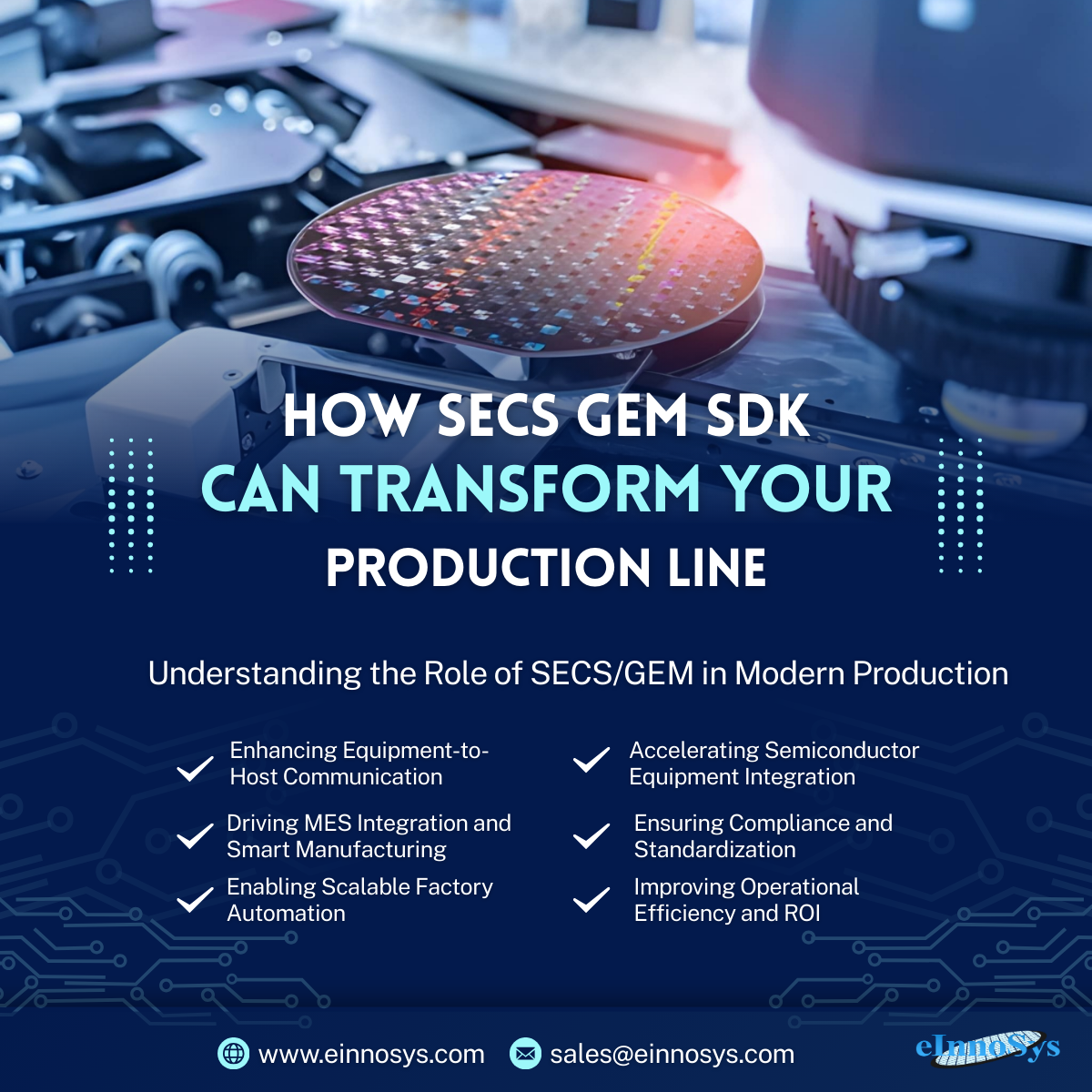
How SECS GEM SDK Can Transform Your Production Line

In today’s highly competitive semiconductor landscape, production efficiency, equipment connectivity, and real-time data visibility are no longer optional—they are essential. As fabs and OEMs move toward smarter and more connected environments, SECS/GEM for Semiconductor Manufacturing has become the backbone of reliable communication between equipment and host systems. At the center of this transformation lies the SECS/GEM SDK, a powerful toolkit that enables seamless equipment connectivity, automation, and compliance.

Whether you are modernizing legacy tools or deploying new manufacturing lines, investing in SECS GEM SDK Development can dramatically improve operational efficiency. From enabling structured Equipment to Host Communication to supporting full-scale Semiconductor Factory Automation, the right SDK simplifies SECS/GEM Integration, ensures protocol compliance, and accelerates time-to-market.

This blog explores how implementing a robust SECS/GEM Communication Software solution can transform your production line and future-proof your manufacturing strategy.

Understanding the Role of SECS/GEM in Modern Production

The SECS/GEM SDK is built on the globally recognized SEMI SECS/GEM Standard, which defines communication between semiconductor manufacturing equipment and host systems such as MES. It provides a structured framework for SECS GEM Protocol Implementation, enabling standardized data exchange and remote equipment control.

At its core, SECS/GEM Software Development enables manufacturers to implement consistent messaging using the SECS II and HSMS Protocol, ensuring reliable and secure communication. This structured communication enables real-time monitoring, recipe management, alarm reporting, and equipment state tracking.

By adopting SECS/GEM for Semiconductor Manufacturing, companies eliminate manual interventions and enable automated workflows. This strengthens Semiconductor Equipment Connectivity, reduces errors, and enhances productivity across the production floor.

Enhancing Equipment-to-Host Communication

One of the biggest advantages of deploying a SECS/GEM SDK is its ability to streamline Equipment to Host Communication. In traditional manufacturing setups, disparate systems often operate in silos. With proper SECS GEM Equipment Integration, production tools can communicate directly with MES, EAP, and other factory systems.

Through structured SECS/GEM Host Integration, fabs can:

  • Collect real-time production data
  • Automate recipe downloads and uploads
  • Monitor alarms and equipment states
  • Improve traceability and reporting

By leveraging advanced SECS GEM Automation Software, manufacturers can create a synchronized production environment where data flows seamlessly between tools and control systems. This strengthens Factory Automation Software strategies and drives measurable gains in OEE and yield.

Accelerating Semiconductor Equipment Integration

As fabs expand or upgrade production lines, integrating new equipment quickly becomes critical. SECS GEM SDK Development simplifies Semiconductor Equipment Integration by offering reusable libraries and prebuilt protocol stacks.

Instead of building communication layers from scratch, engineers can use a validated SECS/GEM Communication Software framework to accelerate deployment. This approach ensures compliance with the SEMI SECS/GEM Standard while reducing development time and risk.

For manufacturers dealing with older tools, a Legacy Equipment SECS/GEM Upgrade becomes essential. Modern SDK solutions allow legacy systems to be retrofitted with standardized communication capabilities, bringing them into modern Semiconductor Factory Automation environments without replacing expensive hardware.

This capability not only reduces capital expenditure but also ensures long-term scalability through structured SECS GEM Protocol Implementation.

Driving MES Integration and Smart Manufacturing

A production line truly transforms when equipment communication integrates seamlessly with Manufacturing Execution Systems. Through MES Integration with SECS/GEM, manufacturers gain centralized control over scheduling, tracking, and quality management.

The SECS/GEM SDK plays a pivotal role in enabling smooth SECS/GEM Integration between tools and MES platforms. It ensures consistent data exchange, supports event reporting, and facilitates recipe verification.

With strong SECS/GEM Host Integration, manufacturers can:

  • Enable automated lot start and stop
  • Implement advanced traceability
  • Reduce cycle time
  • Improve compliance reporting

Modern SECS GEM Automation Software also supports predictive analytics by feeding structured equipment data into AI and monitoring systems. This integration strengthens Semiconductor Equipment Connectivity while supporting Industry 4.0 initiatives.

Ensuring Compliance and Standardization

Compliance with industry standards is critical for global semiconductor operations. A professionally designed SECS/GEM Software Development solution ensures alignment with GEM Compliance Software requirements and global SEMI specifications.

Using a reliable SECS GEM SDK Development approach helps manufacturers:

  • Maintain consistent message structures
  • Validate equipment behavior
  • Ensure standardized alarm handling
  • Achieve smooth customer acceptance testing

With proper SECS GEM Equipment Integration, equipment suppliers can confidently deliver tools that meet customer expectations across international markets.

Standardized SECS GEM Protocol Implementation also simplifies audits and accelerates deployment in multi-fab environments, reducing operational complexity.

Enabling Scalable Factory Automation

As semiconductor manufacturing becomes more advanced, scalability is essential. A flexible SECS/GEM SDK provides the foundation for building robust Factory Automation Software ecosystems.

Through seamless SECS/GEM Integration, manufacturers can integrate:

The use of modern SECS/GEM Communication Software ensures consistent performance across different equipment vendors. This strengthens overall Semiconductor Factory Automation architecture and enables centralized monitoring and control.

Additionally, strong SECS/GEM Host Integration allows production lines to scale without major reconfiguration. Whether expanding a single tool cluster or deploying a new fabrication line, the SDK ensures standardized connectivity.

Improving Operational Efficiency and ROI

Implementing SECS/GEM for Semiconductor Manufacturing directly impacts operational performance. By enabling structured Semiconductor Equipment Connectivity, fabs gain real-time visibility into tool performance and production metrics.

With comprehensive SECS GEM Automation Software, manufacturers can:

  • Reduce downtime through proactive alerts
  • Improve yield through automated recipe validation
  • Minimize human error
  • Enhance data-driven decision-making

Furthermore, investing in SECS GEM SDK Development significantly reduces custom coding requirements. Pre-tested libraries streamline SECS GEM Protocol Implementation, lowering engineering costs and speeding up deployment.

By modernizing infrastructure through Legacy Equipment SECS/GEM Upgrade, manufacturers extend equipment lifespan while aligning with modern automation strategies.

Future-Proofing Your Production Line

The semiconductor industry continues to evolve rapidly, with increasing demand for high-mix, low-volume production and advanced nodes. A scalable SECS/GEM SDK ensures your production line remains adaptable to changing requirements.

Through robust SECS/GEM Software Development, manufacturers can integrate new tools, expand MES capabilities, and implement AI-driven monitoring systems without disrupting existing operations.

With standardized SECS GEM Equipment Integration, global fabs can maintain consistency across multiple sites. Combined with strong SECS/GEM Communication Software, this ensures seamless interoperability and reduced integration risk.

Ultimately, embracing SECS/GEM Integration is not just about connectivity—it’s about building a resilient, data-driven production ecosystem powered by reliable SECS GEM Automation Software.

Conclusion

Transforming a semiconductor production line requires more than upgrading equipment—it demands a strategic approach to connectivity, compliance, and automation. Implementing a powerful SECS/GEM SDK provides the technological foundation needed for scalable growth and operational excellence.

Through structured SECS GEM SDK Development, reliable SECS GEM Protocol Implementation, and seamless SECS/GEM Host Integration, manufacturers can achieve true Semiconductor Factory Automation. From enabling advanced MES Integration with SECS/GEM to modernizing systems through Legacy Equipment SECS/GEM Upgrade, the benefits are measurable and long-lasting.

By investing in robust SECS/GEM Software Development and advanced SECS GEM Automation Software, your production line becomes smarter, more efficient, and fully aligned with global SEMI SECS/GEM Standard requirements.

In a world where precision, speed, and data visibility define success, the right SECS/GEM SDK doesn’t just support your production line—it transforms it.
SECS/GEM vs GEM300: Standaarden die geavanceerde halfgeleiderfabs aandrijven

  • Wereldwijde impact: De wereldwijde investeringen in 300mm fab-apparatuur zullen naar verwachting in 2025 $107 miljard bereiken, wat een dringende behoefte aan gestandaardiseerde automatisering creëert.
  • Kernverschil: Terwijl SECS/GEM basiscommunicatie tussen apparatuur en host afhandelt (starten, stoppen, dataverzameling), voegt GEM300 complexe lagen toe voor volledig geautomatiseerde materiaalverwerking en jobbeheer.
  • Kritieke standaarden: GEM300 introduceert specifieke standaarden zoals E87 (Carrier Management) en E40/E94 (Process-/Control Jobs) om de hoogwaardige en zware ladingen van 300mm wafers te beheren.
  • De essentie: Voor moderne fabs is SECS/GEM het alfabet; GEM300 is de volledige taal die nodig is om de geautomatiseerde fabvloer te laten draaien.

Introductie

De cijfers liegen niet: de strijd om dominantie in de halfgeleiderindustrie is duur en wordt steeds zwaarder. Volgens een recent rapport van SEMI (2025) zullen de wereldwijde uitgaven aan 300mm fab-apparatuur in 2025 alleen al meer dan $107 miljard bedragen, met een verwachte totale investering van $374 miljard tussen 2026 en 2028. Naarmate fabs opschalen om chips voor AI- en edge-apparaten te produceren, krimpt de foutmarge tot vrijwel nul. Je kunt een faciliteit van een miljard dollar niet runnen met plakbriefjes en hoop.

Hier komt de communicatieruggengraat van de fabriek in beeld. Als je apparatuur integreert of een fabvloer beheert, kom je onvermijdelijk op het kruispunt van SECS/GEM en GEM300 terecht. Hoewel ze vaak in één adem worden genoemd, is het een beginnersfout om ze als synoniemen te behandelen—zoals het verwarren van een funderingssteen met het hele huis.
SECS/GEM is de legacy-basis die tools in staat stelde om met de hostcomputer te “praten”. Maar toen wafers van 200mm naar 300mm gingen, moest het gesprek een stuk slimmer worden. Samen vormen SECS/GEM en GEM300 het zenuwstelsel van moderne geautomatiseerde fabricage, maar begrijpen waar de één eindigt en de ander begint is de sleutel tot succesvolle geavanceerde fab-integratie.

De basis: wat is SECS/GEM?

Voordat we kunnen rennen, moeten we leren lopen. SECS/GEM is de grootvader van de industrie, maar laat je niet misleiden door de leeftijd—het verricht nog steeds het zware werk in fabs wereldwijd, van legacy 150mm-lijnen tot de meest geavanceerde 300mm-nodes.

SECS (Semiconductor Equipment Communication Standard) en GEM (Generic Model for Communications and Control of Manufacturing Equipment) vormen in essentie een protocolstack die is gedefinieerd door SEMI-standaarden E4, E5, E30 en E37.
Zie SECS/GEM als een directe telefoonlijn tussen de fab-host (de baas) en de apparatuur (de werknemer). De host kan opdrachten geven zoals “Start”, “Stop” of “Selecteer recept”, en de apparatuur kan terugrapporteren: “Ik heb de batch voltooid” of “Er is een alarm”.

Waarom het werkt

Het standaardiseerde de chaos. Vóór GEM (SEMI E30) had elke apparatuurleverancier zijn eigen eigenaardige manier om data te verzenden. De ene rapporteerde temperatuur in Celsius via binaire code, een andere stuurde ASCII-tekst in Fahrenheit. SECS/GEM dwong iedereen het eens te worden over het openen van verbindingen, het definiëren van variabelen en het afhandelen van alarmen.
SECS/GEM is echter ontworpen in een tijd waarin operators handmatig cassettes met wafers van tool naar tool droegen. De apparatuur hoefde niet te weten wat er aankwam alleen dat een recept moest worden uitgevoerd wanneer een operator op een knop drukte.

De 300mm-disruptie: waarom GEM300 ontstond

Toen kwam de overgang naar 300mm, en werd alles complexer.

Fysiek weegt een FOUP met vijfentwintig 300mm wafers ongeveer 9 kg. Je kunt operators niet vragen dat 12 uur per dag te tillen zonder arbeidsongevallen te verwachten. De industrie stapte daarom over op geautomatiseerde materiaalverwerkingssystemen (AMHS), zoals overhead hoist transports (OHT’s) die door de fab bewegen alsof ze uit een sciencefictionfilm komen.

Deze fysieke verschuiving creëerde een digitale kloof. De “domme” SECS/GEM-standaard was niet meer voldoende. De host moest nu niet alleen de tool coördineren, maar ook de robot die de wafers aanlevert. De tool moest weten:

  • “Is dit de juiste FOUP?”
  • “Welke slots bevatten wafers?”
  • “Hoe ontgrendel ik deze carrier?”

Hier komt GEM300 in beeld. Het is geen vervanging van SECS/GEM, maar een geavanceerde uitbreidingslaag die bovenop de SECS/GEM-basis ligt om volledig geautomatiseerde productie mogelijk te maken.

Technische vergelijking: SECS/GEM vs GEM300-standaarden

Wanneer engineers SECS/GEM met GEM300 vergelijken, gaat het meestal om de reikwijdte van de controle. SECS/GEM richt zich op de machinestatus (draait de tool of staat hij stil?). GEM300 richt zich op materiaal en logistiek (waar is mijn wafer en wie geeft toestemming om deze te verwerken?).

Carrier Management (SEMI E87)

In een standaard SECS/GEM-situatie (200mm) plaatst een operator een cassette en verwerkt de tool deze. Simpel.
In GEM300 bepaalt de E87-standaard exact hoe de apparatuur met de carrier (FOUP) omgaat. De tool moet met het AMHS communiceren om de Carrier ID te verifiëren voordat de klem vergrendelt. E87 beheert de loadport-statussen—of een poort klaar is om een FOUP te ontvangen, of een FOUP is gedockt, of deze geklemd en toegankelijk is.

Opmerking: Zonder E87 zou een OHT-robot een doos wafers van $50.000 op een al volle loadport plaatsen. Dat is een zeer dure “oeps”.

Process Jobs (E40) en Control Jobs (E94)

Dit is het brein van GEM300.
SECS/GEM gebruikt eenvoudige remote-commando’s: “Selecteer recept A. Start.”
GEM300 splits dit op in Process Jobs (E40) en Control Jobs (E94).

  • E40 (Process Job): Definieert wat er met de wafers moet gebeuren.
  • E94 (Control Job): Definieert de logistiek en middelen om het proces uit te voeren.

Dit maakt complexe scenario’s mogelijk, zoals overlappende jobs waarbij een tool al een tweede FOUP verwerkt terwijl de eerste nog afkoelt.

Substrate Tracking (E90)

Met SEMI E90 volgt de apparatuur individuele wafers terwijl ze door robots en proceskamers bewegen. De host weet exact dat “WaferID_12345” zich in “Chamber_B” bevindt. Deze granulariteit is cruciaal voor opbrengstbeheer.

De automatiseringsfactor: AMHS en interoperabiliteit

De magie van 300mm fab-automatisering is interoperabiliteit. In een 200mm fab kon een operator vaak problemen omzeilen. In een GEM300 fab is die menselijke buffer verdwenen. Als een tool niet exact de E87-statusmodellen volgt, wordt hij door het AMHS overgeslagen en stopt de productie.

Waarom GEM300 cruciaal is voor geavanceerde fab-integratie

Het draait om twee woorden: opbrengst en doorvoer. GEM300 maakt vooraf geplande jobs en realtime wafertracking mogelijk, waardoor stilstand en afval drastisch worden verminderd.

Implementatie-uitdagingen

  • Strikte statusmodellen: Afwijkingen leiden tot alarms en lijnstilstand.
  • Complex testen: GEM300 vereist geavanceerde simulators.
  • Legacy-problemen: Oude software patchen leidt vaak tot instabiliteit.

Conclusie

SECS/GEM levert de woordenschat, maar GEM300 levert de grammatica voor volledig geautomatiseerde fabcommunicatie. Samen vormen ze de sleutel tot efficiënte, lights-out productie.

Contact Us Today

Krijg stapsgewijze hulp bij het kiezen tussen SECS/GEM en GEM300


晶圓廠自動化標準:SECS/GEM 與 EINNOSYS 解決方案

概括

  • 核心標準: SEMI E30(GEM)與 E5(SECS-II)仍是現代晶圓製造的基礎骨幹。
  • 市場成長: 隨著晶圓廠邁向工業 4.0,半導體自動化軟體市場持續擴張。
  • 營運效率: 導入標準化通訊協議可將設備整合時間最多縮短 40%。
  • EINNOSYS 優勢: 客製化 SECS/GEM 軟體解決方案,彌合舊式硬體與現代 Fab Host 系統之間的落差。
  • 未來佈局: 對高產量 300mm 晶圓廠而言,轉向 GEM300 與 EDA(Interface A)至關重要。

介紹

全球半導體製造設備市場預計將於 2029 年達到約 1,430 億美元,2024 年起的年複合成長率(CAGR)約為 8%(Fortune Business Insights,2024)。如此龐大的投資突顯一個關鍵現實:隨著晶片幾何尺寸持續縮小,人為錯誤的容忍空間幾乎消失。為了維持良率,晶圓廠必須採用嚴謹的晶圓廠自動化標準,確保所有設備都使用相同的數位語言進行溝通。

在矽產業的早期,設備整合猶如混亂的「西部荒野」,充斥著專有纜線與客製化驅動程式。如今,產業仰賴一套成熟的通訊協議架構,管理從機械手臂到化學氣相沉積腔體的一切。若缺乏這些標準化通道,現代大型晶圓廠將在數分鐘內陷入停擺。

自動化不再只是高階處理器製造的奢侈選項,而是任何追求獲利的晶圓廠的基本要求。無論您管理的是 200mm 類比晶圓廠,或是最先進的 300mm 邏輯製造設施,理解硬體與製造執行系統(MES)之間的互動,都是邁向卓越營運的第一步。

晶圓設備自動化標準架構

每一座智慧晶圓廠的核心,都是 SEMI(半導體設備與材料國際協會)所制定的標準。這些文件定義了設備如何回報狀態、接收配方以及通報警報。對工程師而言,這些標準就像「羅塞塔石碑」,讓日本的微影設備、美國的量測系統,以及歐洲的 MES 能夠無縫協同運作。

SECS/GEM 溝通:基金會

在此生態系中最關鍵的組合便是 SECS/GEM。SECS(半導體設備通訊標準)定義訊息結構,而 GEM(製造設備通訊與控制通用模型)則規範如何利用這些結構來管理設備行為。

可以將 SECS 視為語言的文法與詞彙,而 GEM 則是告訴你何時該說話、該談論什麼主題的禮儀手冊。遵循 SECS/GEM 通訊協議,製造商即可確保任何相容的 Host 系統都能控制任何相容的設備,而無需為每台新機器撰寫客製化程式碼。

SECS-I 和 SECS-II 的作用

SECS-I(E4)傳統上負責實體通訊層,通常使用 RS-232 串列連線。在現代架構中,這多半已被 HSMS(高速 SECS 訊息服務)取代,透過 TCP/IP 在乙太網路上實現更快的資料傳輸。SECS-II(E5)則位於更高層,定義實際的訊息內容,例如「啟動製程」或「回傳溫度資料」。

晶圓廠設備整合的挑戰

將新設備整合至既有產線,幾乎從來不是「即插即用」那麼簡單。即使已有晶圓廠設備整合標準,不同 OEM(原始設備製造商)對 GEM 的實作差異,仍常導致整合困難。

處理舊硬體

許多舊型設備缺乏對現代通訊協議的原生支援。在這種情況下,工程師通常會使用「黑盒子」轉換器或外部控制器,將舊式介面包裝成符合 GEM 的形式。如此一來,晶圓廠便能在不汰換仍具機械壽命的高價設備下,維持製造自動化。

數據過載和頻寬

隨著感測器數量增加,單一設備所產生的資料量可能極為龐大。雖然 SECS/GEM 本身相當高效,但其原始設計並非用於支援現代大數據分析所需的高頻率資料流。這促成了 Interface A(EDA)的發展,與 GEM 並行運作,提供專用資料通道以支援製程優化。

EINNOSYS 智慧製造解決方案

EINNOSYS 已成為因應半導體自動化標準複雜性的關鍵合作夥伴。透過提供軟體產品與整合服務,他們協助晶圓廠將「符合標準」轉化為「可量產」。

實現符合 GEM 標準的設備

對 OEM 而言,使設備達到 GEM 相容是一項重大挑戰。EINNOSYS 提供的 EInnoGEM 軟體 SDK,讓開發者能以最少的程式碼為設備加入 GEM 功能,加速上市時程,並符合全球一線晶圓廠的嚴格要求。

客製化工廠主機通信

在晶圓廠端,最大的挑戰通常是 Fab Host 通訊。EINNOSYS 提供 Host 端解決方案,使 MES 能與多樣化的設備群進行通訊。此集中式控制對於批次追蹤、配方管理,以及實施「違規即停機」邏輯以防止報廢至關重要。

自動化對產量和投資報酬率的影響

根據 McKinsey & Company(2023)報告,成功導入進階分析與自動化的半導體公司,其製造吞吐量可提升 10% 至 15%。這不僅是讓晶圓移動更快,而是降低錯誤發生率。

半導體自動化的未來趨勢

產業正邁向「無人化晶圓廠」,將人員在產線上的存在降至最低。既然人類本質上是會產生污染、偶爾還會掉東西的來源,為何還要留在無塵室?標準化的晶圓廠設備軟體正是實現此轉型的關鍵。

過渡至 GEM300

對 300mm 晶圓廠而言,基本 GEM 已不足夠,必須導入 GEM300 標準,包括 E39(物件服務)、E40(製程管理)與 E94(控制工作管理)。這些標準負責管理 AMHS,確保正確的 FOUP 在正確的時間抵達正確的 Load Port。

人工智慧和預測性維護

透過晶圓廠自動化標準所提供的高品質資料,AI 模型已能預測真空幫浦何時可能失效,或電漿蝕刻製程是否偏離規格。這讓維護模式從「預防性」轉向「預測性」,大幅減少非計畫性停機。

結論

現代半導體產業的核心不僅是矽,而是流經其中的資料。導入完善的晶圓廠自動化標準,確保資料準確、可用且可存取。EINNOSYS 在此生態系中扮演關鍵角色,提供必要的工具與專業,將零散硬體轉化為高良率的整合生產引擎。展望未來,對 SECS/GEM 及其後續標準的掌握,將持續決定晶圓廠的競爭力。

Contact Us Today

獲得關於 Einnosys 晶圓廠自動化解決方案的專家指導


SECS/GEMとは?装置通信プロのための完全ガイド

要約

  • SECS/GEMは、製造装置と工場のホストシステム間の「ユニバーサルな握手(ハンドシェイク)」として機能します。
  • データ交換を標準化し、リアルタイム監視、レシピ管理、および装置のリモート制御を可能にします。
  • このプロトコルスイートには、メッセージ構造のためのSECS-IIと、高速イーサネット転送のためのHSMSが含まれます。
  • 半導体製造におけるSECS GEMは、統合の複雑さを軽減し、高コストなダウンタイムを防止します。
  • 現代の実装では、サイバーセキュリティと堅牢なデータ収集戦略への注力が不可欠です。
  • 適切なインターフェース設計は、インダストリー4.0の取り組みと、世界のチップ生産における予知保全を支えています。

はじめに

フォーチュン ビジネス インサイト(2024年)のレポートによると、世界の半導体市場は2024年に6,810億5,000万ドルに達し、2025年には7,552億8,000万ドルにまで上昇すると予測されています。このような極めてリスクの高い環境では、装置のダウンタイムが1秒発生するごとに、膨大な経済的損失が生じます。Siemens(2024年)の推定では、大規模な製造プラントは計画外の停止により年間平均2億5,300万ドルを失っており、特殊な設備では装置の故障により1時間あたり125,000ドルを超えるコストが発生する場合もあります。

これらのリスクを軽減するために、業界は安定した高性能な通信フレームワークに依存しています。ここで重要になるのがSECS/GEMです。これは、製造実行システム(MES)などの工場ホストシステムが、多様な製造装置と対話するための重要なリンクとして機能します。統一された言語がなければ、現代のファブ(半導体工場)は同期された生産拠点ではなく、沈黙した機械の無秩序な集まりになってしまうでしょう。

本記事では、SECS GEM通信のメカニズム、規格の進化、そして最新およびレガシーな環境で信頼性の高いSECS/GEMインターフェースを実装するための実践的な戦略について解説します。300mmのメガファブを管理している方も、ニッチな組立ラインを担当している方も、運用効率を極める上でこれらのプロトコルを理解することは不可欠です。

SECS GEMとは何か?

この用語は、SEMI(半導体製造装置・材料インターナショナル)が策定した、密接に関連する2つの規格を組み合わせた略称です。本質的には、装置がどのように振る舞い、どのようにデータを転送すべきかを定義する通信インターフェースを指します。これらのプロトコルは、公式のSEMI通信規格に基づいて構築されており、現代のあらゆる製造施設の「デジタル神経系」の技術的基盤となっています。

GEM (SEMI E30) – 振る舞いモデル

GEM(汎用機器モデル)は、SECS-IIの上位に位置します。これは装置の状態遷移(ステートマシン)と期待される振る舞いを定義します。SECS-IIが単語の辞書であるなら、GEMはエチケットのマナー本と言えるでしょう。装置がどのようにステータスを報告し、アラームを処理し、レシピを管理すべきかを概説しています。SECS GEM規格に従うことで、メーカーは自社の装置が工場の自動化ソフトウェアと「プラグアンドプレイ」で互換性を持つことを保証できます。

SECS GEM通信の進化

通信プロトコルは、それが支えるハードウェアと共に進化しなければなりません。初期のチップ製造では装置は比較的単純で、データ要件も控えめでした。しかし、トランジスタの微細化が進み、ウェーハ径が拡大するにつれて、データ量は爆発的に増加しました。

シリアル(SECS-I)から高速(HSMS)へ

初期の転送レイヤーであるSECS-I(SEMI E4)は、RS-232シリアル接続に依存していました。機能的ではありましたが、低速で通信距離にも制限がありました。ファブが完全自動化へと向かう中で、業界はHSMS(高速SECSメッセージサービス、SEMI E37)へと移行しました。HSMSはTCP/IPイーサネットを利用し、リアルタイムのトレースデータや高頻度のセンサー監視に必要な帯域幅を提供します。

現在のほとんどの施設ではHSMSが独占的に使用されていますが、レガシーな装置では依然としてシリアル・イーサネット変換アダプタが必要な場合があります。この移行により、より高速なハンドシェイクと堅牢なエラーリカバリが可能になり、数百台の装置を同時に管理する上で極めて重要になっています。

GEM 300とその先

300mmウェーハの処理では、さらに複雑さが増します。SEMIは「GEM 300」として知られる一連の規格(E39、E40、E87、E94など)を導入しました。これらは、自動搬送、キャリア管理、およびジョブスケジューリングのための特定の機能を追加するものです。これらの拡張により、SECS/GEMインターフェースは、世界最先端の製造施設における特殊なニーズにも対応できるようになっています。

なぜ半導体製造におけるSECS GEMが「王道」であり続けるのか

MQTTやREST APIのような現代的なプロトコルが、いずれこれらのレガシー規格に取って代わるのではないかと疑問に思うかもしれません。しかし、それらの技術は一般的なIoTアプリケーションには優れていますが、半導体の世界が求める決定論的な動作やプロセス特有のモデリングを提供することはできません。

データ収集とトレーサビリティ

データは歩留まり向上のための生命線です。SECS GEMプロトコルを通じて、ホストシステムは「収集イベント(コレクションイベント)」をサブスクライブできます。これらは、ウェーハの完了やガス流量の偏差など、装置にデータレポートの送信を促す特定のトリガーです。トレースデータ収集により、ホストはチャンバーの圧力やランプの電力などの変数を、10Hz以上の高頻度でサンプリングするよう要求できます。

この粒度の細かさにより、統計的工程管理(SPC)や欠陥検出・分類(FDC)が可能になります。プロセスエンジニアが歩留まりの低下に気づいた際、ログを使用して故障の瞬間に各センサーが何をしていたかを正確に把握できるのです。

リモート制御と安全性

自動化されたファブでは、オペレーターがすべての装置の開始ボタンを押すわけにはいきません。SECS/GEMインターフェースを使用すると、ホストの開始、停止、一時停止、中止などのリモートコマンドを送信できます。ただし、安全性が最優先です。GEMは厳格な状態モデルを定義しており、安全インターロックが開いている場合などは装置がコマンドを拒否するように設計されています。

修辞的な問い:なぜ、数千億円規模の施設が、標準化されたプロトコルで安全と精度を確保できるのに、手動操作によるミスのリスクを冒す必要があるのでしょうか?

実装に向けた実践的なステップ

レガシー装置を改造する場合でも、新規装置を構築する場合でも、機能的なインターフェースへの道のりは予測可能な順序をたどります。

  • スコープと要件の定義: どのGEM機能が必須かを特定します。レシピ管理やリモート制御が必要かどうかを判断します。
  • 機能テンプレートの作成: サポートされているすべてのメッセージと変数をリスト化した「GEMマニュアル」を作成します。これがMESチームの参照資料となります。
  • 接続テスト: HSMSリンクを確立します。ファイアウォールが指定されたポート(通常は5000または8000)の通信を許可していることを確認します。
  • ロジックの統合: ドライバーを装置のPLCまたはコントローラーに接続します。センサーが異常を検知した際、即座に正しいアラームメッセージを発信できるようにします。
  • シミュレーションと検証: 本番のウェーハでテストしないでください。シミュレーターを使用してホストの動作を模倣し、装置があらゆるコマンドに正しく応答することを確認します。

よくある落とし穴とサイバーセキュリティ

経験豊富なエンジニアであっても、導入時に障害に直面することがあります。よくある問題の一つは、装置が短時間に大量の情報を送信しすぎてネットワークを圧迫してしまう「データストーム」です。

ネットワークトラフィックの管理

ボトルネックを避けるために、エンジニアは収集イベントのフィルターを設定する必要があります。すべての変数を毎秒送信するのではなく、状態変化が発生したときにのみ重要なパラメータを送信するようにします。これによりネットワークを軽量に保ち、重要なアラームが遅延なくホストに届くようになります。

サイバーセキュリティのギャップ

SECS GEM規格の顕著な特徴は、ネイティブな暗号化や認証機能が欠けていることです。サイバー攻撃が想定されていなかった時代に設計されたため、信頼されたネットワークであることを前提としています。

TXOne Networks(2024年)によると、半導体セクターはランサムウェアの標的として価値が高まっています。インターフェースを保護するために、施設は「多層防御」を実装しなければなりません。これには、ファブネットワークの隔離、産業用ファイアウォールの使用、厳格なアクセス制御が含まれます。

ちょっとした冗談を一つ:もし装置の唯一のセキュリティが「筐体の物理的な南京錠」だけで、暗号化されていないデータを流しているとしたら、それは泥棒に玄関のドアを開け放しているのと同じようなものです。

結論

SECS/GEMスイートが工場自動化の根幹であり続けるのには理由があります。それは、グローバルメーカーが厳格な品質基準を維持しながら生産を拡大することを可能にする、高度な標準化を提供しているからです。ハードウェアとソフトウェアのギャップを埋めることで、これらのプロトコルは個々の機械をインテリジェントなシステムへと変貌させます。
業界が年間売上高1兆ドルに向かって突き進む中で、装置データを収集、分析、そして活用する能力が、グローバルなチップ競争における勝者を決定づけるでしょう。施設の近代化を検討している場合でも、自社装置のファブ対応を確実にしたい場合でも、堅牢なSECS/GEM戦略を立てることが、効率的な未来への第一歩となります。

Contact Us Today

SECS/GEM統合を専門家と一緒に進める

實施 SECS/GEM 和 GEM300: 半導體整合指南

概括

目的:本指南深入探討現代半導體製造中不可或缺的 SECS/GEM 與 GEM300 標準。
主要驅動因素:強調向全自動「無人工廠(Lights Out)」轉型的趨勢,以及標準化通訊的必要性。
技術範圍:涵蓋 SECS/GEM 介面、硬體需求,以及從 200mm 到 300mm 自動化的過渡。
實施策略:為 OEM 與晶圓廠提供部署 eSECS GEM 解決方案的實用建議,以及克服常見整合障礙的方法。
成果:提供一條實現設備與主機無縫連接並提升良率的路線圖。

介紹

全球半導體市場預計在 2030 年達到 1 兆美元,根據 McKinsey & Company(2024)指出,產業必須快速擴大產能以滿足 AI 與汽車市場需求。隨著晶圓廠逼近摩爾定律的極限,設備通訊中的任何誤差空間都已消失。效率不再是目標,而是生存條件。

為了讓這些複雜環境順利運作,產業依賴 SECS/GEM(SEMI 設備通訊標準/通用設備模型)。此框架是晶圓廠的共同語言,使主機系統能與各種設備溝通,從微影設備到量測站皆然。沒有這種標準化,現代智慧晶圓廠將變成混亂的巴別塔。

實施強健的 SECS/GEM 通訊策略,是連接人工操作與「無人工廠」自動化的關鍵。隨著產業進入 SEMI GEM300 標準時代,理解這些協議的細節已成為任何負責設備整合或數位轉型工程師的必修課。

了解 SECS/GEM 框架

SECS/GEM 標準基於 SEMI(國際半導體設備與材料協會)制定的多層協議。在核心層,它定義了資料如何在工廠中封裝、傳送和解析。

協定堆疊:SECS-I、HSMS 和 SECS-II

早期設備使用 SECS-I(E4),依賴 RS-232 序列通訊。然而,現代高速需求已推動產業轉向 HSMS(高速 SECS 訊息服務 – E37)。HSMS 使用 TCP/IP,能在標準乙太網路上提供更快的資料吞吐量和更可靠的連線。

在傳輸層之上是 SECS-II(E5),定義特定訊息結構。它提供設備與主機交換訊息的字典。不論是啟動流程的指令或硬體警報通知,SECS-II 都確保雙方正確理解其意圖。

為什麼 GEM 對設備製造商很重要

SECS 提供字母與詞彙,而 GEM(E30)提供文法。它定義了設備行為的狀態機。OEM 遵循 GEM 模型可確保其設備在亞利桑那或台灣的晶圓廠中都能以可預測的方式運作。

300mm 晶圓廠向 GEM300 的演進

隨著產業從 200mm 過渡到 300mm 晶圓,物料處理的複雜度大幅提升。這促使需要一組更先進的標準,即 GEM300。

GEM300 套件的關鍵組件

GEM300 並非單一標準,而是一套用於自動化晶圓全流程的協議。

  • E40(製程工作管理):管理晶圓加工的「做什麼」與「如何做」。
  • E94(控制工作管理):協調事件順序。
  • E87(載具管理):管理 FOUP(前開式統一匣)放置與移除。
  • E90(基板追蹤):確保每片晶圓在工具中移動過程的完整追蹤。

自動化和減少錯誤

根據 SEMI(2023)報告,300mm 晶圓廠的自動化可將人工錯誤降低多達 40%。在 GEM300 環境中,SECS GEM 的實施讓主機可使用天車系統(OHT)和自動導引車(AGV)進行物料搬運,無須人工介入。此同步程度使半導體設備自動化成為業界標準。

SECS/GEM實施策略

從零開始開發 SECS GEM 介面是一項艱巨任務,可能需要數月工程時間。大多數組織選擇使用專業 SDK 或與整合專家合作以加速上市時間。

客製化開發和中間件之間的選擇

許多人面臨的問題是:開發還是購買?自訂開發提供完全掌控,但需要深入理解 SEMI 標準。相對地,使用 eSECS GEM 軟體解決方案可透過內建狀態機與訊息處理邏輯簡化流程。

測試和驗證

整合很少是「插上即可」。需進行大量測試以確保設備能承受「負面測試」,例如主機傳送非預期指令或網路失效。在 5 萬美元晶圓批量加工中斷的通訊連線,是任何工程師都不願向主管解釋的夢魘。

克服常見的整合挑戰

即使有最佳工具,SECS/GEM 專案仍常遭遇瓶頸。其中一個常見問題是「協議偏移」,即對標準的細微解讀差異導致通訊逾時或資料毀損。

管理大量數據

隨著先進製程控制(APC)與大數據分析的興起,從設備擷取的資料量大幅增加。工程師必須謹慎設計 SECS GEM 實施方式,優先處理關鍵警報,而非一般遙測資料,以避免使 HSMS 連線飽和。

改造舊設備

如果一台功能完好的設備缺乏現代 SECS/GEM 介面該怎麼辦?改造專家通常使用「黑盒子」轉換器或外部 PLC-to-SECS 閘道器。這讓舊設備能加入現代數位架構,而無需全面更新控制系統。

連結的未來:超越傳統創業板

雖然 SECS/GEM 仍是核心技術,但產業正探索 EDA(設備資料擷取),又稱 Interface A。這是條專為資料收集而設計的高頻寬連線,使 SECS/GEM 負責指令與控制。

數位孿生和預測性維護

透過結合 SECS/GEM 即時資料與機器學習模型,晶圓廠正向預測性維護邁進。Gartner(2024)指出,AI 驅動的維護可降低高科技製造的營運成本 20%。若設備能在冒煙前告訴主機它即將故障,晶圓廠便能節省數百萬美元。

數據洞察:標準化的影響

下表顯示從手動或專有介面轉向完全符合 SEMI GEM300 環境後的營運改善。

透過 GEM300 標準提高效率

指標 手動/舊式介面 完整 GEM300 整合 改善幅度
資料準確度 85–90% >99.9%
物料處理錯誤率 約 3.5% <0.1% 35 倍減少
設備整合時間 4–6 個月 4–8 週 3 倍加速
可追溯性水準 以批次為主 以單片晶圓為主 高精度

結論

實施 SECS/GEM 與 GEM300 對半導體製造商而言已非奢侈,而是現代智慧晶圓廠的基礎。從 HSMS 連線的初次握手,到 FOUP 管理的複雜協作,這些標準確保設備與主機系統完美同步。透過採用 eSECS 等現代工具來推動 SECS/GEM 整合,OEM 與晶圓廠工程師可大幅降低停機時間、提升良率,並使營運面對全球市場日益增加的需求時更具韌性。


Contact Us Today

取得逐步協助以實施 SECS/GEM 與 GEM300 整合


SECS/GEM 프로토콜 가이드: Fab의 장비 통신 단순화

요약

  • SECS/GEM 프로토콜은 반도체 및 전자 제조 장비를 위한 범용 통신 표준입니다.
  • 공장 호스트/제조 실행 시스템(MES)이 현장의 장비(툴)와 통신할 수 있도록 구조화된 방식을 정의합니다.
  • 이 표준은 장비 간 상호 운용성을 보장하며, 레시피 관리, 데이터 수집(EDA), 알람 모니터링과 같은 핵심 자동화 작업을 지원합니다.
  • 스트림(Stream), 함수(Function), 변수(Variable)와 같은 핵심 개념을 이해하는 것은 자동화 엔지니어와 장비 제조사(OEM)에 필수적입니다.
  • SECS/GEM 도입은 완전한 디지털 기반의 스마트 팩토리를 구현하는 데 매우 중요하며, 수율, 처리량, 운영 효율성을 크게 향상시킬 수 있습니다.
  • 이 프로토콜은 SEMI(국제 반도체 장비 및 재료 협회)에 의해 관리되고 유지됩니다.

소개

정밀성과 복잡성이 극도로 높은 반도체 제조에서는 공장 바닥의 모든 장비를 완벽하게 제어하는 것이 필수적입니다. SEMI(2024)에 따르면 전 세계 반도체 제조 장비 시장 규모는 2030년까지 1450억 달러를 넘어설 것으로 예상됩니다. 이는 첨단 장비에 대한 막대한 투자를 의미하지만, 장비의 진정한 가치는 단순한 처리 능력이 아니라 공장의 중앙 시스템(MES/Host)과 원활하게 통신하는 능력에 있습니다.

이 지점에서 SECS/GEM 프로토콜이 등장합니다.
SECS/GEM 프로토콜은 팹에서 호스트 시스템이 장비와 통신하고 제어하는 방식을 정의하는 가장 광범위하게 사용되는 표준입니다. 이를 통해 호스트 시스템은 CVD 장비, 노광기, 계측 장비 등 어떤 SECS/GEM 준수 장비와도 동일하고 예측 가능한 언어로 통신할 수 있습니다. 이 표준이 없다면 자동화는 장비마다 커스텀 코드를 작성해야 하는 혼란스러운 환경이 되었을 것입니다.

반도체 자동화, 장비 통합, 공장 디지털화에 참여하는 모든 사람에게 SECS/GEM의 이해는 필수입니다. 이 가이드는 프로토콜의 기본 개념과 구조를 명확하게 설명합니다.

SECS/GEM 디코딩: 자동화를 위한 표준화된 언어

SECS/GEM은 단일 기술이 아니라 SEMI가 개발하고 유지하는 여러 통신 표준의 집합입니다. 이 이름은 다음 두 가지 구성 요소에서 시작됩니다: SECS와 GEM.

SECS: 커뮤니케이션 파이프라인

SECS는 반도체 장비 통신 표준(Semiconductor Equipment Communication Standards)을 의미합니다. 이는 장비와 호스트 간 메시지가 전송되는 물리적/메시지 기반 계층을 정의합니다.

  • SECS-I(E4): RS-232 기반 초기 물리 연결
  • SECS-II(E5): 실제 메시지 구조와 내용을 정의
  • HSMS(E37): 현대 팹에서 사용하는 고속 TCP/IP 이더넷 기반 연결 방식으로, 현재 표준

오늘날 대부분의 팹에서는 HSMS/SECS-II 스택을 사용합니다

GEM: 필수 행동 모델

GEM(Generic Equipment Model)은 메시지 전송 방식이 아닌 장비가 갖춰야 할 필수 동작 규칙(E30) 을 정의합니다.
GEM의 핵심은 예측 가능성입니다.

장비가 SECS/GEM을 준수하면 호스트는 레시피 요청·상태 조회·데이터 수집 방식을 모두 표준화된 형태로 수행할 수 있습니다.

필수 GEM 기능

모든 GEM 준수 장비가 반드시 구현해야 하는 기능:

  • Status Data Collection(SDC): 변수/트레이스/이벤트 기반 데이터 수집
  • Alarm Management: 장비 알람 보고
  • Recipe Management: 레시피 업로드/다운로드/검증
  • Remote Control: 온라인/오프라인, 시작/정지 제어
  • Equipment Status: 장비 상태 조회 가능

커뮤니케이션 툴킷: 스트림, 함수 및 변수

SECS/GEM 메시지는 Stream-Function(S/F) 구조로 구성됩니다.

스트림 및 함수 이해

  • Stream (S): 메시지 카테고리
  • Function (F): 특정 메시지의 종류
  • 기본 구조는 항상 요청(홀수 번호) → 응답(짝수 번호)

사용 중인 키 스트림/함수 쌍


Stream / Function Direction Description Purpose
S1F1 Host → Equipment Are You There 연결 상태 확인 (Connection status check)
S1F2 Equipment → Host On-line Data S1F1 응답 (Response to S1F1)
S6F11 Equipment → Host Event Report Send 이벤트 발생 보고 (Report event occurrences)
S7F1 Host → Equipment Process Program Load Request 레시피 로드 요청 (Request to load a recipe/process program)
S5F1 Host → Equipment Enable Alarm Send 특정 알람 활성화 (Enable specific alarms)


장비 변수, 상태 변수 및 데이터 ID

  • ECs (Equipment Constants): 장비 설정 변수
  • SVs (Status Variables): 실시간 상태
  • DVs (Data Variables): 프로세스 데이터
  • CEIDs (Collection Event IDs): 장비 이벤트 ID

SECS/GEM에서 호스트는 이러한 변수를 구독하고 자동으로 수신할 수 있습니다.

SECS/GEM 프로토콜 구현: 호스트 및 장비 역할

장비 측면(서버 역할)

장비(툴)는 HSMS 서버 역할을 하며 다음을 수행해야 합니다.

  • GEM(E30) 필수 기능 구현
  • 내부 동작을 SECS/GEM 메시지로 변환하는 통신 드라이버
  • SV/DV/CEID/EC 목록을 포함한 GEM Interface Guide 제공

호스트 측(클라이언트 역할)

MES 또는 Cell Controller가 HSMS 클라이언트 역할을 합니다.

주요 역할:

  • S1F13/S1F14: 장비 온라인 전환
  • S7F1/S7F2: 레시피 전송
  •  S3F19/S3F20: Lot 시작 명령
  • S6F3/S6F4: 이벤트 구독
  • 데이터 수집/제조 흐름 제어

이 구조 덕분에 팹은 수백 대의 장비를 표준화된 방식으로 운영할 수 있습니다.

기본 이상: 고급 SECS/GEM 기능

장비 데이터 수집(EDA 또는 인터페이스 A, E120/E125/E134)

EDA는 SECS/GEM의 데이터를 보완하는 고속 데이터 수집 표준입니다.

  • SOAP/HTTPS 기반 별도 통신 채널
  • SECS/GEM의 제어 메시지와 분리
  • 고주파수(밀리초 단위) 데이터 수집 가능
  • 머신러닝 및 고급 분석에 필수

인증 및 규정 준수의 중요성

장비 제조사는 아래 SEMI 표준에 맞춰야 합니다.

  • E30 (GEM)
  • E87 (Carrier Management)
  • E40 (Processing Management)

팹에서는 이를 기반으로 장비의 적합성을 검증합니다.

결론

SECS/GEM은 단순한 통신 규격이 아니라 반도체 제조 자동화의 보편적 기반입니다.
표준화된 메시징·행동 규칙을 통해 장비 통합을 단순화하고, 자동화 및 데이터 기반 운영의 토대를 제공합니다.
반도체 자동화 엔지니어와 OEM에게 SECS/GEM의 숙련도는 필수 역량이며, 스마트 팩토리 구축의 첫 단계입니다.

Contact Us Today

장비 통신을 단순화하기 위한 전문가 가이드 받기


FAB自动化制造自动化

摘要

  • SECS/GEM 是半導體設備與主機系統通訊的核心標準,確保資料一致性與可追溯性。

  • GEM 消除客製化整合問題,讓設備能以統一方式上報事件、警報、資料與配方。

  • 透過標準化的設備狀態模型、事件與資料收集機制,大幅縮短設備導入時間。

  • GEM 的功能涵蓋遠端控制、警報管理、配方下載/上傳、資料收集與設備監控。

  • SECS/GEM 是實現工廠自動化、提升良率、加速量產與支援 MES/APS/調度系統的基礎。

簡介

根據麥肯錫 2023 年報告,全球半導體市場預計在 2030 年成為兆美元產業。
但隨著製程節點縮小、晶圓成本飆升,容錯空間幾乎消失,人力已無法支撐高度精密的需求。
這正是 FAB 自動化的價值所在。
現代晶圓廠需要協調數千個製程步驟、處理 TB 級資料,並讓價值數十億美元的工廠穩定運作。

硬體主軸:無人搬運晶圓

最明顯的自動化系統是 AMHS。走進 300mm 晶圓廠,你會看到天花板上的高速軌道,而不是人類搬運 FOUP。

OHT 天車運輸系統

OHT 就像晶圓的電動計程車,在天花板軌道上移動,精準將晶圓批次送達指定工具。
它必須高速、精準並維持超低震動,才能保護價值數萬美元的晶圓。

EFEM 與 Load Port

OHT 將 FOUP 送到機台後,由 EFEM 接手。
EFEM 提供比無塵室更潔淨的局部環境,並透過機械手臂將晶圓送入製程腔體。
這徹底排除人為污染風險,使晶圓全程保持在最佳環境。

 軟體大腦:連接整個製程

晶圓廠硬體需要軟體指揮。這套軟體架構就像軍事指揮鏈,一層接一層。

MES 製造執行系統

MES 是工廠的「指揮官」。
它負責:
• 工單管理
• 庫存追蹤
• 排程與派工
• 決定哪一批晶圓要進入哪一台工具

EAP 設備自動化控制

EAP 是 MES 的「翻譯官」。
它將 MES 指令轉為機台能理解的語言,並處理:
• 配方驗證
• 執行中資料收集
• 警報處理
沒有 EAP,機台變成「笨機器」,需要操作員手動輸入配方,非常容易造成報廢。

How Fab Automation Transforms Production

SECS/GEM 設備通訊標準

SECS/GEM 是晶圓廠通訊的「USB 標準」。
它讓不同廠牌機台以相同方式通訊,是當今最普及的控制標準。
雖然 EDA(Interface A)已用於高速資料收集,但 SECS/GEM 仍是主要控制協定。

工業 4.0:當資料變成行動

現代 FAB 自動化已不只是控制,而是預測並優化。

預測性維護 (PdM)
AI 可分析震動、聲音與溫度等感測資料,提前預測設備故障。
不再依照固定時程更換零件,而是根據實際狀況維修,避免突發停機與報廢。

數位孿生

工程師可建立晶圓廠的虛擬複製體,模擬物料流動、工具交互與 OHT 交通。
例如:新增機台是否會造成 OHT 壅塞?
只需在數位孿生中模擬即可得知。

自動化晶圓廠的挑戰

老舊設備整合問題

晶圓廠設備價格昂貴,許多工具使用 10–20 年以上。
這些老機台缺乏感測器與運算能力,需藉助 IoT Gateway 或改裝控制器來與系統整合。

整合成本

全面自動化需要高額初期投資,但帶來更高良率、低人力成本與更穩定的產能。

人類角色轉變

自動化不是取代人類,而是讓人類從「操作者」轉為:
• 維護專家
• 數據分析師
• 製程優化工程師

結論

FAB 自動化是推動半導體邁向兆美元產業的核心力量。
整合 OHT、EFEM 等硬體與 MES/EAP 等軟體,能讓工廠達到未來製程所需的精密度。
無論是改造舊機台或規劃新

Contact Us Today

取得逐步協助,實現您的晶圓廠製造自動化

SECS/GEM Integration Guide: Compliance Testing & Implementation

Connectivity is power in semiconductor and electronics manufacturing. Each machine, process, and data item is part of the bigger picture of attaining a seamless automation process, as well as intelligent decision making. The SECS/GEM integration is one of the most significant frameworks that helps to make this transformation and it is a standardized communication protocol that allows closing the gap between equipment and factory automation systems.

You may be updating old systems or establishing a new production facility, but you need to understand how to be able to test compliance with the SECS/GEM and deploy SECS/GEM software and SECS/GEM host integration to make sure that your manufacturing processes are not obsolete in the future

Step 1: Evaluating Equipment Fit

Assessment of the current setup is the first process towards a successful integration of SECS/GEM equipment. The equipment you are using should be able to communicate on SEMI SECS/GEM standard (E5/E30). Most of the modern tools are already equipped with built-in SECS/GEM features, yet older systems may need some of the following elements: communication gateways, or adapter software.

Unless your old machine is native SECS/GEM, there may be a need to use specialized SDKs or middleware, which translates proprietary protocols into SECS-II messages that can be used in the GEM model. This will make all your data, process parameters as well as alarm reports available under one integrated automation platform.

An extensive compatibility test eliminates future delays at great expense and makes sure that your SECS/GEM protocol implementation has a firm foundation.

Step 2: Selecting the SDK and Development Tools of the SECS/GEM

The proper SDK and development tools of SECS/GEM are the next step after compatibility has been checked. A sound SDK makes it easier to cope with command processing, message decoding and event handling.

SECS/GEM software libraries have been written in different programming environments, including .NET, C++, or Java. These devices enable developers to develop layers of communication that are effective in managing both the host (factory) and equipment end.

Further, a SECS/GEM simulator can be used in the development phase to exchange messages without connecting to real hardware to save time and resources. The correct tools minimize the complexity, accelerate integration and assure that your system passes all areas of testing in the SECS/GEM compliance test.

Step 3: Implement SECS/GEM Interface

The SECS/GEM interface is used to provide the interface between the host system and the equipment.

In implementation, specify all pertinent data variables, state models and event reports which represent the behavior of your machine. They need to be defined in terms of the SEMI E5 (SECS-II message format) and E30 (GEM model) specifications in order to become consistent and interoperable.
Every message transaction, such as equipment status, start process, etc., has to fit in the conventional GEM event objects. The well-designed interface can facilitate the SECS/GEM communication as well as reduce downtime and improve traceability and the use of equipment.

Step 4: Integration by Testing and Validating

It is testing that gives theory reality. SECS/GEM interface testing should be done comprehensively before deployment so that the accuracy of messages, their synchronized performance, and their synchronization are all deliberated.

Test benches or leverage SECS/GEM simulation tools to determine the interactions between the host and the equipment in different conditions: normal operations, alarm, disconnection, and recovery sequences. This assists you in identifying the irregularities before their impact to production.

SECS/GEM full compliance testing ensures that the implementation you have made is compliant to the SEMI standards, communicates correctly, and reacts predictably in a real world situation.

Step 5: Deploy, Monitor, and Maintain

After being tested, it is now time to put your SECS/GEM host integration into production. Long-term reliability depends on continuous monitoring and updating on a regular basis.

The proactive maintenance plan should be included to maintain stable communication links and all SEMI standard changes or firmware updates should be installed beforehand. Having an expert like eInnoSys assist you in maintaining your system to be compliant, scalable, and optimised with regards to performance.

Constant updates also enable the integration to keep up with newly added equipment, automation frameworks or cloud-based analytics tools without interfering with any of the current workflows.

The Role of SECS/GEM in Smart Manufacturing in the Present Day

SECS/GEM protocol is not merely a communication layer, it is the core of Industry 4.0 in the manufacturing of semiconductors and electronics.

Allowing standardized data exchange, SECS/GEM will allow factories to have all the data on equipment performance, production measures as well as quality trends. Such visibility drives predictive maintenance, live analytics, and artificial intelligence-based decision-making which eventually results in less downtime and higher yield.

Current smart factories have developed SECS/GEM software to integrate machines with, and connect to MES (Manufacturing Execution Systems), ERP systems and cloud-based dashboards — forming a single digital ecosystem.

The Reasons eInnoSys is the Best SECS/GEM Integration Partner

We think that real automation is based on perfect communication, which is the starting point at eInnoSys. Having years of experience in SECS/GEM equipment integration, we assist semiconductor and electronics manufacturers in the integration of legacy equipment into the digital age, fast, safely, and effectively.

This is what is unique about eInnoSys:

  • SECS/GEM Solutions — Our engineers will guarantee complete SECS/GEM compliance testing with SECS/GEM interface design through verification and backward SECS/GEM communication.
  • High Simulation Tools — Our own SECS/GEM simulator enables you to be able to test and verify integrations prior to live deployment in order to minimize downtime.
  • Tailored Integration Method — We will tailor the SECS/GEM host integration to your current infrastructure and there will be minimal disturbance to the running operations.
  • Long-Term Support — We monitor, update, and optimize your automation environment in addition to first deployment to ensure that it is at its best.

We are committed to ensuring that SECS/GEM software implementation is hassle-free and scalable — so that your factory can be able to achieve increased throughput, reduced costs and smarter automation.

Conclusion

Unlike a technical upgrade, the incorporation of SECS/GEM with your current manufacturing equipment is a strategic position that will lead to a smarter and data-driven future.

Using a systematic methodology — checking the compatibility, selecting the optimal tools, creating a compliant interface, testing hard and finally maintaining the situation — manufacturers would open up new horizons of visibility and control in their operations.

Having an appropriate crisis communication plan among your host and equipment, you will minimize errors, increase efficiency, and make faster and more informed decisions.

Make your automation systems future-proof with the help of eInnoSys and become the full potential of SECS/GEM integration because in the age of smart manufacturing, the interconnected equipment implies the interconnected success.

Frequently Asked Questions About SECS/GEM Integration

  • 1. How do I know if my equipment supports SECS/GEM?

    SECS/GEM (SEMI E5 & E30 standards) is a communication protocol that connects manufacturing equipment with factory automation systems like MES or ERP. It standardizes data exchange across different machines, enabling real-time monitoring, predictive maintenance, and smart manufacturing efficiency.

  • 2. What is SECS/GEM and why is it important?

    Check your equipment’s specs for SEMI E5 (SECS-II) and E30 (GEM) support. Most modern tools include SECS/GEM by default, while older systems may require a communication gateway or middleware. eInnoSys offers compatibility assessments for legacy equipment integration.

  • 3. What is a SECS/GEM simulator?

    A SECS/GEM simulator mimics equipment or host communication, allowing developers to test integrations without using real machines. It’s used for testing, training, and troubleshooting—saving time and reducing production risks.

  • 4. What are the steps in SECS/GEM compliance testing?

    Compliance testing includes verifying SECS-II message formatting, equipment state transitions, event reporting, synchronization, and stress testing. Proper validation ensures reliable communication and SEMI standard compliance.

  • 5. How does SECS/GEM enable smart manufacturing?

    SECS/GEM forms the backbone of Industry 4.0 by enabling standardized, real-time data exchange. It supports AI-driven analytics, predictive maintenance, and improved equipment utilization—helping manufacturers cut downtime and improve yield.

SECS/GEM Messaging in Cloud-Native MES Environments

[vc_row][vc_column width=”1/2″][vc_column_text css=””]

The semiconductor industry is undergoing a significant transformation. As fabs move toward cloud-native MES (Manufacturing Execution Systems), the role of SECS/GEM messaging becomes even more critical in enabling seamless communication between equipment and factory automation systems. With increased demands for efficiency, flexibility, and scalability, choosing the right approach to SECS/GEM integration is vital for modern fabs.

In this blog, we explore how SECS/GEM software supports cloud-native MES, why semiconductor MES automation depends on it, and how both legacy and modern tools can benefit from SECS/GEM protocol in MES environments.

[/vc_column_text][/vc_column][vc_column width=”1/2″][vc_single_image image=”37226″ img_size=”full” alignment=”center” css=””][/vc_column][/vc_row][vc_row][vc_column][vc_column_text css=””]

The Evolution of MES and the Role of SECS/GEM

Traditional MES platforms were designed to operate on-premises, tightly integrated with equipment and host systems. However, as the industry embraces cloud-native MES environments, new challenges emerge around connectivity, scalability, and security.

Here, SECS/GEM integration ensures standardized communication between tools and the MES, regardless of whether the system is running in a data center, private cloud, or hybrid cloud environment.

SECS/GEM software enables equipment to send and receive structured messages.

Cloud-based SECS/GEM communication ensures that the same standards are applied, even in distributed architectures.

MES with SECS/GEM support future-proofs fabs by allowing legacy equipment to operate alongside modern 300mm tools.

Without robust SECS/GEM application development, fabs risk misaligned communication protocols that can lead to downtime, inefficiency, and data loss.[/vc_column_text][/vc_column][/vc_row][vc_row][vc_column][vc_column_text css=””]Why SECS/GEM Integration Matters in Cloud-Native MES

In traditional fabs, SECS/GEM protocols were used to connect equipment directly to on-premises MES or host computers. In cloud-native MES environments, however, connectivity is more complex, involving distributed data flows and multi-cloud systems.

SECS/GEM integration in this context provides several key benefits:

Standardized Messaging – Whether equipment is legacy or modern, SECS/GEM ensures consistent communication.

Real-Time Visibility – With semiconductor MES automation, fabs gain real-time monitoring of process performance, alarms, and yield metrics.

Scalable Data Handling – Cloud-based SECS/GEM communication allows data from multiple sites to be aggregated and analyzed centrally.

Interoperability – MES with SECS/GEM support enables different vendors’ tools to integrate seamlessly.

By leveraging SECS/GEM software, fabs not only streamline operations but also lay the foundation for advanced analytics, predictive maintenance, and AI-driven process control.[/vc_column_text][/vc_column][/vc_row][vc_row][vc_column width=”1/2″][vc_column_text css=””]SECS/GEM Protocol in MES: Practical Applications

Modern fabs are increasingly focused on flexibility—supporting both leading-edge technologies and legacy processes. The SECS/GEM protocol in MES environments addresses this challenge directly by providing a standardized way to manage tool communication.

Some practical applications include:

Remote Equipment Control – Operators can start, stop, and monitor processes from cloud-hosted MES dashboards.

Recipe Management – Equipment automation with SECS/GEM ensures consistency across different tools and production sites.

Data Logging – Centralized data collection improves defect detection and yield tracking.

Custom Applications – Through SECS/GEM application development, fabs can build tailored interfaces, predictive systems, and analytics tools.

This makes SECS/GEM integration not just a technical necessity, but a strategic enabler for modern fab competitiveness.[/vc_column_text][/vc_column][vc_column width=”1/2″][vc_single_image image=”37225″ img_size=”full” alignment=”right” css=””][/vc_column][/vc_row][vc_row][vc_column][vc_column_text css=””]Overcoming Challenges in Cloud-Based SECS/GEM Communication

Moving SECS/GEM messaging into the cloud introduces new complexities. Latency, data security, and integration with legacy equipment must all be addressed.

Latency Control – SECS/GEM software must be optimized to ensure real-time response even in cloud environments.

Data Security – Encryption and access control are critical when implementing cloud-based SECS/GEM communication.

Legacy Integration – Many fabs rely on older tools. With MES with SECS/GEM support, even 200mm equipment can be integrated into cloud MES systems.

Scalability – As fabs grow, semiconductor MES automation powered by SECS/GEM ensures new tools can be added without major reconfiguration.

By deploying the right SECS/GEM integration services, these challenges can be minimized while unlocking the full potential of cloud-native MES.[/vc_column_text][/vc_column][/vc_row][vc_row][vc_column][vc_column_text css=””]Future of SECS/GEM in Cloud MES Environments

The adoption of cloud-native MES represents a fundamental shift for semiconductor manufacturing. SECS/GEM messaging will continue to be the backbone of this transformation, ensuring smooth communication and interoperability.

Key trends to watch include:

AI/ML Integration Using SECS/GEM software data streams for advanced analytics and predictive maintenance.

Multi-Site Automation – Standardized protocols enable global fabs to operate under a unified MES framework.

Hybrid Architectures – Combining on-premises systems with cloud-based SECS/GEM communication for maximum flexibility.

As fabs continue to evolve, SECS/GEM application development will remain central to enabling innovative, efficient, and scalable automation.

The shift to cloud-native MES environments is redefining how fabs approach automation. At the heart of this transformation lies SECS/GEM integration, providing standardized messaging, real-time visibility, and interoperability across diverse equipment.

With the right SECS/GEM software and MES with SECS/GEM support, semiconductor manufacturers can seamlessly integrate legacy and modern tools, improve yields, and reduce downtime.

In short, SECS/GEM messaging is more than a protocol—it is the foundation of semiconductor MES automation in the cloud era, enabling fabs to stay agile, competitive, and future-ready.[/vc_column_text][/vc_column][/vc_row][vc_row][vc_column][vc_column_text css=””]

More Blog Posts

[/vc_column_text][/vc_column][/vc_row]

Success Story: SECS/GEM Integration on Peter Wolters AC 2000-P2 with EIGEMBox

[vc_row][vc_column width=”1/2″][vc_column_text css=””]Introduction

In the semiconductor industry, seamless communication between equipment and host systems is critical for efficiency, traceability, and factory automation. Many legacy tools, however, lack native SECS/GEM interfaces, making integration challenging. One such case was the Peter Wolters AC 2000-P2, a widely used precision lapping and polishing system. Einnosys successfully enabled SECS/GEM connectivity for this equipment using its innovative EIGEMBox solution.[/vc_column_text][vc_column_text css=””]The Challenge

The Peter Wolters AC 2000-P2 was a high-value tool but lacked native SECS/GEM capability. Without standardized communication, the fab struggled with:

  • Limited equipment-to-host connectivity.
  • Manual data logging and recipe management.
  • Difficulty in meeting automation and traceability requirements.
  • High downtime risk during integration attempts with legacy hardware.

The fab needed a non-intrusive, cost-effective, and SEMI-compliant solution that could enable SECS/GEM without impacting existing machine performance.[/vc_column_text][/vc_column][vc_column width=”1/2″][vc_single_image image=”37128″ img_size=”500×500″ alignment=”center” css=””][/vc_column][/vc_row][vc_row][vc_column width=”1/2″][vc_column_text css=””]Benefits of EIGEMBox

By enabling SECS/GEM on the Peter Wolters AC 2000-P2, the fab achieved:

  • Faster Integration: Deployment completed quickly without machine downtime.
  • Standardized Connectivity: Direct host communication via SECS/GEM.
  • Improved Productivity: Automated data collection and recipe management reduced manual effort.
  • Future-Ready Automation: Compatibility with MES, predictive maintenance, and smart manufacturing initiatives.
  • Cost Savings: Extended the life of existing equipment without expensive upgrades.

[/vc_column_text][/vc_column][vc_column width=”1/2″][vc_column_text css=””]The Solution: EIGEMBox

Einnosys deployed its EIGEMBox, a plug-and-play hardware and software solution designed to retrofit legacy equipment with SECS/GEM capability. Key aspects of the solution included:

  • Seamless Retrofit: Integration without altering the machine controller or core software.
  • Full SEMI Compliance: Support for SECS-I, SECS-II, HSMS, and GEM standards.
  • Recipe and Data Handling: Automatic collection of alarms, events, recipes, and process data.
  • Scalable Architecture: Ability to connect multiple legacy tools to the host system.

The implementation was completed in a short timeframe, with minimal disruption to production.[/vc_column_text][/vc_column][/vc_row][vc_row][vc_column][vc_column_text css=””]About Einnosys

Einnosys Technologies is a trusted partner in semiconductor factory automation, offering solutions for fabs, assembly/test/packaging, and OEMs. With products like EIGEMBox and EIGEMEquipment SDK, Einnosys empowers semiconductor companies to achieve seamless equipment integration, predictive maintenance, and AI-driven manufacturing.

Conclusion

This success story highlights how EIGEMBox transformed the Peter Wolters AC 2000-P2 into a fully SECS/GEM-compliant tool, enabling the fab to achieve modern automation goals without replacing existing assets. For fabs looking to bridge the gap between legacy equipment and Industry 4.0, EIGEMBox offers a proven, scalable, and cost-effective path forward.[/vc_column_text][/vc_column][/vc_row]