SECS/GEM을 GEM이 아닌 장비에 통합: 실용적인 엔지니어 가이드

요약

  • 과제: 레거시 또는 비표준 장비를 현대 반도체 및 첨단 제조 공장의 자동화 시스템에 연결하는 것은 가장 어려운 과제 중 하나입니다. 
  • 표준: SECS/GEM(SEMI Equipment Communications Standard/Generic Equipment Model)은 현대 팹에서 호스트-장비 통신을 위해 필수적으로 요구되는 표준 프로토콜입니다. 
  • 목표: 이 가이드는 공장 자동화 엔지니어 및 OEM 장비 제작자가 원래 SECS/GEM 기능이 없는 장비에 SECS/GEM 통합을 구현할 수 있도록 실질적인 절차를 제공합니다.
  • 해결책: 해결책은 보통 “GEM Wrapper” 또는 “Gateway”라고 불리는 소프트웨어 계층을 생성하여 장비의 고유 제어 신호를 표준화된 SECS/GEM 메시지로 변환하는 것입니다.
  •  주요 단계: 제어 포인트 식별, 이벤트 및 알람 매핑, 새로운 Host Communication Interface(HCI)가 안정성과 SECS/GEM 규격을 준수하는지 철저히 테스트하는 단계가 포함됩니다.

소개

반도체 및 첨단 제조 산업은 정밀성과 표준화된 통신 위에서 운영됩니다. 이 통합의 핵심에는 SECS/GEM(SEMI Equipment Communications Standard/Generic Equipment Model)이 있으며, 이는 중앙 호스트 컴퓨터(MES 등)가 생산 장비를 관리하고 모니터링할 수 있게 해주는 사실상의 국제 표준 프로토콜입니다.

그러나 모든 장비가 이 언어를 유창하게 구사하는 것은 아닙니다. 현대 표준 이전에 제작된 레거시 장비, 독자적 인터페이스를 가진 커스텀 장비, 소규모 OEM 장비 등은 기본적으로 SECS/GEM을 지원하지 않습니다. 이러한 “non-GEM” 장비를 자동화된 최신 팹 환경에 통합하는 것은 공장 자동화 엔지니어가 반드시 해결해야 하는 과제입니다.

McKinsey & Company(2023)의 반도체 제조 보고서에 따르면 레거시 장비를 자동화하면 처리량과 가동시간 측면에서 20% 이상의 효율 향상이 가능하다고 합니다. 이는 통합의 경제적 가치가 매우 크다는 뜻입니다.

문제는 다음과 같습니다:
어떻게 이 통신 격차를 실제로 메울 것인가?

이 가이드는 내부 API, 시리얼 포트, TCP/IP 소켓, PLC I/O 등 어떤 고유 인터페이스를 사용하는 장비라도 SECS/GEM 통합을 구현할 수 있도록 단계별 실무 절차를 제공합니다. 목표는 기존에 연결되지 않았던 장비를 완전한 자동화 환경에 통합된, SECS/GEM 준수 장비로 변화시키는 것입니다.

Non-GEM 문제: 통합이 필수적인 이유

반도체처럼 고속·고자본 산업에서 장비가 자신의 상태를 통신하지 못한다는 것은 곧 비용이 발생한다는 의미입니다.

Non-GEM 장비는 보통 다음과 같은 문제를 일으킵니다:

  • 수동 데이터 수집
  • 오류 보고 지연
  • MES가 중요한 공정 명령을 전송할 수 없음

따라서 표준화된 Host Communication Interface(HCI)는 필수입니다.

연결 끊김 인식: 일반적인 Non-GEM 인터페이스

솔루션으로 들어가기 전에 장비가 현재 “어떤 언어를 사용하는지” 이해하는 것이 중요합니다. 통합 계층(Wrapper)은 이 언어를 “듣고” SECS/GEM으로 번역해야 합니다.

독점 API/SDK:

 대형 OEM 장비는 TCP/IP 기반의 고유 라이브러리(API 또는 SDK)를 제공하기도 합니다. 구조화되어 있으나 복잡도가 높습니다.

산업용 프로토콜:

 Modbus, EtherNet/IP, Profibus 등 PLC 기반 제어용 산업용 프로토콜을 사용할 수 있습니다.

간단한 I/O 및 직렬 포트:

 레거시 장비는 디지털/아날로그 I/O, RS-232 시리얼 통신 기반인 경우가 많습니다.
예: “Running,” “Error,” “Ready”

데이터베이스 폴링:

특정 커스텀 장비는 상태/제어 정보를 SQL 기반 DB(MSSQL, MySQL)에 기록하는 방식일 수 있습니다.

핵심 문제는 다음과 같습니다:
이들 인터페이스는 SEMI 표준 메시지 구조(SECS-II 등)를 따르지 않습니다.

연결 구축: SECS/GEM 래퍼 아키텍처

비표준 장비를 GEM 호환 장비로 만드는 가장 현실적이고 일반적인 접근법은 “GEM Wrapper” 또는 “SECS Gateway” 소프트웨어를 구축하는 것입니다.

GEM 래퍼의 핵심 기능

Wrapper는 번역기 역할을 하며 다음 두 가지 방향의 기능을 수행합니다.

호스트-장비(MES 다운스트림):

  • SECS/GEM 메시지 수신 (예: S2F41: Host Command Send)
  • 이를 장비가 이해하는 내부 명령 형식으로 변환
  • 예: 고유 API에 문자열 명령 전송

장비-호스트(MES 업스트림):

  • 장비의 고유 인터페이스 감시
    (예: Modbus 레지스터 polling, 시리얼 포트 listening)
  • 상태 변화 발생 시 이를 SECS/GEM 메시지로 변환
    (예: S6F11: Event Report)

이 계층은 고유 인터페이스의 복잡성을 숨기고 호스트에는 “완전한 SECS/GEM 장비”처럼 보이도록 합니다.

SECS/GEM 통합을 위한 실제 엔지니어링 워크플로우

통합 작업은 구조화된 엔지니어링 프로세스를 따라야 하며 특히 데이터 매핑과 에러 처리 설계가 중요합니다.

1단계: 기본 인터페이스 심층 분석 및 데이터 매핑

첫 단계이자 가장 시간이 많이 드는 작업은 고유 인터페이스 구조를 완전히 분석하고 상세 데이터 맵을 만드는 것입니다.

A. 통제점 식별

호스트가 장비에 보낼 수 있는 명령 정의
예: Start, Stop, Pause, Abort, Recipe Download

B. 장비 변수 매핑(데이터 항목)

호스트가 모니터링해야 하는 주요 값
예:

  • Current Recipe Name
  • Chamber Temperature ($T_{Chamber}$)
  • Wafer Count
  • $O_2$ Flow Rate
  • Status (Idle, Setup, Run, Down)

각 항목에 SECS ID(EVID, CEID, SVID) 부여

C. 이벤트 및 알람 정의

장비 상태 변화(Event), 비정상 상황(Alarm)을 매핑
예:

  • Event: Process Start → Native code 100 → GEM CEID 501
  • Alarm: Over-Temperature → Native error T-99 → GEM ALID 1021

일화:

 레거시 문서는 종종 30년 전 돌에 새겨놓은 듯합니다.
“Wafer Out 신호가 깜빡이는 LED라고?” 같은 순간이 매우 흔합니다.

이 매핑 문서가 해당 비표준 장비의 Generic Equipment Model이 됩니다.

2단계: GEM 래퍼 개발 및 구현

매핑이 완료되면 소프트웨어 개발 단계로 이동합니다.
C#, Java, Python 등 고급 언어 + 상업용 SECS/GEM SDK 사용을 강력히 추천합니다.

메시지 번역 논리

예: S2F49: Equipment Constant Write 처리 절차

  • ECID 확인 (예: ECID 100 = $T_{set}$)
  • SECS 메시지에서 값 추출
  • 장비 인터페이스 명령 형식으로 변환
    (예: Modbus register 40001 write)
  • 장비에 명령 전송
  • 성공/실패 ACK를 S2F50으로 반환

상태 머신 구현

Wrapper는 SECS/GEM Equipment Status Model을 구현해야 합니다.
이는 SEMI E30에서 정의한 유한 상태 기계(FSM)입니다.

예:
$EQP_IDLE → EQP_RUN → EQP_SETUP$

Wrapper는 고유 인터페이스를 모니터링하여 장비 활동을 기반으로 상태를 전환해야 합니다.

3단계: 엄격한 규정 준수 및 신뢰성 테스트

레트로핏 통합에서는 테스트가 개발보다 더 중요합니다.

규정 준수 테스트

  • SECS/GEM 시뮬레이터를 사용해 모든 메시지/쿼리 테스트
  • 이벤트/알람/변수가 정확하고 적시에 보고되는지 확인
  • OEM 수준의 SECS/GEM 호환성 확보

스트레스 테스트

  • MES가 고주파수로 요청을 보내도 안정적으로 동작해야 함
  • 데이터 유실, 크래시 없어야 함

고장 및 복구 테스트

예:

  • 네트워크 끊김
  • 공정 중 장비 전원 다운
  • 통신 타임아웃

Wrapper는 SEMI E30의 link test 및 복구 절차를 구현해야 합니다.

Funny Anecdote:
어떤 팹은 일주일간 버그를 찾다 결국 원인이 “시리얼 케이블 뽑아서 휴대폰 충전한 기술자”였다는 사실을 발견했습니다.
항상 물리 레이어부터 확인하세요!

맞춤화의 역할과 공장 자동화 통합의 미래

Non-GEM 통합 프로젝트는 장비별로 모두 다릅니다.
자동화 프로토콜, MES 요구사항에 따라 상당한 커스터마이징이 필요합니다.

기본 통합 그 이상: 고급 GEM 기능

기본 통신이 구축되면 고급 기능을 구현해 장비의 가치를 최대화할 수 있습니다.

레시피 관리 (S7F1–S7F26)

  • MES가 레시피 업로드/다운로드/관리
  • 수동 입력 제거 → 인간 오류 감소

데이터 튜닝 및 추적 (S6F1, S2F23)

  • SPC용 고주파수 데이터 수집
    예: 100ms마다 chamber pressure

공정 프로그램 선택

  • 제품마다 정확한 레시피 버전 자동 선택

이 기능들은 단순 모니터링을 넘어서
실제 폐루프 제어(Closed-loop Control)
를 가능하게 합니다.

Contact Us Today

비-GEM 장비 개조 및 자동화를 위한 전문가 가이드 받기

결론

GEM Wrapper를 사용한 Non-GEM 장비 통합은 쉽지 않지만 공장의 운영 능력을 근본적으로 향상시키는 필수 작업입니다.
데이터 매핑 → Wrapper 개발 → 규격 준수 테스트까지 방법론적으로 수행하면 레거시/비표준 장비도 최신 자동화 환경에 완벽히 통합할 수 있습니다.

이는 설비의 수명을 연장하고 효율성을 크게 향상시키며 SECS/GEM 통합 비용을 여러 번 상쇄하는 투자입니다.
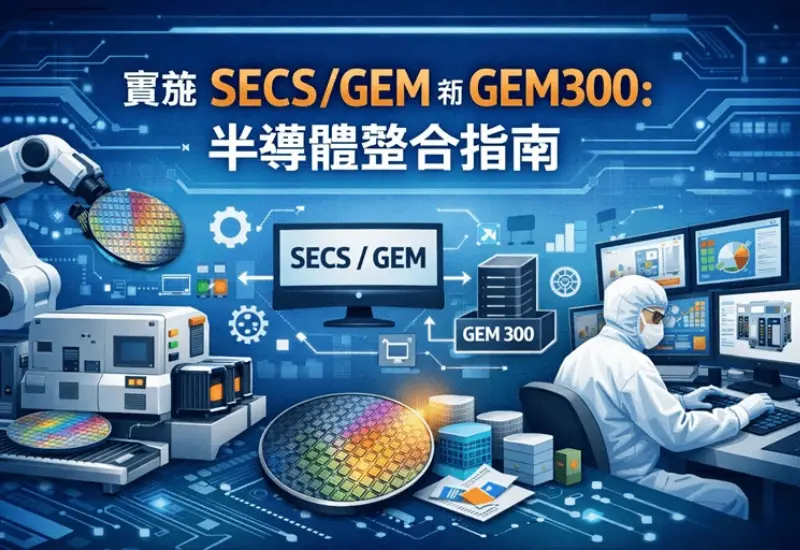


實施 SECS/GEM 和 GEM300: 半導體整合指南

概括

目的:本指南深入探討現代半導體製造中不可或缺的 SECS/GEM 與 GEM300 標準。
主要驅動因素:強調向全自動「無人工廠(Lights Out)」轉型的趨勢,以及標準化通訊的必要性。
技術範圍:涵蓋 SECS/GEM 介面、硬體需求,以及從 200mm 到 300mm 自動化的過渡。
實施策略:為 OEM 與晶圓廠提供部署 eSECS GEM 解決方案的實用建議,以及克服常見整合障礙的方法。
成果:提供一條實現設備與主機無縫連接並提升良率的路線圖。

介紹

全球半導體市場預計在 2030 年達到 1 兆美元,根據 McKinsey & Company(2024)指出,產業必須快速擴大產能以滿足 AI 與汽車市場需求。隨著晶圓廠逼近摩爾定律的極限,設備通訊中的任何誤差空間都已消失。效率不再是目標,而是生存條件。

為了讓這些複雜環境順利運作,產業依賴 SECS/GEM(SEMI 設備通訊標準/通用設備模型)。此框架是晶圓廠的共同語言,使主機系統能與各種設備溝通,從微影設備到量測站皆然。沒有這種標準化,現代智慧晶圓廠將變成混亂的巴別塔。

實施強健的 SECS/GEM 通訊策略,是連接人工操作與「無人工廠」自動化的關鍵。隨著產業進入 SEMI GEM300 標準時代,理解這些協議的細節已成為任何負責設備整合或數位轉型工程師的必修課。

了解 SECS/GEM 框架

SECS/GEM 標準基於 SEMI(國際半導體設備與材料協會)制定的多層協議。在核心層,它定義了資料如何在工廠中封裝、傳送和解析。

協定堆疊:SECS-I、HSMS 和 SECS-II

早期設備使用 SECS-I(E4),依賴 RS-232 序列通訊。然而,現代高速需求已推動產業轉向 HSMS(高速 SECS 訊息服務 – E37)。HSMS 使用 TCP/IP,能在標準乙太網路上提供更快的資料吞吐量和更可靠的連線。

在傳輸層之上是 SECS-II(E5),定義特定訊息結構。它提供設備與主機交換訊息的字典。不論是啟動流程的指令或硬體警報通知,SECS-II 都確保雙方正確理解其意圖。

為什麼 GEM 對設備製造商很重要

SECS 提供字母與詞彙,而 GEM(E30)提供文法。它定義了設備行為的狀態機。OEM 遵循 GEM 模型可確保其設備在亞利桑那或台灣的晶圓廠中都能以可預測的方式運作。

300mm 晶圓廠向 GEM300 的演進

隨著產業從 200mm 過渡到 300mm 晶圓,物料處理的複雜度大幅提升。這促使需要一組更先進的標準,即 GEM300。

GEM300 套件的關鍵組件

GEM300 並非單一標準,而是一套用於自動化晶圓全流程的協議。

  • E40(製程工作管理):管理晶圓加工的「做什麼」與「如何做」。
  • E94(控制工作管理):協調事件順序。
  • E87(載具管理):管理 FOUP(前開式統一匣)放置與移除。
  • E90(基板追蹤):確保每片晶圓在工具中移動過程的完整追蹤。

自動化和減少錯誤

根據 SEMI(2023)報告,300mm 晶圓廠的自動化可將人工錯誤降低多達 40%。在 GEM300 環境中,SECS GEM 的實施讓主機可使用天車系統(OHT)和自動導引車(AGV)進行物料搬運,無須人工介入。此同步程度使半導體設備自動化成為業界標準。

SECS/GEM實施策略

從零開始開發 SECS GEM 介面是一項艱巨任務,可能需要數月工程時間。大多數組織選擇使用專業 SDK 或與整合專家合作以加速上市時間。

客製化開發和中間件之間的選擇

許多人面臨的問題是:開發還是購買?自訂開發提供完全掌控,但需要深入理解 SEMI 標準。相對地,使用 eSECS GEM 軟體解決方案可透過內建狀態機與訊息處理邏輯簡化流程。

測試和驗證

整合很少是「插上即可」。需進行大量測試以確保設備能承受「負面測試」,例如主機傳送非預期指令或網路失效。在 5 萬美元晶圓批量加工中斷的通訊連線,是任何工程師都不願向主管解釋的夢魘。

克服常見的整合挑戰

即使有最佳工具,SECS/GEM 專案仍常遭遇瓶頸。其中一個常見問題是「協議偏移」,即對標準的細微解讀差異導致通訊逾時或資料毀損。

管理大量數據

隨著先進製程控制(APC)與大數據分析的興起,從設備擷取的資料量大幅增加。工程師必須謹慎設計 SECS GEM 實施方式,優先處理關鍵警報,而非一般遙測資料,以避免使 HSMS 連線飽和。

改造舊設備

如果一台功能完好的設備缺乏現代 SECS/GEM 介面該怎麼辦?改造專家通常使用「黑盒子」轉換器或外部 PLC-to-SECS 閘道器。這讓舊設備能加入現代數位架構,而無需全面更新控制系統。

連結的未來:超越傳統創業板

雖然 SECS/GEM 仍是核心技術,但產業正探索 EDA(設備資料擷取),又稱 Interface A。這是條專為資料收集而設計的高頻寬連線,使 SECS/GEM 負責指令與控制。

數位孿生和預測性維護

透過結合 SECS/GEM 即時資料與機器學習模型,晶圓廠正向預測性維護邁進。Gartner(2024)指出,AI 驅動的維護可降低高科技製造的營運成本 20%。若設備能在冒煙前告訴主機它即將故障,晶圓廠便能節省數百萬美元。

數據洞察:標準化的影響

下表顯示從手動或專有介面轉向完全符合 SEMI GEM300 環境後的營運改善。

透過 GEM300 標準提高效率

指標 手動/舊式介面 完整 GEM300 整合 改善幅度
資料準確度 85–90% >99.9%
物料處理錯誤率 約 3.5% <0.1% 35 倍減少
設備整合時間 4–6 個月 4–8 週 3 倍加速
可追溯性水準 以批次為主 以單片晶圓為主 高精度

結論

實施 SECS/GEM 與 GEM300 對半導體製造商而言已非奢侈,而是現代智慧晶圓廠的基礎。從 HSMS 連線的初次握手,到 FOUP 管理的複雜協作,這些標準確保設備與主機系統完美同步。透過採用 eSECS 等現代工具來推動 SECS/GEM 整合,OEM 與晶圓廠工程師可大幅降低停機時間、提升良率,並使營運面對全球市場日益增加的需求時更具韌性。


Contact Us Today

取得逐步協助以實施 SECS/GEM 與 GEM300 整合


FAB自动化制造自动化

摘要

  • SECS/GEM 是半導體設備與主機系統通訊的核心標準,確保資料一致性與可追溯性。

  • GEM 消除客製化整合問題,讓設備能以統一方式上報事件、警報、資料與配方。

  • 透過標準化的設備狀態模型、事件與資料收集機制,大幅縮短設備導入時間。

  • GEM 的功能涵蓋遠端控制、警報管理、配方下載/上傳、資料收集與設備監控。

  • SECS/GEM 是實現工廠自動化、提升良率、加速量產與支援 MES/APS/調度系統的基礎。

簡介

根據麥肯錫 2023 年報告,全球半導體市場預計在 2030 年成為兆美元產業。
但隨著製程節點縮小、晶圓成本飆升,容錯空間幾乎消失,人力已無法支撐高度精密的需求。
這正是 FAB 自動化的價值所在。
現代晶圓廠需要協調數千個製程步驟、處理 TB 級資料,並讓價值數十億美元的工廠穩定運作。

硬體主軸:無人搬運晶圓

最明顯的自動化系統是 AMHS。走進 300mm 晶圓廠,你會看到天花板上的高速軌道,而不是人類搬運 FOUP。

OHT 天車運輸系統

OHT 就像晶圓的電動計程車,在天花板軌道上移動,精準將晶圓批次送達指定工具。
它必須高速、精準並維持超低震動,才能保護價值數萬美元的晶圓。

EFEM 與 Load Port

OHT 將 FOUP 送到機台後,由 EFEM 接手。
EFEM 提供比無塵室更潔淨的局部環境,並透過機械手臂將晶圓送入製程腔體。
這徹底排除人為污染風險,使晶圓全程保持在最佳環境。

 軟體大腦:連接整個製程

晶圓廠硬體需要軟體指揮。這套軟體架構就像軍事指揮鏈,一層接一層。

MES 製造執行系統

MES 是工廠的「指揮官」。
它負責:
• 工單管理
• 庫存追蹤
• 排程與派工
• 決定哪一批晶圓要進入哪一台工具

EAP 設備自動化控制

EAP 是 MES 的「翻譯官」。
它將 MES 指令轉為機台能理解的語言,並處理:
• 配方驗證
• 執行中資料收集
• 警報處理
沒有 EAP,機台變成「笨機器」,需要操作員手動輸入配方,非常容易造成報廢。

How Fab Automation Transforms Production

SECS/GEM 設備通訊標準

SECS/GEM 是晶圓廠通訊的「USB 標準」。
它讓不同廠牌機台以相同方式通訊,是當今最普及的控制標準。
雖然 EDA(Interface A)已用於高速資料收集,但 SECS/GEM 仍是主要控制協定。

工業 4.0:當資料變成行動

現代 FAB 自動化已不只是控制,而是預測並優化。

預測性維護 (PdM)
AI 可分析震動、聲音與溫度等感測資料,提前預測設備故障。
不再依照固定時程更換零件,而是根據實際狀況維修,避免突發停機與報廢。

數位孿生

工程師可建立晶圓廠的虛擬複製體,模擬物料流動、工具交互與 OHT 交通。
例如:新增機台是否會造成 OHT 壅塞?
只需在數位孿生中模擬即可得知。

自動化晶圓廠的挑戰

老舊設備整合問題

晶圓廠設備價格昂貴,許多工具使用 10–20 年以上。
這些老機台缺乏感測器與運算能力,需藉助 IoT Gateway 或改裝控制器來與系統整合。

整合成本

全面自動化需要高額初期投資,但帶來更高良率、低人力成本與更穩定的產能。

人類角色轉變

自動化不是取代人類,而是讓人類從「操作者」轉為:
• 維護專家
• 數據分析師
• 製程優化工程師

結論

FAB 自動化是推動半導體邁向兆美元產業的核心力量。
整合 OHT、EFEM 等硬體與 MES/EAP 等軟體,能讓工廠達到未來製程所需的精密度。
無論是改造舊機台或規劃新

Contact Us Today

取得逐步協助,實現您的晶圓廠製造自動化

SECS/GEM & GEM300: 현대 팹 자동화를 위한 통합 가이드

요약

  • 글로벌 영향: 전 세계 반도체 생산 능력이 사상 최고치를 기록하면서 효율적인 자동화는 선택이 아니라 산업의 생명선이 되었습니다.
  • 표준 스택: SECS/GEM은 단일 프로토콜이 아니라 E4, E5, E37, E30 등으로 구성된 계층형 표준 모음으로, 장비가 공장 호스트와 “대화”할 수 있게 합니다.
  • GEM300의 진화: 300mm 팹에서는 기본 GEM만으로는 부족했습니다. GEM300 스위트(E39, E40, E87, E94, E90)는 캐리어 관리 및 작업 처리 같은 복잡한 물류를 표준화합니다.
  • 구현: 레거시 직렬 연결(SECS-I)에서 고속 이더넷(HSMS)으로의 전환은 현대적 데이터 처리량을 위해 필수적입니다.
  • 효과: 적절한 구현은 통합 시간을 줄이고 수율을 높이며 맞춤형 드라이버의 “스파게티 코드”를 제거합니다.

소개

집에서 쓰는 와이파이가 복잡하다고 느껴진다면, 수십억 달러짜리 장비들이 밀리초 단위로 복잡한 레시피를 서로 속삭여야 하는 반도체 팹을 조정해 보세요. 그 중요성은 엄청납니다. SEMI의 World Fab Forecast(2024)에 따르면 올해 전 세계 반도체 생산 능력은 월 3,000만 웨이퍼라는 사상 최고치에 이를 것으로 전망됩니다. 이는 공급망을 통해 이동하는 엄청난 양의 실리콘을 의미하며, 이 모든 과정은 강력한 자동화 없이는 불가능합니다.

이 제조 교향곡의 중심에는 SECS/GEM이 있습니다. SECS/GEM은 팹의 숨은 영웅으로, 캘리포니아의 증착 장비가 독일에서 개발된 호스트 시스템과 원활하게 대화할 수 있게 해주는 보편적 언어입니다. SECS/GEM이 없다면 반도체 산업은 본질적으로 고가의 섬들로 나뉘어 나노미터 규모의 트랜지스터를 제조하는 데 필요한 정밀한 협업을 할 수 없었을 것입니다.

200mm 레거시 라인을 개조하든, 최첨단 300mm 시설을 도입하든, 이러한 표준을 이해하는 것은 필수입니다. 다만 솔직히 말하면 SEMI 표준 매뉴얼은 선인장을 탈수시킬 만큼 지루할 수 있습니다. 우리는 이것을 이해하기 쉬운 언어로 풀어 E5, E30, 그리고 강력한 GEM300 표준들의 알파벳 수프를 안내하려 합니다.

팹의 중추: SECS/GEM이란?

초심자에게 “SECS/GEM”은 단일 프로토콜처럼 들리지만, 실제로는 함께 작동하는 여러 표준의 스택입니다. 인터넷을 떠올려 보세요: 물리적 케이블, IP 주소, HTML 페이지가 있듯이 SECS/GEM도 유사한 계층 구조를 가집니다.

전송 계층: E4과 E37

데이터가 움직이기 전에 장비와 호스트는 데이터를 어떻게 전송할지 합의해야 합니다.

  • E4 – SECS-I (직렬): “구세대”입니다. RS-232 직렬 케이블을 사용합니다. 느리고 노이즈에 취약하며 현대의 300mm 팹에서는 거의 구식입니다. 하지만 200mm 레거시 팹에 들어가면 20년 된 에처(etcher) 뒤에서 이런 케이블이 아직도 뽑혀 나오는 것을 볼 수 있습니다.
  • E37 – HSMS: “High-Speed SECS Message Services”입니다. 이 표준은 직렬 케이블을 이더넷(TCP/IP) 연결로 대체했습니다. 웨이퍼 맵 데이터와 같이 기가바이트 단위의 데이터를 전송할 때 빠른 전송이 필수적입니다.

문법: E5 – SECS-II

연결이 설정되면 문법 구조가 필요합니다. E5 – SECS-II는 “메시지”를 정의합니다. 통신을 Streams(카테고리)와 Functions(특정 동작)로 나눕니다.

예: S1,F1은 “거기 있나요?”(Are You There Request). S1,F2는 “네, 있습니다”(On Line Data).

E5는 사전을 제공하지만, 대화를 어떻게 이어갈지는 알려주지 않습니다. 가능한 단어들을 나열해 줄 뿐입니다.

동작: E30 – GEM

SECS/GEM이 진정으로 살아나는 곳은 여기입니다. E30 – GEM(General Equipment Model) 표준은 작동 규칙을 정의합니다. 예를 들어 장비에 “Remote 모드에 놓이면 이 특정 명령들을 수락해야 한다”고 지시합니다.

E30가 없으면 한 벤더는 S2,F41를 공정 시작으로 사용하고, 다른 벤더는 같은 코드를 레시피 다운로드에 사용할 수 있어 혼란이 발생합니다. E30은 모든 GEM 준수 도구가 따라야 할 표준 상태 머신(Offline, Online-Local, Online-Remote)을 강제합니다.

왜 자동화에 공통 언어가 필요한가

왜 굳이 이 모든 과정을 거쳐야 할까요? 모든 OEM이 자체 API를 만들게 놔두면 안 될까요?

핵심은 확장성입니다. 현대 팹에는 Applied Materials, Lam Research, Tokyo Electron 등과 같은 30개 이상의 다른 공급업체의 500개 이상의 도구가 있을 수 있습니다. 공장 호스트(MES)가 각 도구마다 커스텀 드라이버를 작성해야 한다면 통합팀은 잠을 잘 수 없을 것입니다.

SECS/GEM은 도구와 호스트를 분리시킵니다.

  • 상호운용성: 호스트 시스템은 장비 제조사가 누구인지와 상관없이 상태 변수(VID)나 수집 이벤트(CEID)를 요청하는 방법을 정확히 알고 있습니다.
  • 수율 향상: 자동화된 데이터 수집은 결함 탐지 및 분류(FDC)를 가능하게 합니다. 챔버의 압력이 50ms 동안 급등하면 SECS/GEM이 즉시 보고하여 호스트가 불량 웨이퍼가 처리되기 전에 라인을 멈출 수 있습니다.
  • 비용 절감: 표준 인터페이스는 신규 장비 설치 시 발생하는 비반복적 엔지니어링(NRE) 비용을 줄입니다.

참고: SECS/GEM이 표준이긴 하지만 “준수”라는 용어는 느슨하게 해석될 수 있습니다. 기술적으로 E30 준수라고 해도 표준을 독특하게 구현해 자동화를 파괴하는 도구가 있을 수 있습니다. 항상 엄격한 테스트 스위트로 검증하세요.

300mm 혁명: GEM300의 등장

산업이 200mm에서 2000년경 300mm 웨이퍼로 이동하면서 물리적으로 무거워진 문제가 생겼습니다. 300mm 웨이퍼가 들어 있는 FOUP(Front Opening Unified Pod)는 작업자가 하루 종일 들고 다니기에는 너무 무겁습니다. 따라서 업계는 OHT(Overhead Hoist Transports), 자동 저장 시스템 등 완전 자동화를 필요로 했습니다.

기본 SECS/GEM만으로는 이러한 복잡한 물류를 처리할 수 없었습니다. 그래서 E30 위에 얹히는 “GEM300” 표준들이 등장했습니다. 이들은 완전 자동화 팹의 복잡성을 관리하기 위한 추가 표준입니다.

E87 – 캐리어 관리

200mm 팹에서는 작업자가 캐세트를 장비에 올려놓고 “시작”을 누릅니다. 300mm 팹에서는 로봇이 FOUP를 로드 포트에 내려놓습니다. 장비는 다음을 알아야 합니다:

  • 이 캐리어 ID가 무엇인가?
  • 슬롯이 올바르게 채워져 있는가?
  • 호스트가 이 장비의 처리 허가를 내렸는가?

E87은 “바인드(Bind)”, “캐리어 진행(Proceed With Carrier)”, “캐리어 아웃(Carrier Out)” 상태를 관리합니다. 이는 도구와 AMHS(자동 물류 시스템)가 완벽히 동기화되도록 보장합니다.

E40 & E94 – 작업 관리

여기서 사람들이 혼동하는 경우가 많습니다. 왜 작업에 대해 두 가지 표준이 필요할까요?

  • E40 (Process Job): 웨이퍼에 실제로 무슨 일이 일어나는지를 정의합니다. “웨이퍼 1번부터 25번까지에 레시피 A를 적용해라.”
  • E94 (Control Job): 감독자 역할을 합니다. Process Job을 감쌉니다. Control Job은 “Process Job 1을 실행하고 완료되면 웨이퍼를 출력 포트로 이동시켜라” 같은 지시를 내립니다.

Control Job은 프로젝트 매니저, Process Job은 전문 하청업체로 생각할 수 있습니다.

E90 – 기판 추적

웨이퍼를 잃어버리면 안 됩니다. 절대. E90은 호스트가 도구 내부의 각 웨이퍼(기판)의 정확한 위치를 추적할 수 있게 합니다. 프로세스 챔버에 있는가? 얼라인(alignment) 장치에 있는가? 냉각 스테이션에 있는가? E90은 그 가시성을 제공합니다.

SECS-I에서 HSMS로의 전환: 속도 업그레이드

레거시 장비를 다루고 있다면 아직도 SECS-I 직렬 연결과 씨름하고 있을 수 있습니다. RS-232 케이블은 악명 높게 까다롭습니다. 접지 루프, 전송 속도(baud rate) 불일치, 케이블 길이 제한(리피터 없이 최대 50피트) 등은 지속적인 골칫거리입니다.

E37 – HSMS는 모든 것을 TCP/IP로 이동시켜 판도를 바꿨습니다.

  • 신뢰성: 더 이상 구부러진 핀이나 신호 열화 문제가 없습니다.
  • 속도: HSMS는 훨씬 빠릅니다. 이는 초당 10회와 같이 챔버 온도를 샘플링하는 현대의 “Trace Data”(E5 Stream 6) 수집에서 중요합니다. SECS-I는 이 데이터 양을 소화하지 못하지만 HSMS는 무리 없이 처리합니다.

팹을 현대화하려면 레거시 SECS-I 포트를 HSMS로 변환하는 SECS/GEM 어댑터를 설치하는 것이 높은 ROI를 제공하는 활동 중 하나입니다. 이를 통해 도구는 즉시 네트워크 준비가 되고 현대적 분석 플랫폼과 통합할 수 있습니다.

구현 과제 및 현대적 솔루션

SECS/GEM 소프트웨어를 구현하는 것은 플러그 앤 플레이가 아닙니다. 오히려 “플러그 앤 디버그”에 가깝습니다. 자동화 엔지니어들이 직면하는 일반적 장애물은 다음과 같습니다.

  1. “스파게티 코드” 함정 개발자들은 종종 E30 상태 모델의 복잡성을 과소평가합니다. “행복한 경로(Happy Path)”에서는 동작하는 빠른 드라이버를 작성하지만, 장비가 예상치 못한 알람이나 통신 이상을 던지면 바로 충돌합니다.
    • 해결책: 원시 SECS 메시지를 처음부터 작성하기보다는 상용 SECS/GEM 드라이버나 라이브러리(SDK)를 사용하세요.
  2. 문서 불일치 장비 매뉴얼에는 변수가 ASCII 문자열이라고 적혀 있는데, 실제로 도구는 2바이트 정수를 보냅니다. 호스트가 충돌합니다.
    • 해결책: 엄격한 특성화(characterization). 연결하기 전에 “골든 스탠다드” 테스트 도구로 기계의 모든 변수와 이벤트를 쿼리하세요.
  3. 200mm 장비에 300mm 로직 적용 200mm 팹에서도 효율을 위해 GEM300 기능(예: 고급 캐리어 관리)을 원하지만 OHT가 없는 경우가 있습니다.
    • 해결책: 하이브리드 접근 방식. 오래된 장비에는 기본 SECS/GEM을 사용하면서 호스트 측에는 300mm 로직을 “흉내” 내는 스마트 미들웨어가 필요합니다.

빠른 참고: 표준 스택

아래는 알아야 할 핵심 표준의 정리입니다.

표준 명칭 주요 기능
E4 SECS-I 물리 계층 (직렬 RS-232). 레거시 전송.
E37 HSMS 물리 계층 (이더넷 TCP/IP). 현대적 전송.
E5 SECS-II 메시지 계층. “문법”(Streams & Functions)을 정의.
E30 GEM 동작 계층. 상태 모델과 제어 규칙을 정의.
E87 Carrier Mgmt GEM300: 로드 포트 및 캐리어 검증 관리.
E40 Process Job GEM300: 레시피 및 웨이퍼 처리 지시 정의.
E94 Control Job GEM300: 고수준 워크플로우 관리.
E90 Substrate Tracking GEM300: 도구 내부의 개별 웨이퍼 추적.

결론

산업이 300mm 표준화 및 그 이상의 영역으로 나아감에 따라 SECS/GEM 인터페이스를 구현하고 유지관리하는 능력은 중요한 기술 세트가 되고 있습니다. 이것은 웨이퍼 가공의 물리적 현실과 수율 분석의 디지털 세계를 연결하는 다리입니다.

OEM 개발자가 도구를 “팹 레디(fab ready)”로 만들려고 하든, 공장 관리자가 라인 가동 시간을 5% 더 확보하려고 하든, 해답은 대개 더 나은 자동화에 있습니다. GEM300 표준은 로드맵을 제공하며, 당신은 그 차를 운전하면 됩니다.

Contact Us Today

GEM300 준수 Fab 자동화에 대한 전문가 지침 받기


반도체 공장 자동화: 주요 장점 및 Einnosys 솔루션

요약

  • 통계적 성장: 전 세계 반도체 매출은 2024년 6,260억 달러로 전년 대비 18.1% 증가하며 팹 인프라 투자를 가속화하고 있습니다(Gartner, 2025).
  • 효율 향상: 자동화 도입 시 생산 현장 처리량이 20~30% 증가하고 단위 생산 비용이 20% 절감될 수 있습니다(McKinsey, 2023).
  • Einnosys 효과: EIGEMBox 및 SeerSight 솔루션은 연간 200만 달러 이상의 다운타임 절감과 팹당 5,000개 이상의 웨이퍼 스크랩 방지를 지원합니다(Einnosys, 2025).
  • 미래 전망: AI 칩 수요 증가로 인해 2025~2027년 사이 300mm 팹 장비 투자가 4,000억 달러에 이를 것으로 예상됩니다(SEMI, 2024).

소개

Gartner(2025) 자료에 따르면 2024년 전 세계 반도체 매출은 6,260억 달러로 전년 대비 18.1% 증가했습니다.
이 성장은 단순히 “더 많은 칩 판매”가 아니라, 거의 무결한 제조 품질에 대한 압박이 극도로 증가하고 있음을 의미합니다.

노드 크기 축소와 AI 칩 수요 폭증으로 인해 현대 팹 운영 복잡성은 인간이 감당할 수 있는 범위를 넘어섰습니다.
이 때문에 공장 자동화는 단순한 경쟁 우위가 아니라 생존을 위한 필수 요소로 자리 잡고 있습니다.

자동화는 수천 개의 공정을 실시간으로 조율하는 디지털 신경망으로 작동하며, 미세한 진동이나 먼지 한 입자로 인해 수백만 달러 규모의 웨이퍼 배치를 폐기하는 상황을 방지합니다.

궁극적으로 엔지니어와 팹 관리자에게 중요한 목표는 다음 두 가지입니다:

  • 처리량 극대화
  • 폐기 최소화

이제 자동화가 혼란스러운 생산 라인을 어떻게 정밀하고 데이터 기반의 체계로 탈바꿈시키는지 살펴보겠습니다.

팹 자동화로의 전략적 전환

자동화의 목적은 인간을 대체하는 것이 아니라, 인간이 가진 변동성과 불확실성으로부터 공정을 보호하는 것입니다.
반도체 제조에서 일관성은 절대적인 가치입니다.

수동 작업, 종이 기반 운영 방식은 이미 시대에 맞지 않습니다.
현대 팹의 핵심은 장비 레벨부터 MES(제조 실행 시스템)까지 이어지는 엔드 투 엔드 데이터 연동입니다.

운영 효율(OEE) 향상

공장 자동화의 가장 빠른 효과는 OEE(설비 종합 효율) 향상입니다.

연구에 따르면 자동화 기반 생산 혁신은:

  • 처리량 20~30% 증가
  • 단위 생산 비용 20% 절감

이라는 결과를 가져올 수 있습니다.

이는 단순한 퍼포먼스 개선이 아니라,
분기 출하 목표 달성 여부를 결정하는 핵심 요소가 됩니다.

글로벌 인력 부족 해결

반도체 산업은 다음과 같은 문제에 직면해 있습니다:

  • 칩 수요는 증가
  • 숙련 인력은 감소

현대 자동화 시스템은 수동, 반복적인 웨이퍼 운송과 로딩 작업을 대신 수행하여,
엔지니어들이 **고부가가치 업무(수율 분석, 공정 최적화)**에 집중할 수 있게 합니다.

참고:
로봇이 심심함을 느끼는지 모르겠지만,
숙련 엔지니어가 매번 알람을 수동 기록해야 한다면 그건 정말 지루한 일입니다.

공장 자동화 장비의 핵심 이점

공장 자동화 장비 투자는 초기 비용이 크지만, 그 효과는 팹 운영 전반에 걸쳐 나타납니다.

향상된 수율 및 스크랩 감소

수율은 팹의 최종 성적표입니다.
단 한 번의 처리 오류도 수만 달러짜리 웨이퍼를 폐기하게 만들 수 있습니다.

자동화는 인적 접촉을 최소화하여:

  • 오염 감소
  • 물리적 손상 감소
  • 웨이퍼 스크랩 감소

와 같은 효과를 제공합니다.

Einnosys는 연간 5,000개 이상의 웨이퍼 불량을 방지한다고 보고합니다.

실시간 데이터 가시성 확보

많은 구형 팹은 다음과 같은 문제를 겪습니다:

  • 장비가 데이터를 생성하지만
  • 시스템이 이를 수집하지 못하고 분석도 못함

즉, “보이지 않는 데이터(dark data)”입니다.

현대 자동화 시스템은:

  • 장비 상태
  • 가스 흐름
  • 온도 변화

등을 실시간으로 시각화하여 예측 유지보수 체계를 구축합니다.

Einnosys 반도체 현장 맞춤 자동화 기술 선도

Einnosys는 일반적인 자동화 장비가 아니라
반도체 팹의 특수 요구사항(예: SECS/GEM, 레거시 장비 통합)을 해결하는
전문화된 자동화 솔루션을 제공합니다.

EIGEMBox  레거시 장비의 한계를 해결

많은 팹이 200mm 구형 장비를 여전히 사용하고 있습니다.
문제는 이 장비들이 현대적 통신 기능이 없다는 점입니다.

EIGEMBox는:

  • 기존 장비 전체 교체 없이
  • SECS/GEM 기능을 추가

하는 특허 기술 솔루션입니다.

레거시 팹이 데이터 기반 생산 체계에 합류할 수 있도록 돕습니다.

SeerSight & xPump 기반 예측 인텔리전스

다운타임은 팹 운영에서 가장 큰 비용입니다.

Einnosys의 SeerSight 및 xPump는:

  • AI/ML 기반 분석
  • 펌프 및 공정 상태 실시간 감지
  • 고장 수주 전 사전 경고

를 제공하여 연간 200만 달러 이상의 다운타임 비용을 절감할 수 있습니다.

비용 vs 역량 — 자동화의 경제적 현실

자동화는 비싸지만,
운영 실패보다 훨씬 저렴합니다.

2025년 300mm 팹 장비 투자액은
역대 최초로 1,000억 달러를 돌파할 전망입니다.

이는 AI 기반 반도체 시장의 폭발적 성장 때문입니다.

기능 비교표

항목 수동/레거시 방식 자동화 스마트 팹
처리량 교대 근무에 제한됨 24시간 연속 운영
오류율 사람 요인에 따라 변동 일관적이며 프로그램 기반
유지보수 고장 후 대응 예측 유지보수
확장성 인력 증가에 의존 디지털 기반 확장

인더스트리 4.0 준비

스마트 팩토리 구현은 단순히 로봇을 구매하는 것이 아닙니다.
팩토리 IT 아키텍처의 역할 재정의가 핵심입니다.

장비에서 발생한 데이터가 몇 시간 후가 아니라 몇 초 만에
AI 기반 수율 모델로 전달될 수 있어야 합니다.

표준 프로토콜(SECS/GEM)이 없다면,
자동화 장비는 “아무 말도 못하는 빠른 기계”일 뿐입니다.

팹 현대화의 미래 트렌드

2028년을 향한 핵심 흐름:

  • 2nm 이하 초미세 공정: 인간이 감독 불가한 원자 단위 정밀도 요구
  • 글로벌 지역화: 미국·유럽·인도 등 신규 팹 확산
  • 지속 가능성: 에너지·용수 절감 자동화 필요

결론

반도체 산업에서 성공하려면
데이터·정밀성·자동화가 필수입니다.

Einnosys와 같은 전문 파트너는
완전 자동화 팹 실현을 앞당기는 핵심 역할을 하고 있습니다.

Contact Us Today

반도체 공장 자동화를 단계별로 지원받으세요


What Is the SECS/GEM Protocol? A Complete Guide to Semiconductor Automation

Introduction to SECS/GEM in Semiconductor Manufacturing

Modern semiconductor fabrication relies heavily on automation to achieve predictable processes, maximize throughput, and maintain world-class yield. Every manufacturing step—from wafer loading to deposition, etching, metrology, and packaging—depends on precise coordination between equipment and the factory’s host systems. This coordination is made possible through one of the most important communication standards in the industry: the SECS/GEM protocol.

SECS/GEM (SEMI Equipment Communications Standard / Generic Equipment Model) is the universal language that allows semiconductor tools to communicate with manufacturing execution systems (MES), factory hosts, and automation software. Without SECS/GEM, fabs would require custom communication for each tool type, making integration slow, expensive, and nearly impossible to scale.

This complete beginner’s guide explains what SECS/GEM is, how it works, and why it remains the backbone of semiconductor automation—even as the industry rapidly advances toward Industry 4.0, digital twins, and AI-driven manufacturing.

Why the SECS/GEM Protocol Matters in Modern Semiconductor Fabs

Standardizing Equipment Communication Across the Fab

Before SECS/GEM, equipment vendors each had their own proprietary communication formats. Integrating a new tool could take months of engineering work. SECS/GEM standardizes message structures, events, commands, status reporting, alarms, and behaviors so that all tools from lithography to packaging communicate uniformly.

This standardization allows fabs to:

  • Reduce integration complexity
  • Achieve faster tool qualification
  • Maintain consistent automation logic across hundreds of machines

Reducing Integration Time and Engineering Effort

Because SECS/GEM defines predictable equipment behavior, factories no longer need to build custom drivers for every tool. Integrators simply connect the equipment to the host via HSMS (Ethernet) or SECS-I (serial), configure event reports, and begin automation.

The result:

  • Shorter installation and ramp-up time
  • Lower engineering cost
  • Fewer communication-related errors

Enabling Reliable Equipment Monitoring and Control

SECS/GEM supports near real-time Equipment Monitoring, alarm reporting, and status changes, giving engineers complete visibility into production lines.
 

It also enables remote operations through standardized Remote Commands (RCMD). This makes automation scalable, safer, and more efficient.

How SECS/GEM Works: Key Components Explained

SECS Message Structure (SxFy Format)

SECS messages follow a structured format: Stream x, Function y (SxFy).
For example:

  • S1F1 — Are You There?
  • S6F11 — Event Report
  • S2F41 — Remote Command

This structured messaging ensures tools behave predictably in all factories globally.

HSMS vs SECS-I: Communication Layers and Transport Protocols

SECS-I (RS-232 serial) was the original method of communication, but most fabs today use HSMS (SEMI E37)—a high-speed Ethernet-based transport.

HSMS advantages:

  • Reliable networking
  • Higher data throughput
  • Better support for factory-wide automation

Event Reporting, Data Collection, and Alarm Handling

Key structures include:

  • Data Collection Events (DCEs)
  • Event IDs (CEIDs)
  • Status Variables (SVs)
  • Equipment Constants (ECs)
  • Alarms (ALIDs)

This rich dataset feeds into supervisory control, analytics systems, yield management tools (YMS), and AI/ML platforms.

SECS/GEM Data Analytics for Real-Time Insights

Using SECS/GEM Data for Trend Analysis and Process Stability

Fabs use SECS/GEM data to track:

  • Chamber temperature
  • Pressure stability
  • Motor torque
  • Recipe parameters
  • Wafer movement timing

Analyzing this data helps detect early process drift and maintain stability across high-volume production.

Role of SECS/GEM Data in Semiconductor Yield Optimization

Yield strongly depends on equipment health and process consistency.

SECS/GEM enables:

  • Rapid root-cause analysis
  • Correlation of equipment parameters to wafer defects
  • Faster identification of out-of-control (OOC) conditions

Yield management teams rely on clean, structured SECS/GEM data to drive consistent output quality.

Integrating SECS/GEM Data With AI/ML and Predictive Models

Modern fabs connect SECS/GEM data streams to:

  • Predictive maintenance systems
  • Fault detection and classification (FDC)
  • Machine learning-based anomaly detection

The result is fewer unexpected tool failures and significantly improved uptime.

Equipment Monitoring Through SECS/GEM

Tracking Status Variables (SVs) for Tool Health

Status Variables are real-time data points that describe machine conditions, such as:

  • Machine state
  • Substate
  • Carrier positions
  • Material handling status

These are essential for production monitoring and automated decision-making.

Using Data Collection Events (DCEs) for Performance Monitoring

DCEs trigger when key events occur—wafer load, vacuum start, recipe completion, or process errors. This allows factories to trace every part of the manufacturing process.

Alarm Management and Fault Detection

Alarms are automatically reported with:

  • Alarm ID
  • Description
  • Timestamp
  • Severity

This supports fast troubleshooting, root-cause identification, and reduced downtime.

SECS/GEM for Automation Engineers: Practical Use Cases

Remote Commands (RCMD) for Recipe and Job Control

Hosts can remotely send commands such as:

  • Start
  • Stop
  • Pause
  • Resume
  • Select Recipe

This eliminates the need for manual operator intervention.

Material Handling and Wafer Tracking Through SECS/GEM

The protocol supports automated material flow by reporting:

  • Carrier load/unload
  • Wafer count
  • Slot mapping
  • Robot errors

MES Integration and Factory Host Connectivity

SECS/GEM connects directly to:

It is the foundation of end-to-end digital manufacturing.

Comparing SECS/GEM With Other Semiconductor Communication Standards

SECS/GEM vs GEM300

GEM300 builds on SECS/GEM to support:

  • Wafer-level tracking
  • Carrier management
  • Durable handling
    Material transport automation
SECS/GEM vs SECS-II
  • SECS-II defines message structure
  • GEM defines behavior models (automation rules)

Together, they form the complete standard.

HSMS vs SECS I

Where EDA/Interface A Fits in Modern Fabs

EDA (Interface A) is used for high-frequency, high-volume data acquisition like fault detection and real-time analytics. SECS/GEM is still required for control, events, and commands.

Common Challenges When Implementing the SECS/GEM Protocol

Handling Custom Equipment Variations

Even with standardization, vendors may customize GEM implementations.
This requires careful mapping and validation.

Ensuring Robust Connection and Message Handling

HSMS sessions need reliable handling of:

  • Heartbeats
  • Reconnect logic
  • Message buffering
Maintaining Data Quality for Analytics Platforms

Poorly defined event reports or SVs degrade data analytics.
Standardized naming and timestamp accuracy are critical.

Future of SECS/GEM in Industry 4.0 Semiconductor Manufacturing

Integration With Digital Twin and AI Systems

SECS/GEM data is essential for the digital thread—from real-time digital twins to predictive process simulations.

Expanding SECS/GEM Data for Predictive Maintenance

AI-driven monitoring can detect anomalies before failures occur.

How Standards Will Evolve in Next-Gen Fabs

Future trends include:

  • Hybrid SECS/GEM + EDA architectures
  • Greater interoperability
  • Enhanced data models for robotics and automation

Conclusion

The SECS/GEM protocol is the foundation of semiconductor automation, enabling seamless communication between thousands of tools and factory systems. Even as the industry moves toward AI, real-time analytics, and hyper-automated fabs, SECS/GEM remains essential due to its reliability, consistency, and global adoption.

For beginners, mastering SECS/GEM opens doors to careers in equipment integration, automation engineering, and data-driven manufacturing—fields central to the future of semiconductor production.

FAQ Section

  • What is SECS/GEM?

    SECS/GEM is the global communication standard that connects semiconductor equipment to factory host systems.

  • Why is SECS/GEM important?

    It standardizes automation, event reporting, remote control, and data collection across fabs.

  • What does SECS stand for?

    SEMI Equipment Communications Standard.

  • What does GEM stand for?

    Generic Equipment Model.

  • What is the difference between SECS-I and HSMS?

    SECS-I uses serial communication; HSMS uses high-speed Ethernet.

  • How does SECS/GEM support equipment monitoring?

    Through status variables (SVs), alarms, and event reporting.

  • Can SECS/GEM be used for data analytics?

    Yes—SECS/GEM Data Analytics is widely used for yield improvement and predictive maintenance.

  • What is GEM300?

    An extension of SECS/GEM used for 300mm wafer automation.

  • Does SECS/GEM work with AI/ML platforms?

    Yes, SECS/GEM data is often fed into ML models for process optimization.

  • Is SECS/GEM still relevant with newer standards like EDA?

    Yes—SECS/GEM is essential for control and automation; EDA complements it for high-volume data.

Modern SECS/GEM Solutions: Flexible SDKs for Seamless Software Integration

[vc_row][vc_column][vc_column_text css=””]The semiconductor manufacturing industry relies heavily on automation and communication standards to ensure efficiency and precision. One of the most widely adopted protocols is SECS/GEM (Semiconductor Equipment Communication Standard/Generic Equipment Model). This standard has become essential for integrating equipment and systems, enabling seamless communication across diverse platforms. With the rise of modern SECS/GEM solutions, flexible SDKs (Software Development Kits) are now paving the way for easier and more effective SECS/GEM integration. This blog explores the evolution and advantages of these modern tools, emphasizing how they revolutionize the use of SECS/GEM software in manufacturing environments.[/vc_column_text][vc_column_text css=””]Understanding the SECS/GEM Protocol

The SECS/GEM protocol serves as the backbone of communication between manufacturing equipment and host systems. It establishes a standardized method for exchanging data, executing commands, and monitoring processes. As a key component of semiconductor manufacturing, the SECS/GEM communication protocol enables automation and facilitates the implementation of GEM300 standards, which are vital for advanced fabs.

Modern SECS/GEM communication solutions offer robust SDKs that simplify the complexities of integrating the SECS/GEM interface into various software systems. These SDKs come with pre-built libraries, documentation, and examples, making it easier for developers to implement SECS/GEM communication without requiring in-depth expertise in the protocol itself. The result is a faster development cycle and a more streamlined manufacturing process.[/vc_column_text][vc_column_text css=””]Why Modern SDKs are Game-Changers

Enhanced Flexibility

Traditional SECS/GEM integration often required extensive coding and a deep understanding of the protocol. Modern SDKs, however, offer enhanced flexibility by providing ready-to-use modules and APIs. These tools allow developers to implement SECS/GEM communication protocols with minimal effort, ensuring compatibility with existing systems while reducing development time.

The flexibility of these SDKs also enables their use in various applications, from legacy equipment to cutting-edge GEM300-compliant machines. By supporting a wide range of scenarios, these SDKs facilitate the seamless integration of SECS/GEM interfaces, empowering manufacturers to adopt new technologies without overhauling their infrastructure.[/vc_column_text][vc_column_text css=””]Improved Usability

One of the most significant benefits of modern SECS/GEM software is its user-friendly design. SDKs are now equipped with intuitive interfaces, comprehensive documentation, and real-world examples that guide developers through the integration process. This user-centric approach not only simplifies SECS/GEM integration but also reduces the learning curve for engineers who may be new to the SECS/GEM protocol.

Scalability and Reliability

As manufacturing demands grow, so does the need for scalable solutions. Modern SECS/GEM communication SDKs are designed with scalability in mind, allowing manufacturers to expand their operations without compromising performance. Additionally, these SDKs offer reliable communication channels that ensure accurate data exchange, even in high-demand environments.[/vc_column_text][/vc_column][/vc_row][vc_row][vc_column width=”1/2″][vc_column_text css=””]Applications of SECS/GEM Integration

The applications of SECS/GEM integration extend far beyond basic communication. With modern SDKs, manufacturers can achieve:

Real-time monitoring: By integrating SECS/GEM communication protocols, fabs can monitor equipment status and process parameters in real time, enabling proactive maintenance and minimizing downtime.

Enhanced automation: SECS/GEM software supports automation by enabling hosts to send commands directly to equipment, streamlining production workflows.

Data-driven decision-making: The data collected through SECS/GEM interfaces can be analyzed to identify trends, optimize processes, and improve overall efficiency.

Compliance with GEM300 standards: For advanced fabs, adhering to GEM300 requirements is critical. Modern SDKs ensure that SECS/GEM communication aligns with these standards, enabling seamless equipment integration in high-tech environments.[/vc_column_text][/vc_column][vc_column width=”1/2″][vc_single_image image=”35263″ img_size=”full” alignment=”center” css=””][/vc_column][/vc_row][vc_row][vc_column][vc_column_text css=””]The evolution of SECS/GEM solutions has transformed how semiconductor manufacturers approach equipment integration. Modern SDKs offer unparalleled flexibility, usability, and scalability, making SECS/GEM integration more accessible than ever before. By leveraging these advanced tools, manufacturers can optimize their operations, enhance automation, and stay competitive in an increasingly demanding industry.

As the semiconductor industry continues to evolve, the importance of robust SECS/GEM communication protocols and software cannot be overstated. Whether you’re working with legacy systems or implementing GEM300-compliant solutions, modern SECS/GEM SDKs provide the foundation for seamless software integration and long-term success.

Incorporating SECS/GEM into your operations has never been easier, thanks to these innovative solutions. Embrace the future of manufacturing with modern SECS/GEM software and unlock the full potential of your production line.[/vc_column_text][/vc_column][/vc_row]

SECS/GEM: The Backbone of Semiconductor Manufacturing Automation

[vc_row][vc_column][vc_column_text]

How Does SECS/GEM Work?

In the world of semiconductor manufacturing, automation is key to maintaining efficiency, consistency, and accuracy in production. One of the core technologies driving this automation is SECS/GEM (SEMI Equipment Communication Standard / Generic Equipment Model). This communication protocol helps ensure that equipment on the factory floor can interact seamlessly with centralized control systems, enabling real-time data exchange, monitoring, and process control. In this post, we’ll take a deep dive into how SECS/GEM works and why it’s essential for modern manufacturing environments.

What is SECS/GEM?

Before we explore how SECS/GEM works, let’s break down what it is.

SECS (SEMI Equipment Communication Standard): This refers to the communication protocol that defines how semiconductor equipment communicates with a host system. It covers the physical layer (the hardware components) and data link layer (how the information is transmitted).

GEM (Generic Equipment Model): GEM standardizes how equipment behaves within a factory automation system. It’s a set of rules that defines how equipment communicates, how processes are controlled, and how data is exchanged.

Together, SECS/GEM facilitates smooth, automated communication between machines and host systems, such as factory control software, ensuring that processes run efficiently and reliably.

How Does SECS/GEM Work?

1. Communication Between Equipment and Host System

At its core, SECS/GEM enables two-way communication between equipment (like wafer processing machines or inspection tools) and the host system (such as factory control software). When the equipment is connected to the host system, SECS/GEM defines the messages exchanged between the two.

These messages can be:

Status Reports: The equipment can send status updates to the host system, such as whether it’s idle, processing, or in an error state.
Process Data: Equipment shares data from the production process, including parameters, measurements, or results.
Alarms and Alerts: If the equipment encounters any problems, it will trigger an alarm and send details to the host system, allowing for immediate action.

The communication uses a protocol called SECS-I for serial communication or SECS-II for network communication. These protocols ensure that the data is transmitted reliably and efficiently between the equipment and the host system.

2. Real-Time Monitoring and Control

One of the main benefits of SECS/GEM is the ability to monitor and control equipment in real time. Through GEM, the host system can send control commands to the equipment, such as starting or stopping a process, adjusting process parameters, or modifying settings.

For example, in a semiconductor wafer fab, the host system can use SECS/GEM to:

Start or pause a particular process.

Change the process recipe (parameters) used by the equipment.
Collect data in real time about production yield or equipment performance.

This ability to control and adjust equipment remotely is crucial for maintaining optimal production efficiency and reducing human error in the factory.

3. Data Collection for Process Optimization

SECS/GEM also facilitates the collection of large amounts of process data from equipment. This data is vital for process optimization, quality assurance, and predictive maintenance. For example:

Process History: Data about each step of the manufacturing process (temperature, pressure, time) can be logged and analyzed to identify patterns and trends.

Equipment Performance: Metrics such as uptime, downtime, and failure rates can be tracked to improve equipment maintenance schedules and reliability.

Yield Analysis: By collecting data on defects, the system can identify areas for improvement in the manufacturing process to increase yield rates.
With this wealth of data, factories can optimize their production processes, reducing waste, improving product quality, and enhancing overall productivity.

Key Components of SECS/GEM

For SECS/GEM to work effectively, it relies on several key components:

SECS/GEM Server: The central software system that communicates with both the host system and the equipment. It’s responsible for managing the communication protocol, sending messages to equipment, and processing responses.

SECS/GEM Client: The equipment or machine that communicates with the SECS/GEM Server. It’s responsible for sending status, process data, and alerts back to the server.

SECS Message: These are the messages that the equipment and host system exchange, containing commands, responses, and data. Messages include specific formats defined by the SECS/GEM standard.

Equipment Model: GEM provides a set of rules (the Generic Equipment Model) that defines how equipment behaves in the system, including its states, commands, and data types.

Benefits of SECS/GEM in Manufacturing

Improved Automation: SECS/GEM reduces the need for manual intervention by automating data collection and process control. This leads to more consistent operations, fewer errors, and less downtime.

Real-Time Data and Control: The ability to receive real-time data from equipment allows factory operators to respond quickly to issues, improving efficiency and product quality.

Scalability: Since SECS/GEM is a standardized protocol, it can be implemented across different types of equipment, making it easier to scale operations and integrate new machines into existing systems.

Predictive Maintenance: By monitoring equipment performance and collecting data over time, SECS/GEM helps identify potential issues before they lead to equipment failure, reducing unexpected downtime and repair costs.

SECS/GEM is the backbone of modern factory automation, enabling seamless communication between equipment and host systems in the semiconductor industry. By automating processes, collecting real-time data, and facilitating remote control of machines, SECS/GEM ensures that production runs smoothly and efficiently. As manufacturing systems become more complex and interconnected, SECS/GEM will continue to play a pivotal role in driving innovation and productivity in industries around the world.

[/vc_column_text][/vc_column][/vc_row][vc_row][vc_column][vc_single_image image=”37745″ img_size=”full” alignment=”center” css=””][/vc_column][/vc_row]

SECS/GEM Communication Software Reference Manual for GEM300.

Summary

  • Connectivity Standards: Highlighting the transition from legacy SECS-I to high-speed HSMS (SEMI E37) for modern 300mm fabs.
  • GEM Compliance: Detailed overview of SEMI E30 requirements, including state models, event reporting, and remote control capabilities.
  • GEM300 Protocols: Technical breakdown of E87 (Carrier Management), E90 (Substrate Tracking), E94 (Control Job), and E40 (Process Job).
  • Implementation Efficiency: Guidance for OEMs to reduce development time while meeting strict fab validation requirements.
  • Future Readiness: Integrating SECS/GEM data with MES for advanced AI-driven yield optimization and predictive maintenance.

Introduction

According to SEMI (2024), global 300mm fab equipment spending is projected to reach a record $137 billion by 2027. This massive investment underscores the necessity for flawless integration between multi-million dollar tools and the factory’s central brain. High-performance SECS/GEM communication software serves as the vital digital handshake that allows disparate machines to function as a unified, automated organism.

Modern semiconductor manufacturing leaves zero room for error. A single communication breakdown during a 300mm wafer transfer can lead to catastrophic material loss and hours of expensive downtime. To mitigate these risks, the industry relies on a rigid set of protocols that govern every interaction, from basic status updates to complex robotic handoffs.

Developing a robust interface requires more than a simple understanding of code. It demands a deep familiarity with the SECS/GEM standards that have defined cleanroom automation for decades. This manual serves as a technical roadmap for engineers and architects tasked with building or maintaining the software layers that keep the world’s most advanced factories running.

Understanding the SECS/GEM Communication Software Stack

The architecture of semiconductor communication is built in layers, each adding a new level of intelligence to the equipment. At its core, the software must handle the physical transport of data, the structure of the message, and the logic of the equipment’s behavior.

The Transport Layer: From SECS-I to HSMS

Historically, equipment relied on SECS-I (SEMI E4) for serial communication. In the modern 300mm era, this has been replaced by High-Speed SECS Message Services, or HSMS (SEMI E37). HSMS utilizes TCP/IP over Ethernet, providing the bandwidth necessary for the high-volume data streams required by modern metrology and lithography tools.

Connectivity State Machine

The HSMS protocol manages the connection state between the equipment and the host. The software must transition through various states, such as “NOT CONNECTED,” “CONNECTED,” and “SELECTED.” A failure to manage these transitions correctly results in a “dead” tool that the factory host cannot see.

The Message Structure: SECS-II (SEMI E5)

If HSMS is the phone line, SECS-II is the language spoken over that line. SECS-II defines the format of every message, known as Streams and Functions. For example, Stream 1, Function 1 (S1F1) is the standard way a host asks, “Are you there?” and the equipment responds with its identity.

Data Item Definitions

Each message contains specific data items like integers, floats, and strings. The SECS/GEM communication software must strictly adhere to these types to prevent parsing errors at the host level. Even a minor discrepancy in data format can halt an entire production line.

Implementing the Generic Equipment Model (GEM)

GEM, defined by the SEMI E30 standard, provides the behavioral logic for the equipment. It ensures that a tool from Vendor A behaves exactly like a tool from Vendor B when the factory host sends a command.

Control States and Host Authority

The GEM control state determines who has authority over the tool. Is a technician at the tool’s keyboard making changes, or is the factory MES in charge?

  • Offline: The tool has no communication with the host.
  • Online/Local: The host can monitor data but cannot initiate movements or start processes.
  • Online/Remote: The host has full control, allowing for “lights-out” manufacturing.

Variable and Event Management

According to a study by Gartner (2024), data-driven decision-making in manufacturing can improve operational efficiency by up to 25%. In the SECS/GEM world, this data is managed through Status Variables (SVs) and Collection Events (CEs).

Dynamic Event Reporting

A primary strength of GEM is that the host can dynamically define which events it wants to hear about. Instead of a tool constantly broadcasting every tiny movement, the host can request a notification only when a process starts, stops, or fails. This flexibility keeps the network from becoming saturated with irrelevant noise.

The Complexity of GEM300 Standards

While basic GEM is sufficient for older 200mm fabs, 300mm facilities require a much more sophisticated suite of protocols. This collection, known as GEM300, manages the logistics of Automated Material Handling Systems (AMHS).

Carrier Management Services (SEMI E87)

In a 300mm fab, wafers are moved in Front Opening Unified Pods (FOUPs). SEMI E87 defines how the tool handles these carriers. When a robot drops a FOUP on a load port, the SECS/GEM communication software must verify the carrier ID, check its content, and ensure the tool is ready to receive it.

Job Management: SEMI E40 and E94

The orchestration of work is divided into Process Jobs and Control Jobs. This distinction allows for high levels of flexibility in how wafers are processed.

  • SEMI E40 (Process Job): Defines what happens to the wafers—the recipe, the specific slots to be processed, and the destination.
  • SEMI E94 (Control Job): Acts as the supervisor, managing a sequence of one or more Process Jobs. It handles the queuing and prioritization of work on the tool.

Substrate Tracking (SEMI E90)

Every single wafer (substrate) must be tracked as it moves through the internal chambers of the tool. SEMI E90 provides the host with real-time visibility into the exact location of every wafer, which is essential for yield analysis if a tool malfunction occurs mid-cycle.

Developing and Validating the Software

For an Original Equipment Manufacturer (OEM), the decision to build or buy a SECS/GEM stack is a critical business choice. Writing a compliant stack from scratch is a monumental task that often takes years of refinement.

Why Pre-Validated Stacks Win

Most successful OEMs utilize a commercial SDK. This approach allows the software team to focus on the equipment’s core functionality rather than the nuances of protocol handshakes. Is it worth risking a launch delay to build a custom transport layer when proven solutions exist? Most industry leaders say no.

Passing the Fab Acceptance Test (FAT)

Before a tool is allowed on the fab floor, it must pass a rigorous validation process. Fabs often have their own internal “GEM Manual” that adds specific requirements to the SEMI standards. Validation software simulates the host and subjects the tool to hundreds of “what-if” scenarios, such as network drops, power flickers, and invalid commands.

SECS/GEM in the Age of Industry 4.0

The cleanroom is a place of absolute precision, where even a microscopic dust particle is treated like a home intruder. In this environment, the data generated by SECS/GEM communication software is more valuable than ever.

High-Bandwidth Data with EDA (Interface A)

While SECS/GEM is excellent for control and status reporting, it was never designed for high-frequency sensor data. This has led to the rise of Equipment Data Acquisition (EDA), also known as Interface A. Modern tools often run SECS/GEM for control and EDA for massive data harvesting, which feeds AI models for predictive maintenance.

Integrating with the MES

The data doesn’t stop at the tool. It flows into the Manufacturing Execution System (MES), which acts as the fab’s central nervous system. This integration allows for a “digital twin” of the production process. If a batch of chips fails final testing, engineers can rewind the SECS/GEM logs to see exactly what happened during the chemical vapor deposition process three weeks earlier.

Best Practices for System Integrators

Integrating a new tool into an existing fab network is a delicate operation. Small mistakes in the SECS/GEM communication software configuration can lead to “ghost” errors that are notoriously difficult to debug.

Documentation and the SEDD File

The SEMI E172 standard introduced the SEMI Equipment Communication Standard (SECS) Equipment Data Documentation (SEDD). This is an XML file that describes the tool’s SECS/GEM interface in a machine-readable format. Providing a clean, accurate SEDD file to the fab’s automation team can reduce integration time by weeks.

Error Handling and Recovery

A robust software implementation must be pessimistic. It should assume the network will fail, the host will send garbage data, and the robot will get stuck. How the software recovers from these states determines its reliability. Does it crash and require a hard reboot, or does it gracefully transition to a safe state and notify the host?

Conclusion

The path to a fully automated, high-yield fab is paved with reliable code. Mastering SECS/GEM communication software is no longer an optional skill for equipment OEMs; it is a fundamental requirement for survival in the 300mm era. By adhering to the GEM300 standards and implementing a robust, pre-validated communication stack, manufacturers can ensure their tools are ready for the intelligence-driven future of semiconductor fabrication.

Contact Us Today

Get Help to Integrate GEM300 SECS/GEM with Your Equipment

How SECS/GEM Transforms Manufacturing Efficiency in 300mm OEM Fabs

Summary

  • Drastic Downtime Reduction: Implementing predictive maintenance can decrease unplanned machine failures by up to 70% (Deloitte, 2022).
  • Financial Optimization: Manufacturers see an average ROI of 10x through reduced repair costs and better spare parts management.
  • Asset Longevity: Real-time monitoring extends the useful life of heavy machinery by preventing “run-to-failure” cycles.
  • Safety & Compliance: Automated alerts prevent catastrophic failures, ensuring a safer work environment and easier regulatory adherence.
  • Operational Excellence: Data-driven insights streamline labor allocation, allowing technicians to focus on high-value tasks rather than routine checks.

Introduction

According to SEMI (2024), global 300mm fab equipment spending is projected to reach a record $137 billion by 2027 as the industry expands to meet AI and automotive chip demand. This massive investment highlights a significant transition where manual handling disappears in favor of total automation. Within this landscape, the implementation of SECS/GEM for 300mm OEM fabs serves as the backbone for all data exchange.

For any OEM entering this space, compliance with specific communication protocols is an entry ticket. High-volume manufacturing facilities require tools that “speak” the same language as the factory’s Manufacturing Execution System (MES). Without this synchronization, the multi-billion-dollar facility grinds to a halt.

Modern OEM wafer equipment must handle complex tasks like automated carrier delivery and substrate tracking without human error. These machines operate within a digital ecosystem where every movement is logged, analyzed, and optimized in real-time.

Understanding SECS/GEM Communication Standards

The SEMI Equipment Communications Standard (SECS) and Generic Model for Communications and Control of Manufacturing Equipment (GEM) define how equipment and host systems interact. While SECS-I and SECS-II provide the syntax and message structure, GEM adds the semantic layer. This ensures that a tool from one vendor behaves predictably when connected to a host from another.

The Evolution from 200mm to 300mm Requirements

In older 200mm facilities, automation was often optional or semi-automated. However, 300mm wafers are heavier and more fragile, making robotic handling a necessity. This shift introduced the “GEM300” suite of standards, which expands upon basic GEM to handle the specific needs of larger substrate processing.

Key Protocols in the GEM300 Suite

To achieve full host equipment integration, OEMs must implement several specific SEMI standards:

  • E30 (GEM): The foundation for status collection and remote control.
  • E40 (Process Management): Manages the execution of recipes and process jobs.
  • E87 (Carrier Management): Oversees the movement and placement of FOUPs (Front Opening Unified Pods).
  • E90 (Substrate Tracking): Monitors the location of every individual wafer inside the tool.
  • E94 (Control Job Management): Coordinates the sequencing of multiple process jobs.

Boosting Semiconductor Manufacturing Efficiency via Automation

Why does standardized communication matter so much for the bottom line? Efficiency in a fab is measured by throughput, yield, and tool uptime. When SECS GEM communication is optimized, the host system can make split-second decisions based on live tool data.

Consider the impact of alarm management. A tool that fails to report the specific cause of a stoppage forces a technician to spend an hour diagnosing the issue. A GEM-compliant tool sends a specific alarm code immediately, allowing the MES to trigger a repair ticket or reroute material to another machine.

Data-Driven Process Optimization

Modern fabs function as giant data engines. Every sensor reading, from gas flow rates to chamber pressure, can be collected via the High-Speed Message Services (HSMS/E37) protocol. This granular intelligence allows engineers to perform predictive maintenance, fixing a component before it breaks and ruins a batch of expensive silicon.

Reducing Human Error through Remote Control

Human presence in a cleanroom is a primary source of contamination. In fact, even a tiny skin cell can ruin a 2nm circuit. By utilizing fab automation software, OEMs allow operators to control tools from a remote command center. This “lights-out” manufacturing approach is the gold standard for 300mm facilities.

Challenges in Host Equipment Integration for OEMs

Building a world-class etching or lithography tool is difficult enough. Adding a complex software layer that complies with dozens of SEMI standards adds another level of frustration. Many OEMs struggle with the nuance of state machines and message timing.

How many times has a tool shipment been delayed because the software failed a “Host Acceptance Test”? These tests are rigorous. The factory host expects the tool to respond to specific commands within milliseconds. If the software architecture is clunky, the tool becomes a bottleneck rather than an asset.

The Complexity of Multi-Vendor Environments

A typical 300mm fab contains equipment from dozens of different suppliers. SECS/GEM for 300mm OEM fabs ensures that the “Tower of Babel” problem is avoided. Without these standards, the factory integration team would need to write custom code for every single machine, a task that would be both expensive and impossible to maintain.

Overcoming Legacy Code Hurdles

Some OEMs attempt to patch old 200mm software to work in 300mm environments. This rarely ends well. The 300mm standards require a more robust handling of “Object Services” (E39), which older systems lack. Starting with a purpose-built automation framework is usually the faster route to compliance.

Choosing the Right Fab Automation Software

For an OEM, the decision to “build vs. buy” its SECS/GEM interface is pivotal. Building a compliant stack from scratch can take years of development and testing. Conversely, utilizing a proven fab automation software solution allows the engineering team to focus on their core competency: the wafer processing technology itself.

Scalability and Future-Proofing

The semiconductor industry moves fast. Today it is 300mm; tomorrow, we might see more 450mm research or even more complex chiplet integration. A flexible software interface can adapt to new SEMI standards without requiring a total rewrite of the tool’s control logic.

Streamlining the Integration Process

A high-quality GEM driver offers a graphical interface for defining the tool’s variables, events, and alarms. This simplifies the task for the software engineer, who can map these internal data points to the SECS/GEM messages required by the fab host.

The Role of HSMS in High-Speed Data Exchange

While the original SECS-I protocol relied on serial communication (RS-232), modern 300mm fabs use HSMS over Ethernet. This allows for massive bandwidth. According to a Gartner report (2023), the volume of data generated by a single fab is expected to grow by 500% over the next five years. HSMS is the pipe that makes this possible.

Is your OEM wafer equipment prepared for this data deluge? High-speed communication is no longer a luxury. It is a fundamental requirement for Advanced Process Control (APC), where the host adjusts tool parameters during a process step to maintain yield.

Conclusion

The transition to high-volume 300mm production requires a radical commitment to connectivity. By prioritizing SECS/GEM for 300mm OEM fabs, equipment manufacturers ensure their tools remain competitive in a landscape that demands perfection. Standardized SECS GEM communication reduces the friction of deployment and maximizes the long-term value of the equipment. As fabs become smarter and more autonomous, the ability to provide seamless host equipment integration will remain the defining factor for success.

Contact Us Today

Get Expert Support to Boost Efficiency with SECS/GEM Automation