Summary
- The SEMI E30 GEM standard provides the foundational framework for communication between semiconductor manufacturing equipment and factory host systems.
- It utilizes the SECS/GEM communication protocol to enable standardized data collection, alarm management, and remote command execution.
- Implementing the GEM specification reduces integration costs for both OEMs and fabs by providing a universal “language” for equipment behavior.
- Standardized state models ensure that tools from different vendors operate predictably within a highly automated environment.
- Compliance is essential for modern fab operations, supporting high-volume production and the transition to Industry 4.0.
Introduction
According to reports from SEMI (2024), global semiconductor manufacturing equipment sales reached a record high of $106.3 billion recently. This massive investment highlights the critical need for precision and interoperability within the modern wafer fab. Central to this orchestrated dance of machinery is the SEMI E30 GEM standard, a protocol that ensures tools from different vendors can talk to a central factory system without a translator.
Without a unified framework, a semiconductor facility would resemble a chaotic bazaar where every merchant speaks a unique dialect. The SEMI E30 GEM standard prevents this linguistic breakdown by defining exactly how equipment should behave and communicate. By standardizing these interactions, facilities achieve higher yields and faster deployment times for new technology nodes.
Effective manufacturing equipment integration relies on these rules to manage everything from simple status updates to complex recipe management. While the technical documentation for the SEMI E30 GEM standard can feel as dense as a lead brick, its purpose remains simple: creating a predictable environment for high-stakes manufacturing. Why does a protocol established decades ago still dominate the most advanced factories on the planet? The answer lies in its elegant balance of flexibility and strict behavioral definitions.
Understanding the SEMI E30 GEM Standard
The SEMI E30 GEM standard, formally known as the Generic Model for Communications and Control of Manufacturing Equipment, serves as the primary bridge between the factory Manufacturing Execution System (MES) and the physical hardware on the floor. It defines which SECS-II messages are required, the context in which they are sent, and the resulting behavior expected from the tool.
The Philosophy of the GEM Specification
The GEM specification acts as a behavioral layer. It dictates how a machine responds when it receives a command. For instance, if the host sends a “Start” command, the standard ensures the tool transitions from an “Idle” state to a “Processing” state predictably. This consistency allows fab automation specialists to write software that controls hundreds of different tools using a single logic set.
It is a bit like a group chat where everyone actually agrees on the rules, a true miracle in the tech world. Without these rules, the MES might send a command that the tool isn’t ready to handle, leading to expensive downtime or, worse, damaged wafers.
Connectivity vs. Behavior
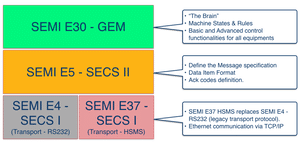
Distinguishing between connectivity and behavior is vital. While SECS-I or HSMS handles the “pipes” that carry data, GEM handles the “meaning” of that data. It moves beyond mere connectivity to define the soul of the machine’s operational logic. Every movement of a robotic arm or change in gas flow is governed by these definitions.
The Technical Foundation: SECS/GEM Communication Protocol
When engineers discuss the SECS/GEM communication protocol, they refer to a stack of standards working in unison. At the bottom sits the transport layer, typically SEMI E37 (HSMS), which uses TCP/IP for high-speed Ethernet communication. Above that resides SEMI E5 (SECS-II), which defines the structure of the messages.
Message Structure and Data Types
The SECS/GEM communication protocol uses a hierarchical tree structure for data. Messages are organized into “Streams” (categories) and “Functions” (specific actions). For example, Stream 1, Function 1 (S1F1) is a simple “Are you there?” request. This structured approach allows for extremely efficient parsing, which is essential when a tool generates thousands of data points every second.
The Significance of HSMS
Before Ethernet became the industry norm, tools relied on RS-232 serial connections. The transition to High-Speed SECS Message Services (HSMS) allowed the SEMI E30 GEM standard to handle the massive data volumes required by modern metrology and lithography tools. Today, the speed of light is essentially the only limit to how fast a fab can respond to tool deviations.
Core Capabilities of the GEM Specification
The GEM specification is categorized into fundamental requirements and additional capabilities. Every GEM-compliant tool must support the fundamental requirements, such as establishing a connection and handling basic state models. Beyond the basics, tools can implement advanced features like recipe management and sophisticated event reporting.
State Models and Control
One of the most powerful features of the SEMI E30 GEM standard is its use of state machines. These models track whether a tool is:
- In “Local” or “Remote” control mode.
- Currently processing a wafer or sitting idle.
- Experiencing a fault or alarm condition.
By monitoring these states, the factory host knows exactly what a tool is doing at any given microsecond. If an operator tries to manually override a tool that the MES is currently controlling, the GEM state model prevents conflicting commands from causing a catastrophic wafer scrap event. It works like a very polite butler who won’t do anything unless you ask in the exact right way, but once he does, he gives you a 40-page report on how it went.
Data Collection and Event Reporting
Modern manufacturing thrives on data. The GEM specification allows the host to “subscribe” to specific events. Instead of the host constantly asking the tool for its temperature, the tool can be programmed to send an update every time the temperature changes by a specific increment. This “event-driven” architecture reduces network traffic and ensures that the most important information reaches the MES immediately.
Implementation for Manufacturing Equipment Integration
For Equipment OEMs, implementing the SEMI E30 GEM standard can be a daunting task. It requires a deep understanding of both the hardware’s physical capabilities and the software’s communication logic. However, the long-term benefits of compliance outweigh the initial development hurdles.
Benefits for Equipment Manufacturers (OEMs)
A tool that adheres to fab automation standards is much easier to sell. Fabs prefer “plug-and-play” equipment. If an OEM provides a robust GEM interface, the integration time for the customer drops from months to weeks. This speed-to-market is a significant competitive advantage in an industry where being late by a single quarter can cost millions in lost revenue.
Challenges in Integration
The primary challenge often involves mapping internal hardware variables to the standard GEM variables. A single etch chamber might have hundreds of sensors. Deciding which of these sensors should be exposed via the SECS/GEM communication protocol requires careful planning to avoid overwhelming the factory network with unnecessary noise.
Why Fab Automation Standards Matter
The move toward Industry 4.0 and “Lights Out” manufacturing makes semiconductor equipment control more critical than ever. According to Gartner (2023), automation in manufacturing environments can lead to a 15% increase in throughput when properly implemented.
Reducing Human Error
Human intervention remains one of the largest sources of contamination and error in a cleanroom. By utilizing the SEMI E30 GEM standard, the factory host can automate recipe downloads and substrate tracking. The tool knows exactly which process to run because the MES told it so, leaving no room for a technician to accidentally select the wrong settings on a touchscreen.
Future-Proofing the Fab
As technology progresses toward 2nm nodes and beyond, the complexity of the data will only increase. The SEMI E30 GEM standard provides a stable foundation that can evolve. While newer standards like SEMI EDA (Equipment Data Acquisition) provide even more data bandwidth, GEM remains the “control” backbone that keeps the factory running.
Advanced GEM Features: Alarms and Limits
Beyond simple status updates, the GEM specification provides robust mechanisms for error handling and process safety. This ensures that the equipment does not operate outside of its safe parameters, protecting both the hardware and the delicate silicon wafers inside.
Alarm Management
In the context of the SEMI E30 GEM standard, an alarm is more than just a flashing light. It is a structured message that tells the host exactly what went wrong and how severe the issue is. GEM requires tools to maintain a list of all possible alarms and their current states. This allows the factory host to disable certain routes or pause production lines automatically when a critical tool reports a fault.
Variable Limits and Monitoring
Modern tools use “Limits Monitoring” to track process variables. If a vacuum level or gas flow rate drifts outside of a pre-defined range, the SECS/GEM communication protocol triggers an event. This proactive approach allows maintenance teams to fix a tool before it produces a defective wafer, shifting the fab from reactive to predictive maintenance.
Conclusion
The SEMI E30 GEM standard continues to be the bedrock of semiconductor manufacturing, providing a reliable framework for semiconductor equipment control and manufacturing equipment integration. By adhering to these fab automation standards, manufacturers ensure that their tools remain productive, their data stays accurate, and their factories remain competitive in an increasingly automated world. Mastering the SEMI E30 GEM standard is the first step toward a truly intelligent fab.
Contact Us Today
Get Expert Guidance for GEM-Based Equipment Communication
Source From: SEMI