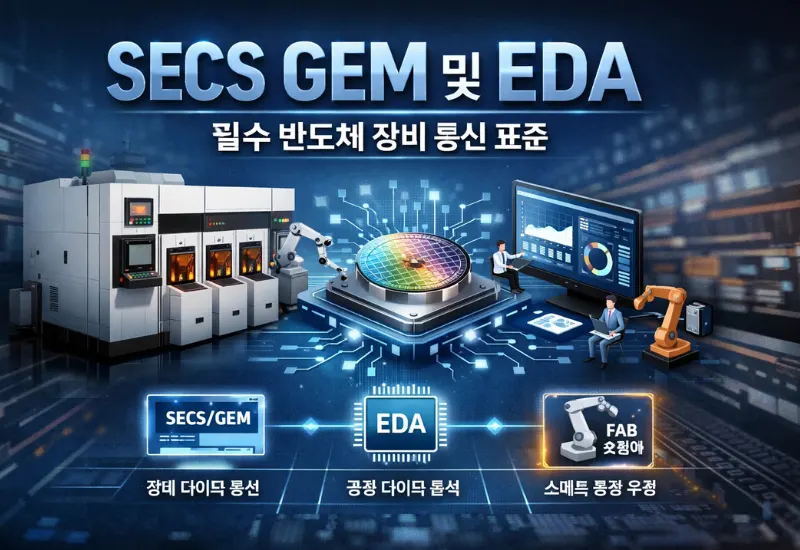
SECS GEM 및 EDA: 필수 반도체 장비 통신 표준

요약

SECS(반도체 장비 통신 표준)*와 *GEM(일반 장비 모델)*은 웨이퍼 팹에서 제조 장비와 공장 호스트 간의 원활한 데이터 교환을 보장하는 핵심 통신 프로토콜이다.

SECS/GEM은 장비 제어, 공정 레시피 관리, 자재 추적, 데이터 수집을 가능하게 하여 대량 생산 반도체 제조의 필수 기반을 제공한다.

반도체 산업은 지속적으로 진화하고 있으며, Interface A 계열 표준(예: EDA, SEMI E134, GEM 300)은 첨단 팹에서 요구되는 고속·대용량 데이터 수집 문제를 해결한다.

이러한 SEMI 통신 프로토콜을 정확히 이해하고 올바르게 구현하는 것은 장비 통합 엔지니어와 팹 IT 팀이 효율적이고 지능적이며 완전 자동화된 반도체 자동화 환경과 MES를 구축하는 데 필수적이다.

소개

SEMI(2024)에 따르면 전 세계 반도체 제조 장비 시장은 매출 기준 1,240억 달러에 이를 것으로 전망되며, 이는 공장 인프라에 대한 막대한 지속적 투자를 의미합니다. 이러한 급속한 확장 속에서 수백만 달러 규모의 복잡한 장비와 공장 제어 시스템 간의 견고하고 표준화되며 신뢰성 높은 통신에 대한 필요성은 절대적입니다. 바로 이 지점에서 반도체 장비 통신 표준이 핵심 역할을 합니다.

현대 팹 연결성의 근간은 SEMI(Semiconductor Equipment and Materials International)가 개발·유지하는 일련의 규격입니다. 이 규격들은 신뢰성 있고 효율적인 장비–호스트 통신을 위해 필요한 언어, 구조, 동작 방식을 정의하여, 서로 다른 벤더의 장비를 하나의 통합된 제조 환경으로 연결할 수 있도록 합니다.

수십 년 동안 SECS/GEM 표준 조합이 업계의 기준이었지만, 고급 분석과 인공지능에 의해 공정 데이터 수요가 폭증하면서 EDA와 같은 새로운 프로토콜이 빠르게 확산되고 있습니다. 이러한 진화를 이해하는 것은 차세대 운영 효율성을 추구하는 모든 팹 연결성 엔지니어와 MES 개발자에게 매우 중요합니다.

기반 개념 – SECS와 GEM 이해하기


자동화 팹을 구축하는 초기 과제는 단순했습니다. 서로 다른 벤더의 리소그래피 장비를 어떻게 중앙 공장 호스트와 의미 있게 “대화”하게 할 것인가? 이에 대한 해답은 SEMI E5와 E30 규격에서 나왔습니다.

SECS – 통신 파이프라인

반도체 장비 통신 표준(SECS)은 단일 프로토콜이 아니라 메시지 전송 및 구조를 정의하는 표준 집합입니다.

SECS-I (SEMI E4)

SECS-I는 RS-232 직렬 통신을 기반으로 물리 계층과 링크 계층을 정의한 레거시 표준입니다. 현재는 대부분 대체되었지만, 메시지 교환의 기본 구조를 확립한 중요한 토대였습니다. 메시지는 스트림(Stream)과 함수(Function) 구조로 정의되며, 일반적으로 SxFy 형식으로 표현됩니다(예: S1F1은 “Are You There 요청”).

H4: SECS-II (SEMI E5)

실제 통신 “언어”가 정의되는 부분입니다. SECS-II는 장비와 호스트 간에 교환되는 메시지의 구조와 의미를 규정합니다. 메시지는 정수, ASCII 문자열, 불리언과 같은 데이터 요소(Item)로 구성되며, 복잡한 구조를 위해 리스트(List)로 묶입니다.
Streams: 특정 기능과 관련된 메시지 그룹(예: 스트림 1 – 장비 상태, 스트림 6 – 데이터 수집)

Functions: 각 스트림 내의 개별 메시지(예: S1F1 Are You There 요청, S1F13 통신 설정 요청)

이 구조를 통해 벤더와 무관하게 호스트와 장비가 동일한 데이터를 일관되게 해석할 수 있습니다.

GEM – 동작 계약(Behavioral Contract)

SECS-II가 메시지를 어떻게 교환하는지를 정의한다면, 언제·왜 교환해야 하는지는 GEM(Generic Equipment Model, SEMI E30)이 담당합니다. GEM은 장비가 “GEM 준수”로 인정받기 위해 반드시 따라야 하는 필수 동작 요구사항 집합입니다.
GEM은 장비의 동작 상태와 메시지 처리 방식을 표준화하는 규칙서라고 볼 수 있으며, 이는 장비 통합 엔지니어의 통합 부담을 크게 줄여줍니다.

핵심 요구사항:

장비 상태 모델: IDLE, SETUP, PROCESSING, FAULT 등 표준 상태 정의

이벤트 보고: 장비 이벤트를 호스트에 보고하는 메커니즘

알람 관리: 중요·비중요 알람의 표준화된 처리 및 보고

레시피 관리: 공정 레시피 업로드, 다운로드, 선택 절차

원격 제어: 호스트에서 공정 시작, 정지, 일시정지 가능

GEM이 없다면 모든 장비마다 개별 통신 드라이버가 필요해지며, 완전 자동화 팹은 사실상 불가능합니다.

진화 – Interface A(EDA/GEM 300)의 부상

웨이퍼 크기 증가, 미세 공정 진화, 공정 복잡도 상승으로 데이터 수집 요구는 폭발적으로 증가했습니다. 트랜잭션 기반 요청–응답 모델에 의존하는 기존 SECS/GEM은 초당 수천 개 센서 데이터를 요구하는 환경에서 병목이 될 수 있습니다.
이 문제를 해결하기 위해 등장한 것이 Interface A, 즉 장비 데이터 수집(EDA)입니다.

EDA – 대용량 데이터 스트리밍

EDA는 현대 팹의 대용량 데이터 수집 한계를 해결하기 위해 설계된 표준 집합입니다. 핵심 규격은 SEMI E125, E134, E138입니다.

표준 명칭 주요 기능 핵심 기술
SEMI E125 장비 자기 기술 규격 장비 내부 구조 및 데이터 수집 능력 정의 XML over HTTP/S
SEMI E134 데이터 수집 관리 규격 호스트의 데이터·이벤트 구독 관리 SOAP/XML
SEMI E138 이산 시계열 데이터 수집 규격 타임스탬프 데이터 전송 정의 SOAP/XML

SECS/GEM이 제어와 데이터를 하나의 연결에서 처리하는 것과 달리, EDA는 데이터 수집 전용 통신 채널(XML/TCP-IP 기반)을 사용합니다. 이는 제어 명령과 대용량 데이터가 서로 간섭하지 않도록 하는 결정적 차별점입니다.

GEM 300 계열

GEM 300은 SECS/GEM 기반 위에 구축된 SEMI 표준 집합으로, 특히 300mm 및 450mm 팹의 자동 자재 처리와 고급 공정 실행을 다룹니다.

  • SEMI E40 (Processing Management): 공정 작업 및 스케줄 관리
  • SEMI E87 (Carrier Management): FOUP 등 캐리어 관리 표준
  • SEMI E90 (Substrate Tracking): 개별 웨이퍼 식별 및 추적

현대 고자동화 팹은 SECS/GEM을 제어 기반으로 사용하고, GEM 300을 통해 자재 처리와 고급 실행을 구현하는 계층적 접근이 필요합니다.

팹 연결성 구현 과제와 모범 사례

규격 준수와 통합 문제

  • 비표준 알람 보고
  • 이벤트 과다 또는 부족 정의
  • SECS-II 데이터 구조 오류

이를 방지하기 위해 규격 준수 체크리스트와 FAT/SAT 테스트는 필수입니다.

성능 최적화와 데이터 무결성

  • EDA 구독 최적화: 필요한 데이터만 선택적으로 수집
  • 네트워크 지연 관리: 저지연 전용 네트워크 권장
  • 타임스탬프 무결성: 시간 동기화 오류는 분석 무효화로 이어짐

정확한 타임스탬프가 없는 테라바이트급 데이터는 의미가 없습니다.

SECS/GEM을 넘어서 – 반도체 통신의 미래

업계는 단순 모니터링을 넘어 AI 기반 자율 제어로 이동하고 있습니다.

  • SEMI E171: 맥락 정보를 포함한 고급 데이터 교환
  • 표준화된 REST API: 비핵심 서비스 통합 단순화
  • 디지털 트윈: 고정밀 실시간 데이터 기반 가상 팹 구현

결론

SECS/GEM부터 EDA/Interface A에 이르기까지의 반도체 장비 통신 표준은 대량 생산을 가능하게 하는 보이지 않는 핵심 인프라입니다. 표준을 정확하고 성능 저하 없이 구현하는 것이 차세대 자동화 팹의 경쟁력을 결정합니다.

Contact Us Today

SECS/GEM 및 EDA 표준 구현을 위한 단계별 지원 받기


SECS/GEM 프로토콜 가이드: Fab의 장비 통신 단순화

요약

  • SECS/GEM 프로토콜은 반도체 및 전자 제조 장비를 위한 범용 통신 표준입니다.
  • 공장 호스트/제조 실행 시스템(MES)이 현장의 장비(툴)와 통신할 수 있도록 구조화된 방식을 정의합니다.
  • 이 표준은 장비 간 상호 운용성을 보장하며, 레시피 관리, 데이터 수집(EDA), 알람 모니터링과 같은 핵심 자동화 작업을 지원합니다.
  • 스트림(Stream), 함수(Function), 변수(Variable)와 같은 핵심 개념을 이해하는 것은 자동화 엔지니어와 장비 제조사(OEM)에 필수적입니다.
  • SECS/GEM 도입은 완전한 디지털 기반의 스마트 팩토리를 구현하는 데 매우 중요하며, 수율, 처리량, 운영 효율성을 크게 향상시킬 수 있습니다.
  • 이 프로토콜은 SEMI(국제 반도체 장비 및 재료 협회)에 의해 관리되고 유지됩니다.

소개

정밀성과 복잡성이 극도로 높은 반도체 제조에서는 공장 바닥의 모든 장비를 완벽하게 제어하는 것이 필수적입니다. SEMI(2024)에 따르면 전 세계 반도체 제조 장비 시장 규모는 2030년까지 1450억 달러를 넘어설 것으로 예상됩니다. 이는 첨단 장비에 대한 막대한 투자를 의미하지만, 장비의 진정한 가치는 단순한 처리 능력이 아니라 공장의 중앙 시스템(MES/Host)과 원활하게 통신하는 능력에 있습니다.

이 지점에서 SECS/GEM 프로토콜이 등장합니다.
SECS/GEM 프로토콜은 팹에서 호스트 시스템이 장비와 통신하고 제어하는 방식을 정의하는 가장 광범위하게 사용되는 표준입니다. 이를 통해 호스트 시스템은 CVD 장비, 노광기, 계측 장비 등 어떤 SECS/GEM 준수 장비와도 동일하고 예측 가능한 언어로 통신할 수 있습니다. 이 표준이 없다면 자동화는 장비마다 커스텀 코드를 작성해야 하는 혼란스러운 환경이 되었을 것입니다.

반도체 자동화, 장비 통합, 공장 디지털화에 참여하는 모든 사람에게 SECS/GEM의 이해는 필수입니다. 이 가이드는 프로토콜의 기본 개념과 구조를 명확하게 설명합니다.

SECS/GEM 디코딩: 자동화를 위한 표준화된 언어

SECS/GEM은 단일 기술이 아니라 SEMI가 개발하고 유지하는 여러 통신 표준의 집합입니다. 이 이름은 다음 두 가지 구성 요소에서 시작됩니다: SECS와 GEM.

SECS: 커뮤니케이션 파이프라인

SECS는 반도체 장비 통신 표준(Semiconductor Equipment Communication Standards)을 의미합니다. 이는 장비와 호스트 간 메시지가 전송되는 물리적/메시지 기반 계층을 정의합니다.

  • SECS-I(E4): RS-232 기반 초기 물리 연결
  • SECS-II(E5): 실제 메시지 구조와 내용을 정의
  • HSMS(E37): 현대 팹에서 사용하는 고속 TCP/IP 이더넷 기반 연결 방식으로, 현재 표준

오늘날 대부분의 팹에서는 HSMS/SECS-II 스택을 사용합니다

GEM: 필수 행동 모델

GEM(Generic Equipment Model)은 메시지 전송 방식이 아닌 장비가 갖춰야 할 필수 동작 규칙(E30) 을 정의합니다.
GEM의 핵심은 예측 가능성입니다.

장비가 SECS/GEM을 준수하면 호스트는 레시피 요청·상태 조회·데이터 수집 방식을 모두 표준화된 형태로 수행할 수 있습니다.

필수 GEM 기능

모든 GEM 준수 장비가 반드시 구현해야 하는 기능:

  • Status Data Collection(SDC): 변수/트레이스/이벤트 기반 데이터 수집
  • Alarm Management: 장비 알람 보고
  • Recipe Management: 레시피 업로드/다운로드/검증
  • Remote Control: 온라인/오프라인, 시작/정지 제어
  • Equipment Status: 장비 상태 조회 가능

커뮤니케이션 툴킷: 스트림, 함수 및 변수

SECS/GEM 메시지는 Stream-Function(S/F) 구조로 구성됩니다.

스트림 및 함수 이해

  • Stream (S): 메시지 카테고리
  • Function (F): 특정 메시지의 종류
  • 기본 구조는 항상 요청(홀수 번호) → 응답(짝수 번호)

사용 중인 키 스트림/함수 쌍


Stream / Function Direction Description Purpose
S1F1 Host → Equipment Are You There 연결 상태 확인 (Connection status check)
S1F2 Equipment → Host On-line Data S1F1 응답 (Response to S1F1)
S6F11 Equipment → Host Event Report Send 이벤트 발생 보고 (Report event occurrences)
S7F1 Host → Equipment Process Program Load Request 레시피 로드 요청 (Request to load a recipe/process program)
S5F1 Host → Equipment Enable Alarm Send 특정 알람 활성화 (Enable specific alarms)


장비 변수, 상태 변수 및 데이터 ID

  • ECs (Equipment Constants): 장비 설정 변수
  • SVs (Status Variables): 실시간 상태
  • DVs (Data Variables): 프로세스 데이터
  • CEIDs (Collection Event IDs): 장비 이벤트 ID

SECS/GEM에서 호스트는 이러한 변수를 구독하고 자동으로 수신할 수 있습니다.

SECS/GEM 프로토콜 구현: 호스트 및 장비 역할

장비 측면(서버 역할)

장비(툴)는 HSMS 서버 역할을 하며 다음을 수행해야 합니다.

  • GEM(E30) 필수 기능 구현
  • 내부 동작을 SECS/GEM 메시지로 변환하는 통신 드라이버
  • SV/DV/CEID/EC 목록을 포함한 GEM Interface Guide 제공

호스트 측(클라이언트 역할)

MES 또는 Cell Controller가 HSMS 클라이언트 역할을 합니다.

주요 역할:

  • S1F13/S1F14: 장비 온라인 전환
  • S7F1/S7F2: 레시피 전송
  •  S3F19/S3F20: Lot 시작 명령
  • S6F3/S6F4: 이벤트 구독
  • 데이터 수집/제조 흐름 제어

이 구조 덕분에 팹은 수백 대의 장비를 표준화된 방식으로 운영할 수 있습니다.

기본 이상: 고급 SECS/GEM 기능

장비 데이터 수집(EDA 또는 인터페이스 A, E120/E125/E134)

EDA는 SECS/GEM의 데이터를 보완하는 고속 데이터 수집 표준입니다.

  • SOAP/HTTPS 기반 별도 통신 채널
  • SECS/GEM의 제어 메시지와 분리
  • 고주파수(밀리초 단위) 데이터 수집 가능
  • 머신러닝 및 고급 분석에 필수

인증 및 규정 준수의 중요성

장비 제조사는 아래 SEMI 표준에 맞춰야 합니다.

  • E30 (GEM)
  • E87 (Carrier Management)
  • E40 (Processing Management)

팹에서는 이를 기반으로 장비의 적합성을 검증합니다.

결론

SECS/GEM은 단순한 통신 규격이 아니라 반도체 제조 자동화의 보편적 기반입니다.
표준화된 메시징·행동 규칙을 통해 장비 통합을 단순화하고, 자동화 및 데이터 기반 운영의 토대를 제공합니다.
반도체 자동화 엔지니어와 OEM에게 SECS/GEM의 숙련도는 필수 역량이며, 스마트 팩토리 구축의 첫 단계입니다.

Contact Us Today

장비 통신을 단순화하기 위한 전문가 가이드 받기


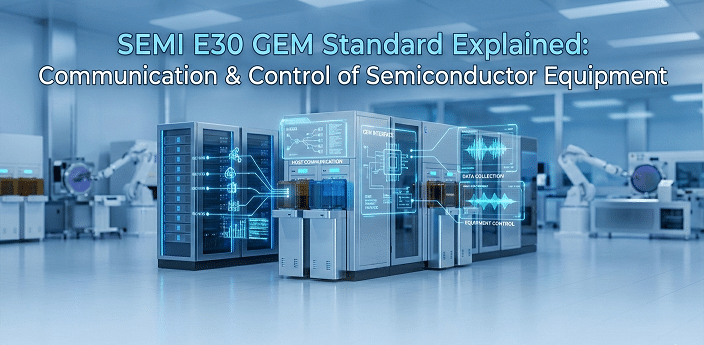
SEMI E30 GEM Standard Explained: Communication & Control of Semiconductor Equipment

Summary

  • The SEMI E30 GEM standard provides the foundational framework for communication between semiconductor manufacturing equipment and factory host systems.
  • It utilizes the SECS/GEM communication protocol to enable standardized data collection, alarm management, and remote command execution.
  • Implementing the GEM specification reduces integration costs for both OEMs and fabs by providing a universal “language” for equipment behavior.
  • Standardized state models ensure that tools from different vendors operate predictably within a highly automated environment.
  • Compliance is essential for modern fab operations, supporting high-volume production and the transition to Industry 4.0.

Introduction

According to reports from SEMI (2024), global semiconductor manufacturing equipment sales reached a record high of $106.3 billion recently. This massive investment highlights the critical need for precision and interoperability within the modern wafer fab. Central to this orchestrated dance of machinery is the SEMI E30 GEM standard, a protocol that ensures tools from different vendors can talk to a central factory system without a translator.

Without a unified framework, a semiconductor facility would resemble a chaotic bazaar where every merchant speaks a unique dialect. The SEMI E30 GEM standard prevents this linguistic breakdown by defining exactly how equipment should behave and communicate. By standardizing these interactions, facilities achieve higher yields and faster deployment times for new technology nodes.

Effective manufacturing equipment integration relies on these rules to manage everything from simple status updates to complex recipe management. While the technical documentation for the SEMI E30 GEM standard can feel as dense as a lead brick, its purpose remains simple: creating a predictable environment for high-stakes manufacturing. Why does a protocol established decades ago still dominate the most advanced factories on the planet? The answer lies in its elegant balance of flexibility and strict behavioral definitions.

Understanding the SEMI E30 GEM Standard

The SEMI E30 GEM standard, formally known as the Generic Model for Communications and Control of Manufacturing Equipment, serves as the primary bridge between the factory Manufacturing Execution System (MES) and the physical hardware on the floor. It defines which SECS-II messages are required, the context in which they are sent, and the resulting behavior expected from the tool.

The Philosophy of the GEM Specification

The GEM specification acts as a behavioral layer. It dictates how a machine responds when it receives a command. For instance, if the host sends a “Start” command, the standard ensures the tool transitions from an “Idle” state to a “Processing” state predictably. This consistency allows fab automation specialists to write software that controls hundreds of different tools using a single logic set.

It is a bit like a group chat where everyone actually agrees on the rules, a true miracle in the tech world. Without these rules, the MES might send a command that the tool isn’t ready to handle, leading to expensive downtime or, worse, damaged wafers.

Connectivity vs. Behavior

Distinguishing between connectivity and behavior is vital. While SECS-I or HSMS handles the “pipes” that carry data, GEM handles the “meaning” of that data. It moves beyond mere connectivity to define the soul of the machine’s operational logic. Every movement of a robotic arm or change in gas flow is governed by these definitions.

The Technical Foundation: SECS/GEM Communication Protocol

When engineers discuss the SECS/GEM communication protocol, they refer to a stack of standards working in unison. At the bottom sits the transport layer, typically SEMI E37 (HSMS), which uses TCP/IP for high-speed Ethernet communication. Above that resides SEMI E5 (SECS-II), which defines the structure of the messages.

Message Structure and Data Types

The SECS/GEM communication protocol uses a hierarchical tree structure for data. Messages are organized into “Streams” (categories) and “Functions” (specific actions). For example, Stream 1, Function 1 (S1F1) is a simple “Are you there?” request. This structured approach allows for extremely efficient parsing, which is essential when a tool generates thousands of data points every second.

The Significance of HSMS

Before Ethernet became the industry norm, tools relied on RS-232 serial connections. The transition to High-Speed SECS Message Services (HSMS) allowed the SEMI E30 GEM standard to handle the massive data volumes required by modern metrology and lithography tools. Today, the speed of light is essentially the only limit to how fast a fab can respond to tool deviations.

Core Capabilities of the GEM Specification

The GEM specification is categorized into fundamental requirements and additional capabilities. Every GEM-compliant tool must support the fundamental requirements, such as establishing a connection and handling basic state models. Beyond the basics, tools can implement advanced features like recipe management and sophisticated event reporting.

State Models and Control

One of the most powerful features of the SEMI E30 GEM standard is its use of state machines. These models track whether a tool is:

  • In “Local” or “Remote” control mode.
  • Currently processing a wafer or sitting idle.
  • Experiencing a fault or alarm condition.

By monitoring these states, the factory host knows exactly what a tool is doing at any given microsecond. If an operator tries to manually override a tool that the MES is currently controlling, the GEM state model prevents conflicting commands from causing a catastrophic wafer scrap event. It works like a very polite butler who won’t do anything unless you ask in the exact right way, but once he does, he gives you a 40-page report on how it went.

Data Collection and Event Reporting

Modern manufacturing thrives on data. The GEM specification allows the host to “subscribe” to specific events. Instead of the host constantly asking the tool for its temperature, the tool can be programmed to send an update every time the temperature changes by a specific increment. This “event-driven” architecture reduces network traffic and ensures that the most important information reaches the MES immediately.

Implementation for Manufacturing Equipment Integration

For Equipment OEMs, implementing the SEMI E30 GEM standard can be a daunting task. It requires a deep understanding of both the hardware’s physical capabilities and the software’s communication logic. However, the long-term benefits of compliance outweigh the initial development hurdles.

Benefits for Equipment Manufacturers (OEMs)

A tool that adheres to fab automation standards is much easier to sell. Fabs prefer “plug-and-play” equipment. If an OEM provides a robust GEM interface, the integration time for the customer drops from months to weeks. This speed-to-market is a significant competitive advantage in an industry where being late by a single quarter can cost millions in lost revenue.

Challenges in Integration

The primary challenge often involves mapping internal hardware variables to the standard GEM variables. A single etch chamber might have hundreds of sensors. Deciding which of these sensors should be exposed via the SECS/GEM communication protocol requires careful planning to avoid overwhelming the factory network with unnecessary noise.

Why Fab Automation Standards Matter

The move toward Industry 4.0 and “Lights Out” manufacturing makes semiconductor equipment control more critical than ever. According to Gartner (2023), automation in manufacturing environments can lead to a 15% increase in throughput when properly implemented.

Reducing Human Error

Human intervention remains one of the largest sources of contamination and error in a cleanroom. By utilizing the SEMI E30 GEM standard, the factory host can automate recipe downloads and substrate tracking. The tool knows exactly which process to run because the MES told it so, leaving no room for a technician to accidentally select the wrong settings on a touchscreen.

Future-Proofing the Fab

As technology progresses toward 2nm nodes and beyond, the complexity of the data will only increase. The SEMI E30 GEM standard provides a stable foundation that can evolve. While newer standards like SEMI EDA (Equipment Data Acquisition) provide even more data bandwidth, GEM remains the “control” backbone that keeps the factory running.

Advanced GEM Features: Alarms and Limits

Beyond simple status updates, the GEM specification provides robust mechanisms for error handling and process safety. This ensures that the equipment does not operate outside of its safe parameters, protecting both the hardware and the delicate silicon wafers inside.

Alarm Management

In the context of the SEMI E30 GEM standard, an alarm is more than just a flashing light. It is a structured message that tells the host exactly what went wrong and how severe the issue is. GEM requires tools to maintain a list of all possible alarms and their current states. This allows the factory host to disable certain routes or pause production lines automatically when a critical tool reports a fault.

Variable Limits and Monitoring

Modern tools use “Limits Monitoring” to track process variables. If a vacuum level or gas flow rate drifts outside of a pre-defined range, the SECS/GEM communication protocol triggers an event. This proactive approach allows maintenance teams to fix a tool before it produces a defective wafer, shifting the fab from reactive to predictive maintenance.

Conclusion

The SEMI E30 GEM standard continues to be the bedrock of semiconductor manufacturing, providing a reliable framework for semiconductor equipment control and manufacturing equipment integration. By adhering to these fab automation standards, manufacturers ensure that their tools remain productive, their data stays accurate, and their factories remain competitive in an increasingly automated world. Mastering the SEMI E30 GEM standard is the first step toward a truly intelligent fab.

Contact Us Today

Get Expert Guidance for GEM-Based Equipment Communication


Source From: SEMI

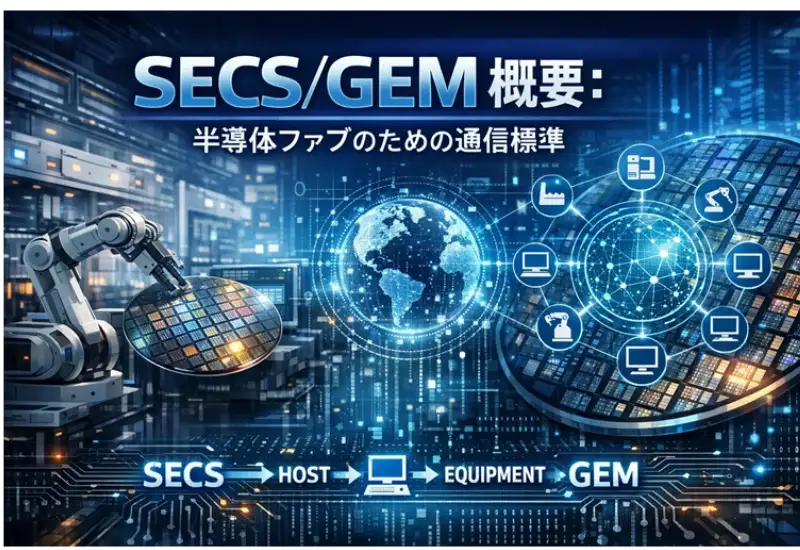
SECS/GEM 概要:半導体ファブのための通信標準

  • グローバルな影響:半導体製造装置の売上が過去最高水準に達する中、標準化された通信の重要性はますます高まっている。
  • 標準規格:SECS/GEM(SEMI E5/E30)は、ファブ装置とホストシステム(MES/EAP)を接続する共通言語として機能する。
  • 主要構成要素:SECS はメッセージ伝送(データの流れ)を担い、GEM は装置の振る舞い(状態モデル、リモート制御、アラーム管理)を定義する。
  • 運用上の利点:導入により完全自動化が可能となり、リアルタイムのデータ収集とレシピ管理によって歩留まりが向上する。
  • 実装:複雑ではあるが、最新のソフトウェアソリューションにより統合が簡素化され、装置ごとにカスタムコードを書くことなくスケール可能となる。

はじめに

現代の半導体ファブに足を踏み入れると、ロボットアームが舞い、FOUP が天井の搬送レールを高速で移動し、クリーンルームの照明が規則正しく点滅している光景が広がるでしょう。しかし、このオーケストラを指揮している“真の指揮者”は目に見えません。

SEMI(2025年)によると、世界の半導体製造装置市場は AI や高性能コンピューティング向けチップ需要の急増により、2025年に 1,330億ドルに達すると予測されています。しかし、工場ホストと通信するための標準化された仕組みがなければ、これらの高価な装置は事実上ただの箱に過ぎません。

ここで重要となるのが SECS/GEM です。これは単なるプロトコルではなく、ファブの神経系そのものです。SECS/GEM がなければ、数十億ドル規模の工場は孤立した装置の集合体に過ぎません。SECS/GEM があって初めて、人の介在なしにナノメートルレベルのトランジスタを生産できる、統合されたインテリジェント製造ラインが実現します。

なぜファブでは接続性が重要なのか

初期の半導体製造では、オペレーターが手動でレシピをロードし、「スタート」ボタンを押していました。しかし、その時代はすでに過去のものです。現代のファブは“ライトアウト”運転が基本であり、自動化が支配しています。

課題は、ファブが技術的な「バベルの塔」であることです。カリフォルニア製のエッチャー、オランダ製の露光装置、日本製の成膜装置――それぞれが独自の内部言語を話します。

この問題を解決するために採用されたのが SECS/GEM 標準です。このプロトコルにより、MES や EAP などのホストシステムは、ベンダーを問わず任意の装置に同じ方法でコマンドを送信し、予測可能な応答を得ることができます。結果として、バラバラな独自ソフトウェアの集合体が、統一された生産ラインへと変わります。

SECS/GEM とは何か

SECS/GEM は、SEMI(Semiconductor Equipment and Materials International)が策定した一連の標準規格です。装置とホストシステム間の通信方法を定義します。

この略語は、2つの異なる役割に分けて考えると理解しやすくなります。

「SECS」― メッセンジャー

SECS は Semiconductor Equipment Communication Standard の略です。SECS は配送トラックのような存在で、「中身」には関心を持たず、データを安全に A 地点から B 地点へ運ぶことに専念します。

  • SEMI E5(SECS-II):メッセージの「文法」を定義。状態要求、レシピ送信、エラー報告などの標準メッセージを規定。
  • SEMI E37(HSMS):最新の通信層。SECS メッセージを TCP/IP(Ethernet)上で送信。
  • SEMI E4(SECS-I):RS-232 シリアル通信を使用する旧規格。現在ではほぼ廃止。

「GEM」― 行動規範

GEM(Generic Equipment Model / SEMI E30)は、装置の振る舞いを定義します。
SECS が配送トラックなら、GEM は運転マニュアルです。

GEM は、装置が特定の状況でどのように振る舞うべきかを明確に規定します。これにより、異なる装置であっても「START」コマンドの意味が完全に一致します。

内部での動作原理

SECS/GEM は Streams & Functions(SxFy) という構造化されたメッセージ形式を使用します。

  • Stream(S):大分類(例:S1=装置状態、S6=データ収集)
  • Function(F):具体的な操作

簡単な通信例:

  • ホスト → 装置(S1F1):「オンラインか?」
  • 装置 → ホスト(S1F2):「オンラインです」
  • ホスト → 装置(S2F41):「START」
  • 装置 → ホスト(S2F42):「コマンド受信」

この厳密な構造により、曖昧さのない自動化が実現します。

GEM 準拠インターフェースの主な機能

リモート制御

装置の開始・停止、レシピ選択、搬送制御をすべて遠隔で実行可能。

アラーム管理

障害発生時に標準形式で即座にホストへ通知。

データ収集

イベントベース・時間ベースのデータ収集により、歩留まり解析や APC を実現。

現代ファブにおける SECS/GEM 導入

SECS/GEM をゼロから実装するのは現実的ではありません。多くの OEM は SDK を使用し、装置の本質的な制御に集中します。

主な課題:

  • レガシー装置の対応
  • GEM 準拠性の検証
  • GEM300(300mm 自動化)への対応

まとめ

SECS/GEM は、半導体ファブにおける知能化の設計図です。
次世代装置を開発する OEM にとっても、効率を最大化したいファブ運営者にとっても、SECS/GEM の理解は「選択肢」ではなく「必須条件」です。

Contact Us Today

SECS/GEM をファブに導入するためのステップバイステップ支援を受ける

よくある質問

SECS と GEM の違いは?

SECS は通信形式、GEM は装置の振る舞いを定義します。

Ethernet で動作しますか?

はい。HSMS により TCP/IP 上で動作します。

旧式装置も GEM 対応できますか?

可能です。GEM 有効化ソフトやゲートウェイを使用します。

歩留まり向上への効果は?

リアルタイムデータ収集により APC が可能となり、不良を事前に防止できます。