
Summary
- SECS/GEM is the common language that lets fab equipment and the MES actually understand each other, built on well-defined SEMI standards.
- It handles the essentials: remote control, alarms, recipes, and clean data exchange so operators don’t have to guess what a machine is doing.
- HSMS brings fast, modern TCP/IP communication, while SECS-I still supports older tools that refuse to retire.
- GEM’s state models and event-driven logic keep equipment behavior predictable and automation stable.
- All that data feeds Industry 4.0 analytics, but real value comes only when integration is done right.
Introduction
According to Gartner (2023), the implementation of advanced factory automation communication protocols can reduce operational costs by up to 15% in high-volume manufacturing environments. That saving doesn’t happen by magic. It comes from a shared language that lets very different machines talk to a single brain. The SECS/GEM communication protocol is the language that shapes almost every action on the fab floor.
Without a robust standard, equipment integration quickly becomes a tower of Babel. Engineers would end up writing custom drivers for every new tool. Months wasted. Competitors move faster. By adopting the SEMI standards, fabs make sure a wafer sorter from one vendor can coexist with a metrology tool from another. Seamlessly.
The following study notes dig into the layers, behaviors, and benefits of this critical technology. Whether you’re a seasoned automation engineer or a developer building a first MES interface, these concepts are must-know. Master them, and you’re set up for success in modern semiconductor manufacturing.
The Building Blocks of SECS/GEM Basics
To get SECS/GEM basics, start with the acronyms. SECS stands for Semiconductor Equipment Communication Standard, and GEM is the Generic Equipment Model. Together, they define both equipment behavior and the data format used when information is exchanged.
The SEMI (Semiconductor Equipment and Materials International) organization maintains these standards to guarantee global interoperability. Before these rules existed, factory IT teams battled proprietary interfaces that made data collection a nightmare. Today, the protocol is the backbone of “Lights Out” manufacturing, human intervention minimized, operations humming.
The Hierarchy of Standards
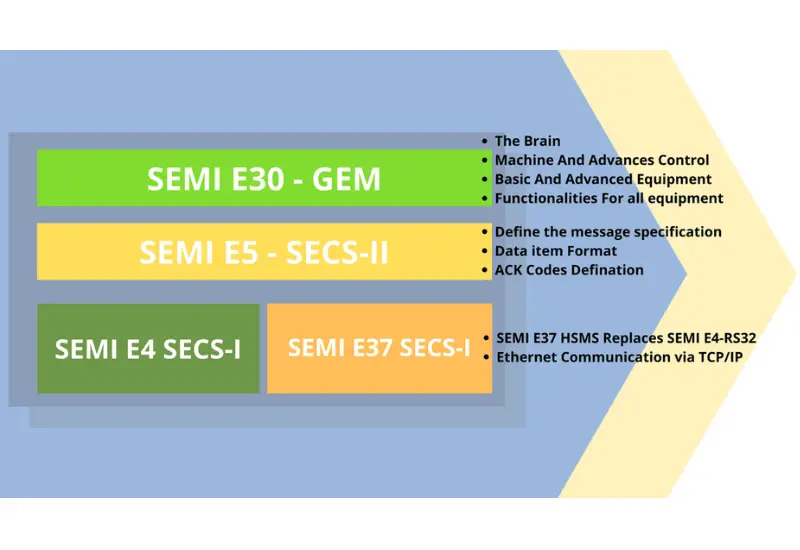
The protocol suite is not a single document. It’s a stack of specialized standards, each handling different layers from the physical wiring up to the machine’s logical state.
- SEMI E4 (SECS-I): The veteran of the group, defining serial communication (RS-232). While less common in new facilities, it still haunts legacy tools in older fabs.
- SEMI E37 (HSMS): The modern successor to SECS-I. High-Speed SECS Message Services (HSMS) uses TCP/IP, allowing machines to connect via standard Ethernet cables at lightning speeds.
- SEMI E5 (SECS-II): This defines the actual content of the messages. It explains how to wrap data into “streams” and “functions,” so both sides understand if they are discussing a temperature reading or a hardware failure.
- SEMI E30 (GEM): The “behavior” layer. It dictates how a machine should respond to certain commands and how it should report its status to the host.
Why GEM is the Gold Standard
If SECS-II gives you the vocabulary, GEM gives you the grammar and etiquette. A machine may be able to send messages (SECS-II), but without GEM, the host won’t know when to expect them. GEM defines specific “state machines” that govern equipment behavior, for example, whether a tool is in “Local” or “Remote” mode. It’s the social contract between host and tool. Simple. Powerful.
Deep Dive into the Architecture of the SECS/GEM Communication Protocol
The SECS/GEM communication protocol runs on a host-equipment relationship, master-slave in traditional terms. Usually, the factory MES plays the host, and the production tool plays the equipment. They trade requests and acknowledgments in a continuous dialogue.
Does a machine truly exist if the MES can’t see its status? In automated fabs, the answer is no. Visibility is the currency of efficiency. The architecture of this protocol is built to maximize that visibility through structured messaging.
The Role of HSMS (SEMI E37)
In modern facilities, HSMS is the preferred transport layer. It replaces the clunky serial cables of the 1980s with high-speed network infrastructure. HSMS handles connection state so that if a network glitch happens, the equipment and host can re-establish their “handshake” without losing critical data. Resilient. Fast.
Understanding SECS-II Streams and Functions
SECS-II messages are organized into Streams (S) and Functions (F). Think of a Stream as a category of conversation and a Function as a specific sentence within that category.
- Stream 1 (Equipment Status): Used to ask if the machine is alive and what it is doing.
- Stream 2 (Equipment Control): Used by the host to tell the machine to start, stop, or change a setting.
- Stream 6 (Data Collection): This is where the heavy lifting happens, as the machine sends chunks of production data back to the host.
- Stream 10 (Terminal Messages): Simple text messages that can appear on the operator’s screen.
Formatting Data Items
Inside these messages, data is packed into precise formats — integers, ASCII strings, lists. That strict formatting ensures a “300” sent by a furnace is read as a numerical temperature, while a “300” sent by a wafer handler is read as a diameter in millimeters. Context matters. Always.
Critical Behaviors Defined by the GEM Standard
The real beauty of the semiconductor communication protocol is predictability. GEM forces every piece of equipment, regardless of function, to follow mandatory behaviors. That consistency lets developers write one set of code to manage hundreds of different machines.
Trying to run a modern fab without a standard protocol is like conducting a symphony where half the musicians play jazz and the other half tune banjos. GEM brings everyone into the same key and tempo.
State Models and Control
A key part of GEM is the Control State Model. It decides who has the authority to move a robot arm or start a process.
Offline: The equipment is disconnected from the host.
Online/Local: An operator at the tool can make changes, but the host can solely watch.
Online/Remote: The host has full control. This is the goal for true factory automation communication.
Collection Events and Variables
Rather than the host constantly polling the machine with “Are you done yet?”, the machine uses Collection Events (CEIDs). When a specific action occurs, say a door closes or a process completes, the machine “publishes” an event. The host subscribes to events it cares about. Result: massive bandwidth savings and cleaner systems.
Enhancing Efficiency through SECS/GEM Tutorial Concepts
If you follow a basic SECS/GEM tutorial, the first lesson is usually Alarms and Limits. In a high-stakes environment where a single ruined wafer costs thousands, knowing the instant a tool deviates is crucial.
Alarm Management
GEM requires equipment to report alarms in a prescribed way. The host must be notified when an alarm is set (triggered) and when it is cleared. That enables real-time dashboards showing which machines are down and why, and it reduces Mean Time to Repair (MTTR). Quick triage. Faster fixes.
Recipe Management
A “recipe” is the set of instructions that tells the tool how to process material. SECS/GEM lets the host upload new recipes or select existing ones. That removes the risk of an operator picking the wrong program and melting a batch of expensive silicon. Big money saved. Small mistakes avoided.
Data Logging for Machine Learning
As Industry 4.0 advances, SECS/GEM-collected data becomes raw material for AI. By analyzing thousands of hours of sensor data sent via Stream 6, engineers can predict when a motor will fail — before it actually does. Predictive. Proactive.
Challenges in Implementation and Integration
Despite well-defined standards, integration rarely goes perfectly. Vendors might implement “optional” GEM features in different ways, causing friction during commissioning. Expect surprises. Plan for them.
Compliance Testing
Before a new tool hits the fab floor, it usually faces rigorous compliance testing. Tools must prove they can handle hundreds of messages per second without crashing. Companies use specialized software simulators to mimic a host and stress-test the equipment’s SECS/GEM interface.
Bridging Legacy and Modern Systems
Many fabs run a mix of HSMS-capable tools and ancient serial-based machines. Integration engineers often use “SECS Gateways” or an “EAP (Equipment Automation Program)” layer to translate these dialects into a single data stream for the MES.
According to a report by McKinsey (2024), “Digital leaders in manufacturing are those who successfully integrate legacy data silos into a unified communication framework.” That line underscores the point: the real value is in the data, and SECS/GEM is the pipe that delivers it.
Conclusion
SECS/GEM isn’t a collection of dusty manuals. It’s the living infrastructure that makes modern electronics manufacturing possible. By standardizing how equipment shares data and accepts commands, it lets factories scale, adapt, and innovate at speeds that once seemed impossible.
The standards will keep evolving as the industry gets smarter. Still, the core principles — structured messaging and predictable behavior — will remain the foundation of any successful factory automation strategy. Want your production line optimized or your new equipment “fab-ready”? A solid GEM implementation is the most effective first step.